
Liquidity Pools are one of the most important innovations in decentralized finance (DeFi). They are the foundation that allows decentralized exchanges (DEXs) and other DeFi platforms to operate without relying on traditional market makers or centralized intermediaries. In simple terms, a liquidity pool is a collection of funds locked in a smart contract. These funds are used to facilitate trading, lending, and other financial activities on blockchain networks.
In traditional finance, liquidity is provided by institutions or individuals who act as market makers. They continuously buy and sell assets to ensure that markets remain active. In DeFi, Liquidity Pools replace these intermediaries with automated systems that rely on smart contracts and community participation. This innovation has made financial markets more open, transparent, and accessible to anyone with an internet connection.
This guide explores how Liquidity Pools work, their benefits, risks, and their role in shaping the future of decentralized finance.
What Are Liquidity Pools?
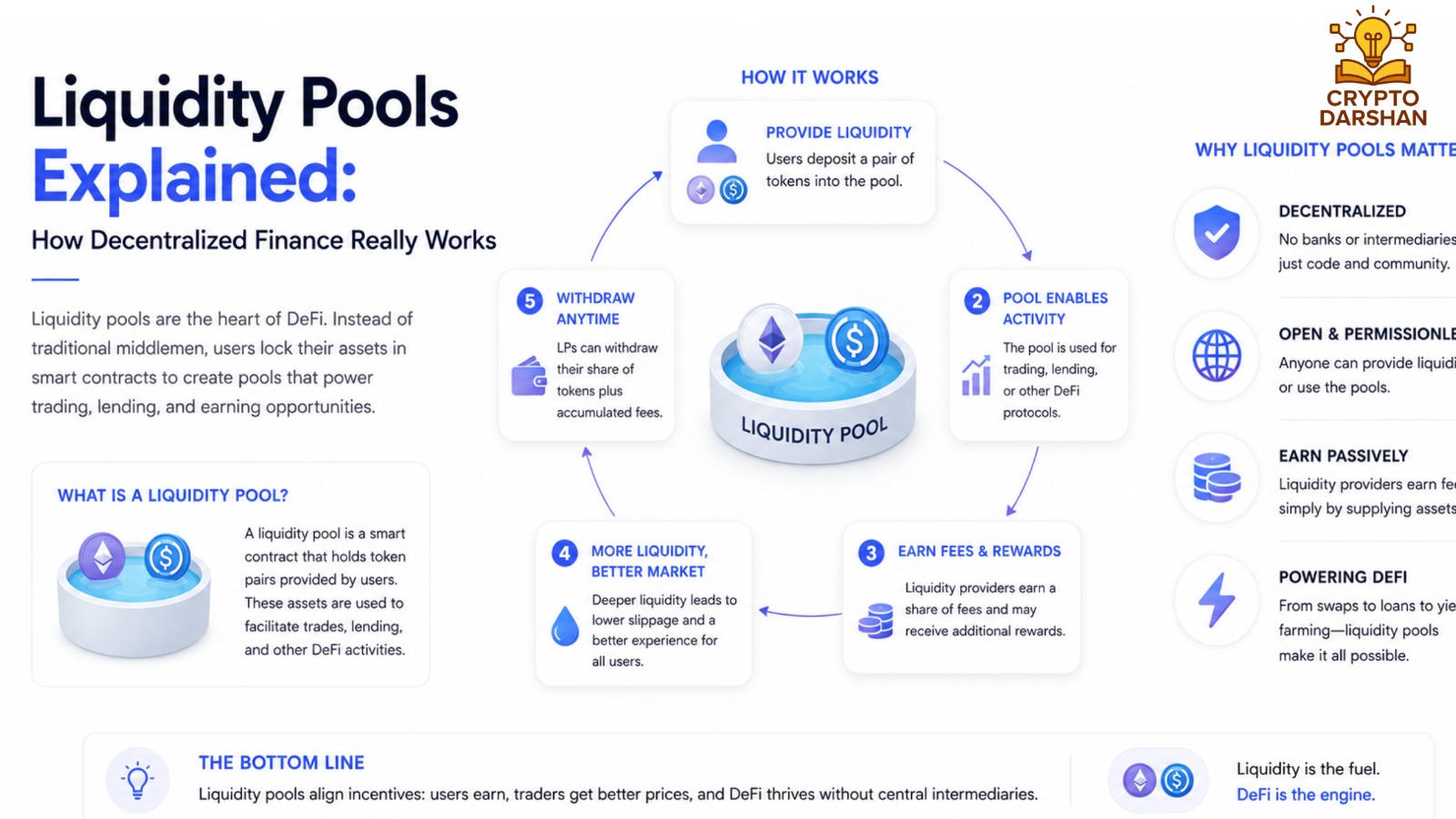
Liquidity pools are the backbone of decentralized finance (DeFi), powering everything from token swaps to lending protocols. It’s the technology behind billions of dollars traded on blockchains. Understanding the fundamentals behind liquidity pools and decentralized exchanges (DEXs) is crucial for anyone in the space to understand the essence of DeFi. Liquidity Pools are smart contracts that hold pairs or groups of tokens. These tokens are supplied by users known as liquidity providers (LPs). When users deposit their tokens into a pool, they enable others to trade those tokens directly on decentralized exchanges. In return, liquidity providers earn rewards, usually in the form of trading fees or governance tokens.
For example, a common Liquidity Pool on a decentralized exchange like Uniswap might contain two tokens, such as ETH and USDC. When someone wants to trade ETH for USDC, the transaction happens directly within the pool. The smart contract automatically adjusts the token ratios and prices based on supply and demand.
Liquidity Pools eliminate the need for order books, which are used in traditional exchanges. Instead, they use automated market maker (AMM) algorithms to determine prices and execute trades. This makes trading faster, more efficient, and available 24/7 without relying on centralized control.
How Liquidity Pools Work

Liquidity Pools operate through smart contracts that manage token balances and execute trades automatically. The most common model used in DeFi is the Automated Market Maker (AMM) model. Here’s how it works:
- Token Pairing: Each Liquidity Pool contains two or more tokens. For example, an ETH/DAI pool holds both ETH and DAI tokens.
- Liquidity Provision: Users deposit equal values of both tokens into the pool. For instance, if ETH is worth $2,000 and DAI is a stablecoin pegged to $1, a user might deposit 1 ETH and 2,000 DAI.
- Price Determination: The AMM algorithm determines the price of each token based on the ratio of tokens in the pool. The most common formula used is x * y = k, where x and y represent the quantities of each token, and k is a constant.
- Trading: When a trader swaps one token for another, the pool’s token ratios change, which automatically adjusts the price.
- Rewards: Liquidity providers earn a portion of the trading fees generated by the pool. These fees are distributed proportionally based on each provider’s share of the pool.
This system ensures that there is always liquidity available for trading, even if there are no direct buyers or sellers at a given moment.
What is Decentralized Finance (DeFi)?

Decentralized Finance, or DeFi, is a financial system built on blockchain technology that operates without traditional banks or financial institutions. Instead of relying on centralized entities like banks, DeFi uses smart contracts on blockchains (like Ethereum) to provide financial services.
Key Features of DeFi
1. Decentralization
- No Central Authority: DeFi platforms run on decentralized networks where no single entity controls the system.
- Smart Contracts: These are self-executing contracts with the terms of the agreement written into code. They automatically execute transactions when certain conditions are met.
2. Accessibility
- Open to Everyone: Anyone with an internet connection can access DeFi services, regardless of location or financial status.
- Permissionless: You don’t need approval from a bank or institution to participate.
3. Transparency
- Public Ledger: All transactions are recorded on the blockchain, which is a public ledger that anyone can view.
- Auditability: Users can verify transactions and smart contract code themselves.
4. Interoperability
- Composable: DeFi protocols can work together like building blocks, allowing users to combine different services.
- Cross-Platform: Many DeFi applications can interact with each other seamlessly.
How DeFi Works
Core Components
- Smart Contracts
- These are the backbone of DeFi. They automate processes like lending, borrowing, and trading without human intervention.
- Decentralized Applications (DApps)
- These are applications built on blockchain networks that provide various financial services.
- Tokens
- Digital assets that represent value. They can be cryptocurrencies (like ETH) or other types of tokens (like stablecoins).
Main DeFi Services
- Decentralized Exchanges (DEXs)
- Platforms like Uniswap and SushiSwap where users can trade cryptocurrencies directly from their wallets without intermediaries.
- Lending and Borrowing
- Platforms like Aave and Compound allow users to lend their crypto assets to earn interest or borrow assets by providing collateral.
- Liquidity Pools
- Collections of funds locked in smart contracts that provide liquidity for trading on DEXs.
- Stablecoins
- Cryptocurrencies pegged to stable assets like the US dollar, providing stability in the volatile crypto market.
- Yield Farming and Staking
- Strategies to earn rewards by providing liquidity or holding certain tokens.
- Synthetic Assets
- Tokenized versions of real-world assets like stocks, commodities, or fiat currencies.
Benefits of DeFi
- Financial Inclusion: Provides access to financial services for people without bank accounts.
- Lower Costs: Reduces fees by eliminating intermediaries.
- Control: Users have full control over their assets.
- Innovation: Rapid development of new financial products and services.
Risks and Challenges
- Smart Contract Risks: Bugs or vulnerabilities in code can lead to loss of funds.
- Market Volatility: Cryptocurrency prices can fluctuate significantly.
- Regulatory Uncertainty: DeFi operates in a gray area of regulation.
- Security Risks: Hacks and exploits are possible if protocols are not secure.
The Role of Liquidity Providers

Liquidity providers (LPs) are the backbone of Liquidity Pools. They supply the tokens that make decentralized trading possible. In return, they earn rewards that can come from multiple sources:
- Trading Fees: Every trade that occurs in a Liquidity Pool generates a small fee. These fees are distributed among all LPs based on their contribution.
- Incentive Programs: Some DeFi platforms offer additional rewards in the form of governance tokens or yield farming incentives.
- Appreciation of Tokens: If the tokens in the pool increase in value, LPs may benefit from capital gains.
However, providing liquidity is not without risks. LPs face potential losses due to price fluctuations, known as impermanent loss, which occurs when the value of deposited tokens changes compared to simply holding them.
Understanding Automated Market Makers (AMMs)

Automated Market Makers are the algorithms that power Liquidity Pools. They replace traditional order books with mathematical formulas that automatically determine prices. The most widely used AMM model is the Constant Product Market Maker, introduced by Uniswap.
Constant Product Formula
The formula x * y = k ensures that the product of the two token quantities remains constant. When a trader buys one token, the supply of that token decreases, and its price increases. This creates a self-balancing system that maintains liquidity at all times.
Variations of AMMs
Different DeFi platforms use variations of the AMM model to suit specific needs:
- Uniswap: Uses the constant product formula for general token swaps.
- Curve Finance: Optimized for stablecoin trading with minimal slippage.
- Balancer: Allows multiple tokens in a single pool with customizable weightings.
- Bancor: Introduces dynamic pricing and impermanent loss protection.
Each AMM design offers unique advantages, but they all rely on the same core principle—automated liquidity provision through smart contracts.
Benefits of Liquidity Pools

Liquidity Pools have transformed the financial landscape by offering several key benefits:
1. Decentralization
Liquidity Pools remove the need for centralized intermediaries. Anyone can provide liquidity or trade directly from their crypto wallet without relying on banks or brokers.
2. Accessibility
DeFi platforms are open to anyone with an internet connection. Liquidity Pools allow users from around the world to participate in financial markets without restrictions.
3. Passive Income
Liquidity providers can earn passive income through trading fees and yield farming rewards. This has attracted many investors seeking alternative income streams.
4. Continuous Liquidity
Unlike traditional exchanges that depend on active buyers and sellers, Liquidity Pools ensure that liquidity is always available. This makes trading faster and more efficient.
5. Transparency
All transactions and pool balances are recorded on the blockchain, providing full transparency and security.
Risks of Liquidity Pools

While Liquidity Pools offer many advantages, they also come with certain risks that participants should understand.
1. Impermanent Loss
Impermanent loss occurs when the price of tokens in a pool changes compared to when they were deposited. If one token’s price rises significantly, the pool automatically rebalances, which can lead to lower returns than simply holding the tokens.
2. Smart Contract Vulnerabilities
Liquidity Pools rely on smart contracts, which are only as secure as their code. Bugs or exploits can lead to loss of funds if the contract is compromised.
3. Market Volatility
Cryptocurrency markets are highly volatile. Sudden price swings can affect the value of tokens in a pool and the returns for liquidity providers.
4. Regulatory Uncertainty
DeFi operates in a rapidly evolving regulatory environment. Changes in laws or government policies could impact the operation of Liquidity Pools.
5. Rug Pulls and Scams
In some cases, malicious developers create fake Liquidity Pools to attract investors and then withdraw all funds. It’s essential to use reputable platforms and verify smart contracts before participating.
Popular Platforms Using Liquidity Pools
Several DeFi platforms have built their ecosystems around Liquidity Pools. Each offers unique features and benefits.
1. Uniswap
Uniswap is one of the first and most popular decentralized exchanges using Liquidity Pools. It allows users to swap ERC-20 tokens directly from their wallets. Uniswap’s simple interface and efficient AMM model have made it a cornerstone of DeFi.
2. SushiSwap
SushiSwap is a fork of Uniswap that introduced additional incentives for liquidity providers, such as governance tokens (SUSHI). It also offers yield farming and staking opportunities.
3. Curve Finance
Curve specializes in stablecoin trading. Its AMM model minimizes slippage and impermanent loss, making it ideal for stable asset swaps.
4. Balancer
Balancer allows users to create multi-token Liquidity Pools with customizable weightings. This flexibility enables portfolio management and automated rebalancing.
5. PancakeSwap
Built on the Binance Smart Chain, PancakeSwap offers lower transaction fees and supports BEP-20 tokens. It has become a popular alternative to Ethereum-based DEXs.
Yield Farming and Liquidity Mining
Liquidity Pools are central to yield farming and liquidity mining, two popular DeFi strategies for earning rewards.
Yield Farming
Yield farming involves moving assets between different Liquidity Pools to maximize returns. Users deposit tokens into pools that offer the highest yields, often measured in annual percentage yield (APY). This strategy requires active management and understanding of market conditions.
Liquidity Mining
Liquidity mining rewards users with governance tokens for providing liquidity. These tokens often grant voting rights and can be traded or staked for additional rewards. Liquidity mining has been a major driver of DeFi growth, attracting billions of dollars in total value locked (TVL).
The Economics of Liquidity Pools

Liquidity Pools create a self-sustaining economic system within DeFi. The incentives for liquidity providers, traders, and developers are aligned through tokenomics and fee structures.
- Liquidity Providers: Earn fees and rewards for supplying tokens.
- Traders: Benefit from instant swaps and transparent pricing.
- Developers: Gain from platform growth and governance participation.
The balance between these participants ensures that Liquidity Pools remain active and efficient. As more users join, the pools become deeper, reducing slippage and improving trading conditions.
The Future of Liquidity Pools

Liquidity Pools are evolving rapidly as DeFi matures. Several trends are shaping their future:
1. Cross-Chain Liquidity
New protocols are enabling Liquidity Pools to operate across multiple blockchains. This increases accessibility and reduces fragmentation in the DeFi ecosystem.
2. Dynamic AMMs
Next-generation AMMs are introducing adaptive algorithms that adjust fees and liquidity parameters based on market conditions.
3. Institutional Adoption
As DeFi gains legitimacy, institutional investors are exploring Liquidity Pools for yield generation and portfolio diversification.
4. Integration with Traditional Finance
Hybrid models are emerging that connect Liquidity Pools with traditional financial systems, bridging the gap between DeFi and mainstream markets.
5. Enhanced Security
Developers are focusing on improving smart contract security through audits, insurance protocols, and decentralized governance.
How to Participate in Liquidity Pools

Participating in Liquidity Pools is straightforward but requires careful consideration.
Step 1: Choose a Platform
Select a reputable DeFi platform such as Uniswap, Curve, or PancakeSwap. Verify that the platform has undergone security audits.
Step 2: Select a Pool
Choose a Liquidity Pool that matches investment goals and risk tolerance. Consider factors like token volatility, trading volume, and fee structure.
Step 3: Deposit Tokens
Provide equal values of the required tokens to the pool. The platform will issue LP tokens representing ownership in the pool.
Step 4: Earn Rewards
As trades occur, LPs earn a share of the fees. Some platforms also offer additional rewards through liquidity mining programs.
Step 5: Withdraw Liquidity
LPs can withdraw their tokens at any time, along with accumulated rewards. However, the value may vary due to price changes and impermanent loss.
Managing Risks in Liquidity Pools

Effective risk management is essential for anyone participating in Liquidity Pools.
- Diversify Investments: Spread liquidity across multiple pools to reduce exposure.
- Monitor Market Conditions: Stay informed about token price movements and platform updates.
- Use Reputable Platforms: Choose platforms with strong security records and transparent governance.
- Understand Impermanent Loss: Use calculators to estimate potential losses before providing liquidity.
- Consider Insurance: Some DeFi protocols offer insurance against smart contract failures.
Liquidity Pools vs. Traditional Market Making
Liquidity Pools differ significantly from traditional market-making systems.
| Aspect | Liquidity Pools | Traditional Market Making |
| Control | Decentralized via smart contracts | Centralized by institutions |
| Accessibility | Open to anyone | Limited to licensed entities |
| Pricing Mechanism | Automated via AMMs | Manual or algorithmic by market makers |
| Transparency | Fully transparent on blockchain | Opaque and regulated |
| Fees | Distributed to liquidity providers | Collected by intermediaries |
Liquidity Pools democratize market making, allowing anyone to contribute liquidity and earn rewards without needing specialized infrastructure or regulatory approval.
Real-World Applications of Liquidity Pools

Liquidity Pools are not limited to trading. They power a wide range of DeFi applications:
- Decentralized Exchanges (DEXs): Enable token swaps without intermediaries.
- Lending Platforms: Use Liquidity Pools to provide loans and earn interest.
- Synthetic Assets: Create tokenized versions of real-world assets.
- Stablecoins: Maintain price stability through liquidity-backed mechanisms.
- Gaming and NFTs: Facilitate in-game economies and NFT marketplaces.
These applications demonstrate the versatility of Liquidity Pools in building decentralized financial ecosystems.
FAQ: Liquidity Pools Explained: How Decentralized Finance Really Works

1. What is a liquidity pool in DeFi?
A liquidity pool is a collection of crypto tokens locked inside a smart contract that allows users to trade, lend, or swap assets without relying on traditional intermediaries like banks or centralized exchanges.
2. How do liquidity pools work?
Liquidity pools work by using automated smart contracts to match buyers and sellers. Users deposit token pairs into the pool, and traders swap assets against that liquidity while paying small transaction fees.
3. Who provides liquidity to these pools?
Anyone can become a liquidity provider (LP) by depositing crypto assets into a DeFi protocol. In return, LPs earn a share of trading fees and sometimes additional token rewards.
4. Why are liquidity pools important in decentralized finance?
Liquidity pools are the backbone of DeFi because they enable decentralized trading, lending, yield farming, and staking without centralized control.
5. What is an Automated Market Maker (AMM)?
An Automated Market Maker is a system that uses algorithms instead of traditional order books to determine asset prices inside liquidity pools.
6. How do liquidity providers make money?
Liquidity providers earn passive income from transaction fees generated by traders using the pool. Some protocols also reward LPs with governance or incentive tokens.
7. What is impermanent loss?
Impermanent loss happens when the price of deposited assets changes significantly compared to simply holding the tokens outside the liquidity pool.
8. Are liquidity pools risky?
Yes. Risks include impermanent loss, smart contract vulnerabilities, rug pulls, hacking incidents, and sudden token price volatility.
Conclusion
Liquidity Pools are the foundation of decentralized finance, enabling seamless trading, lending, and yield generation without intermediaries. By combining smart contracts, automated market makers, and community participation, they have redefined how liquidity is created and managed in digital markets.
While Liquidity Pools offer significant opportunities for passive income and financial inclusion, they also carry risks such as impermanent loss and smart contract vulnerabilities. Understanding these dynamics is essential for anyone looking to participate in DeFi.
As technology evolves, Liquidity Pools will continue to expand beyond blockchain boundaries, integrating with traditional finance and powering the next generation of global financial systems. Their transparency, accessibility, and efficiency make them a cornerstone of the decentralized economy—one that empowers individuals and reshapes the future of finance.