The pace of digital innovation is accelerating, and at the heart of this transformation lies blockchain a technology redefining how data, trust, and transactions work online. While the concept may seem complex, it’s actually built on simple principles that anyone can grasp. Blockchain for Dummies 2026 breaks down this powerful technology into clear, easy-to-understand ideas, explaining what blockchain is, how it functions, why it’s important, and how it’s shaping the digital future. This guide offers a straightforward introduction for beginners who want to explore blockchain without getting lost in technical terms.
What Is Blockchain?
A blockchain is a distributed database that maintains a continuously growing list of ordered records, called blocks. Unlike traditional databases controlled by one company or person, blockchain is decentralized. This means no single entity owns or controls it. Instead, it’s maintained by a network of participants who verify and record transactions together.
Each transaction is stored in a “block.” Once a block is full, it’s linked to the previous one, forming a continuous chain hence the name “blockchain.” Every block contains data, a timestamp, and a unique code called a hash. Once added, the data cannot be changed without altering every block after it, which makes blockchain extremely secure.
If you’re completely new to digital assets, start with our guide, Crypto for Dummies 2026: Zero to Hero in 30 Days, to understand how blockchain powers the entire cryptocurrency ecosystem.
In simple terms, blockchain for dummies means understanding that blockchain is a shared, unchangeable record of transactions that everyone can trust without needing a middleman.
The Evolution of Blockchain

The concept of blockchain began in 1991 when researchers Stuart Haber and W. Scott Stornetta developed a system for timestamping digital documents to prevent tampering. This early idea laid the foundation for blockchain technology.
In 2008, an unknown person or group using the pseudonym Satoshi Nakamoto introduced Bitcoin the first cryptocurrency. Bitcoin used blockchain to record transactions transparently and securely without banks. This innovation changed how people viewed money and trust online.
Since then, blockchain has evolved far beyond cryptocurrency. It’s now used in industries like healthcare, real estate, logistics, education, and even government. The blockchain for dummies approach helps beginners see how this technology grew from a simple idea into a global innovation that powers the digital economy.
Today, blockchain for dummies also explores how blockchain is being integrated into artificial intelligence, the Internet of Things, and even environmental sustainability projects.
How Blockchain Works

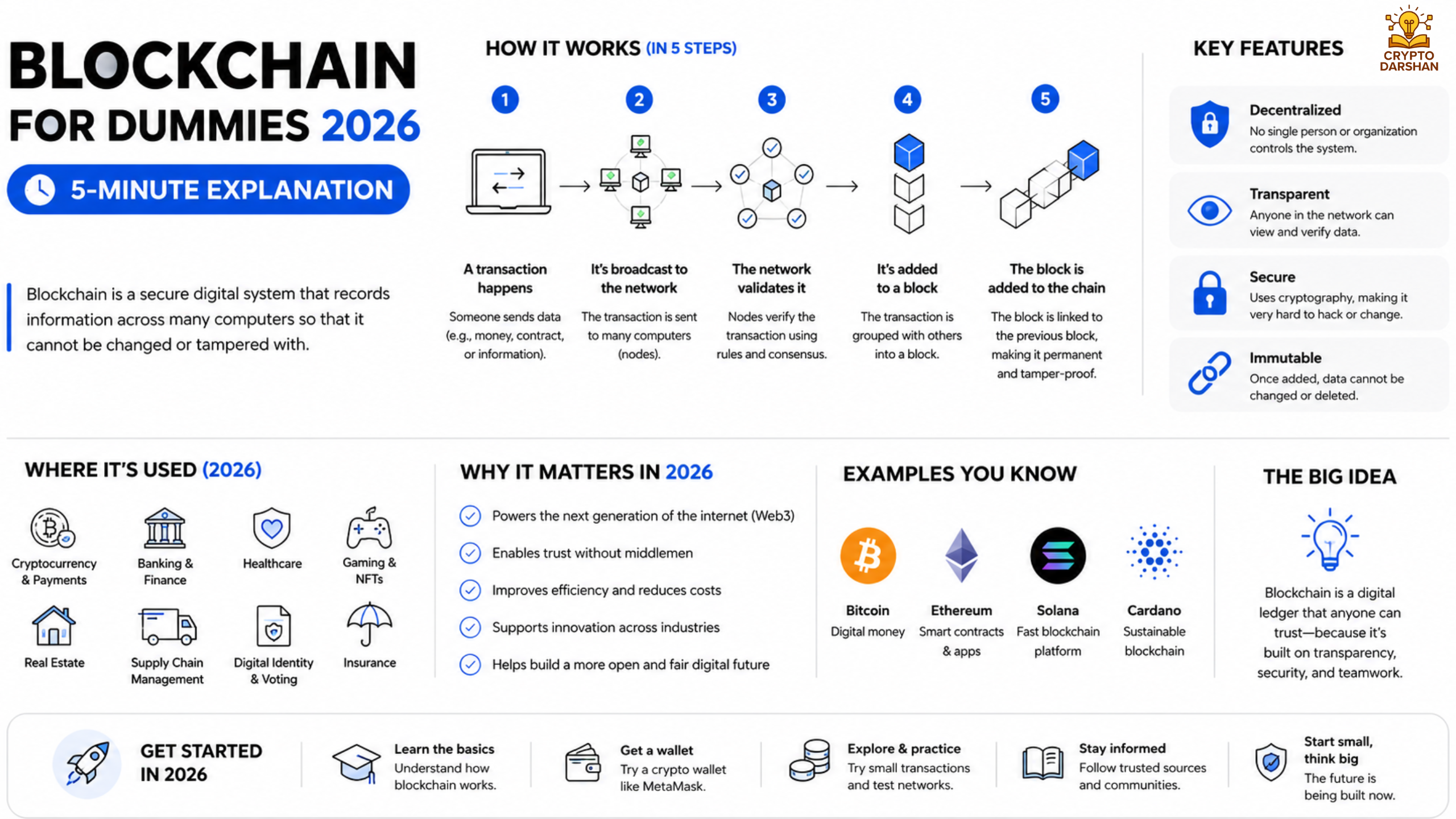
To understand blockchain for dummies, it’s important to know how it functions step by step.
- Transaction Creation – A blockchain transaction begins when someone sends data or value, such as cryptocurrency or a digital contract.
- Verification – The transaction is sent to a network of computers (nodes) that verify its validity.
- Block Formation – Once verified, the transaction is grouped with others into a block.
- Hashing – Each block receives a unique digital fingerprint called a hash.
- Linking Blocks – The new block is linked to the previous one, forming a chain.
- Consensus Mechanism – Networks use methods like Proof of Work (PoW) or Proof of Stake (PoS) to agree on valid transactions.
- Permanent Record – Once added, the block becomes a permanent part of the blockchain and cannot be altered.
This process ensures transparency, security, and trust, the three pillars of blockchain technology. In blockchain for dummies, this process is often compared to a digital notebook that everyone can see but no one can erase.
Key Features of Blockchain

Understanding blockchain for dummies means recognizing its main features:
- Decentralization – No single authority controls the blockchain. This prevents manipulation and ensures fairness.
- Transparency – All transactions are visible to participants, creating accountability.
- Security – Cryptography protects data from tampering and unauthorized access.
- Immutability – Once data is added, it cannot be changed, ensuring trust.
- Consensus – All participants must agree before a transaction is added, preventing fraud.
- Automation – Smart contracts execute automatically when conditions are met, reducing human error.
These features make blockchain one of the most trusted and transformative technologies in the digital world. Blockchain for dummies emphasizes that these features are what make blockchain different from traditional systems.
Types of Blockchain

There are four main types of blockchain networks. Understanding them is key to mastering blockchain for dummies.
- Public Blockchain – Open to everyone, like Bitcoin and Ethereum. Anyone can join, verify, and view transactions. It’s transparent but slower due to high participation.
- Private Blockchain – Controlled by one organization. Access is limited to selected participants. It’s faster and more efficient but less transparent.
- Consortium Blockchain – Managed by a group of organizations. It combines the benefits of public and private blockchains, ideal for industries like banking or supply chains.
- Hybrid Blockchain – A mix of public and private systems. It allows some data to be public while keeping sensitive information private.
Each type serves different needs, from open financial systems to secure business networks.
Blockchain vs. Traditional Databases
| Feature | Blockchain | Traditional Database |
| Control | Decentralized | Centralized |
| Security | Highly secure through cryptography | Vulnerable to single-point attacks |
| Transparency | All participants can view records | Limited access |
| Immutability | Data cannot be changed | Data can be edited or deleted |
| Verification | Consensus-based | Controlled by administrators |
Blockchain offers more trust and security, while traditional databases are faster for simple tasks.
Blockchain technology is transforming how money moves globally, especially when combined with modern fiat-to-crypto payment systems discussed in Fiat to Crypto 2026: Bank Transfer, Card, PayPal Guide.
Real-World Applications of Blockchain

The blockchain for dummies concept becomes clearer when looking at real-world uses.
1. Cryptocurrency
Bitcoin, Ethereum, and other digital currencies use blockchain to record transactions securely. Each transaction is verified by the network, ensuring no double-spending or fraud.
2. Supply Chain Management
Companies use blockchain to track goods from production to delivery, ensuring authenticity and reducing fraud. For example, food companies can trace ingredients from farms to stores, ensuring safety and quality.
3. Healthcare
Blockchain stores patient records securely, allowing doctors to access accurate data while protecting privacy. It also helps track pharmaceuticals to prevent counterfeit drugs.
4. Real Estate
Property transactions can be recorded on blockchain, reducing paperwork and fraud. Buyers and sellers can verify ownership instantly.
5. Voting Systems
Blockchain can make elections more transparent and tamper-proof. Each vote is recorded securely, ensuring fair results.
6. Smart Contracts
These are self-executing agreements coded on blockchain. They run automatically when conditions are met, eliminating the need for intermediaries.
7. Digital Identity
Blockchain helps create secure digital IDs, reducing identity theft and simplifying online verification.
8. Energy and Environment
Blockchain supports peer-to-peer energy trading and tracks carbon credits for sustainability.
These examples show how blockchain is transforming industries worldwide.
Advantages of Blockchain

The blockchain for dummies guide highlights several benefits:
- Security – Data is encrypted and distributed, making hacking difficult.
- Transparency – Every transaction is visible to authorized users.
- Efficiency – Reduces the need for intermediaries, saving time and cost.
- Traceability – Every transaction can be traced back to its origin.
- Automation – Smart contracts streamline processes.
- Trust – Participants can trust the system without knowing each other.
These advantages make blockchain a game-changer for businesses and individuals alike.
Challenges of Blockchain

Even though blockchain is powerful, it faces challenges. Understanding these is part of blockchain for dummies.
- Scalability – As more transactions occur, blockchains can slow down. Developers are working on solutions like sharding and layer-2 scaling.
- Energy Consumption – Some networks, like Bitcoin, use large amounts of electricity. Newer systems like Proof of Stake are more energy-efficient.
- Regulation – Governments are still figuring out how to regulate blockchain. Clear laws are needed to protect users and encourage innovation.
- Complexity – The technology can be hard for beginners to understand.
- Integration – Connecting blockchain with existing systems can be difficult.
- Cost – Setting up blockchain networks can be expensive initially.
Despite these issues, ongoing innovation is solving many of these problems.
Blockchain and Cryptocurrency

Many people first hear about blockchain through cryptocurrency. In blockchain for dummies, it’s important to understand the difference between the two.
Blockchain is the underlying technology, while cryptocurrency is one of its most popular applications. Bitcoin, Ethereum, and other digital currencies rely on blockchain to record transactions securely and transparently. Instead of banks verifying transactions, the blockchain network itself validates them through consensus mechanisms.
In blockchain for dummies, this decentralized structure means cryptocurrencies can operate without central authorities while still maintaining transparency, security, and trust between users.
However, blockchain technology extends far beyond digital money. It can be used to store smart contracts, track supply chains, secure medical records, and verify digital identities across various industries.
As blockchain adoption continues to expand, more long-term investors are exploring retirement-focused digital asset strategies built around blockchain technology. To learn more, read Best Crypto IRA Platforms in 2026: Top Providers Ranked by Fees and Coins.
Smart Contracts Explained

Smart contracts are one of the most exciting parts of blockchain. In blockchain for dummies, they can be described as digital agreements that execute automatically.
For example, imagine renting an apartment. A smart contract could automatically release the digital key once payment is received. No middleman is needed. Smart contracts are written in code and stored on the blockchain. They are transparent, secure, and tamper-proof.
Industries like insurance, real estate, and logistics are already using them to automate processes.
Blockchain in Business

Businesses are adopting blockchain to improve efficiency and trust. The blockchain for dummies approach helps explain how.
- Finance – Banks use blockchain for faster cross-border payments.
- Retail – Stores track products to ensure authenticity.
- Logistics – Companies monitor shipments in real time.
- Healthcare – Hospitals share patient data securely.
- Government – Agencies use blockchain for record-keeping and voting.
Blockchain reduces fraud, increases transparency, and builds trust between companies and customers.
Blockchain and Artificial Intelligence (AI)

Artificial Intelligence (AI) and blockchain are two of the most powerful technologies shaping the digital era. When combined, they create systems that are smarter, more secure, and more transparent. AI relies on large amounts of data to learn and make decisions, while blockchain ensures that this data is accurate, traceable, and tamper-proof.
In blockchain for dummies, this partnership means that AI models can use verified data stored on blockchain networks, reducing the risk of bias or manipulation. For example, in healthcare, AI can analyze patient data stored on blockchain to predict diseases or recommend treatments. In finance, AI can detect fraudulent transactions by analyzing blockchain records in real time.
Blockchain also helps explain AI decisions by keeping a transparent record of how data was used. This improves accountability and trust in AI systems. Together, AI and blockchain are paving the way for smarter cities, automated industries, and secure digital ecosystems.
Blockchain and the Internet of Things (IoT)

The Internet of Things (IoT) connects billions of devices from smart home appliances to industrial sensors that collect and share data. However, managing and securing this massive amount of data is a challenge. Blockchain provides a solution by offering a decentralized and secure way to store and verify IoT data.
In blockchain for dummies, this means that every IoT device can record its data on a blockchain, creating a permanent and verifiable history. For example, in logistics, IoT sensors can track the temperature and location of goods, while blockchain ensures that the data cannot be altered. In smart homes, blockchain can manage communication between devices securely without relying on a central server.
This combination reduces the risk of hacking, improves data integrity, and allows devices to operate autonomously. As IoT continues to expand, blockchain will play a key role in making connected systems safer and more efficient.
The blockchain for dummies explanation also notes that IoT and blockchain together will power smart cities, connected vehicles, and intelligent supply chains.
Blockchain and Education

Education systems around the world are adopting blockchain to improve transparency, security, and accessibility. Academic records, certificates, and degrees can be stored on blockchain, making them tamper-proof and easy to verify.
In blockchain for dummies, this means that students can have a lifelong digital record of their achievements that cannot be lost or forged. Employers can instantly verify qualifications without contacting institutions. Universities can also share research data securely, ensuring authenticity and preventing plagiarism.
Blockchain can even support online learning platforms by verifying course completion and issuing digital badges. This technology is helping create a global education ecosystem where trust and verification are built into every credential.
Blockchain and Government
Governments around the world are exploring blockchain to improve transparency, efficiency, and trust in public services. Blockchain can store records such as land titles, identity documents, and licenses securely, reducing corruption and fraud.
In blockchain for dummies, this means that citizens can verify government data without relying on intermediaries. For example, land ownership can be recorded on blockchain, preventing disputes and illegal transfers. Voting systems can use blockchain to ensure that every vote is counted accurately and cannot be tampered with.
Blockchain also helps governments manage public spending by providing transparent records of how funds are used. This builds trust between citizens and institutions while improving accountability.
Blockchain and Banking
The banking industry is one of the biggest adopters of blockchain technology. Traditional banking systems rely on intermediaries, which can make transactions slow and expensive. Blockchain eliminates these middlemen by allowing direct, peer-to-peer transactions that are secure and transparent.
In blockchain for dummies, this means that banks can process international payments in minutes instead of days. Blockchain also reduces fraud by recording every transaction permanently. Smart contracts can automate loan approvals, interest payments, and compliance checks, saving time and reducing human error.
Banks are also exploring Central Bank Digital Currencies (CBDCs), which use blockchain to create digital versions of national currencies. This innovation could make financial systems more inclusive, giving access to people who don’t have traditional bank accounts.
The blockchain for dummies insight is that blockchain will redefine global finance, making it faster, cheaper, and more accessible to everyone.
Blockchain and Cybersecurity
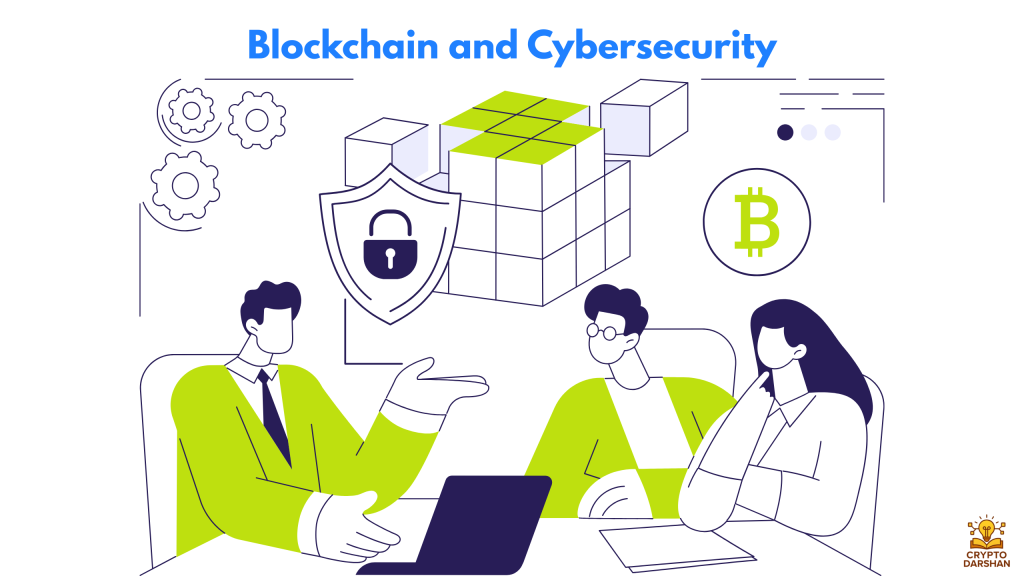
Cybersecurity is one of the biggest challenges in the digital age. Centralized systems are vulnerable to hacking, data breaches, and identity theft. Blockchain offers a decentralized solution that enhances security by distributing data across multiple nodes.
In blockchain for dummies, this simply means there is no single point of failure. Every transaction is encrypted and verified by the network, making it extremely difficult for hackers to alter stored data. Blockchain can also secure digital identities, helping ensure that only authorized users can access sensitive information.
While blockchain technology is considered highly secure, investors and businesses should still understand the growing threats facing the industry, as discussed in Blockchain Security Risks Every Investor Should Know in 2026.
For businesses, blockchain can protect intellectual property, secure communications, and prevent data tampering. As cyber threats continue to grow, blockchain is becoming a cornerstone of modern cybersecurity strategies.
Blockchain and the Metaverse

The metaverse is a virtual world where people can interact, work, and play using digital avatars. Blockchain is the foundation that makes ownership and transactions in the metaverse possible.
In blockchain for dummies, this means that every digital asset from virtual land to clothing for avatars can be recorded on blockchain as proof of ownership. Users can buy, sell, or trade these assets securely without relying on a central authority.
Blockchain also enables decentralized economies within the metaverse, where users can earn cryptocurrency for their activities. Smart contracts ensure that transactions are fair and transparent. As the metaverse grows, blockchain will ensure that digital interactions are secure, verifiable, and user-controlled.
The blockchain for dummies explanation highlights that blockchain gives users real ownership in virtual worlds, creating a new digital economy.
Blockchain and NFTs

NFTs, or Non-Fungible Tokens, are unique digital assets stored on blockchain. Unlike cryptocurrencies, which are identical and interchangeable, NFTs represent ownership of one-of-a-kind items such as art, music, videos, or collectibles.
In blockchain for dummies, NFTs can be thought of as digital certificates of authenticity. When someone buys an NFT, they own a verified record of that item on the blockchain. This record cannot be copied or altered, ensuring that ownership is clear and permanent.
Artists and creators use NFTs to sell their work directly to fans, eliminating intermediaries and earning royalties automatically through smart contracts. Beyond art, NFTs are being used in gaming, real estate, and even event ticketing to prove ownership and prevent fraud.
Blockchain and Future Careers
As blockchain adoption grows, new career opportunities are emerging.
- Blockchain Developers – Build and maintain blockchain systems.
- Smart Contract Engineers – Create automated agreements.
- Blockchain Analysts – Study data and improve performance.
- Legal Advisors – Help companies comply with blockchain laws.
- Project Managers – Oversee blockchain integration in businesses.
In blockchain for dummies, understanding these roles helps learners see how blockchain is shaping the job market.
Blockchain and Future Innovations
The future of blockchain is filled with possibilities. As technology evolves, blockchain will integrate with artificial intelligence, quantum computing, and the Internet of Things to create smarter and more secure systems.
In blockchain for dummies, this means that blockchain will go beyond finance and data storage. It will power decentralized finance (DeFi), decentralized autonomous organizations (DAOs), and tokenized assets that represent real-world items like property or stocks.
Blockchain is also expected to play a major role in Web3, the next generation of the internet where users have greater control over their data, privacy, and digital identities. As industries continue adopting blockchain technology, it could become the foundation of a more transparent, efficient, and trustworthy digital economy.
The rapid growth of blockchain adoption is also one reason institutional investors continue increasing their exposure to digital assets, a trend explored in Why Institutional Investors Are Buying Crypto.
The blockchain for dummies vision is simple: blockchain technology has the potential to shape the next era of innovation, trust, and digital freedom.
FAQ: Blockchain for Dummies 2026: The 5-Minute Complete Guide

1. What is blockchain in simple words?
Blockchain is a digital ledger that records transactions across many computers. Once information is added, it becomes extremely difficult to change, making the system transparent and secure.
2. How does blockchain work?
Blockchain works by grouping transactions into blocks. Each block is verified by a network of computers and linked to the previous block using cryptography, creating a secure chain of data.
3. Why is blockchain important in 2026?
In 2026, blockchain powers cryptocurrencies, decentralized finance (DeFi), NFTs, gaming, supply chain systems, digital identity solutions, and tokenized real-world assets.
4. Is blockchain the same as cryptocurrency?
No. Blockchain is the technology, while cryptocurrency is one application built on top of it. Bitcoin and Ethereum use blockchain to operate securely.
5. What are the main benefits of blockchain?
Key benefits include:
- Transparency
- Security
- Faster transactions
- Lower costs
- Decentralization
- Reduced fraud risk
6. What does decentralization mean?
Decentralization means no single company or government controls the network. Instead, many computers worldwide maintain and verify the blockchain together.
7. Can blockchain be hacked?
Blockchain networks are highly secure, but hacks can still happen through weak apps, exchanges, smart contracts, or stolen wallet keys rather than the blockchain itself.
8. What is a smart contract?
A smart contract is a self-executing digital agreement stored on a blockchain. It automatically performs actions when certain conditions are met.
Conclusion
Blockchain for Dummies 2026 shows that blockchain is more than a buzzword. It’s a revolutionary technology changing how the world stores, shares, and trusts information.
From finance to healthcare, education to art, blockchain is creating a transparent and secure digital future.
Understanding blockchain for dummies means seeing how this technology works, why it matters, and how it’s shaping the next generation of innovation.
Blockchain is not just for experts it’s for everyone ready to embrace the future.