
Wondering how to stake crypto and unlock passive income streams?
Cryptocurrency has evolved far beyond simple trading and investing. One of the most popular ways to earn passive income in the crypto world today is staking. Staking allows holders of certain cryptocurrencies to earn rewards simply by locking their coins in a wallet and supporting the network’s operations. It’s a method that combines technology, finance, and opportunity, all while helping blockchain networks remain secure and efficient.
This comprehensive guide explains everything about crypto staking, what it is, how it works, the best coins to stake, potential risks, and how to get started. Whether a beginner or an experienced investor, understanding staking can open new doors to earning consistent passive income in the digital economy.
What Is Crypto Staking?

Crypto staking is the process of locking up a certain amount of cryptocurrency in a blockchain network to help validate transactions and maintain the network’s security. In return, participants (called stakers) earn rewards, usually in the form of additional tokens.
Staking is an essential component of Proof-of-Stake (PoS) blockchains. Unlike Proof-of-Work (PoW) systems like Bitcoin, which rely on energy-intensive mining, PoS networks establish consensus through staking. This makes staking more energy-efficient and accessible to regular users.
When staking, the coins are kept in the user’s wallet but temporarily locked. The blockchain uses these staked currencies to validate transactions, and the staker receives incentives based on the quantity and duration of staking.
How Does Staking Work?

Staking is the process of locking up your cryptocurrency to help operate and secure a blockchain network. In return, you earn rewards similar to earning interest in a savings account, but instead of a bank, you’re supporting a decentralized network.
Most staking happens on Proof-of-Stake (PoS) blockchains. These networks don’t rely on energy-hungry mining like Bitcoin. Instead, they use staked coins to validate transactions and create new blocks.
Here’s a slightly deeper look at how it works:
1. Proof-of-Stake Mechanism
In a PoS system, validators are chosen to confirm transactions and add new blocks to the blockchain. The selection is based on:
- The amount of crypto staked.
- The length of time it’s been staked.
- Sometimes, a random selection process is used to keep things fair.
The more tokens you stake, the higher your chances of being chosen as a validator and earning rewards.
2. Validators and Delegators
There are two main participants in staking:
- Validators: They run computers that verify transactions and maintain the network. Running a validator requires technical knowledge, constant uptime, and a minimum staking amount (for example, 32 ETH for Ethereum).
- Delegators: Regular users who don’t want to run a node can delegate their tokens to a validator. The validator does the work, and rewards are shared between both parties.
3. Locking Tokens
When you stake, your tokens are locked in the network for a certain period. During this time, you can’t trade or move them. This lock-up ensures network stability and commitment from participants.
Some networks, however, offer liquid staking, where you receive a token representing your staked assets. You can trade or use this token in DeFi platforms while still earning staking rewards.
4. Earning Rewards
Validators (and delegators) earn rewards for helping secure the network. These rewards come from:
- New tokens created by the network (inflationary rewards)
- Transaction fees paid by users
Rewards are distributed proportionally to the amount staked and the validator’s performance. If a validator behaves dishonestly or goes offline, they can lose part of their stake, a penalty known as slashing.
5. Unstaking Process
When you decide to stop staking, you must unstake your tokens. Most blockchains have a waiting period (called an “unbonding period”) before your tokens become available again. This can range from a few days to several weeks, depending on the network.
Benefits of Staking Crypto

Staking offers several advantages that make it an attractive option for crypto investors seeking passive income.
1. Passive Income Generation
Staking allows token holders to earn rewards without actively trading. The returns can range from 3% to over 20% annually, depending on the cryptocurrency and network conditions
2. Network Support
By staking, participants contribute to the blockchain’s security and efficiency. This helps maintain decentralization and ensures smooth network operations.
3. Lower Energy Consumption
Unlike mining, staking doesn’t require expensive hardware or high electricity usage. It’s an eco-friendly alternative to Proof-of-Work systems.
4. Long-Term Investment Growth
Staking encourages holding tokens for longer periods, which can lead to potential price appreciation alongside staking rewards.
5. Accessibility
Many exchanges and wallets now offer simple staking options, making it easy for beginners to participate without technical expertise.
Types of Staking
There are several ways to stake crypto, depending on the blockchain and user preferences.
1. Solo Staking
Solo staking involves running a validator node independently. It offers full control and maximum rewards but requires technical expertise, hardware, and a minimum staking amount (e.g., 32 ETH for Ethereum).
2. Delegated Staking
Delegated staking allows users to delegate their tokens to a validator. The validator performs the technical work, and rewards are shared between the validator and delegators.
3. Staking Pools
Staking pools combine funds from multiple users to increase the chances of earning rewards. This method is ideal for small investors who can’t meet minimum staking requirements.
4. Exchange Staking
Many crypto exchanges, such as Binance, Coinbase, and Kraken, offer staking services. Users can stake directly through their exchange accounts without managing wallets or nodes.
5. Liquid Staking
Liquid staking allows users to stake tokens while still maintaining liquidity. In return, they receive a derivative token representing their staked assets, which can be traded or used in DeFi platforms.
While staking can be profitable, it’s not risk-free. Understanding the potential downsides is crucial before committing funds.
Risks of Staking Crypto
1. Market Volatility
Cryptocurrency prices are highly volatile. Even if staking rewards are high, a sharp drop in token value can offset gains.
2. Lock-Up Periods
Some staking programs require locking tokens for a fixed period. During this time, funds cannot be withdrawn or traded, limiting liquidity.
3. Validator Risks
If staking through a validator, poor performance or malicious behavior by the validator can lead to reduced rewards or penalties (known as slashing).
4. Technical Risks
Running a validator node requires technical knowledge. Improper setup or downtime can result in lost rewards.
5. Platform Risks
When staking through centralized exchanges, users must trust the platform’s security. Hacks or mismanagement can lead to loss of funds.
Popular Cryptocurrencies for Staking

Several cryptocurrencies support staking, each with unique features and reward structures. Below are some of the most popular options in 2026.
1. Ethereum (ETH)
After transitioning to Proof-of-Stake, Ethereum allows users to stake ETH and earn rewards for securing the network. Minimum requirement: 32 ETH for solo staking or any amount via staking pools.
2. Cardano (ADA)
Cardano uses a delegated Proof-of-Stake model, making it easy for users to delegate ADA to staking pools. Average annual returns range from 4% to 6%.
3. Solana (SOL)
Solana is known for its high-speed blockchain and low transaction fees, making it suitable for large-scale decentralized applications. Users can earn passive income by delegating SOL tokens to validators, who help secure the network and process transactions. In return, delegators receive staking rewards, typically ranging from 6% to 8% annually, depending on validator performance and network participation.
4. Polkadot (DOT)
Polkadot uses a Nominated Proof of Stake (NPoS) system where validators secure the network and produce blocks, while nominators support them by staking DOT. Nominators choose trustworthy validators and share in their rewards. Depending on network conditions and validator performance, DOT staking typically offers annual returns of around 10% to 14%
5. Avalanche (AVAX)
Avalanche offers flexible staking options with rewards between 8% and 12%. Validators and delegators both earn rewards for securing the network.
6. Cosmos (ATOM)
Cosmos uses a delegated Proof-of-Stake model, offering around 9% to 12% annual returns. It’s known for its interoperability between blockchains.
7. Tezos (XTZ)
Tezos uses a Proof of Stake–based consensus mechanism known as Liquid Proof of Stake (LPoS), which allows XTZ holders to participate in network security through baking or delegation.
In baking, users who hold the required minimum amount of XTZ can become validators (called bakers) and directly participate in block creation and validation. Tezos allows users to “bake” or delegate XTZ for rewards. Average returns are around 5% to 7% annually.
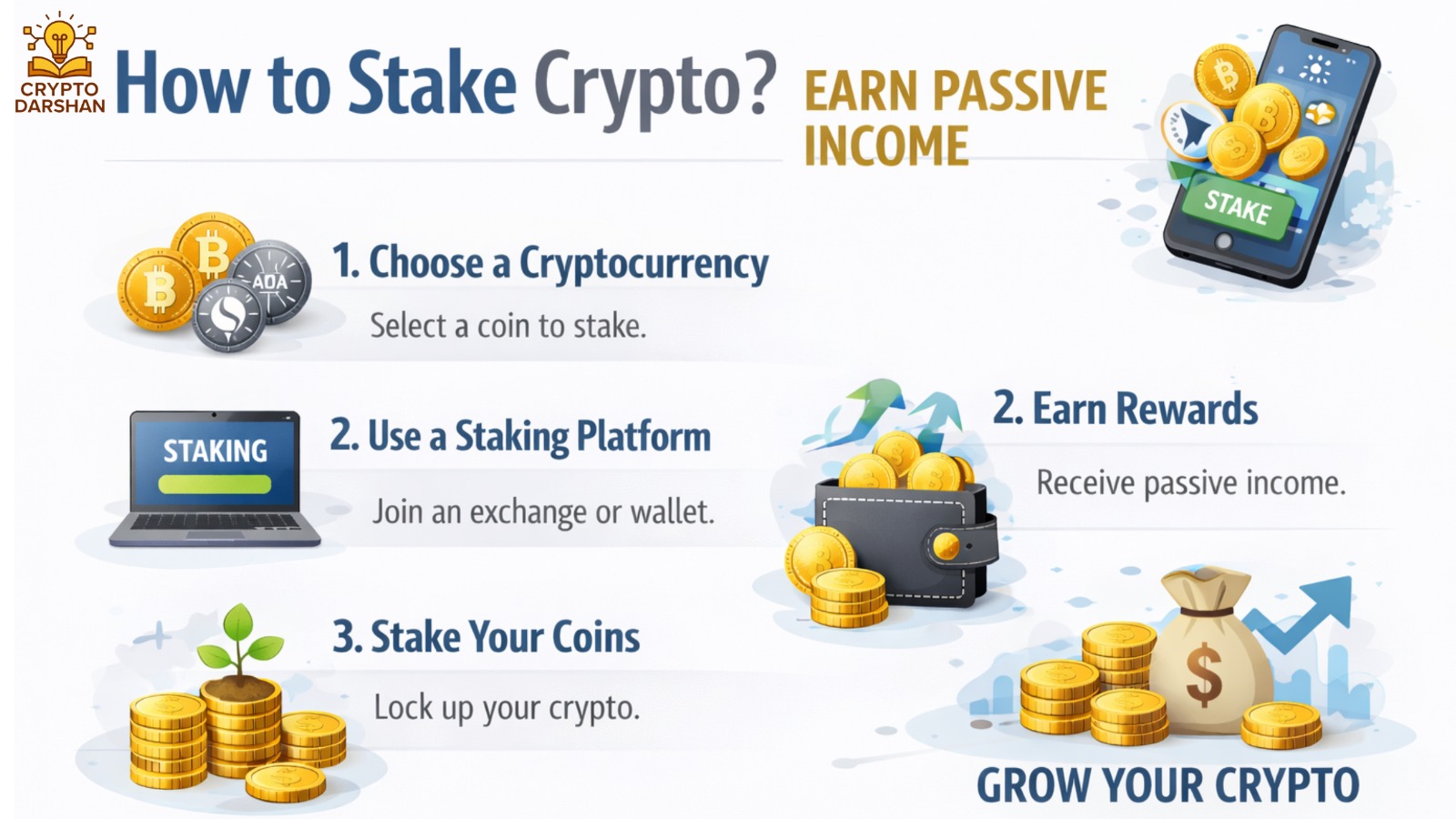
How to Stake Crypto: Step-by-Step Guide

Staking crypto is a simple process that allows token holders to earn passive income while supporting blockchain networks. Here’s a clear, beginner-friendly guide to get started.
Step 1: Choose a Staking Coin
Select a cryptocurrency that supports staking, such as Ethereum (ETH), Cardano (ADA), Solana (SOL), or Polkadot (DOT).
Check factors like:
- Annual reward rate (APY)
- Lock-up period
- Minimum staking amount
- Project reliability and community support
Step 2: Decide How to Stake
There are several ways to stake:
- Exchange Staking: Easiest option; stake directly on platforms like Binance, Coinbase, or Kraken.
- Wallet Staking: Use a crypto wallet that supports staking (e.g., Trust Wallet, MetaMask, or Daedalus).
- Delegated Staking: Delegate tokens to a validator who handles the technical side.
- Solo Staking: Run your own validator node (requires technical knowledge and higher capital).
Step 3: Set Up a Wallet
Download and install a compatible wallet for your chosen cryptocurrency.
Examples:
- Ethereum → MetaMask
- Cardano → Daedalus or Yoroi
- Solana → Phantom Wallet
Secure the wallet with a strong password and back up the recovery phrase safely.
Step 4: Buy and Transfer Tokens
Purchase the cryptocurrency from a trusted exchange and transfer it to your staking wallet.
Always double-check wallet addresses before sending funds.
Step 5: Start Staking

Follow the staking process for your chosen method:
- On exchanges: Go to the staking section, select the coin, and choose the amount to stake.
- On wallets: Select a validator or staking pool, delegate your tokens, and confirm the transaction.
Once staked, your tokens will be locked for a specific period (depending on the network).
Step 6: Monitor Rewards
Track your staking performance and rewards regularly.
Most platforms show:
- Current APY
- Total rewards earned.
- Lock-up duration and unstaking options
Rewards are usually distributed daily, weekly, or monthly, depending on the blockchain.
Step 7: Unstake When Needed
After the lock-up period, you can unstake your tokens. Some networks have a short waiting period (e.g., 3–21 days) before funds become available for withdrawal or trading.
How Much Can Be Earned from Staking

The amount you can earn from staking depends on the cryptocurrency, the network’s reward rate, and how long you keep your tokens locked. Staking rewards are usually shown as an annual percentage yield (APY) similar to earning interest in a savings account.
1. Factors That Affect Staking Rewards
Your staking income is influenced by a few main factors:
- Type of Cryptocurrency: Each blockchain offers different reward rates.
- Amount Staked: The more tokens you stake, the higher your rewards.
- Validator Performance: Reliable validators ensure consistent rewards.
- Lock-Up Period: Some networks offer higher rewards for longer staking durations.
- Network Participation: Fewer stakers often mean higher rewards per participant.
2. Average Staking Returns by Popular Cryptocurrencies
Here’s an overview of typical annual returns for major staking coins:
These rates can change depending on network conditions and token supply.
3. Example Calculation
If you stake $5,000 worth of Solana (SOL) at an 8% APY:
- Annual reward = $5,000 × 8% = $400 per year
- Monthly reward ≈ $33 per month
If the token’s price increases, your total earnings in dollar value can grow even more.
4. Compounding Rewards
Some staking platforms offer auto-compounding, where your earned rewards are automatically restaked to generate additional income. Over time, this increases your total returns.
Example:
If you stake $1,000 at 10% APY with monthly compounding, after one year you’ll have about $1,104, instead of just $1,100.
Tax Implications of Staking Crypto

Staking rewards are usually treated as taxable income when you receive them. Later, if you sell those rewards, you may also owe capital gains tax on any profit.
Here are the key points to remember:
- Income Tax on Rewards
- When you earn staking rewards, their market value at the time you receive them is considered income.
- Example: If you earn 10 SOL worth $100 each, you report $1,000 as income.
- Capital Gains Tax on Sale
- If you later sell or trade those tokens, you pay tax on the difference between the selling price and the value when you received them.
- Example: If SOL rises from $100 to $150, you pay capital gains tax on the $50 profit per token.
- Short-Term vs. Long-Term Gains
- Selling within 12 months = short-term gains (taxed at regular income rate).
- Selling after 12 months = long-term gains (usually lower tax rate).
- Record Keeping
- Track the date, amount, and value of rewards when received and when sold.
- Use crypto tax tools or exchange reports for accuracy.
- Country Variations
- Most countries (like the US, UK, Australia, and India) follow the same rule: income tax on receipt, capital gains tax on sale.
- Always check local tax laws or consult a tax expert..
Staking, Mining, and Yield Farming.

1. What Is Crypto Mining?
Mining is the process of validating blockchain transactions using computational power. It is mainly used in Proof of Work (PoW) blockchains like Bitcoin.
How Mining Works
- Miners use powerful computers to solve complex mathematical problems
- The first miner to solve the puzzle validates a block
- Rewards include newly minted coins + transaction fees
Pros
- High security
- Proven and decentralized system
- Long-term reliability (e.g., Bitcoin)
Cons
- Expensive hardware
- High electricity consumption
- Less eco-friendly
- Increasing competition reduces profitability
2. What Is Crypto Staking?
Staking involves locking your cryptocurrency to help secure a Proof of Stake (PoS) blockchain, such as Ethereum, Cardano, or Solana.
How Staking Works
- You lock (stake) your coins in a wallet or platform
- The network selects validators based on staked amount
- Validators earn rewards for confirming transactions
Pros
- Energy-efficient
- Lower entry barrier than mining
- Predictable rewards
- Beginner-friendly
Cons
- Funds may be locked for a period
- Slashing risk (penalties for bad validator behavior)
- Returns depend on network performance
3. What Is Yield Farming?
Yeild farming is a method in the decentralized finance(DeFi) space that allows users to receive rewards by allocating their digital assets into a DeFi protocol. By depositing funds into liquidity pools, users help facilitate trading and lending activities. In return, they earn interest, transaction fees, or governance tokens, often offering higher returns than traditional finance but with increased risk.
How Yield Farming Works
- Users deposit crypto into liquidity pools
- DeFi platforms use funds for lending/trading
- Rewards come from interest, fees, and governance tokens
Pros
- High potential returns (APY)
- Flexible strategies
- No need for expensive hardware
Cons
- High risk
- Impermanent loss
- Smart contract vulnerabilities
- Requires DeFi knowledge
Tips for Successful Staking

- Research the Project: Understand the blockchain’s fundamentals and staking mechanics before investing.
- Diversify: Stake multiple coins to spread risk.
- Choose Reliable Validators: Select validators with good performance and low commission rates.
- Stay Updated: Follow network updates and governance proposals that may affect staking rewards.
- Use Secure Wallets: Always stake from trusted wallets or exchanges with strong security measures.
The Future of Crypto Staking

As blockchain technology continues to evolve, staking is expected to play an even larger role in the crypto ecosystem. With Ethereum’s full transition to Proof-of-Stake and the rise of new PoS networks, staking is becoming a mainstream investment strategy.
Emerging trends include:
- Liquid staking derivatives that enhance flexibility.
- Cross-chain staking allowing users to stake across multiple blockchains.
- Institutional staking as large investors seek sustainable yield opportunities.
The combination of decentralization, sustainability, and profitability positions staking as a cornerstone of the future digital economy.
As blockchain adoption grows, staking is becoming a core feature of Web3 and the future of the decentralized internet.
Conclusion
Crypto staking is one of the most accessible and rewarding ways to earn passive income in the blockchain world. By locking tokens to support network operations, investors can earn consistent rewards while contributing to the growth and security of decentralized ecosystems.
However, like any investment, staking requires careful research and risk management. Understanding the staking process, choosing reliable platforms, and diversifying across multiple assets can help maximize returns and minimize potential losses.
As the crypto industry matures, staking will continue to evolve offering new opportunities for both individual investors and institutions to participate in the decentralized future of finance.