

The world of cryptocurrency has evolved rapidly over the past decade, transforming from a niche technological experiment into a global financial ecosystem. With thousands of blockchain networks now in existence, each offering unique features and use cases, the need for interoperability has become one of the most pressing challenges in the crypto industry. Interoperability refers to the ability of different blockchain systems to communicate, share data, and transfer assets seamlessly. Despite significant progress in blockchain innovation, achieving true interoperability remains a complex and unresolved issue.
This article explores why it continues to be a major challenge in crypto, the technical and economic barriers that hinder it, and the potential solutions being developed to overcome these obstacles. It also examines the importance of interoperability for the future of decentralized finance (DeFi), non-fungible tokens (NFTs), and the broader blockchain ecosystem.
Understanding Interoperability in Crypto
What Is Interoperability?
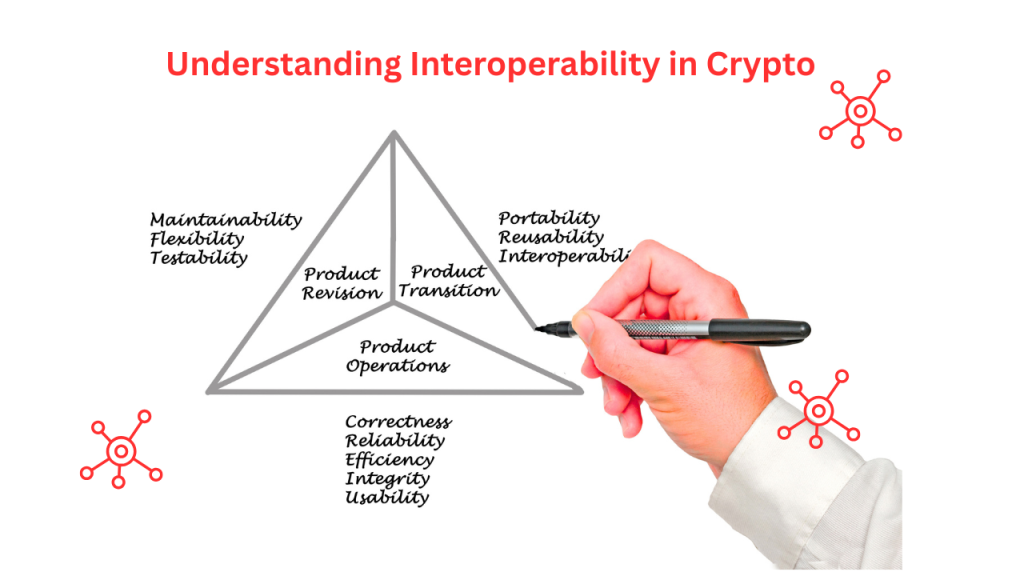
In simple terms, interoperability is the capacity of different blockchain networks to interact and exchange information without intermediaries. Just as the internet enables computers worldwide to communicate through standardized protocols, interoperability aims to create a similar environment for blockchains. It enables users to efficiently move assets, data, and smart contracts across multiple networks.
For example, if a user wants to transfer tokens from Ethereum to Binance Smart Chain (BSC), it would allow this transaction to occur directly, without relying on centralized exchanges or wrapped tokens. This seamless interaction is essential for creating a unified blockchain ecosystem.
Why Interoperability Matters
Interoperability is crucial for several reasons:
- Enhanced User Experience: Users can interact with multiple blockchains without needing to switch wallets or platforms.
- Increased Liquidity: Assets can move freely across networks, improving liquidity in decentralized markets.
- Innovation and Collaboration: Developers can build cross-chain applications that leverage the strengths of multiple blockchains.
- Scalability: Interoperability allows workloads to be distributed across different networks, reducing congestion.
- Decentralization: It reduces reliance on centralized intermediaries, aligning with the core principles of blockchain technology.
Without this, the blockchain ecosystem remains fragmented, limiting its potential to revolutionize global finance and data exchange.
The Current State of Blockchain Fragmentation

The Rise of Multiple Blockchains
The crypto industry has witnessed an explosion of blockchain networks, each designed to solve specific problems. Bitcoin focuses on secure peer-to-peer transactions, Ethereum enables smart contracts, and newer chains like Solana, Avalanche, and Polkadot aim to improve scalability and speed. However, these networks often operate in isolation, creating “blockchain silos.”
Each blockchain has its own consensus mechanism, token standards, and governance model. This diversity, while beneficial for innovation, makes interoperability extremely difficult. For instance, Ethereum uses the ERC-20 token standard, while Binance Smart Chain uses BEP-20. These differences prevent direct communication between the two without specialized bridges or protocols.
The Problem of Blockchain Silos
Blockchain silos hinder the free flow of information and assets. Users must rely on centralized exchanges or third-party bridges to move tokens between networks. This not only introduces security risks but also contradicts the decentralized ethos of blockchain technology. The lack of interoperability also limits the growth of decentralized applications (dApps), as developers must choose a single blockchain to build on, reducing cross-chain functionality.
Technical Challenges of Achieving Interoperability

1. Different Consensus Mechanisms
Each blockchain uses its own unique consensus mechanism to validate transactions and maintain network security. Bitcoin relies on Proof of Work (PoW), Ethereum uses Proof of Stake (PoS), while others employ Delegated Proof of Stake (DPoS), Proof of Authority (PoA), or hybrid models. These mechanisms have fundamentally different rules for how nodes reach agreement on the blockchain’s state. Creating interoperability between networks with different consensus models is extremely complex because each system has its own security assumptions, finality guarantees, and validation processes that don’t naturally align with one another.
2. Incompatible Protocols and Token Standards
Blockchains operate using different data structures, transaction formats, and token standards that aren’t naturally compatible. Ethereum uses ERC-20 for fungible tokens and ERC-721 for NFTs, while Binance Smart Chain uses BEP-20 and Solana uses SPL token standards. These differences mean that blockchains literally “speak different languages” and cannot directly understand each other’s data formats. Without a universal translation layer or standardized protocol, achieving seamless communication between these diverse systems remains a significant technical hurdle.
3. Security Vulnerabilities in Cross-Chain Bridges
Cross-chain bridges are among the most common interoperability solutions, but they’re also the weakest security link in the ecosystem. Bridges typically work by locking assets on one chain and minting equivalent tokens on another, relying on smart contracts or custodial systems. These centralized points of control become attractive targets for hackers. Major exploits like the Ronin Bridge hack ($625 million) and Wormhole breach ($325 million) demonstrate how vulnerable these systems can be. The challenge lies in creating bridges that are both functional and secure without introducing centralized points of failure.
4. Scalability and Network Latency Issues
Achieving real-time interoperability requires synchronizing data across multiple blockchains that operate at different speeds. Bitcoin processes blocks every 10 minutes, Ethereum every 12 seconds, and Solana in under a second. These varying block times create synchronization challenges and potential inconsistencies when trying to coordinate cross-chain transactions. Additionally, network congestion on one blockchain can create bottlenecks that affect the entire interoperability system. Maintaining fast, reliable communication across networks with vastly different performance characteristics is a persistent technical challenge.
5. Smart Contract Compatibility and Execution Environments

Different blockchains use different programming languages and virtual machines for smart contracts. Ethereum uses Solidity and the Ethereum Virtual Machine (EVM), while Solana uses Rust and its own runtime environment. This means that smart contracts written for one blockchain cannot simply be ported to another without significant modifications. Creating the solutions that allow smart contracts on different chains to interact and call each other’s functions requires complex translation layers and standardized execution environments that don’t yet exist at scale.
6. State Management and Data Consistency
Maintaining consistent state across multiple blockchains is technically challenging. Each blockchain maintains its own independent ledger and state, and ensuring that cross-chain transactions are atomic (either fully completed or fully reversed) across all involved networks is difficult. If a transaction succeeds on one chain but fails on another, it creates inconsistencies that can lead to lost funds or corrupted data. Developing robust mechanisms for distributed state management and rollback procedures across heterogeneous blockchain systems remains an unsolved technical problem.
7. Governance and Upgrade Coordination
Each blockchain has its own governance model that determines how protocol upgrades and changes are proposed, voted on, and implemented. Some use on-chain governance with token voting, others rely on off-chain community consensus, and some have centralized development teams. Coordinating upgrades across multiple interconnected blockchains is extremely complex because changes to one network’s protocol could break compatibility with others. The lack of unified governance frameworks means that interoperability solutions must be flexible enough to adapt to independent upgrade cycles while maintaining compatibility.
8. Cryptographic Verification Across Different Systems
Verifying transactions and proofs across different blockchain systems requires complex cryptographic mechanisms. Each blockchain may use different cryptographic algorithms, signature schemes, and hash functions. For example, one chain might use ECDSA signatures while another uses Schnorr signatures. Creating light clients or verification systems that can validate proofs from one blockchain on another requires significant computational resources and sophisticated cryptographic protocols
Economic and Regulatory Barriers

1. Competition Among Blockchains
Many blockchain projects compete for users, developers, and market share. This competition discourages collaboration and standardization. Instead of working together to achieve interoperability, projects often focus on building proprietary ecosystems to retain users.
2. Token Economics and Incentives
Each blockchain has its own native token and economic model. Aligning incentives across different ecosystems is difficult. For example, validators on one network may not have any motivation to support transactions from another network unless properly incentivized.
3. Regulatory Uncertainty
Interoperability introduces complex regulatory challenges. Moving assets across chains can blur jurisdictional boundaries, making it difficult to enforce compliance with local laws. Regulators are still grappling with how to oversee cross-chain transactions, which adds another layer of uncertainty.
4. Compliance and Anti-Money Laundering (AML) Concerns
When assets move seamlessly between blockchains, tracking them for compliance purposes becomes exponentially more difficult. Regulatory bodies worry that interoperability could facilitate money laundering, tax evasion, and other illicit activities by making it easier to obscure the origin and destination of funds. Each blockchain may have different Know Your Customer (KYC) and AML requirements and coordinating these standards across multiple networks presents a major obstacle to achieving true interoperability.
5. Lack of Economic Incentives for Standardization
Developing and implementing interoperability standards requires significant investment in research, development, and coordination. However, individual blockchain projects often lack clear economic incentives to invest in these efforts, especially when proprietary solutions might offer short-term competitive advantages. The absence of a unified funding model or governance structure to support cross-industry standardization efforts means that interoperability development often progresses slowly and inconsistently across the ecosystem.
Existing Solutions for Interoperability

1. Cross-Chain Bridges
Cross-chain bridges are the most common interoperability solution. They allow users to transfer assets between blockchains by locking tokens on one chain and minting equivalent tokens on another. Examples include the Binance Bridge, Avalanche Bridge, and Polygon Bridge. While effective, these systems are often centralized and prone to security vulnerabilities.
2. Sidechains
Sidechains are independent blockchains that run parallel to a main chain. They are connected through a two-way peg, allowing assets to move between them. Polygon, for instance, operates as a sidechain to Ethereum, offering faster and cheaper transactions while maintaining compatibility.
3. Interoperability Protocols
Protocols like Polkadot, Cosmos, and Avalanche are designed specifically to enable interoperability.
- Polkadot uses a relay chain that connects multiple parachains, allowing them to share security and communicate seamlessly.
- Cosmos employs the Inter-Blockchain Communication (IBC) protocol, enabling independent blockchains to exchange data and tokens.
- Avalanche uses subnets that can interact with each other while maintaining their own rules and governance.
4. Wrapped Tokens
Wrapped tokens represent assets from one blockchain on another. For example, Wrapped Bitcoin (WBTC) is an ERC-20 token on Ethereum backed 1:1 by Bitcoin. This allows Bitcoin holders to participate in Ethereum’s DeFi ecosystem. However, wrapped tokens rely on custodians or smart contracts, which can introduce trust issues.
5. Atomic Swaps
Atomic swaps enable peer-to-peer exchanges of cryptocurrencies across different blockchains without intermediaries. They use smart contracts to ensure that both sides of the trade are executed simultaneously or not at all. While promising, atomic swaps are still limited in scope and adoption.
The Role of Interoperability in DeFi and NFTs

Interoperability in DeFi
Decentralized finance relies heavily on interoperability. DeFi platforms like Uniswap, Aave, and Curve operate primarily on Ethereum, but users increasingly demand access to assets and liquidity from other chains. Cross-chain interoperability allows DeFi protocols to expand their reach, enabling users to borrow, lend, and trade assets across multiple networks.
For example, a user could use Bitcoin as collateral on Ethereum-based lending platforms or trade Solana tokens on a Binance Smart Chain DEX. This interconnectedness enhances liquidity, reduces fragmentation, and fosters innovation in financial products.
Interoperability in NFTs
The NFT market also benefits from interoperability. Currently, NFTs created on one blockchain cannot easily be transferred or traded on another. Interoperability would allow NFTs to move freely across ecosystems, enabling broader marketplaces and cross-chain gaming experiences. Projects like LayerZero and Wormhole are exploring solutions to make NFTs interoperable across chains.
The Future of Interoperability

Standardization Efforts
Achieving interoperability requires standardization across the blockchain industry. Organizations like the Blockchain Interoperability Alliance and the Enterprise Ethereum Alliance are working to develop common frameworks and protocols. Standardization will make it easier for developers to build cross-chain applications and for blockchains to communicate effectively.
The Rise of Layer 0 Solutions
Layer 0 protocols, such as Polkadot and Cosmos, are emerging as foundational layers for interoperability. They provide the infrastructure that connects multiple blockchains, enabling them to share security and data. These solutions could become the backbone of a truly interconnected blockchain ecosystem.
Integration with Web3 and the Metaverse
As Web3 and the metaverse evolve, interoperability will play a critical role in connecting decentralized applications, digital assets, and virtual worlds. Users will be able to move their identities, assets, and experiences seamlessly across platforms, creating a unified digital economy.
The Role of AI and Automation
Artificial intelligence could enhance interoperability by automating cross-chain communication and optimizing transaction routing. AI-driven systems could identify the most efficient paths for asset transfers, reducing latency and improving user experience.
Key Projects Driving Interoperability
Polkadot
Polkadot’s architecture is built around a central relay chain that connects multiple parachains. Each parachain can have its own features and governance while benefiting from shared security. This design allows for scalable and secure interoperability between diverse blockchains.
Cosmos
Cosmos uses the Inter-Blockchain Communication (IBC) protocol to connect independent blockchains, known as zones. The Cosmos Hub acts as a central hub that facilitates communication and asset transfers between zones. Its modular design makes it one of the most advanced interoperability frameworks.
Avalanche
Avalanche’s subnet architecture allows multiple blockchains to coexist and interact within its ecosystem. Each subnet can have its own rules, validators, and tokens, while still being interoperable with others through the Avalanche consensus protocol.
Chainlink CCIP
Chainlink’s Cross-Chain Interoperability Protocol (CCIP) aims to provide a universal standard for cross-chain communication. It enables smart contracts on different blockchains to interact securely, paving the way for cross-chain DeFi and data sharing.
The Risks and Limitations of Interoperability

Security Vulnerabilities
Interoperability introduces new attack vectors. Cross-chain bridges and protocols can be exploited if not properly secured. Ensuring the safety of assets across multiple networks remains a top priority.
Complexity and Maintenance
Managing interoperability between multiple blockchains increases system complexity. Developers must ensure compatibility, maintain updates, and handle potential conflicts between networks.
Centralization Risks
Some interoperability solutions rely on centralized intermediaries or validators, which can undermine decentralization. Striking a balance between efficiency and decentralization is a continuing challenge.
Regulatory Concerns
Cross-chain transactions complicate regulatory oversight. Authorities may struggle to track asset movements across jurisdictions, raising concerns about compliance, taxation, and anti-money laundering (AML) enforcement.
The Path Forward

To achieve true interoperability, the blockchain industry must focus on collaboration, standardization, and innovation. Developers, regulators, and users all play a role in shaping the future of cross-chain communication. The following steps are essential:
- Develop Open Standards: Establish universal protocols for data exchange and asset transfers.
- Enhance Security: Implement robust auditing and verification mechanisms for cross-chain systems.
- Promote Collaboration: Encourage partnerships between blockchain projects to build shared infrastructure.
- Educate Users: Increase awareness about the benefits and risks of interoperability.
- Adopt Layer 0 Solutions: Support the growth of foundational interoperability frameworks like Polkadot and Cosmos.
FAQ: Why Interoperability Is Still a Big Challenge in Crypto
1. What does interoperability mean in crypto?
Interoperability in crypto refers to the ability of different blockchain networks to communicate, share data, and transfer assets seamlessly with one another.
2. Why is interoperability important for blockchain adoption?
Without interoperability, blockchains operate in isolated ecosystems. Cross-chain compatibility improves user experience, liquidity flow, scalability, and overall efficiency across the crypto industry.
3. Why is interoperability still difficult in 2026?
Different blockchains use unique consensus mechanisms, programming languages, security models, and architectures, making smooth communication technically complex.
4. What are cross-chain bridges?
Cross-chain bridges are protocols that allow users to transfer tokens and data between separate blockchain networks like Ethereum, Solana, and BNB Chain.
5. Are blockchain bridges secure?
Not always. Bridges have become major targets for hackers because they often hold large amounts of locked liquidity and rely on complex smart contracts.
6. What are the biggest interoperability risks?
Common risks include bridge hacks, validator compromises, network incompatibilities, delayed transactions, and liquidity fragmentation.
7. Which projects are working on interoperability solutions?
Projects like Polkadot, Cosmos, Chainlink, and LayerZero are building interoperability-focused technologies.
8. How does interoperability affect DeFi users?
Better interoperability allows DeFi users to move assets across chains faster, access more liquidity pools, and use multiple decentralized applications without switching ecosystems manually.
Conclusion
Interoperability remains one of the biggest challenges in the crypto industry. While significant progress has been made through bridges, sidechains, and interoperability protocols, the ecosystem is still far from achieving seamless cross-chain communication. Technical complexities, security risks, and regulatory uncertainties continue to hinder progress.
However, the future looks promising. With ongoing innovation in Layer 0 solutions, standardization efforts, and cross-chain protocols, the vision of a fully interconnected blockchain world is becoming more attainable. Interoperability is not just a technical goal—it is the key to unlocking the full potential of decentralized finance, NFTs, and Web3. As the industry continues to evolve, achieving true interoperability will be essential for building a more open, efficient, and inclusive digital economy.