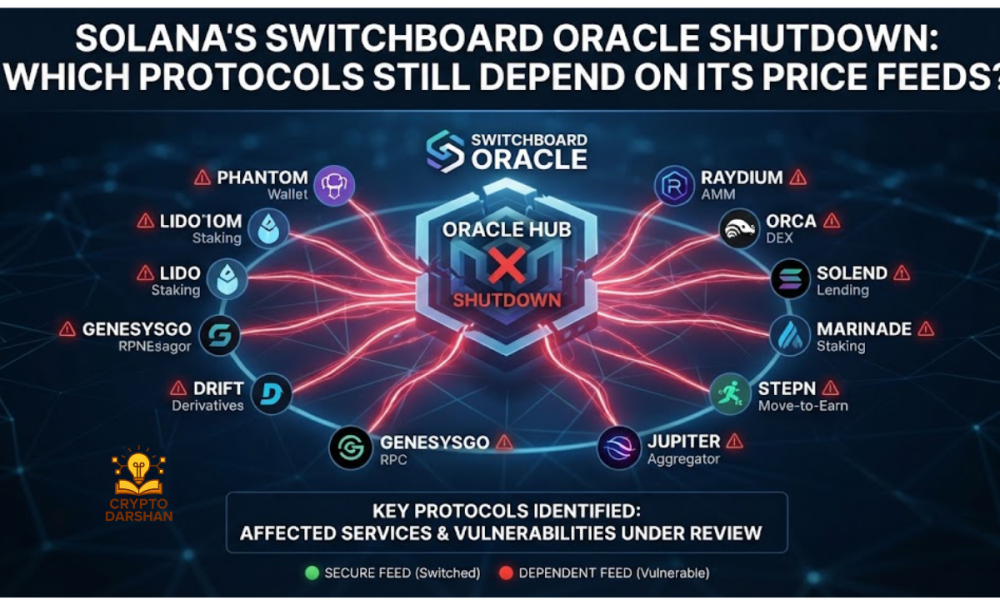
Solana’s Switchboard oracle network officially ended technical support on September 25, 2026, raising urgent questions about which decentralized finance (DeFi) protocols still rely on its price data for collateral valuations, liquidations, and reward calculations. While Switchboard named major integrators like Jito, marginfi, Kamino, and Drift in past documentation, current evidence suggests a fragmented migration landscape—some projects have actively moved away, while others retain outdated references without confirming live dependencies.
The September 25 Deadline: What Actually Stopped?

Switchboard Technology Labs announced its wind-down on September 19, 2026, stating that all implementations were deprecated immediately and technical support would cease on September 25. The team urged integrators to migrate to alternatives like Pyth Network and RedStone. However, the end of corporate support does not automatically mean every on-chain price feed halted—some may continue updating via independent node operators, while others could already be using fallback mechanisms or alternative oracles.
Critically, no public inventory exists showing which specific markets or vaults still pull data from Switchboard accounts as of the deadline. Protocol-level TVL (total value locked) figures cannot be used to estimate exposure, since not all assets within a platform necessarily share the same oracle source.
Jito: Documented Dependency, But Is It Live?
Jito Foundation’s Tip Router documentation explicitly lists Switchboard as the oracle used to determine relative asset weights (e.g., JitoSOL, JTO) in vaults tied to its tip distribution and restaking system. The docs also describe a fallback mechanism for when feeds become unavailable, suggesting built-in redundancy.
However, the Tip Router overview page was last updated nine months prior to September 25, 2026, meaning it may not reflect current on-chain configurations. Without recent transaction data or an official statement from Jito confirming migration status, it remains unclear whether live vaults still depend on Switchboard or have silently switched to another provider.
Marginfi: Active Migration Underway

Marginfi presents a clearer picture. In early September 2026, the lending protocol released version 0.1.11 of its program, introducing nine new oracle setups that do not rely on Switchboard—including integrations with Kamino Scope feeds and exchange-rate-based pricing for liquid staking tokens. Banks began migrating to these new configurations starting September 4, well before the Switchboard shutdown announcement.
That said, marginfi’s documentation does not confirm that all markets completed migration by September 25. Additionally, the upgrade introduced a notable risk: older SDK versions (below 2.8.0) cannot decode banks using the new oracle types, potentially causing initialization failures even for users not interacting with migrated markets.
Kamino and Scope: Aggregation Complicates Attribution
Kamino Finance’s Scope oracle acts as an on-chain aggregator, pulling data from multiple sources (including Pyth, Switchboard, and others) into unified price feeds. Seeing “Scope” in a protocol’s configuration doesn’t reveal whether Switchboard remains an upstream source—only a deep dive into each feed’s entry mapping can confirm that.
Marginfi’s September note lists Scope as one of the Switchboard-independent options, but this applies only to newly configured banks, not necessarily all existing ones. Meanwhile, Kamino continues onboarding institutional users (e.g., Galaxy’s stablecoin vaults in September 2026), though there’s no public evidence these new products use Switchboard.
Why This Matters: Stale Prices Can Trigger Cascading Failures

Oracles are the backbone of DeFi risk management. If a lending protocol accepts stale or frozen prices:
- Borrowers might over-collateralize based on outdated values
- Liquidations could execute at incorrect thresholds
- Reward distributions may become misaligned with real market conditions
For example, an unrelated oracle anomaly on Hyperliquid in July 2026 caused a 17.9% perpetual contract drop and forced liquidations after an erroneous price print. While no such incident has been verified for Switchboard-dependent markets as of September 25, the risk profile remains elevated until migrations are confirmed.
What Users and Developers Should Monitor
To assess real-world impact, stakeholders should track:
- On-chain oracle account addresses for active markets
- Latest price update timestamps post-September 25
- Fallback oracle configurations and freshness rules
- Protocol announcements confirming migration completion
- Transaction success rates for borrows, liquidations, and reward claims
A single successful transaction doesn’t prove continued service—consistent updates over multiple slots are needed to confirm resilience.
The Bottom Line

While Switchboard’s exit marks a significant infrastructure shift for Solana DeFi, the actual exposure is narrower and more nuanced than headline fears suggest. Protocols like marginfi have proactively reduced dependency, while others like Jito retain documented—but potentially stale—references. Until granular, market-by-market audits are published, the safest assumption is that some legacy feeds may still be in use, warranting caution from integrators and users alike.
Disclaimer: This article is for informational purposes only and does not constitute financial advice. Always conduct your own research before interacting with DeFi protocols.