
Risk Management is one of the most important aspects of successful cryptocurrency trading. In the fast-moving world of digital assets, prices can rise or fall within seconds. Without proper Risk Management, traders can lose their entire investment in a single trade. The goal of Risk Management is to protect capital, reduce losses, and ensure long-term profitability. It helps traders make smart decisions, control emotions, and trade with discipline.
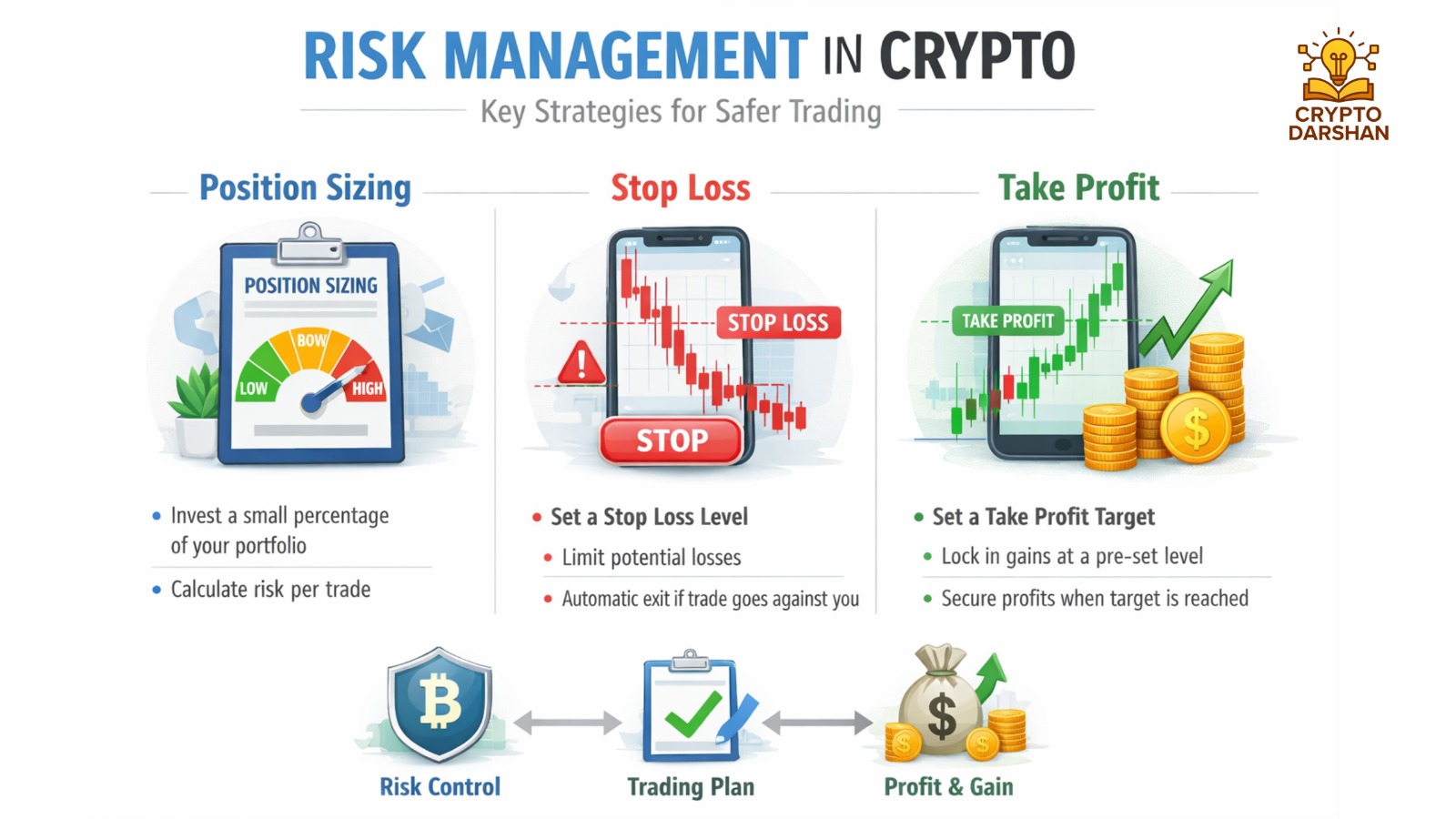
In crypto trading, Risk involves setting clear rules for how much to invest, when to exit a trade, and how to protect profits. The three main tools used for this are position sizing, stop loss, and take profit. These tools help traders manage risk and reward effectively. Understanding how to use them correctly can make the difference between consistent profits and repeated losses.
This guide explores how Risk Management works in crypto trading, how to apply position sizing, stop loss, and take profit strategies, and how to build a trading plan that minimizes risk while maximizing potential returns.
Why Risk Management Matters in Crypto Trading

Cryptocurrency markets are known for their volatility. Prices can move 10%, 20%, or even 50% in a single day. This volatility creates profit opportunities but also increases the risk of loss. Without proper Risk Management, traders can quickly lose control of their portfolios.
1. Protecting Capital
The first rule of trading is to protect capital. Risk Management ensures that no single trade can wipe out an account. By limiting the amount of money risked per trade, traders can survive losing streaks and continue trading.
2. Reducing Emotional Decisions
Emotions like fear and greed often lead to poor trading decisions. Management provides a structured approach that removes emotions from the process. When traders follow a plan, they are less likely to panic or overtrade.
3. Ensuring Long-Term Success
Even the best traders experience losses. The key difference between successful and unsuccessful traders is how they manage those losses. Risk Management allows traders to stay in the game long enough to benefit from profitable opportunities.
4. Adapting to Market Volatility
Crypto markets are unpredictable. Risk Management helps traders adapt to changing conditions by adjusting position sizes and stop losses based on volatility levels.
Core Principles of Risk Management
Effective Risk Management in crypto trading is built on several key principles. These principles guide how traders approach the market and make decisions.
1. Never Risk More Than You Can Afford to Lose
A common rule in trading is to risk only 1–2% of total capital on a single trade. This ensures that even after several losing trades, the account remains intact.
2. Use Position Sizing to Control Exposure
Position sizing determines how much of a cryptocurrency to buy or sell. It is one of the most powerful tools in Risk Management. Proper position sizing ensures that losses remain small relative to account size.
3. Always Use Stop Loss Orders
A stop loss is a predefined price level where a trade will automatically close to prevent further losses. It is a key part of Risk Management because it limits downside risk.
4. Set Take Profit Targets
Take profit levels lock in gains when the market moves in the desired direction. This prevents traders from giving back profits due to sudden reversals.
5. Maintain a Positive Risk-to-Reward Ratio
A good Management strategy aims for trades with a risk-to-reward ratio of at least 1:2. This means risking $1 to earn $2 potentially. Over time, this ratio ensures profitability even with a lower win rate.
Understanding Position Sizing in Crypto Trading

Position sizing is the process of determining how much of a cryptocurrency to buy or sell in a trade. It is a central part of Risk Management because it directly affects how much money is at risk. If you’re new to trading, start with this beginner-friendly guide: Why Most Retail Traders Lose Money in Crypto (And How Not To)
1. The Role of Position Sizing in Risk Management
Position sizing helps traders control exposure to market volatility. By adjusting the size of each trade based on account balance and risk tolerance, traders can manage losses effectively.
2. Calculating Position Size
To calculate position size, traders use the following formula:
Position Size = (Account Balance × Risk per Trade) ÷ (Entry Price − Stop Loss Price)
For example, if a trader has a $10,000 account and risks 2% per trade ($200), with an entry price of $50,000 and a stop loss at $49,000, the position size would be:
Position Size = ($10,000 × 0.02) ÷ ($50,000 − $49,000) = $200 ÷ $1,000 = 0.2 BTC
This calculation ensures that only $200 is at risk if the trade fails.
3. Adjusting Position Size for Volatility
Highly volatile cryptocurrencies require smaller position sizes to manage risk. Stable coins or less volatile assets may allow for larger positions. This flexibility is essential for effective Risk Management.
4. Using Leverage Safely
Leverage allows traders to control larger positions with smaller amounts of capital. However, it also increases risk. Proper Risk Management requires using leverage cautiously and always setting stop losses.
Stop Loss: The Safety Net of Risk Management

A stop loss is a critical tool in Risk Management. It automatically closes a trade when the price reaches a certain level, preventing further losses.
1. Importance of Stop Loss in Crypto Trading
Crypto markets operate 24/7, and prices can change rapidly. Stop losses protect traders from unexpected market moves when they are not actively monitoring trades.
2. Types of Stop Loss Orders
- Fixed Stop Loss: A set price level below the entry point.
- Trailing Stop Loss: Moves with the market price to lock in profits as the trade becomes profitable.
- Volatility-Based Stop Loss: Adjusted based on market volatility indicators like Average True Range (ATR).
3. Setting the Right Stop Loss Level
Stop losses should be placed at logical levels based on technical analysis, such as below support zones or moving averages. Setting them too tight can lead to premature exits, while setting them too wide increases risk.
4. Avoiding Common Stop Loss Mistakes
- Moving stop losses further away to avoid being stopped out.
- Trading without a stop loss.
- Setting stop losses based on emotions instead of analysis.
Proper stop loss placement is a cornerstone of Risk Management and helps maintain discipline in trading.
Take Profit: Securing Gains

Take profit orders are used to lock in profits when the market moves favorably. They are an essential part of Risk Management because they ensure that gains are realized before the market reverses.
1. The Role of Take Profit in Risk Management
Take profit levels help traders stick to their trading plan and avoid greed. By setting predefined profit targets, traders can secure consistent returns.
2. Setting Take Profit Levels
Take profit levels are often based on technical indicators, resistance levels, or a specific risk-to-reward ratio. For example, if the risk is $100, the take profit might be set at $200 for a 1:2 ratio.
3. Using Partial Take Profits
Some traders prefer to take partial profits at different levels. This approach allows them to secure some gains while keeping part of the position open for larger moves.
4. Combining Stop Loss and Take Profit
A balanced Management strategy uses both stop loss and take profit orders. This combination ensures that losses are limited and profits are protected.
Building a Risk Management Plan for Crypto Trading
A Risk Management plan is a structured approach that defines how to handle risk in every trade. It includes rules for position sizing, stop loss, take profit, and overall portfolio management.
1. Define Risk Tolerance
Risk tolerance depends on factors like trading experience, financial goals, and emotional control. Conservative traders may risk 1% per trade, while aggressive traders might risk up to 3%.
2. Set Clear Trading Rules
A good Risk Management plan includes clear rules for:
- Maximum risk per trade
- Maximum number of open trades
- Minimum risk-to-reward ratio
- Stop loss and take profit placement
3. Diversify the Portfolio
Diversification reduces overall risk by spreading investments across different cryptocurrencies. This prevents large losses from a single asset.
4. Monitor and Adjust
Risk Management is not static. Traders should regularly review performance, adjust position sizes, and refine strategies based on market conditions.
Psychological Aspects of Risk Management

Emotions play a major role in trading decisions. Effective Risk Management helps control emotions and maintain discipline.
1. Avoiding Fear and Greed
Fear causes traders to exit trades too early, while greed leads to overtrading. A solid Risk Management plan minimizes emotional influence.
2. Staying Consistent
Consistency is key to long-term success. Following Risk Management rules ensures that decisions are based on logic, not emotion.
3. Learning from Mistakes
Every trader experiences losses. The goal of Risk Management is to learn from those losses and improve future performance.
Advanced Risk Management Techniques
Experienced traders use advanced Risk Management techniques to further protect their capital and optimize returns. Advanced strategies also require careful profit-taking rules: Flash Loans Tutorial: Borrow Millions No Collateral
1. Using the Kelly Criterion
The Kelly Criterion helps determine the optimal position size based on win probability and risk-to-reward ratio. It maximizes growth while minimizing risk.
2. Hedging Strategies
Hedging involves opening opposite positions to reduce exposure. For example, holding Bitcoin while shorting Bitcoin futures can protect against downside risk.
3. Dynamic Stop Loss Adjustments
Adjusting stop losses as the trade moves in favor helps lock in profits and reduce risk exposure.
4. Risk Management with Correlated Assets
Traders should avoid taking multiple positions in highly correlated cryptocurrencies, as this increases overall risk.
Common Risk Management Mistakes in Crypto Trading
Even experienced traders make mistakes that can undermine Risk Management strategies.
1. Ignoring Stop Losses
Failing to use stop losses is one of the biggest mistakes. It exposes traders to unlimited losses.
2. Overleveraging
Using too much leverage magnifies both gains and losses. Proper Risk Management requires using leverage responsibly.
3. Risking Too Much on a Single Trade
Putting too much capital into one trade can lead to large losses. Diversification and position sizing prevent this.
4. Lack of a Trading Plan
Trading without a plan leads to inconsistent results. A Risk Management plan provides structure and discipline.
Tools and Indicators for Risk Management
1. Average True Range (ATR)
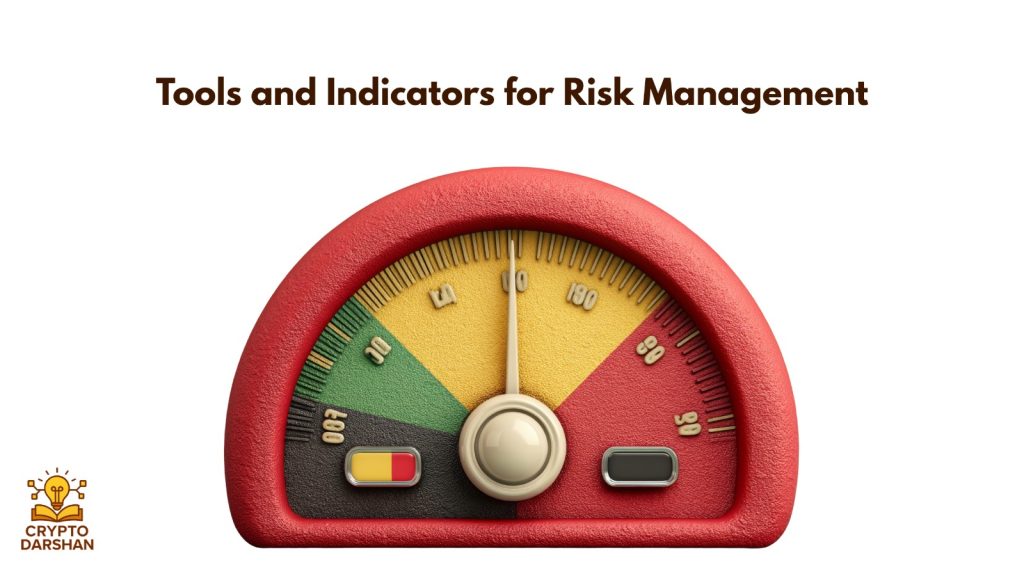
The average true range (ATR) is a technical analysis indicator introduced by market technician J. Welles Wilder Jr. in his book “New Concepts in Technical Trading Systems.” In Risk Management, traders use ATR to determine how far to place stop losses and take profits. A higher ATR means the market is more volatile, so stop losses should be wider to avoid being triggered by normal price fluctuations. A lower ATR suggests a calmer market, allowing for tighter stop losses. This helps traders adjust their strategies based on current market conditions.
2. Moving Averages
Moving averages smooth out price data to show the overall direction of a trend. They are useful in Risk Management because they help identify potential support and resistance levels. Traders often place stop losses below a moving average in an uptrend or above it in a downtrend. This ensures that trades are aligned with the market’s momentum. Common types include the Simple Moving Average (SMA) and the Exponential Moving Average (EMA), both of which help traders make more informed decisions.
3. Position Size Calculators
Position size calculators are essential tools for managing risk per trade. They help traders determine how much of their capital to allocate based on account size, risk percentage, and stop loss distance. By using a position size calculator, traders can ensure they never risk more than their set limit—usually 1–2% of their total account. This tool promotes consistency and prevents emotional decision-making, which is vital for effective Risk Management.
4. Portfolio Trackers
Portfolio trackers allow traders and investors to monitor all their crypto holdings in one place. They provide insights into asset allocation, performance, and overall exposure. In Risk Management, portfolio trackers help identify overexposure to a single asset or sector, allowing for timely rebalancing. By keeping track of profits, losses, and diversification, traders can maintain a balanced portfolio that aligns with their risk tolerance and long-term goals.
Case Study: Applying Risk Management in a Bitcoin Trade

A trader has a $20,000 account and wants to buy Bitcoin at $40,000 with a stop loss at $38,000 and a take profit at $44,000. The trader risks 2% per trade ($400).
Position Size = ($20,000 × 0.02) ÷ ($40,000 − $38,000) = $400 ÷ $2,000 = 0.2 BTC
If the trade hits the stop loss, the loss is $400. If it reaches the take profit, the gain is $800, giving a 1:2 risk-to-reward ratio. This is a textbook example of effective Risk Management.
The Role of Risk Management in Long-Term Crypto Investing

Risk Management is not only for short-term traders. Long-term investors also benefit from managing risk through diversification, rebalancing, and setting exit strategies.
1. Diversification Across Assets
Investing in multiple cryptocurrencies reduces exposure to any single asset’s volatility.
2. Periodic Rebalancing
Rebalancing ensures that portfolio allocations remain aligned with risk tolerance.
3. Setting Long-Term Stop Losses
Even long-term investors should use stop losses to protect against major market downturns.
Developing a Risk Management Mindset
A Risk Management mindset focuses on preservation of capital, consistency, and discipline. It views trading as a long-term process rather than a quick profit opportunity.
1. Focus on Process, Not Outcome
Successful traders focus on following their Risk Management plan rather than chasing profits.
2. Accepting Losses as Part of the Game
Losses are inevitable. The goal of Risk Management is to make sure they are small and manageable.
3. Continuous Learning
Markets evolve, and so should Risk Management strategies. Continuous learning ensures adaptability.
Frequently Asked Questions (FAQ)

1. What is risk management in crypto trading?
Risk management in crypto trading is the process of protecting your capital by controlling potential losses. It involves strategies like position sizing, setting stop losses, and defining take profit levels to ensure you don’t lose too much on any single trade.
2. Why is risk management important in crypto?
Crypto markets are highly volatile. Without proper risk management, traders can lose a significant portion of their capital quickly. Good risk management helps you stay in the game long-term and trade consistently.
3. What is position sizing in crypto trading?
Position sizing refers to how much money you allocate to a single trade. Instead of risking your entire portfolio, you only risk a small percentage (commonly 1–2%) per trade to minimize losses.
4. How do I calculate position size?
Position size depends on:
- Your total capital
- Risk percentage per trade
- Distance to your stop loss
Basic formula:
Position Size = (Account Balance × Risk %) ÷ Stop Loss Distance
5. What is a stop loss in crypto trading?
A stop loss is an automatic order that closes your trade at a predefined price to limit losses. It prevents emotional decision-making and protects your capital during sudden market moves.
6. Where should I place my stop loss?
Stop losses should be placed based on technical analysis, such as:
- Support and resistance levels
- Trendlines
- Key chart patterns
Avoid placing them too tight, as market noise can trigger them unnecessarily.
7. What is a take-profit order?
A take profit order automatically closes your trade when a target profit level is reached. It helps lock in gains without needing to monitor the market constantly.
Conclusion
Risk Management is the foundation of successful crypto trading. It protects capital, reduces emotional trading, and ensures long-term profitability. By mastering position sizing, stop loss, and take profit strategies, traders can navigate the volatile crypto market with confidence.
Effective Risk Management is not about avoiding losses entirely; it’s about controlling them. With a solid Risk Management plan, traders can survive losing streaks, capitalize on winning trades, and build sustainable success in cryptocurrency trading.