The rise of decentralized finance, or DeFi, has transformed how people interact with money, investments, and financial systems. Built on blockchain technology, DeFi Protocols allow users to lend, borrow, trade, and earn interest without relying on traditional banks. At the heart of these systems are smart contracts, self-executing programs that automatically enforce agreements between parties.
As the DeFi ecosystem grows, developers are increasingly turning to smart contract templates to build new platforms quickly. These templates act as ready-made frameworks that can be customized and deployed with minimal coding. This “copy-paste” approach has made it easier than ever to launch new DeFi Protocols, but it also raises questions about security, originality, and sustainability.
This article explores how smart contract templates are shaping the DeFi landscape, the benefits and risks of using them, and what the future holds for decentralized finance innovation.
Understanding Smart Contracts

What Are Smart Contracts?
Smart Contracts are digital agreements written in code and stored on a blockchain. They automatically execute actions when specific conditions are met. For example, a smart contract can release funds when a borrower repays a loan or transfer tokens when a trade is completed.
Unlike traditional contracts, smart contracts don’t require intermediaries like banks or lawyers. They rely on blockchain’s transparency and immutability to ensure trust between parties. This automation reduces costs, speeds up transactions, and eliminates human error.
How Smart Contracts Power DeFi Protocols
DeFi Protocols rely on smart contracts to manage financial operations. Every lending platform, decentralized exchange (DEX), or yield farming system uses smart contracts to handle deposits, withdrawals, and interest calculations.
For instance, when a user deposits tokens into a DeFi lending platform, a smart contract records the deposit, calculates interest, and allows withdrawals—all without human involvement. This automation is what makes DeFi Protocols efficient, transparent, and accessible to anyone with an internet connection.
Smart contracts power real-world use cases like escrow. Explore this in Crypto Escrow Services: Safe Smart Contracts for Real Estate.
The Rise of Smart Contract Templates

What Are Smart Contract Templates?
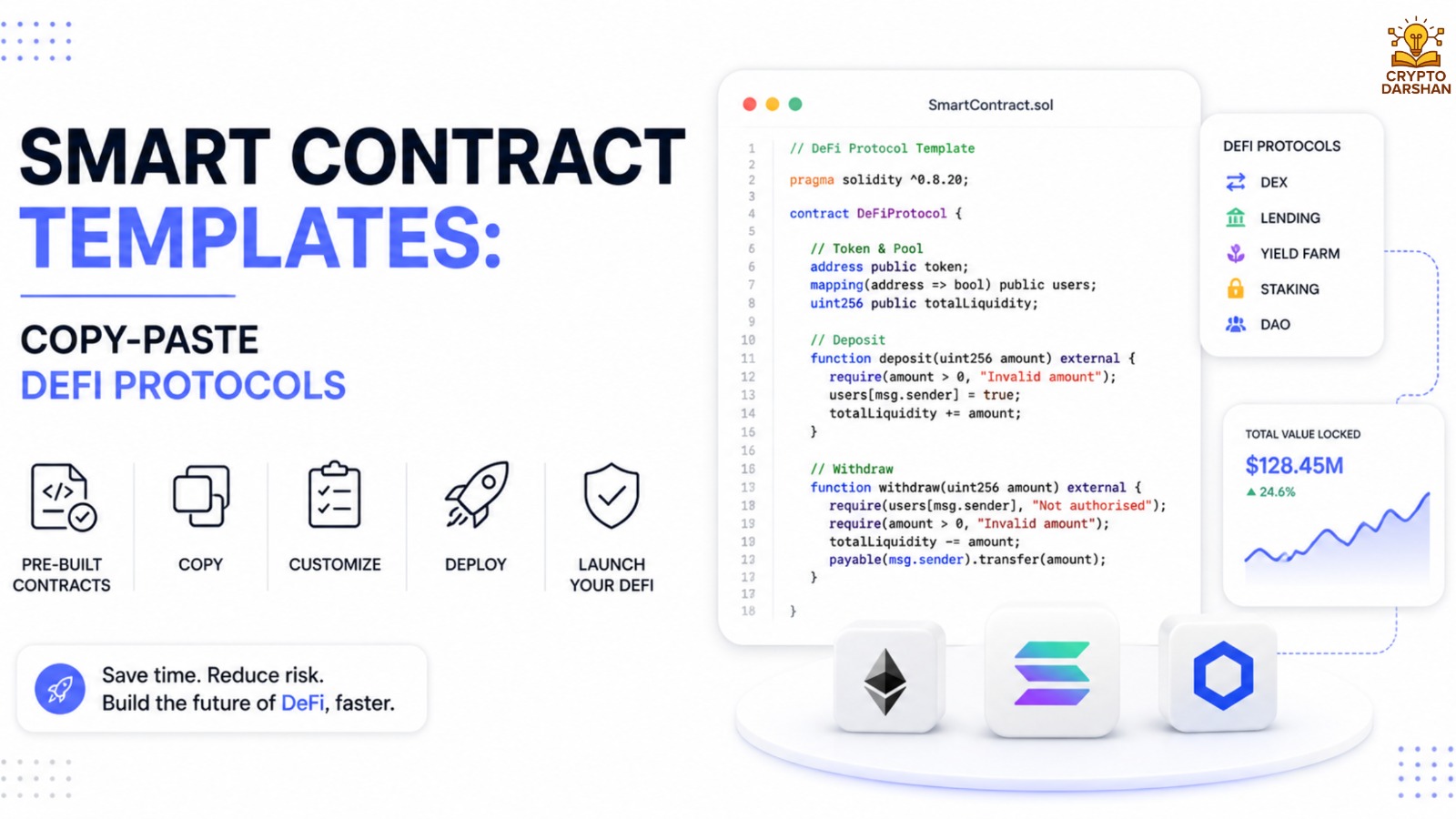
Smart contract templates are predefined scripts that include code structures and logic and can be tailored to specific needs. They serve as blueprints for creating smart contracts, streamlining the development, testing, and deployment of these digital agreements. The core components of smart contract templates include standard protocols, predefined functions, and security measures that ensure robust and reliable execution.
These templates often include standard functions for token creation, staking, liquidity pools, and governance systems. They serve as blueprints for building decentralized applications (dApps) quickly and efficiently.
Why Developers Use Templates
The DeFi space moves fast, and competition is fierce. Developers use smart contract templates to save time, reduce costs, and minimize coding errors. Templates also allow smaller teams to launch projects that would otherwise require large development budgets.
By using proven templates, developers can focus on innovation—such as improving user experience or adding new features—rather than reinventing the wheel. This approach has led to an explosion of new DeFi Protocols, each offering unique variations of existing models.
The Copy-Paste Culture in DeFi

What Is Copy-Paste Culture in DeFi?
Copy-paste culture in DeFi refers to the widespread practice of developers taking existing smart contract code from successful projects and reusing it to create new platforms. Instead of building from scratch, developers copy open-source code, make minor modifications, and launch their own versions. This has become common because most DeFi Protocols make their code publicly available, encouraging transparency but also enabling rapid replication.
To spot trending DeFi sectors, use tools like Cryptocurrency Heatmap: Hottest Sectors Right Now.
Key Points Explaining Copy-Paste Culture

1. Open-Source Foundation Enables Copying
Most successful DeFi Protocols like Uniswap, Aave, and Compound are open-source, meaning their code is freely available on platforms like GitHub. This transparency is a core principle of decentralized finance—it allows anyone to verify how the system works and ensures there are no hidden backdoors. However, this openness also means anyone can copy the entire codebase. Developers can download the code, change a few parameters like token names or fee structures, and deploy it as a new project.
2. Forking: The Technical Term for Copying
In blockchain terminology, “forking” means creating a copy of an existing project’s code to start a new project. There are two types: hard forks (creating a completely separate blockchain) and code forks (copying smart contract code for a new application). In DeFi, code forking is extremely common. For example, SushiSwap forked Uniswap’s code, and PancakeSwap forked it again for Binance Smart Chain.
Cloned projects are often easier to manipulate, learn how in Market Maker Manipulation: Spotting Fakeouts in Crypto.
3. Speed to Market Drives Copy-Paste Behavior
The DeFi space moves incredibly fast, with new trends emerging weekly. Developers who can launch quickly often capture market share before competitors. Copy-paste development allows teams to go from concept to launch in days rather than months. When yield farming became popular, hundreds of farming platforms appeared almost overnight, most using copied code from projects like Yearn Finance.
4. Low Barrier to Entry Creates Market Saturation
Because smart contract templates are readily available, almost anyone with basic blockchain knowledge can launch a DeFi Protocol. This democratization has positive aspects—it allows talented developers without large budgets to compete. However, it also floods the market with similar projects. At the peak of DeFi summer in 2020, dozens of nearly identical decentralized exchanges and yield farms launched daily.
5. The “Vampire Attack” Strategy

Some projects use copy-paste culture aggressively through “vampire attacks”—copying a competitor’s code and offering better incentives to steal their users and liquidity. SushiSwap famously did this to Uniswap by offering SUSHI token rewards to liquidity providers who migrated. While controversial, this strategy proved effective and has been replicated many times.
6. Minimal Innovation in Many Clones
The ease of copying has led to a proliferation of projects that add no real value. Many cloned DeFi Protocols simply change the token name, adjust reward rates, or modify the user interface while keeping the core functionality identical. These “copy-paste” projects often lack long-term vision or sustainability. They’re designed to capitalize on short-term hype, attract liquidity quickly, and sometimes exit through rug pulls (where developers drain funds and abandon the project.
7. Security Risks from Blind Copying
Copying code without fully understanding it creates serious security vulnerabilities. Developers might modify critical functions incorrectly, introduce bugs, or fail to update security patches from the original project. Many hacks in DeFi have occurred because teams copied code but didn’t properly audit their changes. Even small modifications can have unintended consequences. For example, changing how a smart contract calculates interest rates might create an exploit that allows attackers to drain funds.
8. Positive Aspects: Learning and Experimentation
Despite the negatives, copy-paste culture has positive elements. It allows new developers to learn by studying and modifying existing code. Many successful projects started as forks but evolved into something unique. Copy-paste culture also enables rapid experimentation—developers can test new economic models or governance structures by modifying proven templates.
9. Cross-Chain Expansion Through Copying

Copy-paste culture has accelerated DeFi’s expansion across multiple blockchains. When Ethereum gas fees became prohibitively expensive, developers copied successful Ethereum DeFi Protocols and deployed them on cheaper alternatives like Polygon, Avalanche, and Fantom. This cross-chain copying brought DeFi to new users who couldn’t afford Ethereum’s high transaction costs.
10. Community and Ethical Considerations
The DeFi community has mixed feelings about copy-paste culture. Some view it as healthy competition that keeps projects innovative and user-focused. Others see it as lazy development that undermines original creators. Ethical questions arise: Should developers who copy code give credit to the original creators? Should they contribute improvements back to the original project? Some projects embrace being copied and see it as validation of their success.
Popular Smart Contract Templates in DeFi

1. ERC-20 Token Templates
The ERC-20 standard is the foundation for most tokens on the Ethereum blockchain. Developers use ERC-20 templates to create new tokens for DeFi Protocols. These templates define how tokens are transferred, approved, and tracked.
By using ERC-20 templates, developers can easily integrate their tokens into wallets, exchanges, and other DeFi platforms without compatibility issues.
2. Liquidity Pool Templates
Liquidity pools are essential for decentralized exchanges and yield farming platforms. Templates for liquidity pools include functions for adding, removing, and swapping tokens.
Projects like Uniswap and SushiSwap have inspired countless clones that use similar templates to create automated market makers (AMMs). These templates make it easy to launch new DeFi Protocols that facilitate token trading without centralized intermediaries.
3. Lending and Borrowing Templates
Lending templates allow users to deposit assets and earn interest or borrow against their holdings. Platforms like Compound and Aave have open-sourced their code, enabling developers to create similar DeFi Protocols.
These templates handle complex calculations for interest rates, collateral ratios, and liquidation processes, making them valuable for developers building financial applications.
4. Staking and Yield Farming Templates
Staking templates let users lock tokens to earn rewards, while yield farming templates automate reward distribution across liquidity pools. These templates are widely used in DeFi Protocols that incentivize user participation.
By adjusting reward rates or token types, developers can create unique staking systems while relying on proven code structures.
5. Governance Templates
Governance templates enable decentralized decision-making within DeFi Protocols. They allow token holders to vote on proposals, protocol upgrades, and fee structures.
Using governance templates ensures transparency and fairness, as all decisions are recorded on the blockchain. Projects like MakerDAO and Compound have set the standard for decentralized governance systems.
Advantages of Using Smart Contract Templates

1. Faster Development
Smart contract templates drastically reduce development time. Instead of writing code from scratch, developers can deploy ready-made templates and customize them. This speed allows new DeFi Protocols to enter the market quickly and respond to emerging trends.
2. Lower Costs
Developing blockchain applications can be expensive. Templates cut costs by eliminating the need for large development teams. Startups and independent developers can launch DeFi Protocols with minimal resources, democratizing access to decentralized finance.
3. Reduced Errors
Templates are often tested and audited, reducing the risk of bugs or vulnerabilities. By using reliable templates, developers can build more secure DeFi Protocols and avoid costly mistakes that could lead to hacks or losses.
4. Interoperability
Standardized templates ensure compatibility across different platforms. For example, ERC-20 tokens created from templates can easily interact with wallets, exchanges, and other DeFi Protocols, promoting a more connected ecosystem.
5. Encourages Innovation
By handling the technical foundation, templates free developers to focus on innovation. They can experiment with new tokenomics, user interfaces, or governance models while relying on proven smart contract structures.
Risks and Challenges of Smart Contract Templates

1. Security Vulnerabilities
Copying code without understanding it can introduce serious security flaws. Even small changes to a template can create vulnerabilities that hackers exploit. Many DeFi Protocols have suffered losses due to poorly implemented templates or untested modifications.
2. Lack of Originality
The ease of using templates has led to a flood of cloned projects. Many DeFi Protocols offer identical features with minor cosmetic changes. This lack of originality can make it difficult for new projects to stand out or attract long-term users.
3. Regulatory Concerns
As DeFi Protocols grow, regulators are paying closer attention. Projects that copy existing templates without proper compliance measures may face legal challenges. Developers must ensure their platforms follow local and international financial regulations.
4. Dependence on Open-Source Code
While open-source code promotes collaboration, it also means that vulnerabilities are visible to everyone. Hackers can study templates to find weaknesses. Developers must regularly audit and update their DeFi Protocols to stay secure.
5. User Trust Issues
With so many cloned projects, users may struggle to trust new DeFi Protocols. Scams and rug pulls have damaged the reputation of the DeFi space. Building transparency and community engagement is essential to regain user confidence.
Case Studies: Copy-Paste DeFi Protocols in Action

1. SushiSwap vs. Uniswap
SushiSwap began as a direct fork of Uniswap’s code. By adding token incentives for liquidity providers, it quickly gained popularity. This example shows how copy-paste development can lead to innovation when combined with new ideas. Both platforms now coexist as major DeFi Protocols.
2. PancakeSwap on Binance Smart Chain
PancakeSwap is another Uniswap clone, built on Binance Smart Chain instead of Ethereum. It offered lower fees and faster transactions, attracting millions of users. This demonstrates how adapting existing templates to new blockchains can create successful DeFi Protocols.
3. Compound Forks
Several lending platforms have forked Compound’s open-source code to create their own DeFi Protocols. While some added unique features, others simply replicated the original. This highlights both the potential and pitfalls of using smart contract templates.
The Role of Audits and Security in Template-Based DeFi

Importance of Smart Contract Audits
Audits are essential for ensuring the safety of DeFi Protocols built from templates. Independent security firms review the code to identify vulnerabilities before deployment. Regular audits help maintain user trust and prevent costly exploits.
Common Security Practices
Developers should follow best practices such as:
- Conducting multiple audits before launch
- Using bug bounty programs to reward ethical hackers
- Implementing time locks for major transactions
- Keeping transparency with open-source updates
By prioritizing security, developers can build safer DeFi Protocols even when using pre-existing templates.
The Future of Smart Contract Templates in DeFi

1. Standardization and Best Practices
As the DeFi industry matures, standardized templates will become more common. These templates will include built-in security features and compliance tools, making it easier to launch safe and reliable DeFi Protocols.
2. Cross-Chain Compatibility
Future templates will support multiple blockchains, allowing DeFi Protocols to operate seamlessly across networks like Ethereum, Polygon, and Solana. This interoperability will expand user access and liquidity.
3. AI-Assisted Development
Artificial intelligence could help developers customize templates more efficiently. AI tools might analyze market trends and suggest optimal configurations for new DeFi Protocols, reducing human error and improving performance.
4. Enhanced Security Frameworks
Next-generation templates will include automated security checks and real-time monitoring. These features will help detect suspicious activity and protect users from hacks or exploits.
5. Greater Regulatory Integration
As governments develop clearer rules for decentralized finance, templates may include built-in compliance modules. This will help DeFi Protocols meet legal requirements without sacrificing decentralization.
How to Build a DeFi Protocol Using Smart Contract Templates

Step 1: Choose a Blockchain Platform
Select a blockchain that supports smart contracts, such as Ethereum, Binance Smart Chain, or Polygon. Each platform offers different transaction speeds, fees, and developer tools.
Step 2: Select a Template
Choose a smart contract template that fits your project’s goals—whether it’s a DEX, lending platform, or staking system. Many open-source templates are available on GitHub and blockchain developer communities.
Step 3: Customize the Code
Modify parameters like token names, interest rates, or reward structures. Ensure that changes align with your project’s vision and user needs. Avoid altering core logic unless you fully understand the code.
Step 4: Test Thoroughly
Before launching, test your smart contracts on a blockchain testnet. This helps identify bugs and ensures your DeFi Protocol functions as intended.
Step 5: Conduct Security Audits
Hire professional auditors to review your code. Security audits are crucial for protecting user funds and building trust in your DeFi Protocol.
Step 6: Launch and Promote
Once tested and audited, deploy your DeFi Protocol on the mainnet. Build a community through social media, partnerships, and transparent communication.
The Ethical Side of Copy-Paste DeFi Development

Open Source vs. Plagiarism
While open-source code encourages collaboration, copying without credit crosses ethical lines. Developers should acknowledge original creators and contribute improvements back to the community.
Building Value Beyond Code
Successful DeFi Protocols offer more than just copied code—they provide better user experiences, stronger communities, and innovative features. Ethical developers focus on long-term value rather than quick profits.
Encouraging Responsible Innovation
The DeFi community thrives when developers share knowledge responsibly. By improving existing templates and maintaining transparency, the ecosystem can grow sustainably and securely.
FAQ: Smart Contract Templates & Copy-Paste DeFi Protocols

1. What are smart contract templates?
Smart contract templates are pre-written pieces of blockchain code that developers can reuse to build decentralized applications (dApps) quickly without starting from scratch.
2. Are copy-paste DeFi protocols safe to use?
Not always. While templates speed up development, blindly copying code without understanding it can introduce security risks, bugs, or vulnerabilities.
3. Why do developers use smart contract templates?
Templates save time, reduce development costs, and provide tested structures for common use cases like token creation, staking, and lending protocols.
4. What are the risks of using copy-paste contracts?
Major risks include hidden backdoors, outdated code, security flaws, and incompatibility with newer blockchain standards.
5. Can beginners use smart contract templates?
Yes, but with caution. Beginners should study the code, test thoroughly, and ideally get audits before deploying any contract to a live network.
6. What is a smart contract audit?
A smart contract audit is a security review conducted by experts to identify vulnerabilities, bugs, and potential exploits in the code before deployment.
7. Which platforms provide reliable smart contract templates?
Popular sources include OpenZeppelin, GitHub repositories, and blockchain development frameworks like Hardhat and Truffle.
Conclusion
Smart contract templates have revolutionized how DeFi Protocols are built. They make development faster, cheaper, and more accessible, allowing anyone to participate in the decentralized finance revolution. However, the ease of copying code also brings challenges—security risks, lack of originality, and ethical concerns.
The future of DeFi Protocols depends on balancing innovation with responsibility. As templates evolve with better security, cross-chain compatibility, and regulatory compliance, they will continue to shape the next generation of decentralized finance.
In the end, smart contract templates are powerful tools. When used wisely, they can accelerate progress and expand financial freedom worldwide. But when misused, they can undermine trust and stability. The key lies in using these tools to build safer, smarter, and more transparent DeFi Protocols for everyone.