
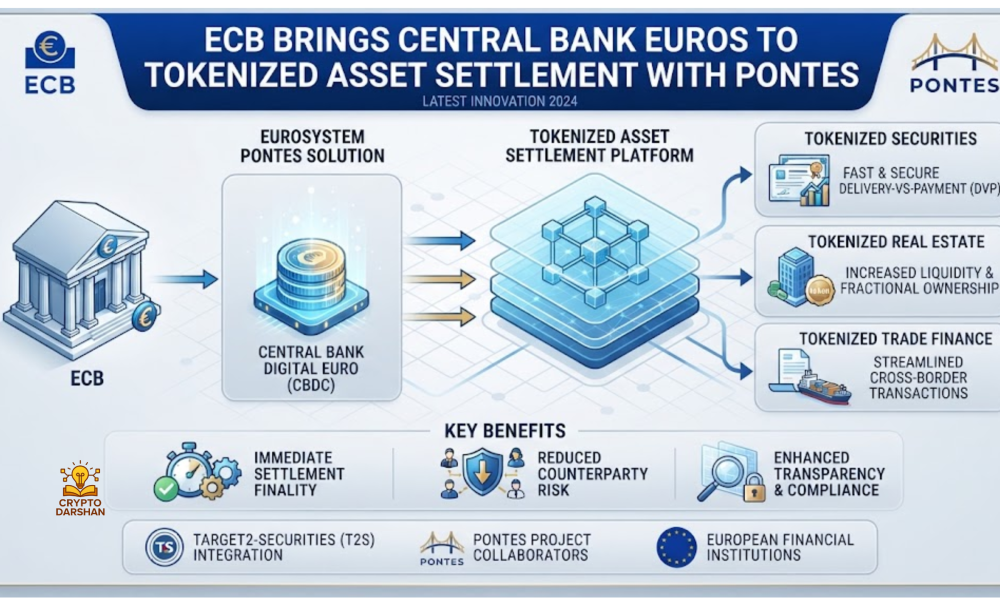
The European Central Bank has launched Pontes, a new settlement service designed to support blockchain-based financial transactions using central bank money. The platform connects distributed ledger technology networks used by financial institutions with the Eurosystem’s existing TARGET Services.
The launch marks an important step in Europe’s plan to integrate blockchain technology into traditional financial markets. Rather than relying only on commercial bank deposits or privately issued stablecoins, participating institutions can use central bank euros for the cash side of tokenized asset transactions.
What Is Pontes?

Pontes is an infrastructure service developed by the ECB for wholesale financial markets. It allows transactions recorded on distributed ledger technology platforms to settle against funds held in the Eurosystem’s payment infrastructure.
In simple terms, the platform helps connect blockchain-based securities markets with the central bank’s established settlement systems. This means financial institutions can use blockchain to issue, trade or transfer assets while maintaining access to central bank money.
The service is not designed for everyday consumer payments. Instead, it focuses on wholesale transactions involving banks, securities firms, clearing organizations and other regulated financial institutions.
Deutsche Bank, Santander and securities clearing group Clearstream are among the first institutions to complete onboarding for Pontes.
At launch, the platform will operate from 8 a.m. to 4 p.m. Central European Time on business days. The ECB plans to expand its operating hours and introduce additional features as the system develops.
Why Central Bank Money Matters
Tokenized securities can be settled using several forms of digital money. These may include commercial bank deposits, stablecoins or other privately issued payment instruments. However, each option can carry different levels of credit, liquidity and price risk.
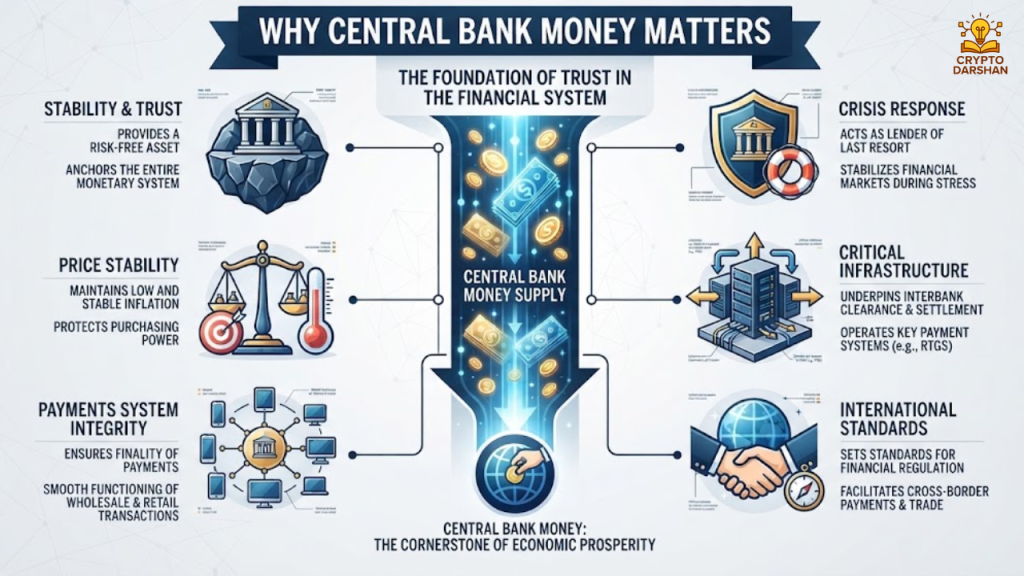
Central bank money is generally viewed as the safest form of settlement asset in the financial system because it represents a direct claim on the central bank. By bringing central bank euros into blockchain-based markets, Pontes could reduce risks linked to the cash leg of a transaction.
This is particularly important when institutions trade tokenized bonds, funds or other regulated financial assets. If the asset is recorded on a blockchain but the payment is completed through a private digital instrument, the transaction may still depend on the stability and reliability of that issuer.
Pontes is intended to provide a stronger settlement anchor. It allows the securities side of a transaction to use distributed ledger technology while the payment side remains connected to Eurosystem infrastructure.
How the Settlement System Works
Pontes does not require every financial institution to use the same blockchain network. Instead, it is designed to connect different market-facing DLT platforms with the Eurosystem’s TARGET infrastructure.
This approach could help institutions continue using their own blockchain systems while gaining access to central bank settlement. It also avoids forcing the entire European financial market onto one network during the early stages of tokenization.
Initially, legal settlement finality for the cash side will remain linked to TARGET2, the Eurosystem’s real-time gross settlement system. Future versions of Pontes are expected to move settlement finality onto a Eurosystem-operated distributed ledger platform.
The ECB also plans to add smart contract functionality over time. Smart contracts could automate specific conditions in a transaction, such as the simultaneous delivery of a tokenized bond and the corresponding payment.
This type of process is often described as atomic settlement. It aims to ensure that both sides of a trade complete together, reducing the chance that one party transfers an asset without receiving payment.
ECB Plans Tokenized Bond Investments
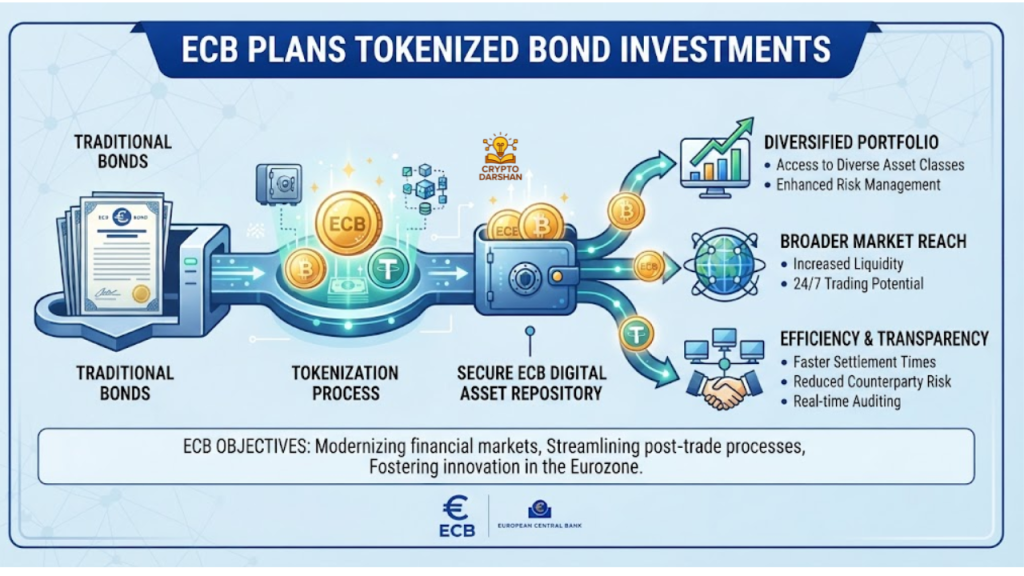
The ECB is also preparing to participate in the tokenized securities market as an investor.
The central bank plans to allocate a small portion of its €23 billion own funds portfolio to blockchain-based securities. The initial investments are expected to focus on highly rated, euro-denominated debt issued by public institutions.
The ECB has not disclosed the exact size of the planned allocation. However, it described the investment as a tiny portion of the overall portfolio.
The move would give the central bank direct experience with the issuance, trading and settlement of digital securities. It may also help the ECB assess the practical benefits and limitations of using DLT-based infrastructure in institutional markets.
The planned investments follow changes to the Eurosystem’s collateral framework. Under those changes, certain marketable securities issued through DLT services operated by central securities depositories can qualify as collateral for Eurosystem credit operations.
These assets must still meet existing eligibility requirements. They may also be subject to applicable valuation haircuts, just like traditional marketable securities.
Pontes Supports Europe’s Tokenization Strategy
The launch forms part of a wider European effort to develop a regulated digital financial market. The ECB is working on Pontes alongside Appia, a longer-term program focused on creating a more integrated European tokenized financial system.
The central bank selected 61 financial market participants and public institutions for an Appia contact group. These organizations will provide input on the development of Pontes and the future structure of tokenized markets.
The ECB believes DLT could make some financial processes faster and more efficient. Blockchain-based systems may combine the issuance, trading and settlement stages of an asset within a more connected digital environment.
Tokenization could also support programmable financial products. For example, a bond could automatically distribute payments when predefined conditions are met. Other potential applications include automated collateral management, delivery-versus-payment transactions and more efficient corporate actions.
However, the ECB has acknowledged that Europe’s traditional settlement systems already provide many safeguards and functions. The challenge is to introduce blockchain technology without weakening financial stability, legal certainty or operational resilience.
Central Banks Continue Testing Blockchain Settlement
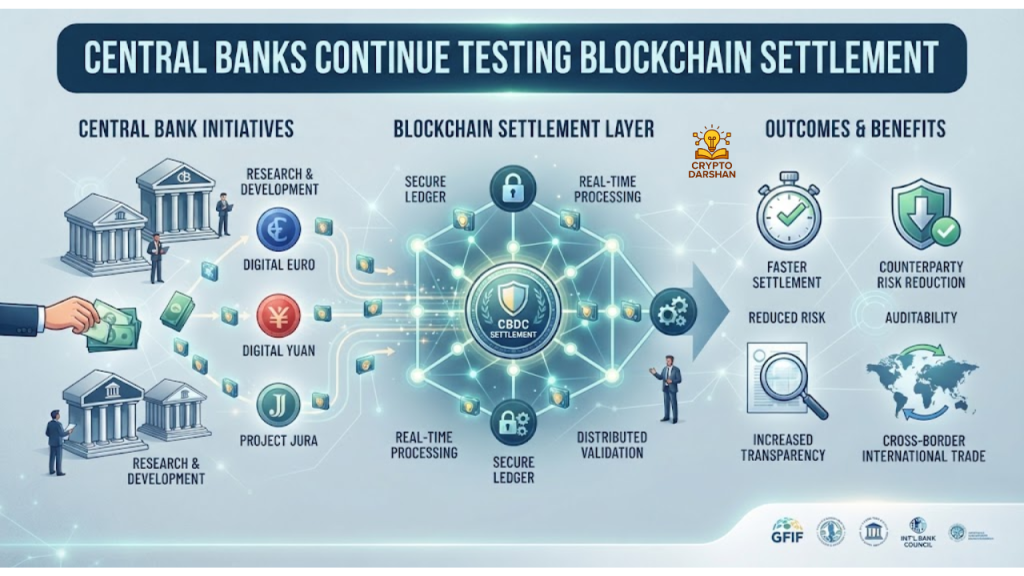
The ECB is not alone in exploring blockchain-based financial infrastructure.
Switzerland has used Project Helvetia to study the settlement of tokenized securities with wholesale central bank digital currency. The Bank of England is testing DLT-based trading and settlement through its Digital Securities Sandbox.
Commercial financial institutions are also developing blockchain settlement networks. Several European firms are testing tokenized government bonds, structured products and other securities across public and private blockchain systems.
These projects suggest that tokenization is moving beyond experimental demonstrations. Banks and market infrastructures are increasingly examining whether blockchain can support real financial activity at scale.
The success of these systems will depend on more than transaction speed. Institutions will also need clear legal rules, strong cybersecurity, compatible networks and reliable access to central bank liquidity.
Pontes Is Separate From the Digital Euro
Pontes should not be confused with the ECB’s planned digital euro. Pontes is aimed at wholesale financial transactions between institutions, while the digital euro is intended for consumers and everyday payments.
The ECB is preparing a 12-month digital euro pilot for the second half of 2027. The pilot may involve merchants, banks, payment providers and national central banks across the euro area.
Possible tests could cover online purchases, mobile payments, in-store transactions and person-to-person transfers. The ECB is targeting readiness for a potential digital euro launch in 2029, although this will depend on European Union legislation and a later decision by the ECB’s Governing Council.
Together, Pontes and the digital euro represent two separate parts of Europe’s digital money strategy. Pontes focuses on wholesale markets and tokenized securities, while the digital euro targets retail payments.
A New Settlement Layer for European Finance
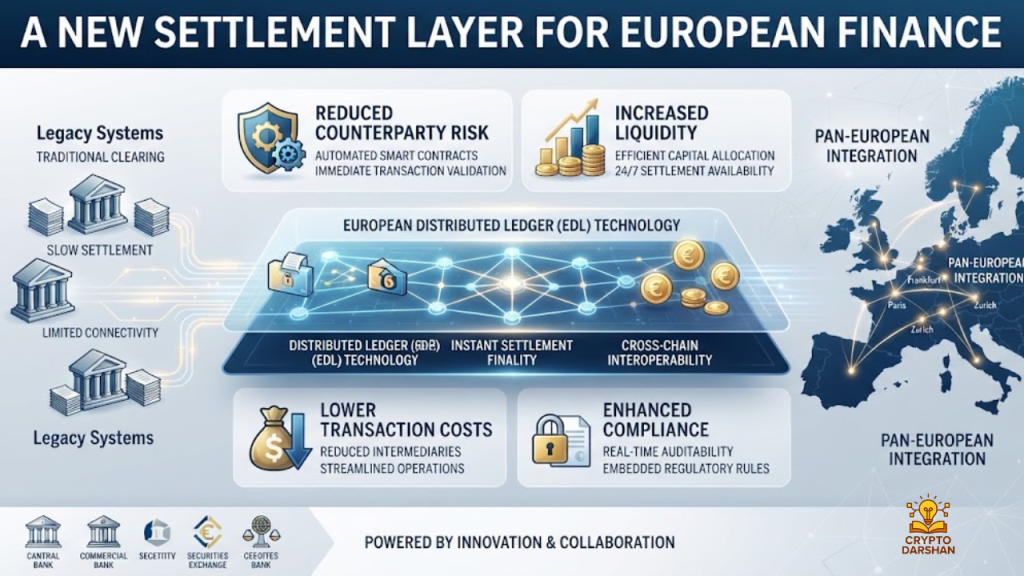
The launch of Pontes gives financial institutions a way to connect blockchain-based markets with central bank euros. It also signals that the ECB wants public financial infrastructure to remain relevant as tokenization expands.
The platform is still in its early phase, with limited operating hours and a small group of initial participants. Future upgrades could introduce longer availability, wider market access, smart contracts and settlement finality on a Eurosystem-operated DLT network.
If those plans succeed, Pontes could become an important bridge between traditional European finance and blockchain-based markets. Its development may help determine whether tokenized securities become a niche experiment or a standard part of the financial system.