
Decentralized Finance, commonly known as DeFi, is one of the most transformative innovations in the blockchain and cryptocurrency ecosystem. It represents a shift from traditional, centralized financial systems to peer-to-peer finance enabled by decentralized technologies built on blockchain networks. DeFi eliminates intermediaries like banks, brokers, and payment processors, allowing users to access financial services directly through smart contracts.
This guide explores everything about DeFi, its meaning, how it works, its benefits, risks, and the future of decentralized finance. Whether a beginner or an experienced crypto enthusiast, this comprehensive guide provides a clear understanding of how DeFi is reshaping the global financial landscape.
What is Decentralized Finance(DeFi)?

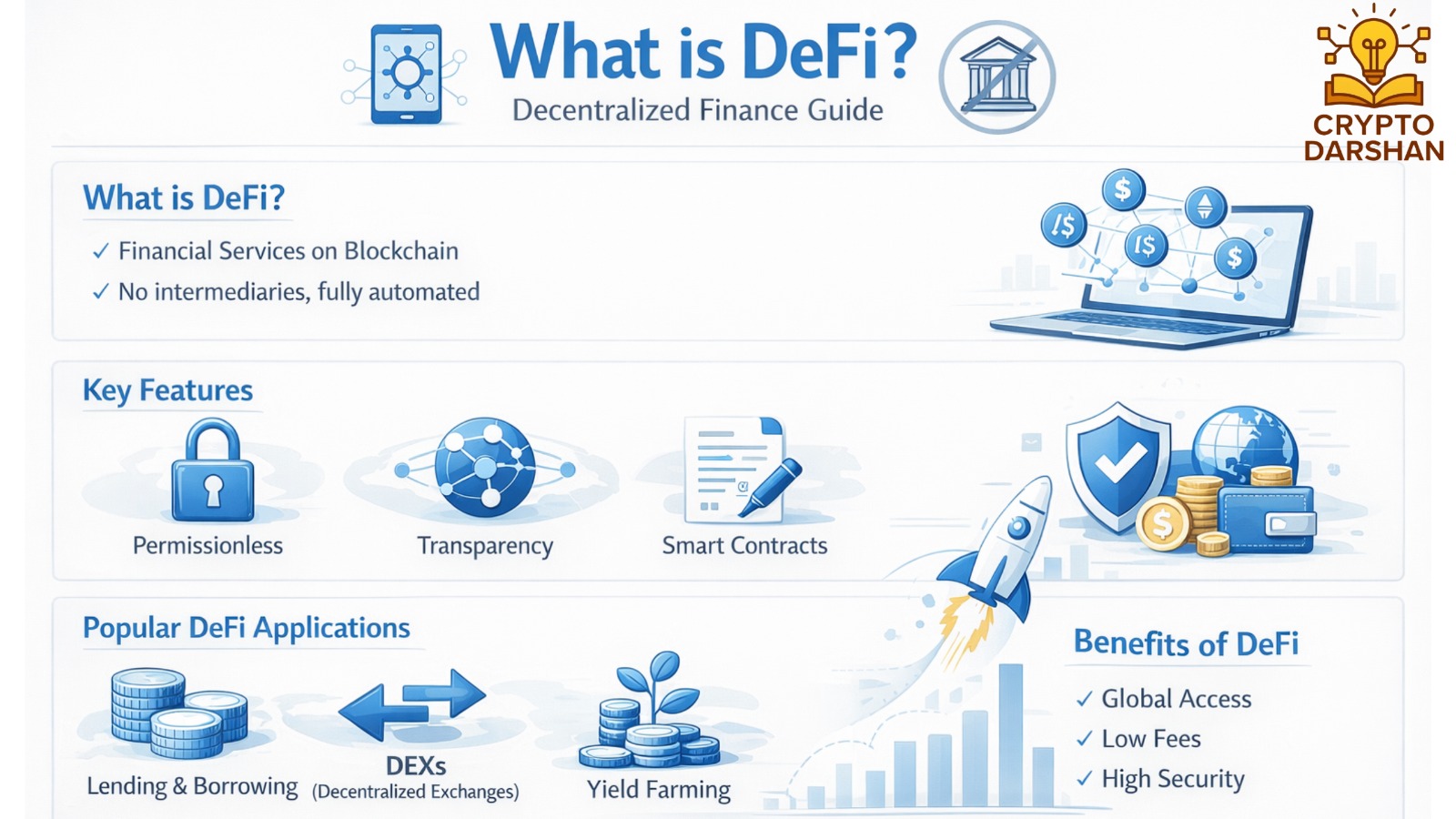
DeFi (Decentralized Finance) refers to a collection of financial applications built on blockchain technology that operate without centralized authorities. Instead of relying on traditional financial institutions, DeFi uses smart contracts, self-executing programs that run on blockchains like Ethereum to automate transactions and enforce agreements.
In simple terms, DeFi allows anyone with an internet connection to borrow, lend, trade, save, or invest without needing a bank account or credit history. It’s open, permissionless, and transparent, giving users full control over their assets.
DeFi did not emerge overnight; it evolved from Bitcoin’s peer-to-peer model, as explained in our detailed guide on From Bitcoin to DeFi: A Deeper Look into the Crypto Ecosystem.
Understanding DeFi: From Evolution to Getting Started

The Evolution of DeFi
DeFi, short for Decentralized Finance, didn’t appear overnight. It’s the result of years of innovation in blockchain technology.
- 2009 – Bitcoin’s Beginning: Bitcoin introduced the idea of digital money that doesn’t need banks. It showed that people could send and receive value directly
- 2015 – Ethereum Launch: Ethereum took things further by allowing developers to build applications on its blockchain using smart contracts programs that automatically execute transactions when certain conditions are met.
- 2017 – Early DeFi Projects: Platforms like MakerDAO started offering decentralized lending and borrowing, marking the start of real DeFi use cases.
- 2020 – DeFi Boom: The “DeFi Summer” saw massive growth in decentralized exchanges, lending platforms, and yield farming. Billions of dollars flowed into DeFi protocols.
- Today – Multi-Chain DeFi: DeFi is no longer limited to Ethereum. Many blockchains now support DeFi apps, making the ecosystem faster, cheaper, and more accessible.
In short, DeFi evolved from simple digital money (Bitcoin) to a full financial system built on blockchain technology.
How Decentralized Finance Works.

DeFi works through smart contracts, pieces of code that run on blockchains like Ethereum. These contracts replace banks and brokers by automatically handling transactions.
Here’s how it works in simple terms:
- Smart Contracts: These are like digital agreements that execute themselves. For example, if you lend crypto to someone, a smart contract ensures you get your money back with interest.
- Decentralized Applications (dApps): These are apps built on blockchains that let you interact with DeFi services like trading, lending, or staking directly from your wallet.
- Tokens: DeFi uses cryptocurrencies and tokens to represent assets. Some are stable (like USDC or DAI), while others are governance tokens that give users voting rights.
- Wallets: You use a crypto wallet (like MetaMask or Trust Wallet) to connect to DeFi platforms. Your wallet acts as your bank account but you’re in full control.
Example:
If you want to earn interest on your crypto, you can deposit it into a DeFi lending platform like Aave. The smart contract automatically lends your funds to borrowers and pays you interest no bank needed.
Core Features of Decentralized Finance(DeFi)

- Decentralization: No central authority controls the system. Governance is distributed among token holders.
- Transparency: All transactions are recorded on public blockchains, ensuring full visibility.
- Accessibility: Anyone with an internet connection can participate, regardless of location or financial background.
- Interoperability: DeFi protocols can integrate and interact with each other, creating a composable financial ecosystem.
- Programmability: Smart contracts enable the creation of complex financial instruments and automated systems.
- Non-Custodial: Users retain full control over their funds at all times.
Popular DeFi Applications

DeFi encompasses a wide range of financial services. Below are the most common categories:
1. Decentralized Exchanges (DEXs)
DEXs allow users to trade cryptocurrencies directly without intermediaries. Examples include Uniswap, SushiSwap, and PancakeSwap. These platforms use automated market makers (AMMs) to facilitate trading through liquidity pools.
2. Lending and Borrowing Platforms
Platforms like Aave, Compound, and MakerDAO enable users to lend their crypto assets and earn interest or borrow funds by providing collateral. Smart contracts manage the entire process, ensuring transparency and security.
3. Stablecoins
Stablecoins are cryptocurrencies pegged to stable assets like the US dollar. They reduce volatility and are widely used in DeFi. Examples include DAI, USDC, and USDT.
4. Yield Farming and Liquidity Mining
Yield farming, also known as liquidity mining, is a process where cryptocurrency holders lend or stake their assets in DeFi protocols to earn returns. This practice allows individuals to generate passive income from their digital assets while contributing to the liquidity of DeFi platforms.
5. Staking
Staking allows users to lock their tokens in a network to support operations like transaction validation and earn rewards. It’s a key feature in Proof-of-Stake (PoS) blockchains.
6. Derivatives and Synthetic Assets

A synthetic asset is a financial security that is designed to mimic the performance of another security while altering key characteristics of that underlying security, like duration and cash flow. DeFi platforms like Synthetix and dYdX offer synthetic assets that mimic the value of real-world assets such as stocks, commodities, or fiat currencies.
7. Insurance Protocols
DeFi insurance platforms like Nexus Mutual and Cover Protocol protect users against smart contract failures, hacks, or other risks.
8. Asset Management
DeFi asset management tools like Yearn Finance automate investment strategies to maximize returns across multiple protocols.
Benefits of Decentralized Finance(DeFi)

- Financial Inclusion: DeFi opens access to financial services for unbanked populations worldwide.
- Transparency: Every transaction is recorded on a public ledger, ensuring accountability.
- Lower Costs: By removing intermediaries, DeFi reduces transaction fees and operational costs.
- Global Access: DeFi operates 24/7 across borders, enabling seamless global transactions.
- Ownership and Control: Users maintain full control over their assets without relying on third parties.
- Innovation: DeFi fosters rapid innovation through open-source development and composability.
Risks and Challenges of DeFi.
While Decentralized Finance (DeFi) offers freedom, transparency, and innovation, it also comes with several risks and challenges that users should understand before participating.
1. Smart Contract Vulnerabilities
DeFi platforms rely on smart contracts pieces of code that execute automatically. If there’s a bug or flaw in the code, hackers can exploit it and steal funds. Even audited projects have faced losses due to coding errors or overlooked vulnerabilities.
2. Regulatory Uncertainty
DeFi operates without centralized control, which makes it difficult for governments to regulate. Many countries are still developing legal frameworks for DeFi, creating uncertainty for users and developers. Future regulations could impact how DeFi platforms operate or restrict access in some regions.
3. Market Volatility
Cryptocurrencies are highly volatile. Sudden price drops can cause collateralized loans to be liquidated or reduce the value of assets locked in DeFi protocols. This volatility makes DeFi investments risky, especially for beginners.
4. Liquidity Risks
DeFi platforms depend on liquidity provided by users. If many users withdraw their funds at once, it can cause liquidity shortages, making it difficult for others to trade or withdraw assets.
5. Scams and Rug Pulls
Because DeFi is open and permissionless, anyone can create a project. Some developers launch fake projects, attract investors, and then disappear with the funds a scam known as a “rug pull.” Users must research projects carefully before investing.
6. Complexity and User Errors
DeFi platforms can be complicated for new users. Mistakes like sending funds to the wrong address, using the wrong network, or interacting with fake websites can lead to permanent loss of funds.
7. Oracle Risks

Many DeFi protocols rely on oracles services that provide real-world data (like asset prices) to smart contracts. If an oracle provides incorrect or manipulated data, it can trigger false transactions or liquidations.
8. Network Congestion and High Fees
When blockchain networks like Ethereum become congested, transaction fees (gas fees) can rise sharply. This makes small transactions expensive and can delay important operations like loan repayments or trades.
9. Lack of Consumer Protection
Unlike traditional finance, DeFi has no customer support or insurance for lost funds. If you lose access to your wallet or fall victim to a hack, there’s usually no way to recover your assets.
10. Interoperability Risks
As DeFi expands across multiple blockchains, cross-chain bridges are used to move assets between networks. These bridges can be vulnerable to hacks, as seen in several high-profile attacks.
Decentralized Finance vs Traditional Finance

Traditional Finance (TradFi)
Traditional finance is the financial system most people already use. It includes banks, insurance companies, stock exchanges, payment services, and government-regulated institutions.
In this system, financial institutions act as intermediaries. For example, when you send money, take a loan, or invest, a bank or broker processes and approves the transaction. These institutions control user funds, set rules, and charge fees for their services.
Traditional finance relies heavily on trust; users must trust banks to keep their money safe, governments to regulate fairly, and third parties to protect personal data. While this system offers stability and legal protection, it can be slow, expensive, and restrictive, especially for international transactions or people without access to banking services.
Decentralized Finance (DeFi)
DeFi is a blockchain-based financial system that removes intermediaries like banks and brokers. Instead, it uses smart contracts, self-executing programs on blockchains such as Ethereum or Solana, to automate financial services.
In DeFi, users have full control over their assets through crypto wallets. You don’t need permission from a bank to lend, borrow, trade, or earn interest. Anyone with an internet connection and a wallet can participate, making DeFi globally accessible and inclusive.
Trust in DeFi is placed in code and blockchain transparency, not institutions. All transactions are publicly verifiable, and rules are enforced automatically. This often results in faster transactions and lower fees, especially across borders.
The Role of Ethereum in DeFi
Ethereum is the foundation of DeFi. It’s the first blockchain that allowed developers to build smart contracts and decentralized applications.
Here’s why Ethereum is so important:
- Smart Contract Platform: Ethereum made it possible to create programmable money and financial applications.
- ERC-20 Tokens: Most DeFi tokens follow this standard, making them compatible across different platforms.
- Large Developer Community: Thousands of developers build and improve DeFi apps on Ethereum.
- Security and Trust: Ethereum’s network is one of the most secure and widely used in the world.
However, Ethereum has faced challenges like high gas fees and slow transaction speeds. This led to the rise of Layer 2 solutions (like Polygon and Arbitrum) and other blockchains that offer faster and cheaper transactions.
The Rise of Multi-Chain DeFi

DeFi started on Ethereum, but now it’s expanding across multiple blockchains this is called multi-chain DeFi.
Different blockchains bring unique advantages:
- Binance Smart Chain (BSC): Low fees and fast transactions.
- Polygon: A Layer 2 solution that makes Ethereum faster and cheaper.
- Solana: Known for high speed and low costs.
- Avalanche: Focuses on scalability and interoperability.
- Arbitrum and Optimism: Layer 2 networks that reduce Ethereum’s congestion.
Multi-chain DeFi allows users to move assets between blockchains easily. This improves liquidity, reduces costs, and gives users more choices.
For example, you can trade tokens on Ethereum, stake them on Polygon, and borrow against them on Avalanche all within the DeFi ecosystem.
Governance in DeFi

DeFi projects often use Decentralized Autonomous Organizations (DAOs) for governance. Token holders can propose and vote on protocol changes, ensuring community-driven decision-making. Examples include MakerDAO and Compound Governance.
This decentralized governance model promotes transparency and aligns incentives between developers and users.
How to Get Started with Decentralized Finance

Getting started with DeFi is easier than it sounds. You don’t need a bank account or approval just a crypto wallet and internet access.
Step 1: Set Up a Wallet
Download a non-custodial wallet like MetaMask, Trust Wallet, or Coinbase Wallet. This wallet will store your crypto and connect you to DeFi apps.
Step 2: Buy Cryptocurrency
Purchase some crypto (like ETH) from a trusted exchange. You’ll need it to pay for transactions and interact with DeFi platforms.
Step 3: Connect to a DeFi Platform
Visit a DeFi app such as Uniswap, Aave, or Compound, and connect your wallet. You’ll see your balance and can start using DeFi services.
Step 4: Explore DeFi Services
- Lending: Earn interest by lending your crypto.
- Borrowing: Use your crypto as collateral to borrow other assets.
- Trading: Swap tokens on decentralized exchanges.
- Staking: Lock your tokens to earn rewards.
- Yield Farming: Provide liquidity to earn extra tokens.
Step 5: Stay Safe
- Double-check website URLs to avoid scams.
- Never share your wallet’s private key or seed phrase.
- Start small and learn before investing large amounts.
Security Tips for DeFi Users
- Always verify smart contract addresses.
- Avoid clicking on suspicious links or fake websites.
- Use hardware wallets for large holdings.
- Diversify investments across multiple platforms.
- Stay updated on audits and community reviews.
The Future of DeFi
The future of DeFi looks promising, with continuous innovation and adoption. Key trends shaping its future include:
- Integration with Traditional Finance: Banks and institutions are exploring DeFi partnerships and blockchain-based services.
- Regulatory Clarity: Governments are developing frameworks to ensure consumer protection while fostering innovation.
- Cross-Chain Interoperability: Seamless asset transfers across blockchains will enhance liquidity and usability.
- DeFi 2.0: The next generation of DeFi protocols focuses on sustainability, improved tokenomics, and better user experience.
- Institutional Adoption: Hedge funds and asset managers are entering DeFi for yield opportunities.
- Real-World Asset Tokenization: DeFi will increasingly integrate real-world assets like real estate, bonds, and commodities.
DeFi is a core pillar of Web3, enabling trustless financial services, which we explore further in Web3 Explained: Future of the Decentralized Internet.
Conclusion
Decentralized Finance(DeFi) is revolutionizing the financial world by creating an open, transparent, and permissionless ecosystem. It empowers individuals to take control of their finances, eliminating the need for intermediaries and enabling global access to financial services. While challenges like regulation and security remain, the potential of DeFi to reshape the global economy is undeniable.
As blockchain technology evolves, Decentralized Finance will continue to expand, offering innovative solutions that redefine how money, assets, and value move across the world. The future of finance is decentralized, and DeFi is leading the way.