Bitcoin, the world’s first and most popular cryptocurrency. Since its creation in 2009, Bitcoin has evolved from a niche digital currency into a global financial asset. In 2026, buying Bitcoin is easier than ever, but safety remains the top priority.
This comprehensive guide explains how to buy Bitcoin safely and easily, step by step. It covers everything from understanding Bitcoin and choosing the right exchange to storing it securely and avoiding scams. Whether new to crypto or looking to refresh knowledge, this guide provides all the essential information to start investing in Bitcoin confidently.
What Is Bitcoin?

Bitcoin is a decentralized digital currency that uses blockchain technology to enable peer-to-peer transactions without the need for a central authority like a bank or government. Bitcoin allows peer-to-peer transactions, meaning users can send and receive money directly without intermediaries. It’s often referred to as “digital gold” because of its limited supply; only 21 million Bitcoins will ever exist.
Key Features of Bitcoin
- Decentralized: No single entity controls Bitcoin.
- Limited Supply: Only 21 million coins will ever be mined.
- Transparent: All transactions are recorded on a public blockchain.
- Secure: Protected by cryptography and a global network of miners.
- Global: Can be sent anywhere in the world within minutes.
Why Buy Bitcoin in 2026?

Bitcoin has matured significantly since its early days. It’s now recognized as a legitimate asset class by investors, institutions, and even governments.
Bitcoin’s price changes frequently due to market demand, adoption, and news events, which are explained in detail in What Drives Cryptocurrency Prices? A Guide for Intermediate Crypto Users.
Here are some reasons why buying Bitcoin in 2026 makes sense:
- Store of Value: Bitcoin is often compared to gold because it holds value over time and is resistant to inflation.
- Portfolio Diversification: Adding Bitcoin to an investment portfolio can reduce risk and increase potential returns.
- Growing Adoption: More businesses, payment platforms, and countries are accepting Bitcoin.
- Limited Supply: The scarcity of Bitcoin increases its long-term value potential.
- Technological Advancements: Upgrades like the Lightning Network make Bitcoin faster and cheaper to use.
How Bitcoin Works

Bitcoin is a digital currency that operates on a decentralized network called blockchain. Unlike traditional money controlled by banks or governments, Bitcoin runs on a peer-to-peer system where users can send and receive funds directly without intermediaries.
To understand how Bitcoin works, it helps to break it down into its main components and processes.
1. The Blockchain: Bitcoin’s Foundation
At the heart of Bitcoin is the blockchain, a public digital ledger that records every transaction ever made.
- Each block contains a list of transactions.
- Blocks are linked together in chronological order, forming a chain, hence the name “blockchain.”
- Once a block is added, it cannot be changed or deleted, ensuring transparency and security.
Every participant in the Bitcoin network has access to this ledger, which makes it nearly impossible to manipulate or falsify transactions.
2. Bitcoin Transactions
A Bitcoin transaction is a digital message that transfers ownership of Bitcoin from one person to another.
Each transaction includes:
- Sender’s address (public key)
- Receiver’s address (public key)
- Amount of Bitcoin being sent
- Digital signature (to verify authenticity)
When someone sends Bitcoin, the transaction is broadcast to the network, where it awaits verification by miners.
3. Mining and Verification
Mining is the process that keeps the Bitcoin network secure and functional. Miners are individuals or organizations that use powerful computers to validate transactions and add them to the blockchain.
Here’s how it works:
- Miners collect pending transactions into a block.
- They compete to solve a complex mathematical puzzle (called proof of work).
- The first miner to solve it adds the block to the blockchain.
- The miner receives a reward in newly created Bitcoin (known as the block reward) plus transaction fees.
This process ensures that all transactions are legitimate and prevents double-spending — the act of using the same Bitcoin twice.
4. Bitcoin Wallets and Keys
To use Bitcoin, you need a wallet, which stores your digital keys.
- Public Key: Like your bank account number it’s shared with others to receive Bitcoin.
- Private Key: Like your password, it must be kept secret because it gives access to your Bitcoin.
When you send Bitcoin, your wallet uses your private key to sign the transaction, proving that you own the funds. Losing your private key means losing access to your Bitcoin permanently.
5. Decentralization and Security
Bitcoin’s network is decentralized, meaning no single entity controls it. Thousands of computers (nodes) around the world maintain copies of the blockchain.
This decentralization provides several benefits:
- Security: Hacking one node doesn’t compromise the entire network.
- Transparency: Anyone can view transactions on the blockchain.
- Censorship Resistance: No government or bank can block or reverse transactions.
6. Bitcoin Supply and Halving
Bitcoin’s supply is limited to 21 million coins. Bitcoin halving refers to an event that takes place about every four years and reduces the block reward by 50%. This lowers the supply of bitcoins entering the market, which increases scarcity and can act to raise its price if market conditions remain the same.
This controlled supply makes Bitcoin scarce, similar to precious metals like gold, and helps maintain its value over time.
7. The Role of Nodes

Nodes are computers that run Bitcoin software and help maintain the network. They:
- Verify transactions and blocks.
- Enforce Bitcoin’s rules (like preventing double-spending).
- Store a full copy of the blockchain.
Nodes ensure that the Bitcoin network remains decentralized and trustworthy.
8. Bitcoin Transactions in Action
Here’s a simple example of how a Bitcoin transaction works:
- Alice wants to send 0.01 BTC to Bob.
- Alice opens her Bitcoin wallet and enters Bob’s public address.
- Her wallet signs the transaction with her private key.
- The transaction is broadcast to the Bitcoin network.
- Miners verify and include it in a new block.
- Once confirmed, Bob receives the Bitcoin in his wallet.
This entire process usually takes a few minutes, depending on network congestion and transaction fees.
9. The Lightning Network
To make Bitcoin faster and cheaper for everyday use, developers created the Lightning Network a second-layer solution built on top of the Bitcoin blockchain.
It allows users to open payment channels and conduct instant, low-cost transactions without waiting for blockchain confirmations. Once the channel closes, the final balance is recorded on the main blockchain.
This innovation makes Bitcoin more practical for small, frequent payments.
10. Why Bitcoin Works So Well
Bitcoin’s success comes from combining several powerful features:
- Mathematical Security: Transactions are protected by cryptography.
- Transparency: Every transaction is publicly verifiable.
- Decentralization: No single point of failure.
- Scarcity: Limited supply ensures long-term value.
- Global Accessibility: Anyone with internet access can use it.
Bitcoin isn’t just digital money; it’s a new way to think about ownership, trust, and financial freedom.
Key Components of Bitcoin
- Blockchain: The public ledger that records all transactions.
- Mining: The process of validating transactions and creating new Bitcoins.
- Wallets: Digital tools that store Bitcoin securely.
- Private Keys: Secret codes that give access to Bitcoin holdings.
- Public Keys: Addresses used to receive Bitcoin.
Understanding these basics helps ensure safe and informed Bitcoin purchases.
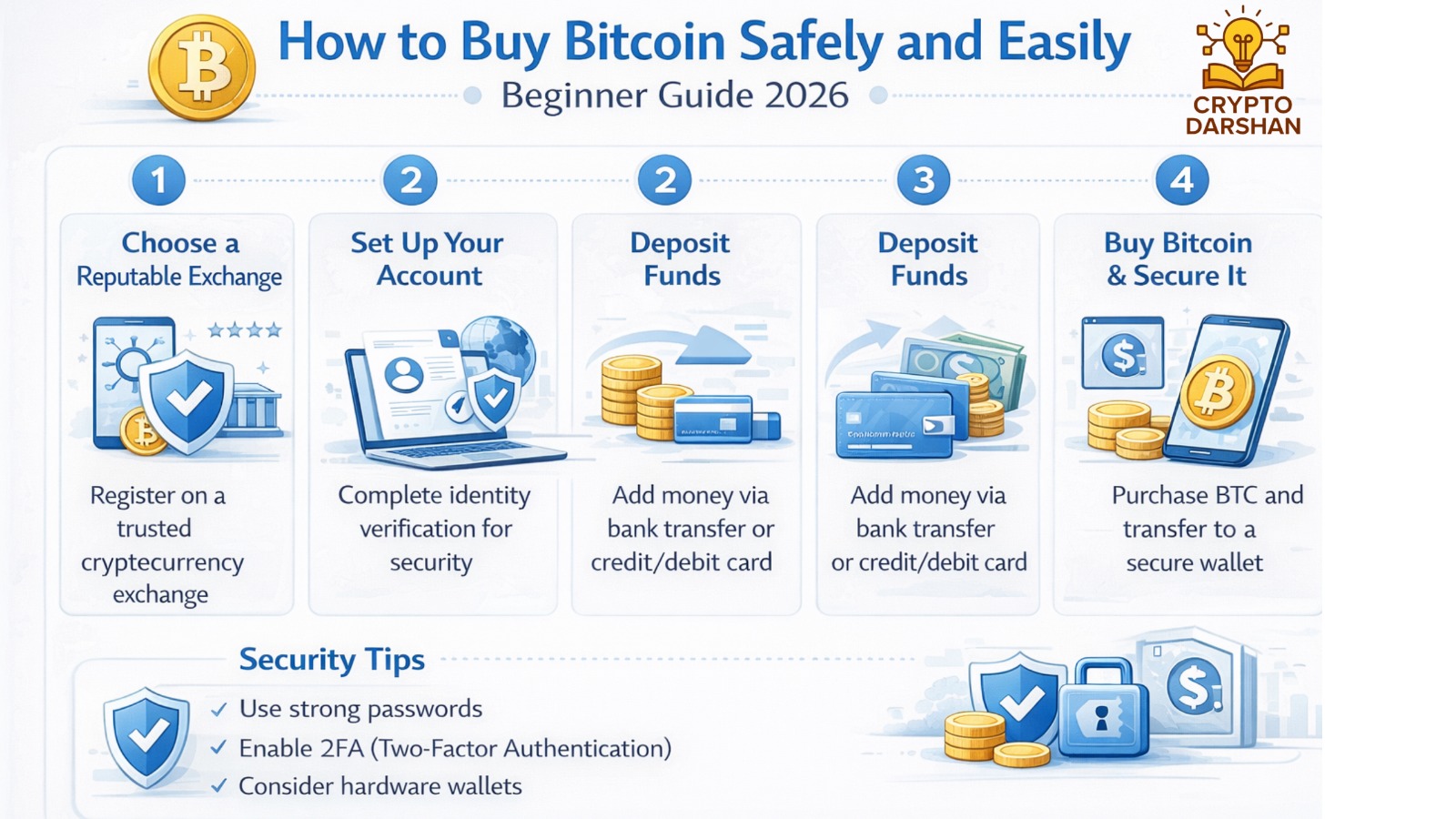
Step-by-Step Guide: How to Buy Bitcoin Safely and Easily

While Bitcoin is considered relatively safe, beginners may also explore other low-risk options listed in Best Cryptocurrency to Buy with Low Risk for Beginners.
Buying Bitcoin in 2026 is simple, but following the right steps ensures safety and success.
Step 1: Choose a Reliable Bitcoin Exchange
A cryptocurrency exchange is a platform where users can buy, sell, and trade Bitcoin. Choosing a trustworthy exchange is the first and most important step.
Factors to Consider
- Reputation: Choose exchanges with a strong track record and positive reviews.
- Security: Look for platforms with two-factor authentication (2FA), cold storage, and insurance.
- Regulation: Ensure the exchange complies with local laws and regulations.
- Fees: Compare trading and withdrawal fees.
- User Experience: A simple, intuitive interface makes trading easier.
Step 2: Create and Verify an Account
Once an exchange is selected, create an account. Most platforms require identity verification to comply with Know Your Customer (KYC) regulations.
Verification Process
- Provide an email address and create a strong password.
- Verify the email.
- Submit identification documents (passport, driver’s license, or ID card).
- Complete facial verification if required.
Verification ensures account security and prevents fraud.
Step 3: Secure a Bitcoin Wallet
A Bitcoin wallet stores private keys, the codes needed to access and manage Bitcoin. There are two main types of wallets:
1. Hot Wallets (Online)
- Connected to the internet.
- Convenient for frequent transactions.
- Examples: MetaMask, Trust Wallet, Coinbase Wallet.
2. Cold Wallets (Offline)
- Not connected to the internet.
- Best for long-term storage.
- Examples: Ledger Nano X, Trezor Model T.
Tip: For maximum security, store large amounts of Bitcoin in a cold wallet and keep only small amounts in a hot wallet for daily use.
Step 4: Deposit Funds
Before buying Bitcoin, deposit funds into the exchange account. Most exchanges support multiple payment methods:
- Bank Transfer: Secure and suitable for large amounts.
- Credit/Debit Card: Fast but may have higher fees.
- PayPal or E-Wallets: Convenient for small purchases.
- Crypto Deposit: Use other cryptocurrencies to buy Bitcoin.
Always check deposit fees and processing times before transferring funds.
Step 5: Buy Bitcoin
Once the account is funded, it’s time to buy Bitcoin.
Buying Options
- Market Order: Buys Bitcoin instantly at the current market price.
- Limit Order: Sets a specific price to buy Bitcoin when it reaches that level.
- Recurring Purchase: Automatically buys Bitcoin at regular intervals (ideal for dollar-cost averaging).
After purchasing, the Bitcoin will appear in the exchange wallet.
Step 6: Transfer Bitcoin to a Personal Wallet

Leaving Bitcoin on an exchange is risky because exchanges can be hacked. Always transfer Bitcoin to a personal wallet for safety.
How to Transfer
- Copy the wallet’s public address.
- Go to the exchange’s withdrawal section.
- Paste the address and confirm the transaction.
- Wait for blockchain confirmation (usually a few minutes).
Once confirmed, the Bitcoin is safely stored in the personal wallet.
Popular Exchanges in 2026
- Coinbase: Beginner-friendly and highly secure.
- Binance: Offers low fees and advanced trading options.
- Kraken: Known for strong security and global availability.
- Bitstamp: One of the oldest and most trusted exchanges.
- Gemini: Regulated and ideal for U.S. users.
How to Store Bitcoin Safely

Security is the most important part of owning Bitcoin. Losing access to private keys means losing Bitcoin permanently.
- Use Hardware Wallets: Store Bitcoin offline to prevent hacks.
- Enable Two-Factor Authentication (2FA): Adds an extra layer of protection.
- Backup Wallets: Keep multiple backups of wallet recovery phrases.
- Avoid Public Wi-Fi: Never access wallets or exchanges on unsecured networks.
- Keep Private Keys Secret: Never share private keys or seed phrases.
Common Mistakes to Avoid When Buying Bitcoin
Buying Bitcoin can be exciting, especially for beginners entering the world of cryptocurrency. However, many new investors make avoidable mistakes that can lead to financial loss or frustration. Understanding these common pitfalls helps ensure a safer and smarter Bitcoin investment journey.
1. Leaving Bitcoin on Exchanges
One of the biggest mistakes beginners make is keeping their Bitcoin on an exchange after buying it. Exchanges are convenient for trading but are also prime targets for hackers. If an exchange is hacked or shuts down, you could lose your funds.
2. Falling for Scams and Fake Websites
The crypto world attracts scammers who create fake websites, social media accounts, and investment schemes promising huge returns. These scams often trick users into sending Bitcoin or revealing private keys
3. Ignoring Security Practices
Many users neglect basic security measures like enabling two-factor authentication (2FA) or using strong passwords. This makes accounts vulnerable to hacking.
4. Buying Without Research
Jumping into Bitcoin because of hype or social media trends can lead to poor decisions. Some investors buy at high prices without understanding the market or technology.
5. Investing More Than You Can Afford to Lose

Bitcoin’s price can be volatile. Investing money you can’t afford to lose can cause stress and panic during market dips.
6. Using Public Wi-Fi for Transactions
Accessing your exchange or wallet on public Wi-Fi networks exposes you to hackers who can intercept your data.
7. Losing Private Keys or Recovery Phrases
Your private key or recovery phrase is the only way to access your Bitcoin. If lost, your funds are gone forever there’s no password reset option.
8. Not Understanding Fees
Every Bitcoin transaction involves fees for trading, transferring, or withdrawing. Ignoring these can reduce profits or cause confusion.
9. Falling for “Guaranteed Profit” Schemes
No one can guarantee profits in Bitcoin. Scammers often promise fixed returns or “double your money” offers to lure investors.
10. Not Diversifying Investments
Putting all your money into Bitcoin can be risky. While Bitcoin is the most established cryptocurrency, diversification helps reduce exposure to volatility
11. Ignoring Tax Obligations
In many countries, Bitcoin transactions are taxable. Failing to report gains or losses can lead to penalties.
12. Panic Selling During Market Dips
Bitcoin’s price often fluctuates sharply. Many beginners panic and sell at a loss when prices drop, missing out on potential recoveries.
13. Using Unverified Apps or Wallets
Downloading fake or unverified crypto apps can lead to stolen funds. Some malicious apps mimic legitimate wallets or exchanges.
14. Ignoring Backup and Recovery Options

If your device is lost or damaged, you could lose access to your Bitcoin without proper backups.
15. Not Staying Updated
The crypto industry evolves quickly. Ignoring updates about security, regulations, or technology can put your investment at risk.
How to Buy Bitcoin Anonymously

While most exchanges require identity verification, some methods allow buying Bitcoin with more privacy:
- Peer-to-Peer (P2P) Platforms: Connect buyers and sellers directly.
- Bitcoin ATMs: Allow cash purchases without full KYC (limits may apply).
- Decentralized Exchanges (DEXs): Enable trading without intermediaries.
However, always follow local laws and regulations when buying Bitcoin anonymously.
How to Sell Bitcoin
Selling Bitcoin is a straightforward process, but it’s important to do it safely and choose the right method based on your needs. Whether you want to convert Bitcoin into cash, another cryptocurrency, or stablecoins, the process follows a few simple steps.
1. Choose Where to Sell Your Bitcoin
There are several ways to sell Bitcoin, each with its own advantages:
a. Cryptocurrency Exchanges
The most common and convenient method. Exchanges like Coinbase, Binance, Kraken, and Bitstamp allow users to sell Bitcoin directly for fiat currency (like USD, EUR, or INR).
Pros:
- Easy to use.
- High liquidity.
- Multiple withdrawal options.
Cons:
- Requires identity verification.
- May charge transaction fees.
b. Peer-to-Peer (P2P) Platforms
P2P platforms like Binance P2P or LocalBitcoins connect buyers and sellers directly. You can negotiate prices and payment methods.
Pros:
- More privacy
- Flexible payment options
Cons:
- Requires caution to avoid scams.
- May take longer to complete transactions.
c. Bitcoin ATMs
Some Bitcoin ATMs allow users to sell Bitcoin for cash. You simply send Bitcoin to the ATM’s address and withdraw cash once confirmed.
Pros:
- Instant cash
- No need for an exchange account
Cons:
- High fees
- Limited availability
d. Over the Counter (OTC) Desks
For large transactions, OTC desks offer direct trading between buyers and sellers, often with personalized service.
Pros:
- Ideal for large amounts
- Less price slippage
Cons:
- Higher minimum trade amounts
- Requires verification.
2. Transfer Bitcoin to the Platform
If your Bitcoin is stored in a personal wallet, transfer it to the exchange or platform where you plan to sell.
Steps:
- Log in to your exchange account.
- Go to the “Deposit” or “Wallet” section.
- Copy the Bitcoin deposit address.
- Open your personal wallet and send the desired amount to that address.
- Wait for blockchain confirmation (usually a few minutes).
Once confirmed, your Bitcoin will appear in your exchange account balance.
3. Place a Sell Order
After your Bitcoin is available on the platform, you can sell it using one of the following order types:
a. Market Order
Sells Bitcoin instantly at the current market price.
- Best for quick sales.
- May result in slightly lower prices due to market fluctuations.
b. Limit Order
Sets a specific price at which you want to sell.
- The order executes only when the market reaches your chosen price.
- Ideal for maximizing profits.
c. P2P Sale
If using a P2P platform, choose a buyer, agree on a price, and complete the transaction once payment is received.
4. Withdraw Your Funds

After selling Bitcoin, you can withdraw your funds in fiat currency or stablecoins.
Withdrawal Options:
- Bank Transfer: Send funds directly to your bank account.
- E-Wallets: Withdraw to PayPal or other supported wallets.
- Stablecoins: Convert Bitcoin into USDT, USDC, or DAI for crypto-based savings.
Tip: Always double-check withdrawal details to avoid sending funds to the wrong account.
5. Keep Records for Taxes
In most countries, selling Bitcoin is considered a taxable event. Keep detailed records of:
- The date of sale
- The amount sold.
- The sale price.
- Transaction fees.
These records help calculate capital gains or losses for tax reporting.
6. Stay Safe When Selling Bitcoin
- Use only reputable exchanges or verified P2P platforms.
- Enable two-factor authentication (2FA) on all accounts.
- Avoid sharing personal information with unknown buyers.
- Confirm payments before releasing Bitcoin in P2P trades.
- Be cautious of phishing websites and fake apps.
By following these steps, you can sell Bitcoin confidently and efficiently in 2026 and beyond.
Bitcoin Tax Regulations in Various Countries (2026)
Bitcoin taxation differs across countries, depending on how each government classifies and regulates cryptocurrencies. By 2026, most nations have established clear frameworks for taxing Bitcoin transactions, treating it as either property, an asset, or income.
1. United State
- Classification: Bitcoin is treated as property by the Internal Revenue Service (IRS).
- Tax Type: Capital gains tax applies when Bitcoin is sold, traded, or used for purchases.
- Short-Term vs. Long-Term:
- Held less than one year → taxed as ordinary income.
- Held more than one year → taxed at lower long-term capital gains rates.
- Mining and Staking: Income from mining or staking is taxed as ordinary income at the time it’s earned.
- Reporting: All crypto transactions must be reported on tax returns using IRS Form 8949 and Schedule D.
2. United Kingdom
- Classification: Bitcoin is considered a capital asset.
- Tax Type: Capital gains tax (CGT) applies when Bitcoin is sold or exchanged.
- Allowances: Individuals have an annual CGT allowance; profits below this threshold are tax-free.
- Mining and Trading:
- Mining income is taxable as trading income.
- Frequent traders may be classified as running a business and taxed accordingly.
- Reporting: HMRC requires detailed records of all transactions, including dates, amounts, and counterparties.
3. European Union (EU)
- Classification: Bitcoin is recognized as a digital asset.
- Tax Type:
- No Value Added Tax (VAT) on Bitcoin transactions.
- Capital gains tax applies to profits from sales or exchanges.
- Rates: Vary by country — for example:
- Germany: No tax if Bitcoin is held for more than one year.
- France: Flat tax rate on capital gains (around 30%).
- Spain: Progressive tax rates based on income level.
- Reporting: EU countries require crypto exchanges to share user data under the DAC8 directive for tax transparency.
4. Canada
- Classification: Bitcoin is treated as a commodity.
- Tax Type:
- Capital gains tax applies when Bitcoin is sold or traded.
- 50% of the gain is taxable.
- Mining and Business Use:
- Mining income is taxable as business income.
- Businesses accepting Bitcoin must report its fair market value in Canadian dollars.
- Reporting: The Canada Revenue Agency (CRA) requires detailed transaction records.
5. Australia
- Classification: Bitcoin is considered property for tax purposes.
- Tax Type:
- Capital gains tax applies when Bitcoin is sold, traded, or used for purchases.
- Personal use transactions (small purchases) may be exempt.
- Mining and Business Use:
- Mining income is taxable as business income.
- Businesses must record Bitcoin’s value in Australian dollars at the time of receipt.
- Reporting: The Australian Taxation Office (ATO) monitors crypto transactions through exchanges.
6. India
- Classification: Bitcoin is categorized as a Virtual Digital Asset (VDA).
- Tax Type:
- 30% tax on profits from selling or transferring Bitcoin.
- 1% Tax Deducted at Source (TDS) on every crypto transaction.
- No Deductions: No deductions allowed except for the cost of acquisition.
- Losses: Losses from Bitcoin cannot be offset against other income.
- Reporting: All transactions must be reported under the Income Tax Act.
7. Japan
- Classification: Bitcoin is recognized as legal property under the Payment Services Act.
- Tax Type:
- Profits from Bitcoin trading or sales are taxed as miscellaneous income.
- Tax rates are progressive, ranging from 5% to 45%.
- Mining and Business Use: Mining income is taxable as business income.
- Reporting: Crypto exchanges must register with the Financial Services Agency (FSA) and report user data.
8 United Arab Emirates (UAE)
- Classification: Bitcoin is recognized as a virtual asset.
- Tax Type:
- No personal income tax or capital gains tax on Bitcoin.
- Businesses operating in free zones may enjoy tax exemptions.
- Regulation: The Virtual Assets Regulatory Authority (VARA) oversees crypto activities in Dubai.
- Reporting: Companies must comply with anti-money laundering (AML) and KYC regulations.
9. South Africa
- Classification: Bitcoin is treated as a financial asset.
- Tax Type:
- Capital gains tax applies to profits from Bitcoin sales.
- Mining and trading income are taxed as ordinary income.
- Reporting: The South African Revenue Service (SARS) requires full disclosure of crypto holdings.
How to Avoid Bitcoin Scams

Scams remain a major threat in the crypto world. Common scams include fake exchanges, phishing websites, and Ponzi schemes.
How to Stay Safe
- Only use verified and reputable exchanges.
- Double-check website URLs before logging in.
- Never share private keys or recovery phrases.
- Be cautious of “too good to be true” offers.
- Follow official social media channels for updates.
Future of Bitcoin in 2026 and Beyond
Bitcoin continues to evolve with new technologies and wider adoption.
Key Trends
- Institutional Investment: More companies and funds are adding Bitcoin to their portfolios.
- Mainstream Payments: Businesses increasingly accept Bitcoin for goods and services.
- Layer 2 Solutions: The Lightning Network enables faster and cheaper transactions.
- Regulatory Clarity: Governments are creating clearer frameworks for crypto use.
- Environmental Improvements: New mining technologies are making Bitcoin more sustainable.
Bitcoin’s future looks strong as it becomes a key part of the global financial system.
Frequently Asked Questions (FAQ)

1. Is Bitcoin safe to buy in 2026?
Yes, if purchased from reputable exchanges and stored securely in a personal wallet.
2. How much Bitcoin should a beginner buy?
Start small, even $10 or $50 worth, and increase gradually as confidence grows.
3. Can Bitcoin be hacked?
The Bitcoin network itself is highly secure, but wallets and exchanges can be hacked if not properly protected.
4. Do I need to buy a whole Bitcoin?
No. Bitcoin is divisible into smaller units called satoshis, so it’s possible to buy fractions of a Bitcoin.
5. What happens if I lose my private key?
Losing the private key means losing access to the Bitcoin permanently. Always back up recovery phrases securely.
Conclusion
Buying Bitcoin safely and easily in 2026 is achievable with the right knowledge and precautions. By choosing a trusted exchange, securing a personal wallet, and following best practices, anyone can invest in Bitcoin confidently.
Bitcoin represents more than just a digital currency it’s a revolutionary financial system that empowers individuals worldwide. As adoption grows and technology advances, Bitcoin’s role in the global economy will only strengthen.
Start small, stay informed, and prioritize security. The journey into Bitcoin begins with a single step and that step can lead to a smarter, more independent financial future.