
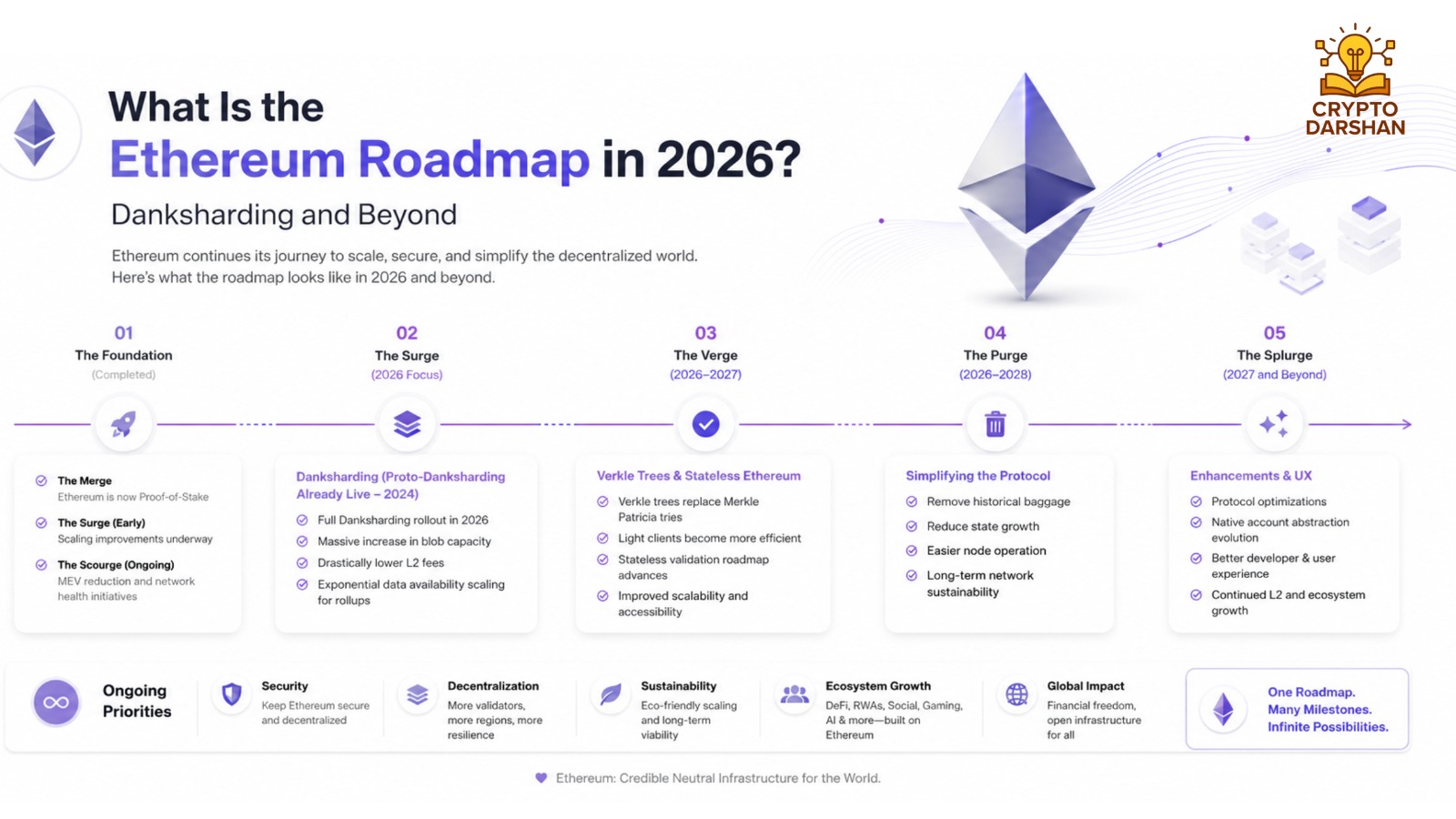
The Ethereum Roadmap in 2026 represents one of the most ambitious and transformative journeys in blockchain history. As the world’s leading smart contract platform, Ethereum continues to evolve beyond its original design, addressing scalability, sustainability, and decentralization challenges. The roadmap outlines a series of upgrades and innovations that aim to make Ethereum faster, cheaper, and more secure while maintaining its decentralized ethos.
In 2026, Ethereum stands at the intersection of technological maturity and mass adoption. The network has already transitioned from Proof of Work (PoW) to Proof of Stake (PoS), significantly reducing its energy consumption. Now, the focus shifts toward scalability through Danksharding, rollups, and other Layer 2 solutions. These advancements are designed to make Ethereum capable of supporting millions of users and applications without compromising performance or decentralization.
This comprehensive guide explores the Ethereum Roadmap in 2026, detailing its key phases, technological innovations, and the broader implications for the blockchain ecosystem. It also examines how Ethereum’s evolution impacts developers, investors, and users worldwide.
The Evolution of the Ethereum Roadmap
The Early Vision
Ethereum was launched in 2015 by Vitalik Buterin and a team of developers who envisioned a decentralized world computer. The initial roadmap focused on enabling smart contracts and decentralized applications (dApps). However, as adoption grew, scalability and transaction costs became major bottlenecks.
The early Ethereum Roadmap included several phases:
- Frontier (2015) – The initial release for developers and miners.
- Homestead (2016) – The first stable version of Ethereum.
- Metropolis (2017–2019) – Introduced usability and security improvements.
- Serenity (2020–2022) – Marked the transition to Proof of Stake through Ethereum 2.0.
Each phase brought Ethereum closer to its long-term goal: a scalable, secure, and sustainable decentralized platform.
The Merge: A Turning Point
The Merge, completed in September 2022, was a monumental milestone in the Ethereum Roadmap. It replaced the energy-intensive Proof of Work consensus mechanism with Proof of Stake, reducing Ethereum’s energy consumption by over 99%. This transition also laid the foundation for future scalability upgrades.
The Merge unified the original Ethereum mainnet with the Beacon Chain, enabling validators to secure the network by staking ETH instead of mining. This shift not only improved sustainability but also enhanced network security and economic efficiency.
Post-Merge Developments
After the Merge, Ethereum entered a new era focused on scalability and efficiency. The Ethereum Roadmap introduced several key phases:
- The Surge – Focused on scaling through rollups and sharding.
- The Verge – Introduced Verkle trees for improved data storage.
- The Purge – Simplified the protocol by removing historical data.
- The Splurge – Included miscellaneous upgrades and optimizations.
By 2026, Ethereum is deep into the Surge phase, with Danksharding emerging as the centerpiece of its scalability strategy.
Understanding Danksharding
What Is Danksharding?
Danksharding is the next major step in the Ethereum Roadmap, designed to dramatically increase the network’s data availability and throughput. It is named after Ethereum researcher Dankrad Feist, who proposed a simplified and more efficient version of traditional sharding.
In traditional sharding, the blockchain is divided into multiple shards, each processing its own transactions and smart contracts. However, this approach introduces complexity and potential security risks. Danksharding takes a different approach by focusing on data availability sampling and blob-carrying transactions.
Instead of splitting the network into multiple shards, Danksharding allows validators to verify large amounts of data efficiently without downloading everything. This makes it possible to scale Ethereum to handle thousands of transactions per second while maintaining decentralization.
The Role of Proto-Danksharding (EIP-4844)
Before full Danksharding, Ethereum introduced Proto-Danksharding through EIP-4844, also known as “The Surge upgrade.” This intermediate step adds a new transaction type called blob-carrying transactions, which store large chunks of data (blobs) off-chain but are still verifiable by the network.
Proto-Danksharding significantly reduces the cost of rollup transactions, making Layer 2 solutions more affordable and efficient. It sets the stage for full Danksharding by introducing the necessary infrastructure and data-handling mechanisms.
Danksharding is designed to work alongside Layer 2 scaling solutions, enabling faster and cheaper transactions without sacrificing security.
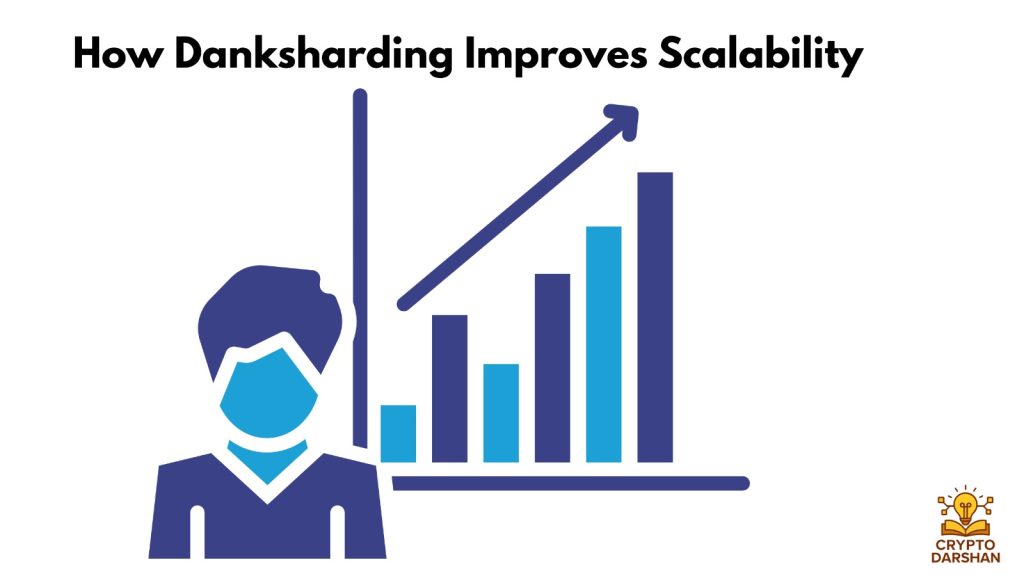
How Danksharding Improves Scalability
1. Data Availability Sampling (DAS)
Danksharding introduces a revolutionary approach where validators don’t need to download entire blocks of data to verify transactions. Instead, they can randomly sample small portions of data to confirm availability. This means the network can handle much larger amounts of data without overwhelming individual validators, making the system more efficient and accessible.
2. Blob-Carrying Transactions
The system introduces a new type of transaction that carries large “blobs” of data. These blobs are stored temporarily off-chain but remain verifiable by the network. This approach dramatically reduces the burden on Ethereum’s main chain while still maintaining security and transparency. Think of it as creating a temporary storage space that doesn’t clog up the permanent record.
3. Massive Cost Reduction for Layer 2 Rollups
Rollups, which bundle hundreds of transactions together—need to post data back to Ethereum’s main chain. Danksharding makes this data posting exponentially cheaper by providing dedicated space for rollup data. When rollups become more affordable, users benefit from lower transaction fees, sometimes reducing costs by 10-100x compared to current rates.
4. Parallel Processing Capabilities
Unlike traditional blockchain designs that process transactions sequentially, Danksharding enables multiple data blobs to be processed simultaneously. This parallel processing architecture means Ethereum can handle thousands of transactions simultaneously rather than one after another, dramatically increasing overall network throughput.
5. Scalability Without Sacrificing Decentralization
The most impressive aspect of Danksharding achieves massive scalability improvements while keeping hardware requirements reasonable. Validators can participate without needing expensive, high-powered computers because they only verify samples of data rather than everything. This preserves Ethereum’s core principle of decentralization—allowing more people to run nodes and secure the network.
With these improvements, Ethereum can support thousands of rollups and millions of users, making it a truly global decentralized platform.
The Ethereum Roadmap: Key Phases in 2026
1. The Surge: Scaling Through Rollups and Danksharding
The Surge phase focuses on scaling Ethereum’s capacity to handle more transactions. Rollups—Layer 2 solutions that bundle multiple transactions into one—play a central role. Danksharding complements rollups by providing cheap and abundant data availability.
By 2026, the Ethereum Roadmap envisions a network capable of processing over 100,000 transactions per second (TPS) through rollups and sharding combined. This level of scalability rivals traditional payment systems like Visa, making Ethereum suitable for mainstream adoption.
Learn why scalability upgrades matter by understanding Ethereum gas fees and the factors that make transactions expensive during periods of high network activity.
2. The Verge: Verkle Trees and Stateless Clients
The Verge introduces Verkle trees, a new cryptographic data structure that replaces Merkle trees. Verkle trees allow for smaller proofs and more efficient verification, enabling stateless clients—nodes that can verify transactions without storing the entire blockchain.
This upgrade reduces hardware requirements for validators and improves decentralization by allowing more participants to run nodes.
3. The Purge: Simplifying the Protocol
The Purge aims to streamline Ethereum by removing unnecessary historical data and simplifying the protocol. This reduces storage requirements and improves network performance. It also lowers the barrier to entry for new validators and developers.
By 2026, Ethereum’s state size is expected to be significantly smaller, making it easier for users to run full nodes and contribute to network security.
4. The Splurge: Continuous Innovation
The Splurge includes miscellaneous upgrades that enhance Ethereum’s functionality, security, and user experience. These may include improvements to the Ethereum Virtual Machine (EVM), better developer tools, and enhanced interoperability with other blockchains.
The Ethereum Roadmap emphasizes continuous innovation, ensuring that the network remains adaptable to emerging technologies and user needs.
Layer 2 Solutions and the Ethereum Roadmap
The Role of Rollups
Rollups are essential to Ethereum’s scalability strategy. They process transactions off-chain and post compressed data to the mainnet, reducing congestion and fees. There are two main types of rollups:
- Optimistic Rollups – Assume transactions are valid unless challenged.
- Zero-Knowledge (ZK) Rollups – Use cryptographic proofs to verify transactions instantly.
Danksharding enhances rollups by providing cheap data availability, allowing them to scale even further. This synergy between Layer 1 and Layer 2 is a cornerstone of the Ethereum Roadmap.
Major Rollup Projects
Several rollup projects are leading the charge in 2026:
- Arbitrum – Focused on Optimistic Rollups with high throughput.
- Optimism – Aims to create a sustainable ecosystem through retroactive public goods funding.
- zkSync – Utilizes ZK-Rollups for instant finality and low fees.
- StarkNet – Employs STARK proofs for scalability and privacy.
These projects collectively contribute to Ethereum’s scalability and user adoption, aligning with the broader Ethereum Roadmap goals.
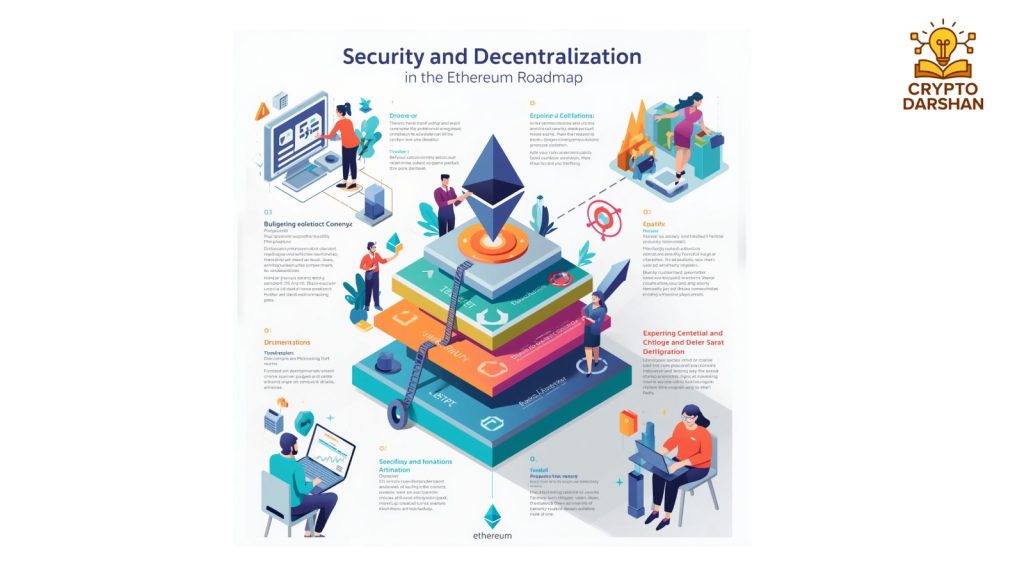
Security and Decentralization in the Ethereum Roadmap
Maintaining Decentralization
One of Ethereum’s core principles is decentralization. As the network scales, maintaining this principle becomes more challenging. The Ethereum Roadmap addresses this by ensuring that upgrades like Danksharding and Verkle trees reduce hardware requirements, allowing more users to participate as validators. The Ethereum roadmap also builds upon the success of Ethereum staking, which helps secure the network while allowing ETH holders to earn rewards.
Enhancing Security
Ethereum’s security model relies on economic incentives and cryptographic proofs. With Proof of Stake, validators are financially motivated to act honestly. Future upgrades will introduce additional security measures, such as improved slashing conditions and enhanced validator diversity.
Danksharding also improves security by making data availability more robust. Data Availability Sampling ensures that no single entity can withhold critical data, preserving the integrity of the network.
The Economic Impact of the Ethereum Roadmap
ETH as a Deflationary Asset
Since the introduction of EIP-1559 in 2021, Ethereum has implemented a fee-burning mechanism that removes a portion of transaction fees from circulation. Combined with Proof of Stake, this has made ETH a deflationary asset, meaning its supply decreases over time.
As network activity increases with Danksharding and rollups, more ETH is burned, potentially increasing its value. This economic model aligns with the long-term sustainability goals of the Ethereum Roadmap.
Staking and Validator Rewards
Staking remains a key component of Ethereum’s economy. Validators earn rewards for securing the network, while users can participate through staking pools or liquid staking protocols. The Ethereum Roadmap aims to make staking more accessible and decentralized, reducing reliance on large staking providers.
DeFi and NFT Ecosystem Growth
Ethereum continues to dominate the decentralized finance (DeFi) and non-fungible token (NFT) sectors. With lower fees and higher throughput, these ecosystems are expected to expand further in 2026. The Ethereum Roadmap supports this growth by providing the infrastructure needed for mass adoption.
Environmental Sustainability
The transition to Proof of Stake drastically reduced Ethereum’s energy consumption, making it one of the most environmentally friendly blockchains. The Ethereum Roadmap continues to prioritize sustainability by optimizing network efficiency and reducing hardware requirements.
Danksharding further contributes to sustainability by minimizing redundant data storage and computation. This ensures that Ethereum remains a green and scalable platform for the future.
Developer Ecosystem and Tooling
Improved Developer Experience
The Ethereum Roadmap places strong emphasis on improving the developer experience. Upgrades like Verkle trees and stateless clients simplify node operation, while enhanced EVM compatibility ensures that developers can build more efficiently.
Cross-Chain Interoperability
Interoperability is another key focus area. Ethereum’s roadmap includes initiatives to improve communication between different blockchains and Layer 2 networks. This fosters a more connected and collaborative Web3 ecosystem.
Open-Source Innovation
Ethereum’s open-source nature encourages global collaboration. Thousands of developers contribute to its codebase, ensuring continuous improvement and innovation. The Ethereum Roadmap reflects this community-driven approach, evolving through research, experimentation, and consensus.
Challenges and Criticisms

Complexity of Upgrades
One of the main challenges in the Ethereum Roadmap is the complexity of implementing multiple upgrades simultaneously. Each phase introduces new technologies that must be tested and integrated carefully to avoid network disruptions.
Competition from Other Blockchains
Ethereum faces competition from newer blockchains like Solana, Avalanche, and Cardano, which offer high throughput and low fees. However, Ethereum’s strong developer community and robust ecosystem give it a significant advantage.
User Experience and Adoption
Despite improvements, Ethereum still faces challenges related to user experience, such as wallet management and transaction fees. The Ethereum Roadmap aims to address these issues through Layer 2 solutions and better user interfaces.
The Future Beyond Danksharding

Full Danksharding Implementation
By 2026, Ethereum is expected to transition from Proto-Danksharding to full Danksharding. This will unlock the network’s full scalability potential, enabling seamless interaction between Layer 1 and Layer 2.
Quantum Resistance and Advanced Cryptography
Future phases of the Ethereum Roadmap may include quantum-resistant cryptographic algorithms to safeguard against emerging threats. Research in zero-knowledge proofs and homomorphic encryption will further enhance privacy and security. Beyond scaling, Ethereum researchers are also exploring innovations such as post-quantum cryptography to strengthen future network security.
Integration with Real-World Assets
Ethereum’s infrastructure is increasingly being used to tokenize real-world assets such as real estate, stocks, and commodities. The scalability improvements from Danksharding will make these applications more practical and efficient.
The Path to Global Adoption
The ultimate goal of the Ethereum Roadmap is global adoption. With scalability, security, and sustainability achieved, Ethereum aims to become the foundational layer for the decentralized internet—supporting everything from finance and gaming to governance and identity.
FAQ: The Ethereum Roadmap in 2026: Danksharding and Beyond
1. What is the Ethereum roadmap in 2026?
The Ethereum roadmap in 2026 focuses on improving scalability, reducing transaction costs, enhancing decentralization, and strengthening network security. Key priorities include scaling technologies such as Danksharding, Layer 2 expansion, and protocol optimizations.
2. What is Danksharding?
Danksharding is Ethereum’s long-term scaling solution designed to dramatically increase data availability for Layer 2 networks. It allows Ethereum to process far more data efficiently, helping rollups handle a larger number of transactions at lower costs.
3. How does Danksharding differ from traditional sharding?
Traditional sharding splits the blockchain into multiple chains that process transactions independently. Danksharding instead focuses on data availability, enabling Layer 2 rollups to scale while Ethereum maintains a unified execution layer.
4. What is Proto-Danksharding?
Proto-Danksharding, introduced through EIP-4844, is an intermediate step toward full Danksharding. It introduces “blob” transactions that provide cheaper data storage for rollups, reducing Layer 2 transaction fees.
5. Why is Danksharding important for Ethereum?
Danksharding helps Ethereum support millions of users by increasing throughput and lowering costs. It makes decentralized applications (dApps), DeFi platforms, and blockchain gaming more affordable and efficient.
6. Will Danksharding reduce Ethereum gas fees?
While Danksharding may not directly lower Layer 1 gas fees, it significantly reduces costs for Layer 2 rollups. Users transacting on Layer 2 networks can benefit from much cheaper fees.
7. What role do Layer 2 networks play in Ethereum’s roadmap?
Layer 2 networks such as rollups are central to Ethereum’s scaling strategy. They process transactions off-chain while relying on Ethereum for security and settlement.
8. How will Ethereum’s scalability improve after Danksharding?
Full Danksharding could increase Ethereum’s data capacity by orders of magnitude, allowing Layer 2 solutions to process tens of thousands—or potentially hundreds of thousands—of transactions per second.
9. Is Ethereum still decentralized after implementing Danksharding?
Yes. Ethereum developers are designing Danksharding to preserve decentralization by allowing validators to verify data efficiently without requiring excessive hardware resources.
Conclusion
The Ethereum Roadmap in 2026 represents a bold vision for the future of decentralized technology. From the Merge to Danksharding and beyond, Ethereum continues to push the boundaries of what is possible in blockchain innovation. Each phase of the roadmap builds upon the last, creating a network that is more scalable, secure, and sustainable than ever before.
Danksharding stands as the centerpiece of this evolution, enabling Ethereum to handle massive amounts of data and transactions while maintaining decentralization. Combined with Layer 2 rollups, Verkle trees, and protocol simplifications, Ethereum is poised to become the backbone of the decentralized web.
As the Ethereum Roadmap unfolds, it not only transforms the blockchain ecosystem but also redefines how digital economies operate. With its commitment to innovation, community, and sustainability, Ethereum remains the leading force driving the next generation of decentralized applications and global financial systems.