

Chainlink’s LINK token is trading near $8.22, placing the cryptocurrency under renewed attention from traders and long-term investors. At this price, LINK remains far below Standard Chartered’s long-term target of $200 by the end of 2030.
A move from $8.22 to $200 would represent a gain of roughly 24 times. In percentage terms, that would equal more than 2,300% upside if the forecast becomes reality. However, the target is a long-term projection, not a guarantee that LINK will reach the level.
Market data shows that Chainlink has recently traded around the $8.20 range, with a market capitalization of approximately $6.15 billion and daily trading volume above $140 million. These figures can change quickly because cryptocurrency prices are highly volatile.
Why Standard Chartered Is Bullish
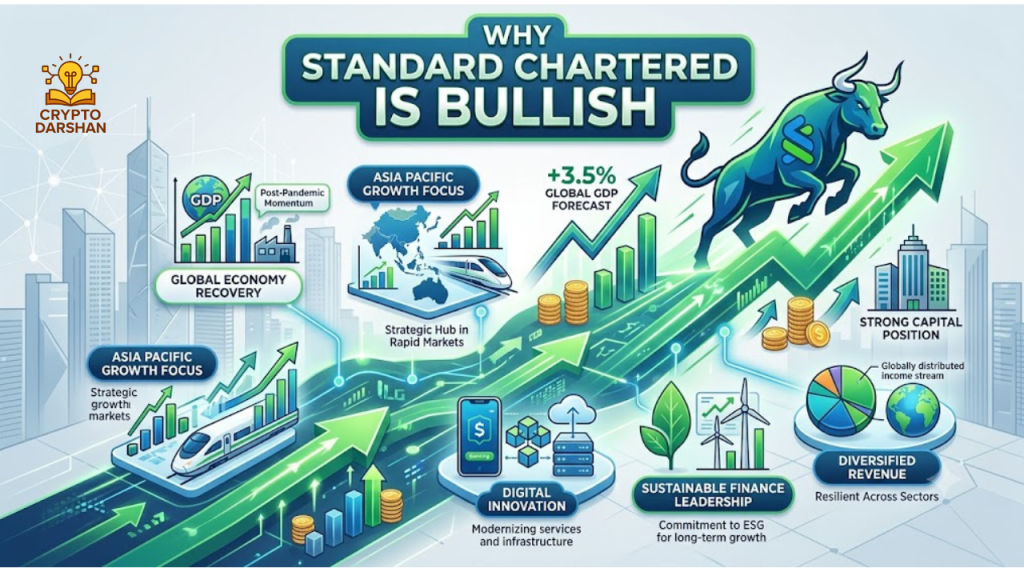
Standard Chartered’s forecast is based on the expected growth of tokenized real-world assets and decentralized finance. Tokenization involves creating blockchain-based versions of assets such as bonds, funds, stocks, real estate, and other financial products.
The bank expects the value of tokenized assets on blockchain networks to grow from about $340 billion to approximately $4 trillion by the end of 2028. It also projects that assets deployed in DeFi could increase to around $2.7 trillion by 2030.
This growth could create more demand for blockchain infrastructure. Financial institutions need reliable data feeds, market prices, interest rates, reserve reports, and cross-chain settlement systems when they issue or manage tokenized assets.
Chainlink is designed to provide many of these services.
Chainlink’s Role in Blockchain Finance

Chainlink is best known as a decentralized oracle network. Oracles connect blockchain applications with information from outside the blockchain. This information can include asset prices, weather data, interest rates, sports results, and proof-of-reserves reports.
Smart contracts cannot naturally access external data on their own. For example, a lending protocol needs accurate price information to decide whether a borrower has enough collateral. Chainlink’s oracle infrastructure helps deliver that information to decentralized applications.
The network also provides cross-chain communication through the Chainlink Cross-Chain Interoperability Protocol, commonly called CCIP. This system is intended to help transfer data and tokens between different blockchain networks.
Standard Chartered estimates that Chainlink secures more than $110 billion in total value. The bank also says the network covers about 70% of oracle-dependent value across global DeFi and more than 80% on Ethereum.
If tokenized financial products expand, the need for trusted data and cross-chain communication could grow alongside them.
Institutional Adoption Supports the Case
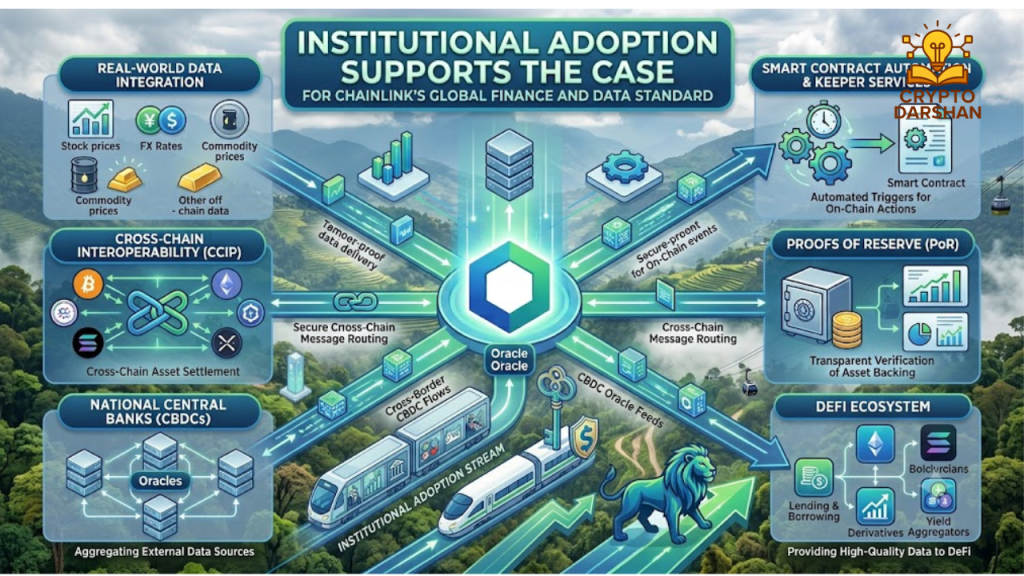
The Chainlink investment thesis is not based only on retail cryptocurrency demand. The project has also worked with major financial and technology institutions.
Standard Chartered’s report referenced organizations such as Swift, DTCC, Euroclear, JPMorgan, Mastercard, UBS, Fidelity, and S&P Global as users or participants in Chainlink-related services.
These partnerships are important because institutional blockchain projects often require dependable infrastructure before moving from a test phase to full production.
Tokenized funds and bonds may need continuous data about net asset values, interest rates, transaction records, and asset reserves. That could make institutional applications more data-intensive than many existing crypto-native products.
However, partnerships and pilot programs do not always create immediate revenue. The main question is whether these experiments become large, recurring commercial services.
CCIP Growth Could Become a Catalyst

Cross-chain activity is another part of the bullish argument for LINK. As more blockchains issue tokenized assets, investors may need systems that allow those assets to move between networks.
According to Standard Chartered’s analysis, more than $7 billion in token value has moved from older bridge systems to Chainlink’s CCIP. The report also said quarterly CCIP volume reached $4.9 billion in the second quarter, representing significant year-over-year growth.
A larger CCIP user base could increase network activity and support demand for Chainlink services. It may also strengthen Chainlink’s position in the developing market for blockchain interoperability.
Still, Chainlink faces competition from other interoperability providers. Investors will need to watch whether CCIP can maintain its growth and attract more institutional customers over time.
LINK Price Levels to Watch

From a technical perspective, the $8.00 to $8.10 area has been viewed as an important support zone in recent market analysis. If buyers continue defending that level, LINK could attempt to recover toward the $8.40 to $8.50 range.
A sustained move above that resistance area could improve short-term market sentiment. On the other hand, a clear break below $8 may increase selling pressure and expose LINK to further losses.
Technical patterns can offer useful clues, but they cannot predict sudden changes caused by Bitcoin volatility, regulation, network problems, or broader macroeconomic events.
Risks Behind the $200 Forecast

The Standard Chartered projection depends on several major assumptions. Institutional tokenization must grow at the expected pace, blockchain pilots must become production systems, and Chainlink must retain a strong share of the oracle and interoperability markets.
There is also competition from other oracle and cross-chain providers. Technical failures, smart contract vulnerabilities, regulatory restrictions, or weak demand for tokenized assets could reduce Chainlink’s future revenue.
For these reasons, the $200 target should be treated as an optimistic scenario rather than a certain outcome. Investors should consider market conditions, project fundamentals, personal risk tolerance, and position size before making any decision.
Final Outlook
Chainlink’s current price near $8.22 looks small compared with Standard Chartered’s $200 forecast for 2030. The bank’s bullish case is built on a potential expansion of tokenized assets, institutional blockchain usage, DeFi growth, and demand for reliable cross-chain infrastructure.
Whether LINK can deliver a 24-fold rally will depend on real adoption, recurring fees, successful CCIP growth, and Chainlink’s ability to remain a leading infrastructure provider. For now, the project remains one of the most closely watched tokens in the tokenization and DeFi sectors—but its long-term forecast carries substantial uncertainty.