Standard Chartered’s digital assets team has highlighted Bitcoin, Ethereum, Solana, and XRP as four cryptocurrencies that could see major upside over the next few years, but their bullish forecasts come with meaningful risks that everyday investors should understand before jumping in.
New Ultra‑Bullish Crypto Outlook

Standard Chartered, a major global bank, has released a fresh set of aggressive price targets for leading cryptocurrencies, signaling strong confidence in the long‑term growth of the digital asset market. Led by Geoff Kendrick, the bank’s digital assets research group believes that institutional adoption, DeFi expansion, and clearer regulation could drive substantial gains over the next 12 to 18 months and beyond
In this news breakdown, we’ll look at the four highlighted cryptos—Bitcoin, Ethereum, Solana, and XRP—why Standard Chartered is so bullish on them, and what risks you should keep in mind as a retail investor.
Bitcoin: Institutional Bid Behind Six‑Figure Targets

Standard Chartered has doubled down on Bitcoin, even in the middle of a difficult market environment. The bank now expects Bitcoin to reach around $100,000 by the end of 2026, then move toward $200,000 in 2027 and potentially $500,000 by 2030 if its thesis plays out.
The core driver behind these projections is institutional adoption:
- Wall Street firms are rolling out new Bitcoin investment products, such as funds and structured notes, aimed at both retail and professional investors.
- Large institutions are gradually adding Bitcoin to diversified portfolios, treating it as a form of “digital gold” and a hedge against monetary debasement.
- Some companies are putting Bitcoin on their balance sheets as a treasury asset, reinforcing demand and signaling confidence in its long‑term role.
These factors feed into Standard Chartered’s view that Bitcoin can sustain higher valuations over time as liquidity deepens and volatility slowly moderates.
Ethereum: DeFi, Stablecoins, and Tokenized Assets
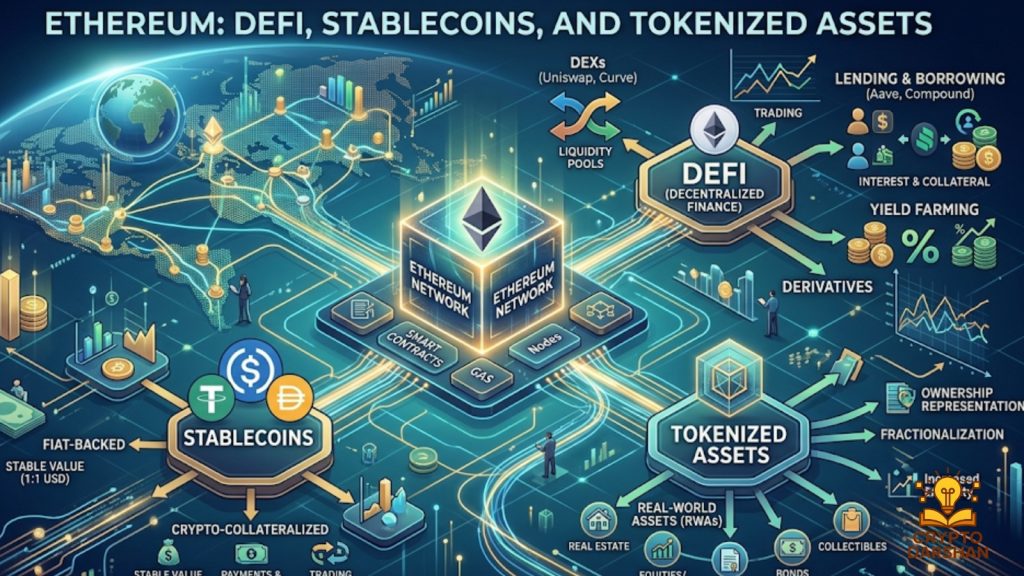
Ethereum is the second major crypto on Standard Chartered’s watchlist, and the bank sees it as a core infrastructure asset for the future of finance. At a current price just below $2,000, the bank believes Ethereum could climb to $10,000 by 2027, with a much more ambitious target of $40,000 by 2030.
The bullish thesis for Ethereum rests on three key themes:
- DeFi dominance: Ethereum remains the leading smart‑contract platform for decentralized finance, hosting lending protocols, DEXs, and yield‑generating applications.
- Stablecoin growth: A large share of stablecoin activity, including issuance and on‑chain transfers, is built on Ethereum’s network, creating strong demand for block space and fees.
- Real‑world asset (RWA) tokenization: The bank expects tokenized representations of traditional assets like stocks and bonds to expand rapidly, and sees Ethereum as a primary settlement layer for these instruments.
Standard Chartered also notes that political support matters: the White House has emphasized Ethereum as a key building block in its broader crypto and blockchain strategy, which could help accelerate regulatory clarity and institutional adoption
Solana: Fast, Cheap, and Chasing Ethereum

Solana is the third cryptocurrency that Standard Chartered believes could deliver outsized gains. The bank describes Solana as a faster and cheaper alternative to Ethereum, and has set a price target of $265 by 2027, with a long‑term projection as high as $2,000 by 2030. From a current level of about $75, that would represent roughly 2,500% upside if the forecast were to materialize.
Solana’s investment case in this report focuses on:
- High throughput and low fees, which make it attractive for applications that require speed and scalability, such as trading and gaming.
- Its rising role in DeFi, where Solana now ranks just behind Ethereum in terms of total value locked (TVL)—the total value of assets committed to protocols on the chain.
- A strategic shift from meme‑coin speculation toward institutional‑grade products, including more sophisticated DeFi instruments targeted at banks and financial institutions.
For Solana to justify the aggressive price targets, Standard Chartered essentially expects it to complete this pivot to being a serious institutional DeFi and infrastructure chain, rather than just a hotspot for retail speculation.
XRP: The “Banker’s Coin” and Regulatory Tailwinds

The fourth crypto highlighted by Standard Chartered is XRP, the token associated with Ripple’s payments network. XRP currently trades around $1.10, but the bank projects that it could reach $7 by 2027 and potentially as high as $28 by 2030 if its thesis holds.
XRP’s story is closely tied to traditional finance:
- Ripple has built a blockchain‑based payments infrastructure targeted at banks and major financial institutions, aiming to offer faster and cheaper cross‑border transfers.
- Because of this focus on enterprise adoption, XRP is often called the “banker’s coin,” reflecting its positioning in institutional payment rails rather than purely retail speculation.
- The pending Digital Asset Market Clarity Act (“Clarity Act”) is seen as a potential catalyst, as clearer legal rules could make it easier for financial institutions to deploy Ripple’s solutions and hold XRP.
Standard Chartered argues that if regulation lowers barriers for banks to use Ripple’s network, demand for XRP could increase significantly, which in turn might support higher prices over the long term.
Are These Price Targets Realistic?

Although the report is highly optimistic, even Standard Chartered acknowledges that crypto remains a cyclical and volatile asset class. The recent downturn in the market has already forced the bank to reduce its 2026 price targets, underscoring how quickly sentiment and assumptions can change.
Prediction markets provide a useful reality check:
- For Bitcoin, the probability of hitting $100,000 in 2026 is currently estimated at around 13%, much lower than the certainty implied by headline forecasts
- For Ethereum, prediction markets only assign about a 10% chance of reaching $4,000 this year, suggesting that traders as a whole are more cautious than the bank’s latest numbers
If the crypto market fails to rebound strongly in the second half of 2026, Standard Chartered may need to cut its projections again, which would affect the perceived upside for these four coins.
What This Means for Everyday Investors

For retail investors, the key takeaway is that major institutions like Standard Chartered are still structurally bullish on top‑tier crypto assets, despite recent price corrections. Their forecasts highlight how Bitcoin, Ethereum, Solana, and XRP could benefit from long‑term trends such as institutional adoption, DeFi growth, and clearer regulation, but they do not eliminate the risks of volatility, policy shifts, or technological setbacks.
If you are considering any of these cryptocurrencies, it’s important to:
- Treat institutional price targets as scenarios rather than guarantees, and combine them with your own research and risk tolerance.
- Diversify across assets and time horizons, instead of chasing a single ultra‑bullish prediction
- Stay updated on regulation, especially around payments and DeFi, as laws like the Clarity Act could significantly change the landscape for tokens such as XRP.
Standard Chartered’s report is a strong reminder that crypto remains a high‑reward, high‑risk market—one where major gains are possible, but only for investors prepared for sharp cycles and changing narratives