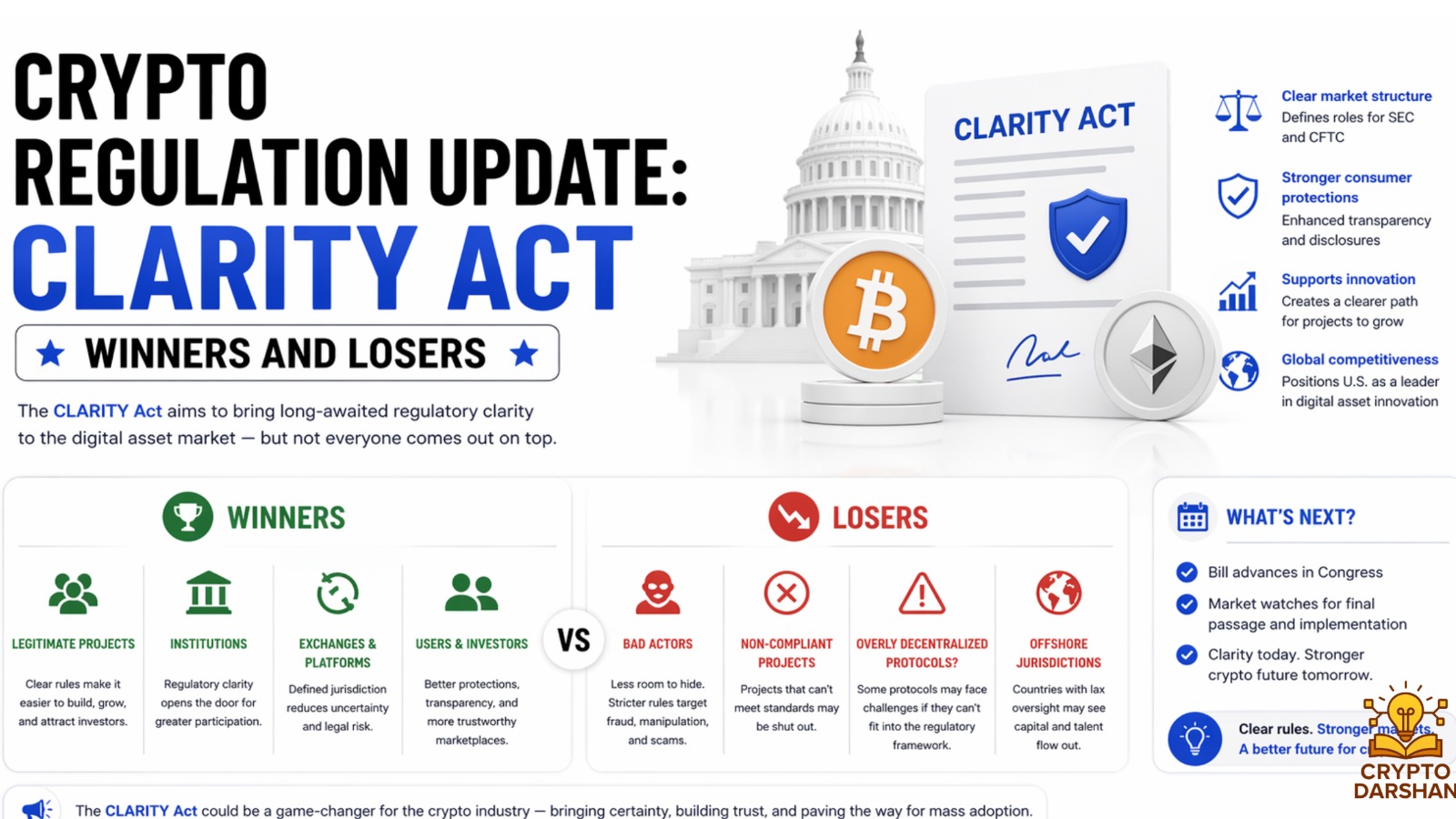
The CLARITY Act represents one of the most significant developments in cryptocurrency regulation in recent years. Designed to bring transparency, accountability, and legal certainty to the digital asset industry, the CLARITY Act aims to define how cryptocurrencies, tokens, and blockchain-based assets are classified and governed under U.S. law. For years, the crypto market has operated in a gray area, with regulators struggling to determine whether digital assets should be treated as securities, commodities, or entirely new financial instruments. it seeks to resolve this confusion by establishing a clear legal framework that benefits both innovators and investors.
This comprehensive guide explores the key provisions of the CLARITY Act, its potential impact on the crypto ecosystem, and the winners and losers emerging from this landmark legislation. By understanding the implications of the CLARITY Act, stakeholders can better navigate the evolving regulatory landscape and prepare for the future of digital finance.
Introduction to Crypto Regulation

Crypto regulation refers to the set of laws, policies, and guidelines established by governments and financial authorities to oversee the use, trading, and development of cryptocurrencies and blockchain-based assets. The goal of crypto regulation is to ensure transparency, protect investors, prevent fraud, and maintain financial stability while allowing innovation to flourish. As the cryptocurrency market has grown into a multi-trillion-dollar industry, regulators worldwide have recognized the need to create clear frameworks that define how digital assets fit into existing financial systems.
Crypto regulation covers several key areas, including anti-money laundering (AML) compliance, taxation, consumer protection, and the classification of digital assets as securities, commodities, or currencies. The challenge lies in balancing innovation with oversight—ensuring that legitimate projects can thrive while preventing misuse of digital assets for illegal activities.
Recent Updates in Crypto Regulation
In recent years, crypto regulation has evolved rapidly. Governments and financial authorities have moved from skepticism to active engagement, recognizing the potential of blockchain technology. Several major updates have shaped the current regulatory landscape:
- Global Coordination Efforts: International organizations such as the Financial Action Task Force (FATF) have introduced global standards for crypto transactions, including the “Travel Rule,” which requires exchanges to share sender and receiver information for large transfers.
- Stablecoin Oversight: Regulators have increased scrutiny of stablecoins due to concerns about their reserves and potential impact on financial stability. Many jurisdictions now require stablecoin issuers to maintain transparent, audited reserves.
- Taxation Clarity: Countries like the United States, the United Kingdom, and Australia have introduced clearer tax guidelines for crypto gains, staking rewards, and DeFi income.
- Licensing Requirements: Many nations now require crypto exchanges and custodians to obtain licenses, implement KYC (Know Your Customer) procedures, and comply with AML regulations.
- Emergence of the CLARITY Act: In the U.S., the CLARITY Act has become a cornerstone of crypto regulation, aiming to define digital assets clearly and establish a unified framework for oversight.
These updates mark a shift from reactive enforcement to proactive regulation, signaling that the crypto industry is entering a more mature and structured phase.
What Is the CLARITY Act?

The Digital Asset Market Clarity Act ,formally the Digital Asset Market Clarity Act of 2025, known as the CLARITY Act, is the most comprehensive piece of crypto regulation ever to pass one chamber of the United States Congress. It passed the House of Representatives on July 17, 2025, with a 294-134 vote. It has not passed the Senate.
The CLARITY Act, short for Cryptocurrency Legal Accountability and Regulatory Transparency for Innovation and Trustworthiness Act, is a proposed piece of legislation aimed at providing a unified regulatory framework for digital assets in the United States. Its primary goal is to eliminate ambiguity in how cryptocurrencies are classified and regulated, ensuring that both developers and investors have a clear understanding of their legal obligations.
For years, the crypto industry has faced uncertainty due to overlapping jurisdictions between the Securities and Exchange Commission (SEC) and the Commodity Futures Trading Commission (CFTC). The CLARITY Act seeks to define which digital assets qualify as securities, which fall under commodities, and which may be exempt from traditional classifications altogether. By doing so, it aims to foster innovation while protecting consumers and maintaining market integrity.
The Need for the CLARITY Act

The introduction of the CLARITY Act stems from the growing demand for regulatory certainty in the crypto industry. The lack of clear guidelines has led to numerous enforcement actions, lawsuits, and confusion among market participants. Several key factors highlight why the CLARITY Act is necessary:
1. Regulatory Ambiguity
Before the CLARITY Act, crypto projects often faced uncertainty about whether their tokens would be classified as securities. This ambiguity discouraged innovation and led to inconsistent enforcement actions by regulators.
2. Investor Protection
Without clear rules, investors were exposed to fraudulent projects and market manipulation. The Act aims to establish standards that protect consumers while allowing legitimate projects to thrive.
3. Global Competitiveness
Other countries, such as the United Kingdom, Singapore, and Switzerland, have already implemented clear crypto regulations. The CLARITY Act helps the U.S. remain competitive in the global digital economy by providing a stable regulatory environment.
4. Encouraging Institutional Adoption
Institutional investors have been hesitant to enter the crypto market due to regulatory uncertainty. The CLARITY Act provides the legal clarity needed for large financial institutions to participate confidently.
5. Promoting Innovation
By defining clear boundaries, the CLARITY Act encourages blockchain developers and entrepreneurs to innovate without fear of retroactive enforcement or unclear compliance requirements.
Key Provisions of the CLARITY Act

The CLARITY Act introduces several important provisions that reshape how digital assets are regulated in the United States. These provisions aim to balance innovation with investor protection and market stability.
1. Definition of Digital Assets
The CLARITY Act provides a standardized definition of digital assets, categorizing them into three main types:
- Digital Commodities: Assets like Bitcoin that operate on decentralized networks and are not controlled by any single entity.
- Digital Securities: Tokens that represent ownership, profit-sharing, or investment contracts, similar to traditional securities.
- Digital Payment Tokens: Cryptocurrencies primarily used for transactions and payments, such as stablecoins.
This classification helps determine which regulatory body—SEC, CFTC, or Treasury—has jurisdiction over each asset type.
2. Safe Harbor for Developers
One of the most innovative aspects of the CLARITY Act is the introduction of a safe harbor provision. This allows blockchain developers to launch new tokens without immediate classification as securities, provided they meet transparency and decentralization requirements within a specified timeframe. This provision encourages innovation while ensuring accountability.
3. Disclosure Requirements
The CLARITY Act mandates that crypto projects disclose key information about their operations, governance, and tokenomics. These disclosures aim to protect investors by ensuring transparency and reducing the risk of fraud.
4. Consumer Protection Measures
To safeguard retail investors, the CLARITY Act introduces strict anti-fraud provisions, requiring exchanges and custodians to implement robust security and compliance systems. It also mandates clear communication of risks associated with digital asset investments.
5. Interagency Coordination
It establishes a framework for cooperation between the SEC, CFTC, and other regulatory agencies. This coordination ensures consistent enforcement and prevents overlapping jurisdictional conflicts that have plagued the industry.
How the CLARITY Act Impacts the Crypto Industry

The CLARITY Act has far-reaching implications for every segment of the crypto ecosystem, from developers and exchanges to investors and regulators. Its impact can be analyzed across several dimensions.
1. Developers and Startups
For blockchain developers and startups, the CLARITY Act provides much-needed legal certainty. The safe harbor provision allows them to innovate without fear of immediate regulatory backlash. However, it also imposes new compliance obligations, such as transparency reports and investor disclosures.
2. Exchanges and Trading Platforms
Crypto exchanges stand to benefit from the CLARITY Act’s standardized classification system. Clear definitions of digital assets simplify compliance and reduce the risk of enforcement actions. However, exchanges will need to enhance their reporting and security systems to meet new regulatory standards.
3. Investors
Investors are among the biggest winners of the CLARITY Act. With improved transparency and consumer protection measures, they can make more informed decisions. The Act also reduces the risk of investing in fraudulent or non-compliant projects.
4. Institutional Participants
Institutional investors, such as hedge funds and asset managers, gain confidence from the regulatory clarity provided by the CLARITY Act. This could lead to increased institutional participation, driving liquidity and stability in the crypto market.
5. Regulators
The CLARITY Act benefits regulators by providing a unified framework for oversight. It reduces jurisdictional conflicts and allows agencies to focus on enforcement rather than interpretation.
Winners of the CLARITY Act

The CLARITY Act creates clear advantages for certain groups within the crypto ecosystem. These winners stand to gain from the increased transparency, legal certainty, and investor confidence that the Act brings.
1. Legitimate Blockchain Projects
Projects with transparent governance, real-world utility, and decentralized structures are the biggest winners. The CLARITY Act rewards compliance and innovation, allowing these projects to operate without fear of arbitrary enforcement.
2. Crypto Exchanges
Exchanges that already adhere to strong compliance standards will benefit . The new framework legitimizes their operations and may attract more institutional clients seeking regulated trading environments.
3. Investors and Consumers
Retail and institutional investors gain from enhanced protection and transparency. The CLARITY Act ensures that projects disclose essential information, reducing the risk of scams and misinformation.
4. Stablecoin Issuers
Stablecoin projects that maintain transparency and proper reserves will thrive under the CLARITY Act. The legislation provides a clear path for regulatory approval, enabling stablecoins to play a larger role in payments and DeFi ecosystems.
5. The U.S. Economy
By fostering innovation and attracting global talent, the CLARITY Act strengthens the U.S. position as a leader in blockchain technology. It encourages domestic investment and job creation in the digital asset sector.
Losers of the CLARITY Act

While the CLARITY Act benefits many, it also poses challenges for certain players in the crypto space. These “losers” may face increased scrutiny, compliance costs, or reduced flexibility.
1. Non-Compliant Projects
Projects that rely on opaque governance, lack transparency, or engage in deceptive practices will struggle under the CLARITY Act. The new disclosure requirements make it difficult for such projects to operate undetected.
2. Unregulated Exchanges
Exchanges that fail to meet compliance standards or operate without proper licensing will face enforcement actions. The CLARITY Act’s emphasis on consumer protection leaves little room for unregulated platforms.
3. Privacy Coin Developers
Privacy-focused cryptocurrencies may face stricter oversight due to concerns about money laundering and illicit activity. The CLARITY Act’s transparency requirements could limit their adoption in regulated markets.
4. Speculative Traders
The CLARITY Act may reduce the extreme volatility that speculative traders thrive on. As the market matures and becomes more regulated, opportunities for short-term manipulation may diminish.
5. Foreign Projects Avoiding U.S. Regulation
International projects that previously avoided U.S. oversight may now face stricter entry requirements. The CLARITY Act’s global influence could pressure other jurisdictions to adopt similar standards.
The CLARITY Act and the SEC-CFTC Divide

One of the most contentious issues in crypto regulation has been the jurisdictional divide between the SEC and the CFTC. The Act addresses this by clearly delineating responsibilities:
- The SEC oversees digital securities—tokens that represent investment contracts or ownership stakes.
- The CFTC regulates digital commodities—assets like Bitcoin and Ethereum that function as decentralized commodities.
- The Treasury Department manages digital payment tokens and anti-money laundering compliance.
This division of labor reduces confusion and ensures that each agency focuses on its area of expertise. It also prevents overlapping enforcement actions that have previously hindered market growth.
The CLARITY Act and DeFi Regulation

Decentralized Finance (DeFi) has been one of the fastest-growing sectors in crypto, but it also presents unique regulatory challenges. The CLARITY Act introduces specific guidelines for DeFi platforms:
- Transparency Requirements: DeFi protocols must disclose governance structures, smart contract audits, and risk factors.
- Compliance Standards: Platforms facilitating lending, borrowing, or trading must implement anti-fraud and anti-money laundering measures.
- User Protection: The Act mandates clear communication of risks to users, ensuring informed participation.
While these measures may increase compliance costs, they also legitimize DeFi as a recognized financial sector, paving the way for institutional adoption.
The CLARITY Act and Stablecoins

Stablecoins play a crucial role in the digital economy, serving as a bridge between traditional finance and crypto. The CLARITY Act introduces comprehensive regulations for stablecoin issuers:
- Reserve Requirements: Issuers must maintain transparent reserves backed by verifiable assets.
- Regular Audits: Independent audits ensure that stablecoins remain fully collateralized.
- Consumer Protection: Clear redemption policies protect users from liquidity crises.
These provisions enhance trust in stablecoins, making them more attractive for payments, remittances, and decentralized finance applications.
The CLARITY Act and NFTs

Non-Fungible Tokens (NFTs) have revolutionized digital ownership, but their regulatory status has been uncertain. The Act clarifies that NFTs representing unique digital assets are not securities unless they are marketed as investment contracts. This distinction protects artists and creators while preventing misuse of NFTs for speculative or fraudulent purposes.
The CLARITY Act and Global Implications

The CLARITY Act is not just a domestic policy, it has global implications. As one of the world’s largest financial markets, U.S. regulations often set international standards. The Act could inspire other countries to adopt similar frameworks, promoting global consistency in crypto regulation. This harmonization benefits multinational crypto companies and reduces the risk of regulatory arbitrage.
Challenges in Implementing the CLARITY Act
Despite its benefits, the CLARITY Act faces several implementation challenges:
- Technological Complexity: Regulators must understand rapidly evolving blockchain technologies to enforce the Act effectively.
- Resource Constraints: Agencies may require additional funding and expertise to oversee the expanding crypto market.
- Industry Resistance: Some crypto projects may resist increased oversight, citing concerns about innovation and privacy.
- Global Coordination: Aligning international regulations remains a complex task, especially with differing national priorities.
Addressing these challenges will be crucial to the Act’s long-term success.
The Future of Crypto Regulation After the CLARITY Act

The CLARITY Act marks the beginning of a new era in crypto regulation. As the industry matures, additional legislation may build upon its foundation, addressing emerging technologies such as decentralized identity, Web3 governance, and tokenized real-world assets. The Act’s success will depend on continuous collaboration between regulators, developers, and investors.
In the long term, the CLARITY Act could transform the crypto market into a more transparent, stable, and inclusive ecosystem. By balancing innovation with accountability, it sets the stage for sustainable growth and mainstream adoption.
FAQ: CLARITY Act Winners and Losers

1. What is the CLARITY Act?
The CLARITY Act is a proposed U.S. crypto regulation framework designed to clearly define how digital assets are classified and which agencies oversee them.
2. Why is the CLARITY Act important for the crypto industry?
It aims to remove regulatory uncertainty by establishing clear rules, which could encourage innovation, institutional investment, and broader adoption.
3. Which regulators are involved under the CLARITY Act?
The Act primarily clarifies the roles of the U.S. Securities and Exchange Commission and the Commodity Futures Trading Commission in overseeing different types of crypto assets.
4. Who are the biggest winners of the CLARITY Act?
Projects with strong decentralization, compliant token structures, and transparent governance are likely to benefit the most, along with institutional investors seeking regulatory clarity.
5. Which crypto projects could be considered “losers”?
Highly centralized projects or those that resemble unregistered securities may face stricter scrutiny, compliance costs, or even delisting risks.
6. How does the CLARITY Act affect Bitcoin and Ethereum?
Major assets like Bitcoin and Ethereum are generally expected to fall under more favorable classifications due to their decentralization.
7. Will the CLARITY Act impact crypto exchanges?
Yes. Exchanges may need to register differently depending on the assets they list, which could change how trading platforms operate and what tokens are available.
8. Does this Act make crypto safer for investors?
Potentially. Clearer rules can reduce fraud and improve transparency, but risks like volatility and market manipulation still remain.
Conclusion
The CLARITY Act represents a turning point for the cryptocurrency industry. By providing clear definitions, regulatory boundaries, and investor protections, it resolves years of uncertainty that have hindered growth. The winners, legitimate projects, compliant exchanges, and informed investors—stand to benefit from a more stable and trustworthy market. The losers, non-compliant actors and opaque operations, will face increased scrutiny and potential exclusion.
Ultimately, the CLARITY Act is not just about regulation; it’s about building a foundation for the future of digital finance. Its emphasis on transparency, accountability, and innovation ensures that the crypto industry can evolve responsibly while maintaining the core principles of decentralization and freedom that define blockchain technology.