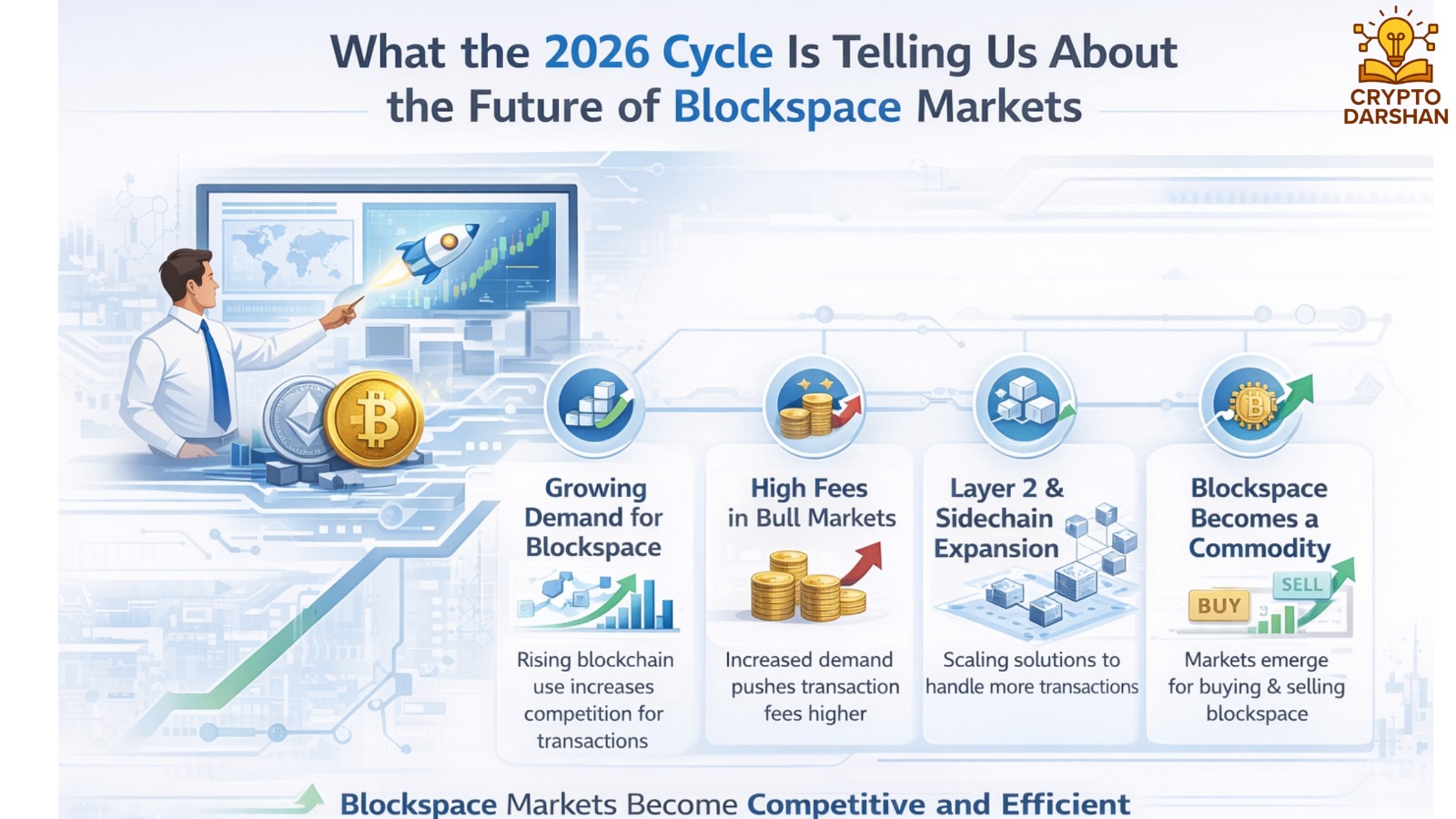
The 2026 crypto cycle marks a turning point in the evolution of blockchain economics. Unlike previous cycles driven by speculation, hype, and retail mania, this era is defined by the maturation of blockspace markets, the economic systems that determine how blockchain networks allocate, price, and monetize their computational resources. As decentralized applications (dApps), rollups, and modular blockchains proliferate, the demand for it has become the central driver of value across the crypto ecosystem.
Understanding the 2026 cycle requires looking beyond token prices and focusing on the underlying infrastructure that powers decentralized systems. Blockspace, the finite capacity of a blockchain to process transactions and execute smart contracts, has emerged as the new oil of the digital economy. The way it is produced, traded, and consumed reveals where the industry is heading.
This article explores how the 2026 cycle is reshaping markets, the forces driving demand and supply, the role of modular architectures, and what this means for investors, developers, and users. It also examines the economic models, competitive dynamics, and regulatory trends shaping the future of blockchain scalability and monetization.
1. Understanding Blockspace: The Foundation of Blockchain Economics

1.1 What Is Blockspace?
Blockspace refers to the finite capacity within a blockchain block that is available for storing transactions and other data. See a blockchain like a digital ledger (it’s more than this anyway), and each “block” as a page in that ledger. Block space is essentially how much “writing room” is available on each page. Users compete for this space by paying transaction fees, creating a market where it is the primary commodity.
In simple terms, blockspace is the “real estate” of a blockchain. Just as land in a city becomes more valuable as demand increases, they become more expensive when network activity surges. This dynamic underpins the economic structure of all blockchain networks.
1.2 The Evolution of Blockspace Markets
In the early days of Bitcoin and Ethereum, blockspace pricing was straightforward: users paid fees directly to miners or validators to include their transactions. Over time, as networks grew more complex, new layers of abstraction emerged. Rollups, sidechains, and modular architectures introduced secondary markets, where different layers compete and cooperate to provide scalability.
By 2026, the markets have evolved into multi‑layered ecosystems. Base layers like Ethereum, Solana, and Bitcoin provide foundational security, while rollups and app‑specific chains offer specialized environments for computation and storage. The interplay between these layers defines the modern economy.
1.3 Why it Matters
Blockspace is the ultimate bottleneck in blockchain scalability. Every decentralized application, from DeFi protocols to NFT marketplaces, depends on it. The cost and availability of blockspace determine user experience, transaction throughput, and network sustainability. As demand for decentralized computation grows, efficient allocation becomes critical to the industry’s long‑term viability.
The pace markets are ultimately driven by transaction costs. In The Economics of Gas Fees: Who Really Pays for Blockchains?, we break down how fee mechanisms work, why prices spike during congestion, and how this directly reflects demand for limited blockspace.
2. The 2026 Cycle: A Shift from Speculation to Utility

2.1 The Maturation of the Crypto Market
Previous crypto cycles were dominated by speculative narratives: ICOs in 2017, DeFi in 2020, and NFTs in 2021. The 2026 cycle, however, is characterized by utility‑driven growth. Institutional adoption, real‑world asset tokenization, and enterprise blockchain integration have created sustained demand for reliable, scalable infrastructure.
This shift has redirected attention from token speculation to the economics of blockspace. Investors now evaluate networks based on throughput, latency, and fee efficiency rather than hype or meme potential.
2.2 The Rise of Modular Architectures
The modular blockchain thesis, separating execution, consensus, and data availability, has become mainstream by 2026. Networks like Celestia, EigenLayer, and Avail have redefined how block space is produced and consumed. Instead of monolithic chains handling all functions, modular systems allow specialized layers to optimize specific tasks.
This modularization has created interconnected markets, where rollups purchase data availability from base layers, and applications rent execution capacity from rollup providers. The result is a dynamic, multi‑tiered economy resembling cloud computing markets.
2.3 Institutional Demand and Real‑World Integration
Institutional players now consume blockspace directly. Banks, supply chain companies, and governments deploy smart contracts for settlement, compliance, and data verification. These entities require predictable fees, high throughput, and regulatory clarity, driving demand for enterprise‑grade solutions.
The 2026 cycle demonstrates that blockspace is no longer a niche commodity for crypto enthusiasts; it is a critical infrastructure resource for global digital systems.
3. The Supply Side: How They are Produced

3.1 Base Layer Production
At the base layer, blockspace is produced by validators or miners who secure the network. The supply is constrained by protocol parameters such as block size, gas limits, and consensus speed. Increasing the supply at this level often requires trade‑offs between decentralization, security, and scalability.
Ethereum’s transition to proof‑of‑stake and its rollup‑centric roadmap exemplify this balance. Instead of expanding base layer capacity indefinitely, Ethereum focuses on optimizing rollup efficiency and data availability.
3.2 Rollups and Layer‑2 Solutions
Rollups aggregate multiple transactions off‑chain and submit compressed proofs to the base layer. This approach multiplies effective blockspace supply without compromising security. By 2026, rollups like Arbitrum, Optimism, zkSync, and Starknet have become major producers, each with distinct pricing models and performance characteristics.
Rollups sell execution blocks to users and developers, while purchasing data availability blockspace from base layers. This creates a two‑sided market where efficiency and interoperability determine competitiveness.
3.3 App‑Specific Chains and Subnets
App‑specific chains, such as Cosmos zones and Avalanche subnets, produce dedicated for individual applications. These environments allow developers to customize parameters like gas fees, consensus mechanisms, and governance. The trade‑off is reduced composability with other ecosystems.
In 2026, many DeFi protocols and gaming platforms operate their own chains, effectively becoming blockspace providers. This trend decentralizes production and diversifies the supply landscape.
3.4 Data Availability Layers
Data availability (DA) layers ensure that transaction data is accessible for verification. Networks like Celestia and EigenDA specialize in providing DA to rollups. This specialization has created a new category of blockspace producers focused solely on data integrity and scalability.
4. The Demand Side: Who Buys it and Why

4.1 Decentralized Applications (dApps)
dApps are the primary consumers of blockspace. Each transaction, contract execution, or state update requires space within a block. As user bases grow, so does demand. DeFi protocols, NFT platforms, and gaming applications compete for limited capacity, driving up fees during peak periods.
As demand grows, access to data becomes just as important as execution. In Why Data Availability Is the Next Big Battleground in Blockchain, we explain how efficient data access is reshaping scalability and redefining the limits.
4.2 Rollups and Middleware Providers
Rollups themselves are major blockspace buyers. They purchase data availability from base layers and resell execution capacity to end users. Middleware providers, such as oracles, bridges, and indexing services, also consume to maintain network functionality.
4.3 Institutional and Enterprise Users
Enterprises use blockspace for asset tokenization, supply chain tracking, and compliance automation. These users prioritize reliability and predictability over cost, often entering long‑term contracts with blockspace providers.
4.4 Retail Users and Communities
Retail users indirectly consume blockspace through wallets, games, and social applications. Their collective activity influences network congestion and fee dynamics. In 2026, user‑friendly interfaces abstract away gas fees, but the underlying economics still depend on blockspace demand.
5. Pricing Mechanisms in Blockspace Markets

5.1 Fee Markets and Auctions
Most blockchains use auction‑based fee markets where users bid for inclusion. Ethereum’s EIP‑1559 introduced a base fee mechanism that adjusts dynamically based on demand. Rollups and modular chains have adopted similar models, often with additional layers of complexity.
5.2 Dynamic Pricing and Predictive Models
Advanced networks now use predictive algorithms to forecast demand and adjust fees proactively. These models analyze historical data, mempool activity, and cross‑chain signals to stabilize pricing. This reduces volatility and improves user experience.
5.3 Subscription and Reservation Models
Some block providers offer subscription‑based access, allowing users to reserve capacity in advance. This model appeals to enterprises and high‑frequency traders who require guaranteed throughput. It mirrors cloud computing’s reserved instance model.
5.4 Cross‑Layer Arbitrage
Differences in pricing across layers create arbitrage opportunities. Traders and protocols route transactions through the cheapest available path, optimizing for cost and speed. This dynamic fosters competition and efficiency across the ecosystem.
6. The Economics of Blockspace in 2026

6.1 Blockspace as a Commodity
By 2026, blockspace is treated as a tradable commodity. Marketplaces allow participants to buy, sell, and lease capacity across networks. Tokenized representations of blockspace enable futures and derivatives trading, allowing hedging against fee volatility.
6.2 Elastic Supply and Demand
Unlike physical commodities, block supply is elastic within protocol constraints. Developers can deploy new rollups or sidechains to increase capacity. However, demand often scales faster than supply, maintaining upward pressure on prices during bull markets.
6.3 Value Capture and Revenue Distribution
Validators, sequencers, and DA providers capture revenue from blockspace sales. Protocols distribute these earnings through staking rewards, token burns, or treasury allocations. The most successful networks balance profitability with affordability to sustain growth.
6.4 The Role of Interoperability
Interoperability between blockchains enhances market efficiency. Cross‑chain bridges and messaging protocols allow blockspace to be utilized seamlessly across ecosystems. This reduces fragmentation and promotes a unified global economy.
7. Technological Innovations Shaping Markets

7.1 Zero‑Knowledge Proofs (ZKPs)
ZKPs enable scalable and private computation. zk‑rollups compress transaction data efficiently, increasing blockspace utilization. By 2026, ZK technology underpins most high‑performance rollups, reducing costs and enhancing security.
7.2 Data Availability Sampling (DAS)
DAS allows nodes to verify data availability without downloading entire blocks. This innovation improves scalability and decentralization, enabling lightweight clients to participate in validation.
7.3 Modular Execution Layers
Execution layers can now be deployed as independent modules connected to shared DA layers. This modularity allows developers to customize performance parameters and optimize blockspace usage for specific applications.
7.4 AI‑Driven Optimization
Artificial intelligence models analyze network conditions and optimize transaction routing. These systems predict congestion, adjust gas fees, and allocate it dynamically, improving efficiency across the ecosystem.
8. Competitive Dynamics Among Blockspace Providers

8.1 Ethereum’s Dominance and Rollup Ecosystem
Ethereum remains the leading blockspace provider due to its security and developer network. However, most activity now occurs on rollups, making Ethereum the settlement and DA layer for a vast modular ecosystem.
8.2 The Rise of Alternative Layer‑1s
Networks like Solana, Avalanche, and Sui compete by offering high throughput and low fees. Their monolithic designs appeal to applications requiring real‑time performance, such as gaming and high‑frequency trading.
8.3 Modular Networks and Data Availability Wars
Celestia, EigenLayer, and Avail compete in the DA market, offering scalable and cost‑efficient solutions. Their success depends on interoperability, reliability, and integration with major rollups.
8.4 App‑Specific Economies
App‑specific chains create micro‑economies where blockspace is tailored to niche use cases. These ecosystems thrive on customization and community governance, offering alternatives to generalized blockspace markets.
9. Regulatory and Policy Considerations

9.1 Defining Blockspace as a Resource
Regulators are beginning to recognize blockspace as a digital commodity. This classification influences taxation, accounting, and compliance frameworks. Clear definitions are essential for institutional adoption.
9.2 Environmental and Energy Concerns
Proof‑of‑stake systems have reduced energy consumption, but large‑scale blockspace production still requires significant computational resources. Sustainability metrics are becoming part of regulatory assessments.
9.3 Data Sovereignty and Privacy
As blockspace markets globalize, questions arise about data jurisdiction and privacy. Governments seek to ensure that sensitive data stored on public blockchains complies with local regulations.
9.4 Market Manipulation and Fair Access
Ensuring fair access to blockspace is a growing concern. Regulators monitor for anti‑competitive behavior, such as preferential treatment by sequencers or validators. Transparency and open access remain key principles.
10. The Future of Blockspace Markets

10.1 Tokenized Blockspace and Derivatives
A tokenized block allows users to trade future capacity. Derivatives markets enable hedging against fee volatility, similar to energy or bandwidth futures. This financialization adds depth and liquidity to markets.
10.2 Cross‑Chain Liquidity and Unified Markets
Interoperability protocols are converging toward unified blockspace markets where users can access capacity across multiple chains through a single interface. This integration mirrors the evolution of global financial markets.
10.3 Autonomous Market Makers for Blockspace
Automated systems dynamically price and allocate blockspace based on real‑time demand. These autonomous market makers (AMMs) ensure efficient utilization and reduce congestion.
10.4 The Role of AI and Predictive Infrastructure
AI‑driven infrastructure predicts demand surges and reallocates resources automatically. This predictive capacity transforms blockspace markets into self‑optimizing systems, minimizing waste and maximizing throughput.
11. Implications for Developers and Investors
11.1 Developers: Building for Efficiency
Developers must design applications that optimize blockspace usage. Efficient smart contract design, compression techniques, and off‑chain computation reduce costs and improve scalability.
11.2 Investors: Evaluating Economics
Investors now analyze networks based on blockspace supply, demand elasticity, and revenue models. Metrics such as fee revenue, utilization rates, and DA costs have become key valuation indicators.
11.3 Protocol Designers: Balancing Incentives
Protocol designers face the challenge of balancing validator rewards, user affordability, and network sustainability. Incentive alignment is crucial to maintaining healthy blockspace markets.
11.4 Users: Navigating a Multi‑Layered Ecosystem
Users interact with multiple layers, wallets, rollups, and DA providers, often without realizing it. Simplified interfaces and gas abstraction tools are essential for mainstream adoption.
12. Challenges and Risks Ahead

12.1 Fragmentation and Complexity
The proliferation of layers and chains increases complexity. Fragmented liquidity and inconsistent standards hinder seamless user experiences. Interoperability remains a top priority.
12.2 Centralization Risks
As the markets mature, large providers may dominate supply, leading to centralization. Ensuring open participation and decentralized governance is vital for long‑term resilience.
12.3 Security and Data Integrity
Cross‑chain bridges and modular architectures introduce new attack vectors. Maintaining data integrity across layers requires robust cryptographic guarantees and continuous auditing.
12.4 Economic Volatility
Blockspace prices fluctuate with market cycles. During bull runs, fees can spike dramatically, while bear markets may reduce validator incentives. Sustainable pricing mechanisms are needed to stabilize the ecosystem.
13. The Broader Economic Impact

13.1 Blockspace as Digital Infrastructure
It has become a foundational layer of the digital economy, akin to cloud computing or internet bandwidth. Its efficient allocation determines the scalability of decentralized systems worldwide.
13.2 Integration with Traditional Finance
Tokenized assets, stablecoins, and on‑chain settlement systems rely on blockspace. As traditional finance integrates with blockchain, demand for secure and compliant solutions will continue to grow.
13.3 The Emergence of Data Economies
Blockspace markets intersect with data economies, where information storage, computation, and verification are monetized. This convergence creates new business models and revenue streams.
13.4 Global Accessibility and Inclusion
Decentralized blockspace markets democratize access to financial and computational resources. By lowering barriers to entry, they empower individuals and communities worldwide.
14. Predictions for the Next Decade

- Unified Blockspace Exchanges: Cross‑chain marketplaces will allow seamless trading of blockspace across ecosystems.
- AI‑Optimized Networks: Predictive algorithms will manage congestion and pricing autonomously.
- Tokenized Infrastructure Funds: Investors will gain exposure to revenue through tokenized funds.
- Regulated Commodities: Governments will establish frameworks for trading and taxation.
- Sustainable Scalability: Energy‑efficient consensus and compression technologies will reduce environmental impact.
- User‑Centric Abstraction: Wallets will hide complexity, offering frictionless access to multi‑chain blockspace.
- Decentralized Governance Models: DAOs will oversee the allocation and pricing fairness.
- Integration with AI and IoT: Machine‑to‑machine transactions will consume it autonomously, expanding demand exponentially.
15. FAQ

1. What is a blockspace market in simple terms?
A blockspace market refers to how users compete to get their transactions included in a blockchain block. Since it is limited, users pay fees to prioritize their transactions, creating a market driven by supply and demand.
2. Why is the 2026 cycle important for blockspace markets?
The 2026 cycle highlights how demand for block has shifted beyond simple transfers to include DeFi, NFTs, AI-related transactions, and rollups. This growing demand is reshaping how it is priced, allocated, and optimized.
3. What key trends define blockspace markets in 2026?
Major trends include:
- Rise of Layer 2 scaling solutions
- Fee market optimization (e.g., dynamic pricing models)
- Increased competition between blockchains
- Growth of MEV (Maximal Extractable Value) markets
- Specialized chains for specific use cases
4. How do fees reflect blockspace demand?
Transaction fees act as a real-time indicator of demand. When network activity spikes, fees rise as users compete for limited space. When demand drops, fees decrease, making blockspace markets highly dynamic.
5. What role do Layer 2 solutions play in blockspace markets?
Layer 2 networks reduce congestion on main blockchains by processing transactions off-chain and settling them in batches. This effectively creates new supply, easing pressure on Layer 1 fee markets.
6. What is MEV and why does it matter?
MEV (Maximal Extractable Value) refers to profits that validators or bots can extract by reordering, including, or excluding transactions. In 2026, MEV has become a major force shaping blockspace pricing and fairness.
7. Are blockspace markets becoming more efficient?
Yes, but with trade-offs. Improvements like better fee mechanisms and rollups increase efficiency, but they also introduce complexity and new forms of competition, especially among sophisticated players.
8. How are institutions influencing the markets?
Institutions are:
- Competing for priority transaction inclusion
- Using advanced algorithms to optimize fees
- Participating in MEV strategies
Their presence is making blockspace markets more competitive and data-driven.
16. Conclusion
The 2026 cycle reveals a fundamental truth: the future of blockchain lies not in speculative tokens but in the efficient allocation of blockspace. As modular architectures, rollups, and data availability layers redefine scalability, it has become the core economic unit of decentralized systems.
The evolution of blockspace markets mirrors the growth of the internet and cloud computing, transforming from experimental infrastructure into a global utility. The networks that manage the most efficiently will shape the next decade of digital innovation.
For developers, investors, and policymakers, understanding it’s economics is no longer optional; it is essential. The 2026 cycle is not just another phase in crypto’s boom‑and‑bust history; it is the dawn of a new era where it becomes the foundation of the decentralized world.