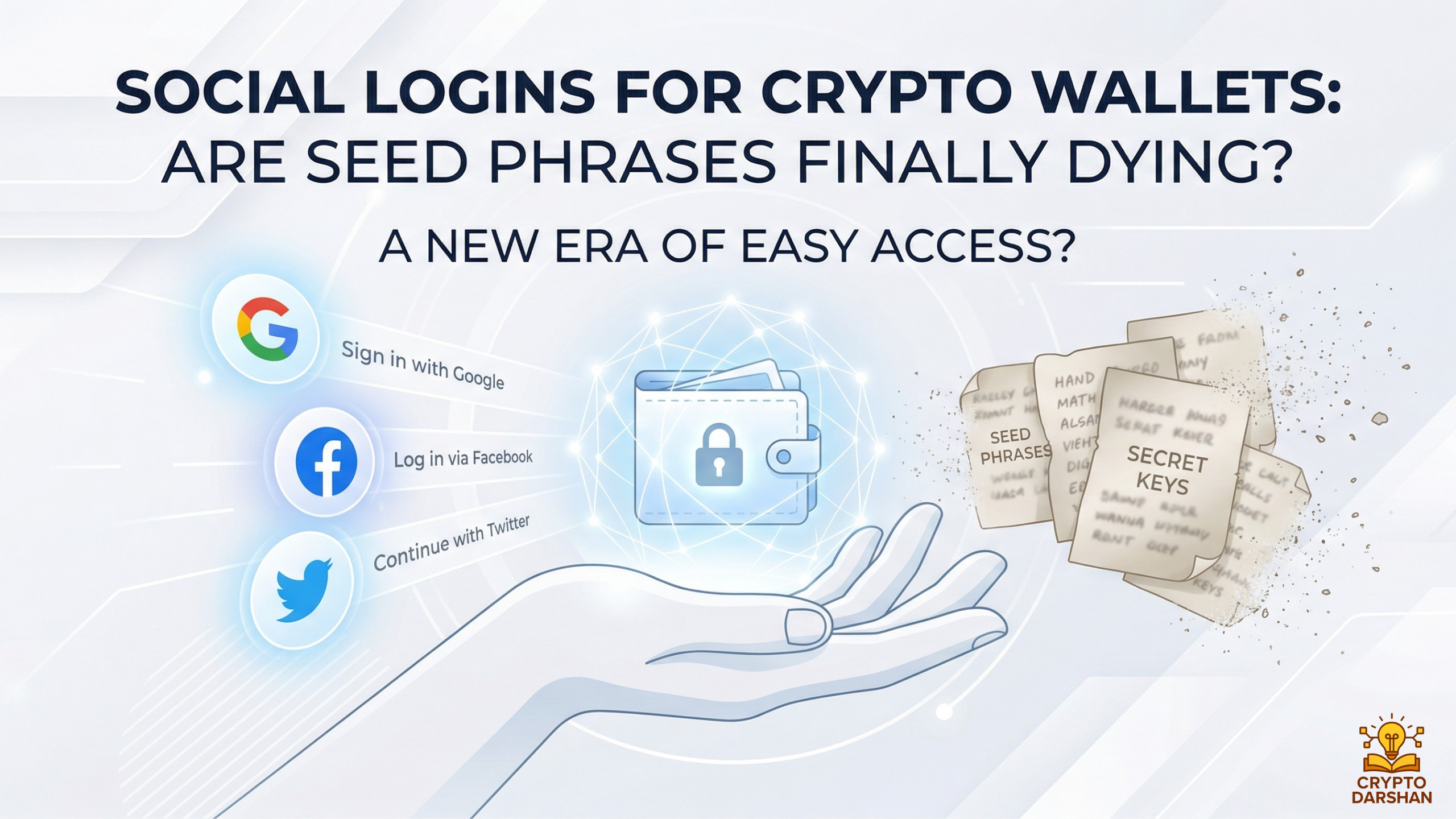
Seed phrases have been the backbone of self-custody since the earliest days of crypto. They’re also one of the biggest reasons mainstream users still hesitate to use wallets. A 12–24 word recovery phrase is powerful, but it’s unforgiving: lose it and you lose access; leak it and you lose everything.
Now a new wave of wallets is pushing “social login” experiences—sign in with Google, Apple, email, or passkeys—while still claiming to preserve self-custody. This shift is often grouped under account abstraction, MPC (multi-party computation), smart contract wallets, and keyless wallets. The promise is simple: crypto wallets that feel like modern apps.
So, are seed phrases finally dying?
Not exactly. But they are being hidden, replaced, split, or made optional—and that’s a big deal. In this guide, we’ll break down how social logins work in crypto wallets, what’s actually happening under the hood, the security trade-offs, and what it means for the future of self-custody.
Why Seed Phrases Became the Standard
Seed phrases (typically BIP-39 mnemonics) solved a real problem: how do you back up a wallet without copying raw private keys?
The primary purpose of a seed phrase is to provide a human-readable format for the complex cryptographic keys that control access to your cryptocurrency holdings. From that master secret, wallets derive many addresses and keys. This gave users:
- Portability: restore your wallet on any compatible app
- Offline backup: write it down, store it in a safe
- No dependency: no company needed to recover access
- Deterministic structure: one phrase controls many accounts
For early adopters, this was perfect. Crypto was niche, users were technical, and self-custody was the point.
But as crypto tried to reach everyday users, seed phrases became a major friction point.
Why Seed Phrases Are Failing Mainstream Adoption
Seed phrases are secure in theory, but in practice they create failure modes that normal users aren’t trained to handle.
The biggest UX problems
1. Users don’t back them up properly
Many people skip writing them down, screenshot them, or store them in cloud notes. Each choice introduces risk.
2. The consequences are extreme
Forget a password? Reset it. Lose a seed phrase? Funds can be gone forever.
3. Phishing is relentless
Attackers don’t need to hack cryptography. They just trick users into typing the phrase into a fake site.
4. Multi-device life is normal now
People expect to sign in on phone, laptop, tablet. Seed phrases weren’t designed for that.
5. Customer support can’t help
Self-custody means no “forgot password” button. That’s philosophically aligned with crypto, but it’s not aligned with mainstream expectations.
The adoption reality
If crypto wallets want to compete with fintech apps, they need:
- Familiar onboarding
- Easy recovery
- Multi-device sync
- Reduced user error
- Lower phishing success rates
That’s why “seedless” wallets are booming.
What “Social Login” Means in Crypto Wallets
In normal apps, social login means authentication is delegated to an identity provider like Google or Apple. You click “Continue with Google,” approve, and you’re in.
In crypto wallets, “social login” usually means:
- You authenticate with Google/Apple/email/passkey to unlock or reconstruct your wallet key, not to “log into a server account” (at least in non-custodial designs).
- The wallet uses cryptography to ensure no single party (including the wallet company) can move funds alone.
However, not all “social login wallets” are equal. Some are:
- Custodial (the company controls keys; social login is just account access)
- Non-custodial but assisted (keys are split; recovery uses providers)
- Smart contract wallets (your “account” is a contract with programmable recovery)
So the key question isn’t “Does it use Google login?”
It’s: Who can sign transactions, and what happens if you lose access?
The Main Technologies Enabling Seedless Wallets
Seed phrases are one way to manage keys. Social login wallets use different architectures.
A) MPC Wallets (Multi-Party Computation)
MPC allows a private key to be split into shares so that:
- No single share reveals the full key
- Multiple shares can jointly sign a transaction
- Recovery can be designed around replacing lost shares
A common pattern is 2-of-3:
- Share A: on your device
- Share B: held by the wallet provider (or a secure enclave service)
- Share C: stored in cloud backup or another device
To sign, you might need two shares. If you lose your phone, you can recover using the other shares after authenticating via social login.
Why MPC is popular:
It keeps the “private key” concept but removes the need for users to handle a seed phrase directly.
Trade-off:
You may depend on the provider’s infrastructure for signing or recovery, even if they can’t steal funds alone.
B) Smart Contract Wallets & Account Abstraction
On networks like Ethereum, a wallet can be a smart contract rather than a simple externally owned account (EOA). This enables:
- Social recovery (guardians can restore access)
- Spending limits
- Multi-sig-like security
- Session keys (temporary keys for apps)
- Gas sponsorship (someone else pays fees)
Account abstraction (often discussed as ERC-4337 and related approaches) makes wallets behave more like programmable accounts.
Why this matters for seed phrases:
If your wallet is a contract, recovery doesn’t have to mean “restore the same private key.” You can rotate keys and update permissions.
Trade-off:
Smart contract wallets can be more complex, may rely on bundlers/relayers, and introduce smart contract risk.
C) Passkeys and WebAuthn
Passkeys are becoming mainstream across Apple, Google, and browsers. They use public-key cryptography and are resistant to phishing.
In a wallet context, passkeys can:
- Authenticate you to reconstruct key shares
- Approve sensitive actions
- Replace passwords and reduce SIM-swap risk
Why passkeys are a big deal:
They align crypto security with modern consumer security standards.
Trade-off:
Passkeys are tied to ecosystems (iCloud Keychain, Google Password Manager). That’s convenient, but it introduces platform dependency.
D) Social Recovery and Guardians
Social recovery means you choose trusted parties (friends, devices, institutions) as guardians. If you lose access, a threshold of guardians can approve recovery.
Example: 3-of-5 guardians can restore your wallet.
Guardians can be:
- Your other devices
- Friends/family
- A hardware wallet
- A professional service
Why it’s powerful:
It mirrors how people actually manage risk—distributed trust.
Trade-off:
It requires setup and social coordination. Guardians can be compromised or coerced.
The future of blockchain innovation extends beyond wallets, with AI-driven crypto projects rapidly gaining traction. Read more in “Top AI Crypto Coins in 2026: Where Smart Money Is Going.”
How Seedless Recovery Works
Let’s make this concrete. Here are common recovery designs.
Flow 1: Email/Google login + MPC shares
You create a wallet.
The wallet generates key shares:
- One share stays on your phone
- One share is encrypted and stored in cloud
- One share is held by the provider (or a secure service)
You lose your phone.
You install the wallet on a new phone.
You sign in with Google/email.
The wallet retrieves encrypted shares and reconstructs signing ability using threshold rules.
What you experience
“I logged in and my wallet came back.”
What’s happening
cryptographic reconstruction, not a seed phrase restore.
Flow 2: Passkey-based wallet access
- You create a wallet and register a passkey.
- Your passkey is synced across devices via your OS ecosystem.
- On a new device, you authenticate with biometrics.
- The wallet uses passkey authentication to unlock key material or request shares.
What you experience: Face ID / fingerprint unlock.
What’s happening: public-key authentication and secure enclave operations.
Flow 3: Smart contract wallet with guardians
- Your wallet is a smart contract.
- You set guardians (friends/devices).
- You lose your main device.
- You initiate recovery from a new device.
- Guardians approve.
- The contract updates the authorized key to your new device.
What you experience: “My guardians helped me recover.”
What’s happening: on-chain permission update.
Security: What Improves, What Gets Worse
Seed phrases are simple: one secret controls everything. That simplicity is both strength and weakness.
What social login wallets can improve
1. Reduced phishing success
Users are less likely to type a seed phrase into a fake site if they never see one.
2. Better recovery outcomes
People lose phones. Seedless recovery can prevent permanent loss.
3. Stronger default security
MPC + device security + passkeys can outperform “seed phrase in Notes app.”
4. Multi-device support
Modern users expect it. Seedless designs can support it safely.
What can get worse

1. New trust assumptions
Even if a provider can’t steal funds alone, they may still:
- Be required for recovery
- Be a target for attackers
- Be pressured to block access in some jurisdictions
2. More moving parts
More infrastructure means more potential failure points:
- Cloud backups
- Identity providers
- Recovery services
- Smart contract code
3. Account takeover risks shift
Instead of “steal seed phrase,” attackers may target:
- Email compromise
- Google/Apple account compromise
- SIM swap (if SMS is used anywhere)
- Device malware
4. Privacy leakage
Linking wallet access to a social identity can create metadata trails.
The key takeaway
Seed phrases concentrate risk in one place: the phrase. Seedless wallets distribute risk across systems: identity, devices, providers, and cryptography.
Neither is automatically “more secure.” It depends on implementation and user behavior. Wallet security and ownership can also influence governance participation and voting power in decentralized networks. To understand how these power dynamics shape blockchain ecosystems, read our article Blockchain Governance Wars: Forks, Votes, and Behind-the-Scenes Power.
Custodial vs Non-Custodial: Where Social Login Fits
This is where marketing can get confusing.
Custodial wallet with social login
- Company controls keys
- Social login controls access to your account
- Recovery is easy
- You rely on the company fully
This is similar to an exchange account.
Non-custodial wallet with social login
- You control funds cryptographically
- Social login is used to authenticate recovery or unlock key shares
- Provider may not be able to move funds alone
This is closer to self-custody, but with assistance.
How to tell the difference (simple checks)
Ask:
- Can the provider move funds without me?
If yes, it’s custodial.
- Can I export a key or migrate easily?
If no, you may be locked into a proprietary system.
- What happens if the provider disappears?
If you lose access, that’s a major risk.
- Is recovery on-chain (contract-based) or off-chain (service-based)?
On-chain recovery can be more transparent, but still not risk-free.
Privacy Implications of Social Login Wallets
Seed phrases are anonymous by default. Social login is not.
Even if the wallet is non-custodial, using Google/Apple/email can create linkages:
- Your wallet creation time tied to an identity
- IP/device metadata tied to login events
- Potential correlation between accounts and addresses
Some wallets mitigate this with:
- Minimal data collection
- Zero-knowledge approaches
- Local-only key shares
- Optional anonymous modes
But users should assume: social login increases the chance of identity correlation, especially if combined with KYC on ramps.
UX and Product Design: Why This Is Happening Now
Three forces are pushing seed phrases out of the default experience:
1) Crypto is competing with fintech UX
People compare wallets to banking apps, not to command-line tools.
2) Mobile security got better
Secure enclaves, biometrics, passkeys, and OS-level protections make device-based security more viable.
3) Smart contract wallets matured
Account abstraction and wallet infrastructure (bundlers, paymasters, relayers) make advanced UX possible.
The result: wallets can finally offer:
- One-tap onboarding
- Gasless transactions (in some setups)
- Recovery without panic
- Safer defaults for non-technical users
Regulation and Compliance Pressures
Social login wallets sit in a complicated space:
- They may not custody funds, but they may provide critical infrastructure
- They may be asked to comply with sanctions or legal orders
- They may need to implement risk controls if they integrate fiat ramps
This doesn’t mean seedless wallets are “bad.” It means users should understand:
- Censorship resistance can be weaker if recovery depends on a provider
- Jurisdiction risk matters if the provider is centralized
For high-value, high-sovereignty use cases, these factors are important.
Who Should Use Seedless Wallets—and Who Shouldn’t
Seedless/social login wallets are great for:
- New users onboarding for the first time
- Small-to-medium balances
- Everyday spending wallets
- NFT/gaming/social apps where UX matters
- Users who are likely to lose a seed phrase or store it insecurely
Seed phrases (or hardware + robust backups) are better for:
- Large long-term holdings
- Users who want maximum independence
- People comfortable with operational security
- Treasury management and institutional custody setups (often multi-sig)
A practical approach many experienced users take:
- Seedless wallet for daily use
- Cold storage / hardware wallet for savings
Best Practices If You Choose Social Login
If you’re going seedless, treat it like a security system—not just a login button.
Do this:
- Use passkeys if available (more phishing-resistant than passwords).
- Harden your email account (2FA, recovery codes, strong password manager).
- Avoid SMS-based recovery wherever possible.
- Add a second recovery method (another device, hardware key, or guardian).
- Understand the provider dependency: read what happens if their service is down.
- Test recovery with a small wallet before moving serious funds.
- Keep a separate “vault” wallet for long-term holdings.
Don’t do this:
- Assume “Google login” means Google controls your crypto
- Assume “non-custodial” means “no trust required”
- Store sensitive recovery info in plain cloud notes
- Put your life savings into a wallet you can’t migrate from
The Likely Future: Seed Phrases Won’t Die, But They’ll Fade
Seed phrases are unlikely to disappear completely because they offer something unique:
- A universal, offline, provider-independent backup method
- A standard that works across many wallets
- A simple mental model for sovereignty
But they are already losing their role as the default onboarding method.
What’s more likely:
- Seed phrases become advanced mode
- Wallets ship with seedless by default
- Recovery becomes multi-layered (passkeys + guardians + optional phrase)
- Standards emerge for portable seedless recovery (so users aren’t locked in)
In other words: seed phrases won’t “die.” They’ll become less visible—like how manual PGP key management exists, but most people use secure messaging without thinking about keys.
Wallet innovation is only one part of the broader transformation happening across blockchain technology. As usability and infrastructure evolve, new sectors such as AI-driven crypto projects are also gaining strong investor attention. Explore this trend in Top AI Crypto Coins in 2026: Where Smart Money Is Going.
FAQ: Social Logins for Crypto Wallets
1. What is a seed phrase in a crypto wallet?
A seed phrase is a list of 12 to 24 randomly generated words that acts as the master key for a cryptocurrency wallet. It allows users to recover their wallet and access their funds if they lose their device or reinstall the wallet. However, if the seed phrase is lost or stolen, the funds in the wallet can be permanently lost or compromised.
2. What are social logins for crypto wallets?
Social login wallets allow users to create or access a crypto wallet using familiar authentication methods such as Google, Apple, email, or passkeys. Instead of manually saving a seed phrase, the wallet uses technologies like encryption or multi-party computation (MPC) to securely manage the private key behind the scenes.
3. Are seed phrases becoming obsolete?
Seed phrases are not completely disappearing, but newer wallet technologies are reducing the need for users to manage them manually. Social login wallets, MPC wallets, and smart-contract wallets aim to simplify recovery while still maintaining self-custody. For advanced users and cold wallets, seed phrases are still widely used.
4. How do social recovery wallets work?
Social recovery wallets allow users to designate trusted “guardians”—such as friends, family members, or other devices—who can help restore access to the wallet. Recovery typically requires approval from a set number of guardians (for example, 3 out of 5), reducing the risk of losing access permanently.
5. What is MPC in crypto wallets?
MPC (Multi-Party Computation) is a cryptographic technique where a private key is split into multiple encrypted parts stored in different locations. The full key is never exposed in one place, making it harder for attackers to steal it while still allowing users to sign transactions securely.
6. Are social login wallets safe?
Social login wallets can be safe if implemented properly, but they introduce different risks compared to seed phrase wallets. Potential risks include smart contract vulnerabilities, guardian misuse, or dependence on external authentication systems. Security ultimately depends on the wallet’s architecture and how recovery mechanisms are designed.
7. Why are crypto wallets moving away from seed phrases?
Seed phrases create a single point of failure. If users lose the phrase or accidentally reveal it, their funds may be permanently lost. Because managing seed phrases is difficult for beginners, many developers are building wallet systems that offer simpler recovery methods similar to traditional apps.
8. Can you still use a seed phrase with modern wallets?
Yes. Many modern wallets allow users to export or generate a seed phrase backup even if they initially sign up with social login. This ensures that users still have full control over their private keys if they prefer traditional self-custody.
Conclusion
Social logins in crypto wallets are not just a UX trend—they’re a response to the biggest pain point in self-custody: seed phrase management. With MPC, smart contract wallets, passkeys, and social recovery, wallets can now offer experiences that feel like modern apps while still preserving meaningful user control.
Seed phrases aren’t dying in the technical sense. They’re being demoted—from mandatory to optional, from default to advanced, from visible to hidden.
For mainstream adoption, that’s probably the right direction.