
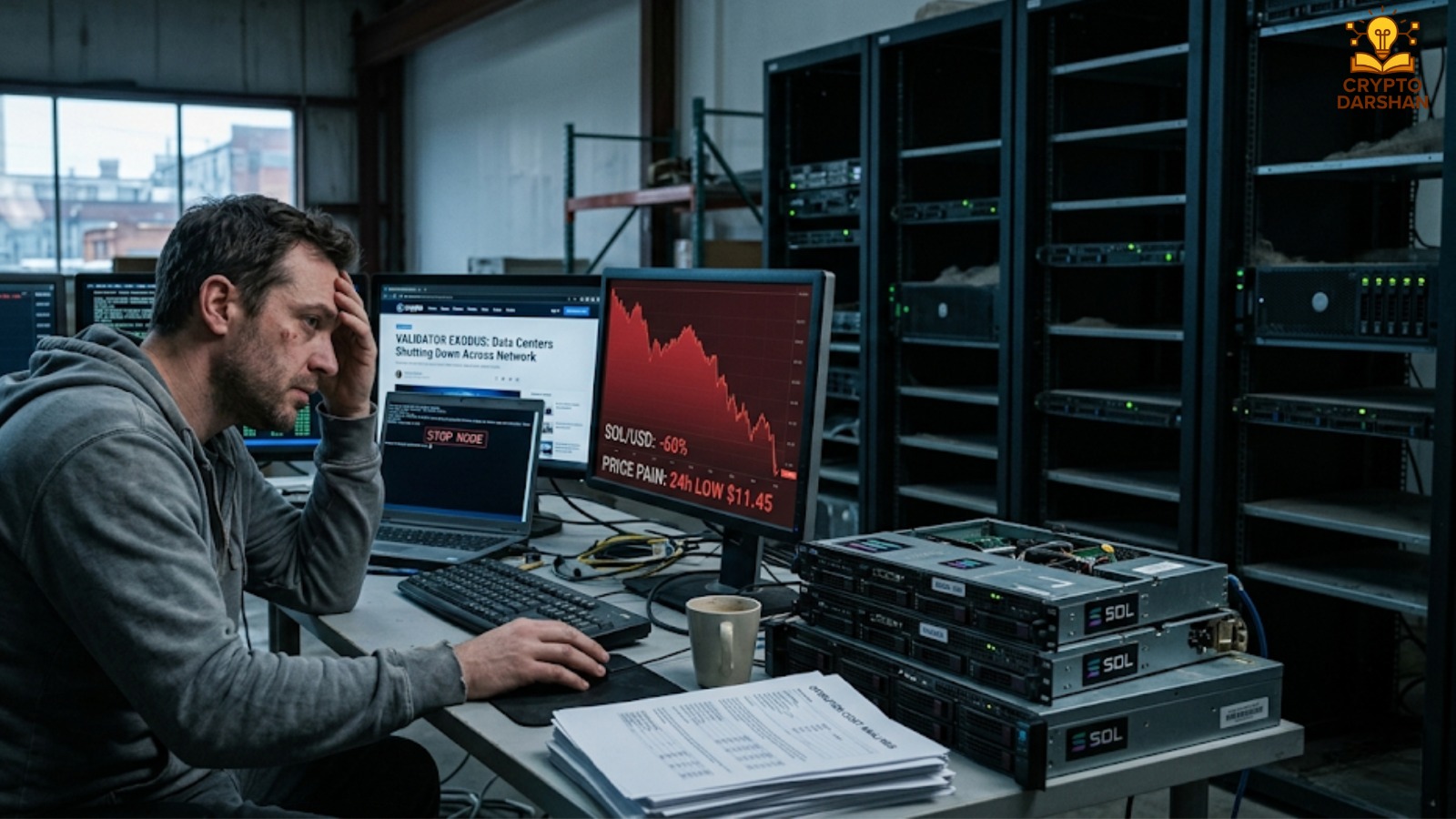
Solana is going through a rough patch again. The token is down about 68% from its all‑time high, and the number of validators securing the network has fallen by a similar margin, raising fresh concerns about security, decentralization, and long‑term investor confidence.
Solana’s Price: From Peak Hype to Sharp Drawdown

Solana was one of the strongest performers in the last crypto cycle, delivering huge returns as it climbed into the top tier of blockchain networks by market cap. At its peak, SOL traded near record highs before slipping as market conditions turned and speculative flows cooled.
- SOL now trades about 68% below its all‑time high, even after its massive rally in the previous year.
- The price decline follows a broader cooldown in altcoins and meme‑driven speculation that once helped push Solana volumes and activity to extreme levels.
- Despite the drawdown, Solana still ranks among the largest crypto assets, with strong liquidity and an active ecosystem across DeFi, NFTs, and real‑world assets.
For investors, this combination, still a top network, but well off the peak, naturally raises the question: is this a discounted opportunity or a warning sign?
Validator Count Drops Back to 2021 Levels

Alongside the price slump, Solana’s validator set has shrunk dramatically. This is a key datapoint, because validators are the machines and operators that help secure the network, confirm transactions, and keep the chain decentralized.
- Active Solana validators have fallen from more than 2,500 at the peak in 2023 to around 800 now, roughly a 65–68% decline.
- Current validator numbers are back to levels last seen in 2021, despite Solana hosting far more value and activity today.
- The decline has been steady over the last few years, with an acceleration after protocol‑level changes and higher performance expectations made it harder for weaker validators to remain profitable.
On the surface, losing nearly two‑thirds of the validator set looks alarming, especially for anyone who equates validator count directly with decentralization and security. Validator behavior is closely tied to consensus design. Explore this in Why Consensus Algorithms Matter More Than Most Investors Think
Why Validators Are Leaving the Network

The validator exodus is not driven by a single factor. Instead, it is the result of economic pressure, technical demands, and protocol decisions that changed the incentives and requirements for running a node on Solana.
Key drivers include:
- Economic squeeze: Running a high‑performance Solana validator requires powerful hardware and stable infrastructure, which can become unprofitable when token prices fall and staking rewards compress.
- Network pruning and quality controls: Solana introduced processes to remove underperforming or non‑contributing validators, aiming to reduce spam, improve latency, and boost overall throughput.
- Competitive staking environment: Large, well‑run validators and staking providers attract most of the stake, leaving smaller operators with too little delegated SOL to cover costs.
Supporters argue that this is a “quality over quantity” transition, where inefficient validators exit, leaving a smaller but stronger core set of operators. Critics counter that even if the remaining validators are technically better, concentrating power in fewer hands undermines the decentralization story that underpins the value of a public blockchain.
Security and Decentralization: How Worried Should You Be?

With both price and validator count dropping by similar percentages, it is natural to question whether Solana is still secure enough to justify long‑term investment.
Points in favor of the network:
- Solana still processes transactions far faster and cheaper than many rivals, which supports real usage across DeFi, NFTs, and tokenized real‑world assets.
- Core developers and ecosystem teams claim that many departing validators were low‑quality and that the network is more robust now, not less.
Risks that remain:
- A smaller validator set concentrates voting power and makes it easier for large players or coordinated groups to influence the network.
- Solana does not have a perfect uptime record, with several historical outages and performance issues that still weigh on its reputation among conservative investors.
In simple terms, Solana is faster and cheaper than most competitors, but it carries more technical and centralization risk than the most battle‑tested networks.
Is Solana’s 68% Drop a Buy Signal or a Red Flag?

For traders and long‑term holders, Solana’s situation is nuanced. The 68% drawdown from the all‑time high puts SOL in “deep discount” territory compared to its peak, but not necessarily in “no‑brainer bargain” territory.
Bullish arguments:
- If network usage continues to grow and more value moves on‑chain, demand for SOL to pay fees and secure the network could support a long‑term recovery.
- Any renewed risk appetite in crypto markets could favor high‑beta assets like Solana that have already proven they can rally dramatically in bull markets.
Bearish or cautious arguments:
- The shrinking validator set could signal deeper structural issues, potentially limiting decentralization and raising long‑term governance concerns.
- A history of outages and the need for ongoing technical fixes mean Solana may remain a “higher‑risk, higher‑reward” bet compared to more mature networks.
To understand how network activity affects costs and incentives, read The Economics of Gas Fees: Who Really Pays for Blockchains?
For everyday readers, the takeaway is simple: Solana is not dead, but it is clearly in a more fragile phase. The price crash and validator decline should be seen as a serious risk factor, not just noise, especially for anyone considering large or long‑term exposure.