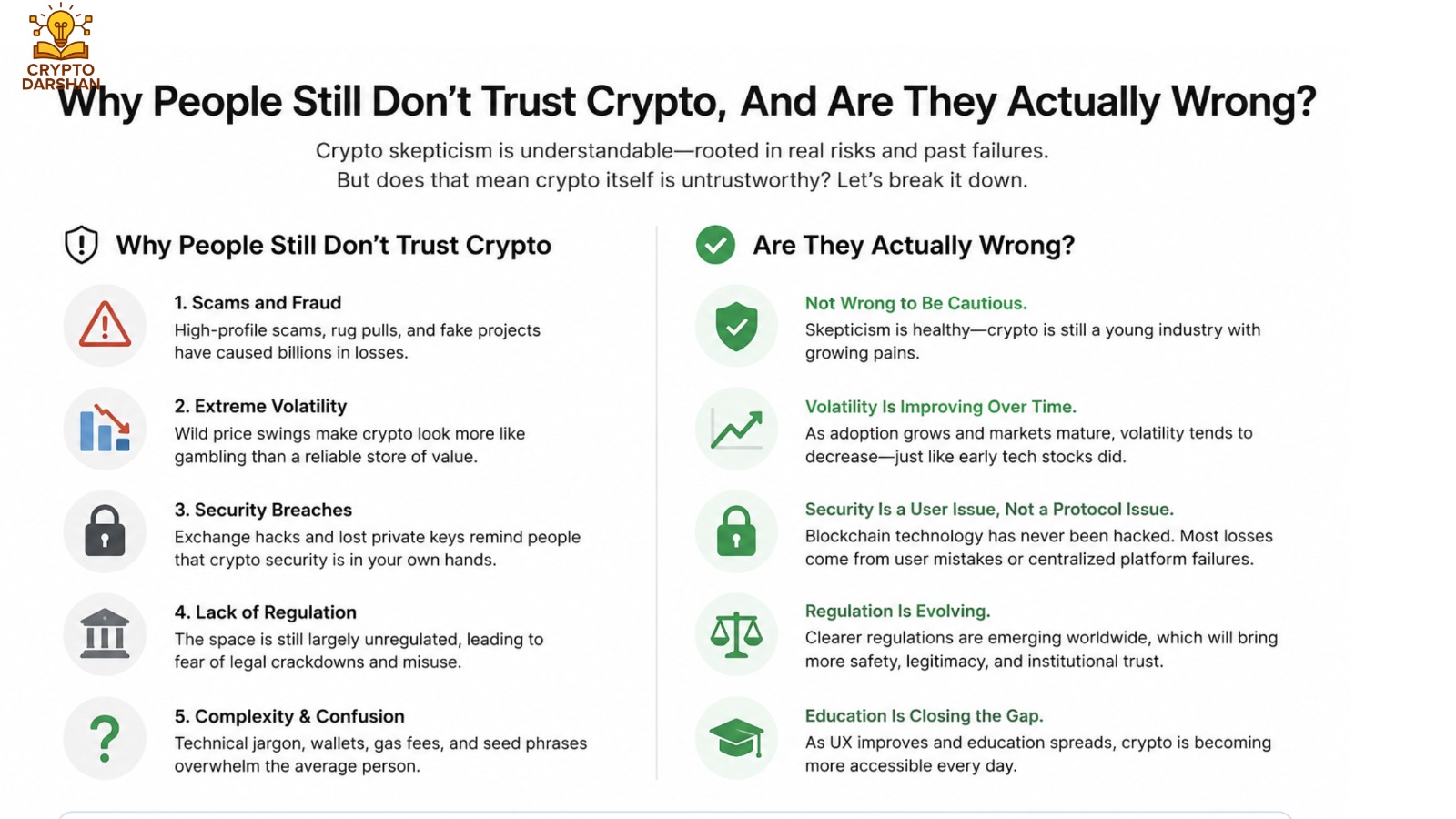
Cryptocurrency has been around for over 15 years. Bitcoin hit an all-time high of $126,198 in October 2025. Governments are drafting crypto laws. Wall Street banks are building blockchain divisions. And yet, the majority of people still don’t trust crypto.
Not a small minority. The majority.
According to a CivicScience survey from April 2026, 65% of U.S. adults say they have little to no trust in cryptocurrency, with only 9% expressing high trust. A Motley Fool 2026 Cryptocurrency Investor Trends Survey found that roughly 78% of Americans have never owned crypto — and the top reasons they give are almost always the same: they don’t understand it, they think it’s a scam, or they’re afraid of losing everything.
So should we dismiss their reluctance as ignorance? Or are they picking up on something real?
This blog breaks down the honest, data-backed reasons why people don’t trust crypto, examines whether those fears are justified, and explores what it would actually take for the average person to trust crypto in 2026 and beyond.
The Numbers Don’t Lie — Most People Still Don’t Trust Crypto

Before we analyze why, let’s sit with the scale of the problem.
According to the Motley Fool’s 2026 Cryptocurrency Investor Trends Survey of 2,000 U.S. adults:
- Only 22% of Americans own cryptocurrency or hold it through an ETF.
- 60% of non-owners say they don’t understand cryptocurrency.
- 32% of never-owners believe crypto is a scam.
- Only 4% of those who have never owned crypto find cryptocurrency exchanges “very trustworthy.”
- That number jumps to 38% among current owners — showing a massive perception gap.
The Federal Reserve’s 2025 SHED report backs this up: only 2% of U.S. adults used crypto to purchase in 2025, and just 1% used it to send money to friends or family.Even as Bitcoin broke records, adoption stayed flat. That alone tells you trust is the bottleneck — not technology, not access.
The simple truth: when people don’t trust crypto, they don’t use it. And right now, most people don’t trust crypto.
Past Disasters Have Left Real Scars

To understand why people resist the idea to trust crypto, you need to understand what they’ve watched unfold over the last several years.
The FTX Collapse (2022) — The Wound That Won’t Heal
The collapse of FTX remains the defining trust-breaking moment in crypto’s history. Founded by Sam Bankman-Fried (SBF), FTX was once valued at over $32 billion. Then, in November 2022, it imploded — taking $8 billion in customer funds with it.
Bankman-Fried was convicted on seven counts of fraud and conspiracy and sentenced to 25 years in prison. FTX’s downfall exposed how the firm had mixed customer deposits with risky investments at its trading arm, Alameda Research — all without customers’ knowledge or consent.
As of October 2024, $7.1 billion in creditor repayments had been processed, with further distributions still pending in 2026. Many victims received U.S. dollar repayments rather than crypto, cutting them off from the market rebound, deepening their bitterness and skepticism.
The FTX collapse didn’t just destroy one company. It dragged down lending firms, venture funds, and trading desks across the entire industry. Bitcoin prices cratered. Venture funding dried up. And millions of retail investors were left asking: if the third-largest exchange in the world could vanish overnight, how can I ever trust crypto again?
The honest answer is that fear makes complete sense.
Scams Are Getting Worse, Not Better
One of the clearest reasons people refuse to trust crypto is the explosion of fraud — and the data in 2025–2026 is alarming.
Investment Scam Statistics Paint a Concerning Picture
One of the biggest reasons people remain skeptical of cryptocurrency is the sheer scale of fraud and cybercrime that continues to affect the industry. While blockchain technology itself has proven to be remarkably resilient, criminals have become increasingly sophisticated in finding ways to exploit investors through scams, social engineering, and security vulnerabilities.
The numbers from 2025 illustrate why trust remains a challenge. Americans lost an estimated $6.1 billion to investment fraud during the first three quarters of the year alone, making investment scams one of the most costly forms of financial crime. Cryptocurrency was the preferred payment method for many of these schemes, with victims losing approximately $863 million in crypto assets during the same period.
What’s particularly concerning is the pace at which these losses are growing. The amount stolen through crypto-related investment scams increased by roughly $300 million compared to the same period in 2024, suggesting that fraudsters are becoming more effective at targeting victims despite greater public awareness.
Another alarming trend is the rise of impersonation scams. According to blockchain analytics firm Chainalysis, these scams surged by 1,400% year-over-year in 2025. In many cases, scammers pose as trusted businesses, government agencies, celebrities, or investment experts to convince people to send funds or reveal sensitive information.
Cybersecurity threats have also intensified. Hackers stole approximately $3.4 billion worth of cryptocurrency in 2025, representing a 55% increase from the $2.2 billion stolen in 2024. These attacks targeted exchanges, decentralized finance (DeFi) platforms, wallets, and other crypto-related services, highlighting the ongoing security challenges facing the industry.
Adding another layer of concern, North Korean state-sponsored hacking groups were responsible for an estimated $2.02 billion in stolen cryptocurrency during 2025, marking their largest annual haul on record. These groups have increasingly turned to crypto theft as a way to generate revenue and bypass international sanctions, making cybersecurity not just a financial issue but also a geopolitical one.
When people say they don’t trust crypto because it’s too risky, this is what they’re reacting to. The scam ecosystem surrounding cryptocurrency is real, massive, and growing fast. Any honest assessment of why people won’t trust crypto has to start here.
Volatility Is a Feature — But Also a Bug
Crypto supporters often say volatility is a feature of an emerging asset class, not a flaw. But for most people, volatility is the exact reason they can’t bring themselves to trust crypto with their money.
Bitcoin went from $69,000 in November 2021 to under $17,000 a year later — a drop of over 75%. It then recovered to hit $126,198 in October 2025. For a long-term holder, that’s a great story. For someone who bought near the top and sold near the bottom — it’s devastating.
A POLITICO survey from early 2026 found that 45% of participants believe that investing in cryptocurrencies is not worth the risk. That’s not irrational. For people without the financial buffer to absorb a 70% loss, putting money into crypto is genuinely dangerous. The debate over crypto’s credibility is closely connected to the issues discussed in Why “Decentralized” Does Not Always Mean Better.
The volatility issue also connects to a broader psychological barrier: people trust things that behave predictably. Banks pay low but stable interest. Real estate moves slowly. Stocks fluctuate but within a range most people can emotionally manage. Crypto doesn’t behave like anything else — and that unpredictability is a deep reason people refuse to trust crypto as a financial tool.
The Knowledge Gap Is the Biggest Barrier of All

Here’s a stat that doesn’t get enough attention: the biggest reason people don’t trust crypto isn’t fear of scams or volatility — it’s that they simply don’t understand it. While scams and fraud dominate headlines, the broader evolution of blockchain businesses shows why The Hardest Part of Building a Blockchain Business extends beyond simply gaining public trust.
The 2025 Crypto Confidence Pulse (National Cryptocurrency Association / Harris Poll) found that:
- 4 out of 5 U.S. adults do not hold any crypto
- Nearly 90% of non-holders said they are not knowledgeable about buying, using, selling, or trading crypto
- 49% cited lack of understanding as the single biggest barrier to entry
The Motley Fool’s 2026 survey reinforces this: nearly half of non-owners (48%) say they don’t even know how to buy crypto, and 35% don’t know what they’d do with it even if they had some.
Stuart Alderoty, President of the NCA, summed it up bluntly: “Crypto’s biggest barrier is comprehension.” He noted that nearly a quarter of non-holders said they would use crypto if they could pay for goods and services with it — but they don’t realize they already can.
This knowledge gap is a central reason people don’t trust crypto. When something feels opaque, confusing, and surrounded by technical jargon, trust doesn’t form. Trust requires understanding. And most people, right now, don’t have it.
Regulation — The Double-Edged Sword

One of the most common arguments for why people should trust crypto is that regulation is coming and coming fast. In theory, clearer rules mean safer markets, better consumer protections, and fewer bad actors.
Here’s where things stand in 2026:
- The EU’s MiCA (Markets in Crypto-Assets) regulations are now in force, creating a unified framework for crypto across Europe
- The U.S. Senate has been debating the CLARITY Act, which would expand the CFTC’s authority over digital commodities
- The DOJ Scam Center Strike Force recovered $580 million in crypto within its first three months of operation
- Major exchanges like Binance and OKX have adopted Proof-of-Reserve (PoR) audits to demonstrate solvency — though critics note these lack continuity and don’t fully address liabilities
But here’s the tension: crypto was built to exist outside traditional financial systems. Heavy regulation could protect retail investors in the long run while fundamentally altering what crypto is. Some in the crypto community see regulation as a betrayal. Others see it as the only path to mainstream trust.
The YouGov data from March 2026 adds a nuanced wrinkle: more than 27% of U.S. adults don’t trust banks and credit unions either. For these people, the issue isn’t specifically about whether to trust crypto — it’s about a broader skepticism toward any financial institution. Crypto hasn’t proven itself a safer alternative yet.
Are the Skeptics Actually Wrong? An Honest Verdict

Where Crypto Skeptics Are Right
1. Scam losses are still a major problem
Crypto fraud continues to cost investors billions of dollars every year. Rug pulls, phishing attacks, fake investment schemes, and other scams remain common, giving many people legitimate reasons to be cautious.
2. Major platforms can fail unexpectedly
The collapse of FTX demonstrated that even well-known and widely trusted crypto companies can unravel quickly. Events like these have damaged confidence across the industry and highlighted the risks of relying on centralized platforms.
3. Volatility can be dangerous
Cryptocurrency prices can rise or fall dramatically within days or even hours. For investors without sufficient financial reserves, these sudden swings can lead to significant losses.
4. Regulations are still developing
Many countries are still working on clear crypto regulations. This uncertainty creates challenges for both investors and businesses and can make the market feel less secure.
5. Consumer protections are limited
Unlike traditional banking systems, crypto transactions are often irreversible. If funds are stolen or sent to the wrong address, there may be little or no way to recover them.
6. Public trust remains relatively low
The fact that many people still distrust cryptocurrency is not simply a marketing issue. It reflects genuine concerns about security, transparency, and the industry’s history of failures.
Where Skeptics May Be Missing the Bigger Picture

1. The underlying technology is highly secure
Blockchain networks themselves have proven remarkably resilient over time. Most major losses occur because of human error, poor security practices, or vulnerable third-party platforms—not because the blockchain was compromised.
2. Bitcoin has delivered strong long-term performance
Despite frequent market downturns, Bitcoin has historically outperformed many traditional asset classes over longer investment periods, making it difficult to dismiss entirely as a failed experiment.
3. Crypto has real-world use cases
Beyond trading and speculation, cryptocurrencies are increasingly used for international payments, remittances, decentralized finance, and improving access to financial services in underbanked regions.
4. Adoption continues to grow
Millions of new users enter the crypto ecosystem every year. Growing participation from individuals, businesses, and institutions suggests that digital assets are becoming a more established part of the global financial landscape.
5. Regulations are improving
Frameworks such as Europe’s MiCA regulations and similar initiatives around the world are helping create stronger standards for transparency, investor protection, and market oversight.
What Would It Actually Take to Trust Crypto?

If we want people to genuinely trust crypto, not just hype it — here’s what needs to happen:
1. Better Education, Not Better Marketing
The industry needs to close the comprehension gap. Nearly 90% of non-holders say they don’t understand crypto. No amount of Super Bowl ads fixes that. Plain-language education, reliable tools, and transparent user experiences are the foundation.
2. Stronger Regulatory Floors
People trust things within systems of accountability. MiCA in Europe is a start. The U.S. needs equivalent legislation that protects retail investors without strangling innovation. Proof-of-reserves should be standard, not optional.
3. Reduced Scam Infrastructure
The DOJ’s recovery of $580 million in early 2026 shows enforcement is possible. It needs to scale. Impersonation scams growing 1,400% year-over-year is not a sustainable reality for any industry that wants mainstream trust.
4. Stable Use Cases Beyond Speculation
People trust crypto most when it does something useful that nothing else does as well — cross-border payments, financial inclusion, programmable contracts. Leading with utility, not price appreciation, builds durable trust.
5. Honest Acknowledgment of Risk
Perhaps the most underrated trust-builder: honesty. Platforms, influencers, and advocates who acknowledge the real risks of crypto — rather than hype every price move — do more for long-term trust than any bull run.
FAQ: Why People Still Don’t Trust Crypto — And Are They Actually Wrong?

1. Why do many people still distrust cryptocurrency?
Many people associate crypto with scams, hacks, market crashes, and extreme price volatility. Negative media coverage and a lack of understanding also contribute to skepticism.
2. Is the lack of trust in crypto justified?
In some cases, yes. The crypto industry has experienced fraud, exchange failures, rug pulls, and security breaches. However, not all crypto projects are risky, and the industry has matured significantly over time.
3. What are the biggest concerns people have about crypto?
Common concerns include volatility, security risks, regulatory uncertainty, scams, money laundering, and the complexity of managing digital assets.
4. How has crypto’s reputation been affected by scams?
High-profile scams and project failures have damaged public confidence. Many newcomers view these incidents as evidence that the entire industry is unsafe, even though legitimate projects also exist.
5. Why is crypto considered risky compared to traditional investments?
Crypto assets can experience large price swings in short periods. Unlike traditional investments, many cryptocurrencies operate in a less regulated environment and may lack established valuation methods.
6. Has trust in crypto improved over the years?
Yes. Increased institutional participation, clearer regulations in some regions, improved security practices, and growing real-world adoption have helped improve confidence in the sector.
7. Do major companies and institutions trust crypto?
Many organizations now explore or invest in blockchain technology and digital assets. However, institutional involvement does not eliminate the risks associated with cryptocurrency investments.
8. How does regulation affect trust in crypto?
Regulation can increase trust by improving transparency, consumer protection, and accountability. At the same time, excessive or unclear regulations may create uncertainty for businesses and investors.
9. Are cryptocurrency exchanges safe?
Some exchanges have strong security measures and compliance programs, while others have experienced breaches or collapsed due to poor management. Users should research platforms carefully before using them.
Conclusion: Trust Crypto Slowly, Eyes Wide Open
The question isn’t whether to trust crypto or dismiss it entirely. The question is whether the trust being offered is earned.
Right now, the data is clear: 65% of adults have little to no trust in crypto, and they have good reasons. Scams are rising. Volatility is real. The regulatory environment is incomplete. The memory of FTX has not faded.
But trust isn’t static. It can be built through transparency, regulation, education, and sustained reliability. The crypto industry has made real progress in some of these areas. It has significant ground to cover in others.