Slippage is one of the most common yet misunderstood concepts in crypto trading. It affects every trader, from beginners to professionals, and can have a significant impact on profits and losses. In simple terms, this occurs when the price at which a trade is executed differs from the price expected at the time of placing the order. This difference can be small or large, depending on market conditions, liquidity, and order type.
In the fast-moving world of cryptocurrency, prices can change in seconds. The decentralized nature of crypto markets, combined with high volatility, makes it a frequent occurrence. Understanding this concept is essential for beginners to trade effectively and avoid unexpected losses. This article explains what it is, why it happens, how it affects trading, and how to minimize its impact.
What Is Slippage?

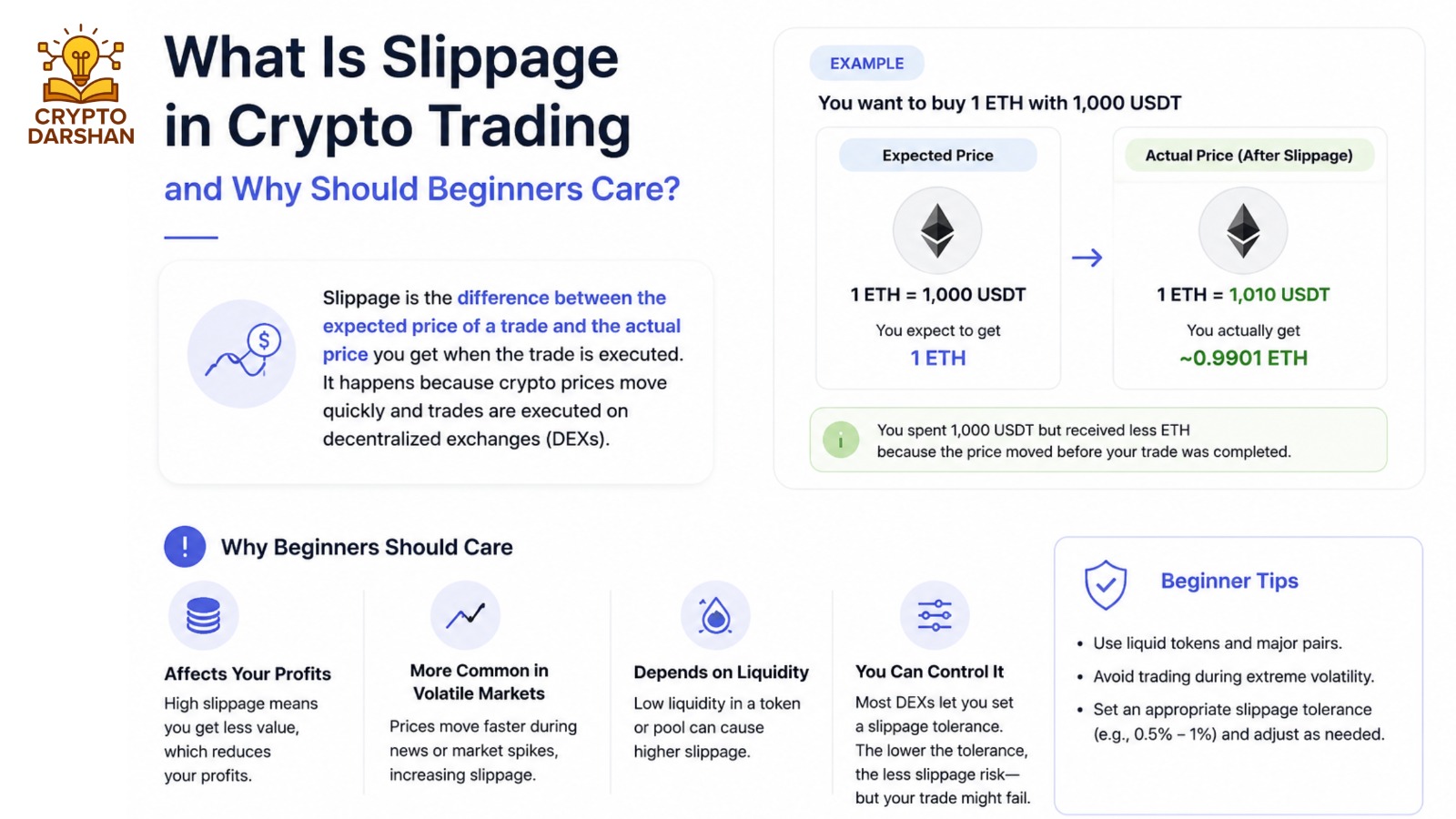
Slippage refers to the difference between the expected price of a trade and the actual price at which the trade is executed. It can occur in any financial market, but it is especially common in crypto trading due to the high volatility and lower liquidity compared to traditional markets.
For example, imagine placing an order to buy Bitcoin at $40,000. By the time the order is executed, the price might have risen to $40,050. The $50 difference is price deviation. Similarly, if the price drops to $39,950 before execution, the trader experiences a favorable outcome, meaning they got a better price than expected.
It can be positive or negative:
Positive Slippage: The trade executes at a better price than expected.
Negative Slippage: The trade executes at a worse price than expected.
While the positive form can increase profits, the negative form can reduce them or even cause losses. Understanding how this mechanism works helps traders make better decisions and manage risk effectively.
Why Slippage Happens in Crypto Trading
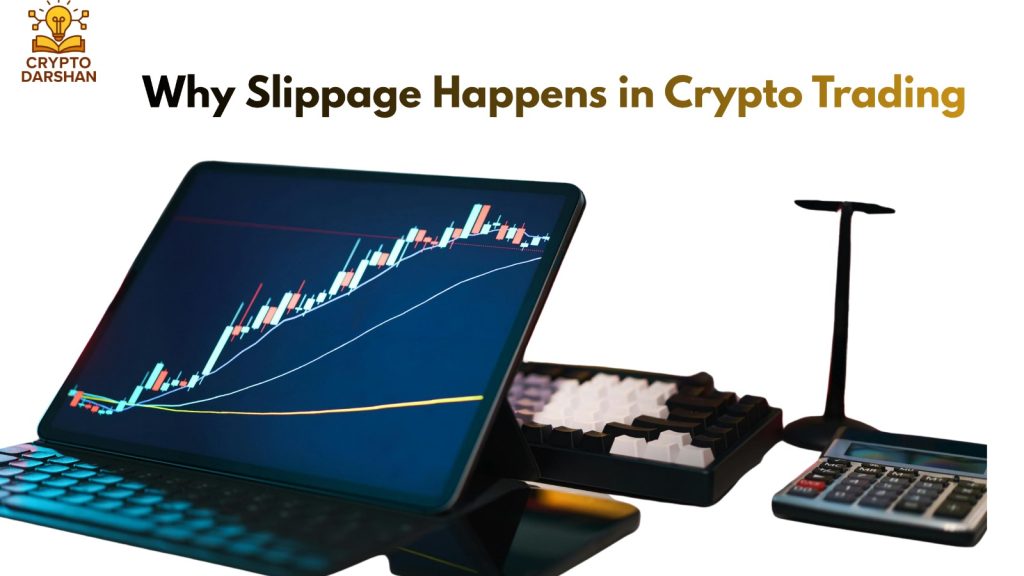
It occurs due to several factors that influence how orders are executed in the market. The main causes include:
1. Market Volatility
Cryptocurrency prices can change rapidly within seconds. When the market is highly volatile, prices move quickly between the time an order is placed and when it is executed. This rapid movement often leads to price deviation, especially during major news events or sudden market swings.
2. Low Liquidity
Liquidity refers to how easily an asset can be bought or sold without affecting its price. In markets with low liquidity, there may not be enough buyers or sellers at a given price, so orders fill at the next available level, causing execution gaps. Smaller or newer cryptocurrencies often have lower liquidity, making them more prone to this effect.
3. Order Size
Large orders can cause price deviation because they may consume multiple price levels in the order book. For example, if a trader tries to buy a large amount of a coin, there might not be enough sellers at the desired price. The order moves up the order book, filling at higher prices and resulting in an unfavorable execution.
4. Order Type
The type of order used also affects execution outcomes. Market orders, which execute immediately at the best available price, are more prone to this issue. Limit orders, on the other hand, specify a maximum or minimum price and only execute when that price is available, reducing the risk of price deviation.
5. Exchange Latency
The speed of the trading platform or exchange can also contribute to execution gaps. If there is a delay between placing and executing an order, the market price may change during that time. High latency or slow internet connections can increase the likelihood of such price gaps.
Types of Slippage in Crypto Trading
This price deviation can occur in different forms depending on the direction of price movement and the type of trade. The main types include:
1. Positive Slippage
Positive slippage happens when a trade is executed at a better price than expected. For example, if a trader places a buy order at $1,000 and it executes at $995, they experience a favorable fill. This benefits the trader by improving the trade result.
2. Negative Slippage
Negative slippage occurs when a trade is executed at a worse price than expected. For instance, if a trader places a buy order at $1,000 but it executes at $1,010, they receive an unfavorable fill. This cuts into profits or increases losses.
3. Zero Slippage
A zero-deviation fill means the trade executes at exactly the expected price. This is ideal but rare in volatile markets like crypto. It usually happens in highly liquid markets or when using limit orders.
How Slippage Affects Crypto Traders

This phenomenon can have a significant impact on trading performance, especially for beginners who may not fully understand how it works. The effects include:
1. Reduced Profit Margins
Negative execution gaps can eat into profits by increasing the cost of buying or reducing the return from selling. Even small amounts can add up over multiple trades, especially for day traders or scalpers who make frequent transactions.
2. Increased Trading Costs
Price deviation effectively acts as an additional trading cost. When combined with exchange fees and spreads, it can make trading more expensive than expected. Managing this is essential to keep overall costs under control.
3. Missed Opportunities
In fast-moving markets, unfavorable fills can cause traders to miss entry or exit points. For example, a trader might plan to buy at a specific price, but the price gap pushes the execution higher, reducing potential gains.
4. Emotional Stress
Unexpected price deviations can lead to frustration and emotional trading decisions. Beginners may feel discouraged or make impulsive trades to recover losses, which can worsen the situation.
Slippage in Different Market Conditions
The amount of price deviation experienced depends on market conditions. Understanding how it behaves in different scenarios helps traders prepare and adapt their strategies.
1. Bull Markets
In a bull market, prices are rising rapidly. Buy orders are more likely to experience negative fills because demand pushes prices higher. Sell orders may experience positive outcomes if prices continue to rise after the order is placed.
2. Bear Markets
In a bear market, prices are falling. Sell orders may experience unfavorable fills as prices drop quickly, while buy orders might benefit from positive execution if prices fall further before completion.
3. High-Volatility Periods
During major news events, announcements, or sudden market movements, volatility spikes. This tends to increase price deviation because prices change rapidly, and liquidity may temporarily decrease as traders adjust their positions.
4. Low-Volume Periods
When trading volume is low, such as during weekends or off-peak hours, liquidity decreases. This raises the risk of unfavorable fills, as there are fewer active buyers and sellers.
How to Measure Slippage
It can be measured by comparing the expected price of a trade with the actual execution price. The formula is:
Slippage = (Execution Price – Expected Price) / Expected Price × 100
For example, if a trader expects to buy Bitcoin at $40,000 but the order executes at $40,100, the deviation is:
(40,100 – 40,000) / 40,000 × 100 = 0.25%
This means the trader experienced a 0.25% negative execution gap. Measuring it helps traders evaluate the performance of their strategies and exchanges.
How to Minimize Slippage in Crypto Trading

While price deviation cannot be completely avoided, traders can take steps to minimize its impact. The following strategies are effective for reducing it:
1. Use Limit Orders
Limit orders allow traders to set a specific price at which they want to buy or sell. The order will only execute if the market reaches that price, preventing unexpected execution gaps. However, the downside is that the order may not execute if the price never reaches the limit.
2. Trade During High Liquidity Periods
Trading when the market has high liquidity reduces adverse fills. Liquidity peaks during overlapping hours of major markets or when trading popular assets like Bitcoin and Ethereum.
3. Avoid Trading During High Volatility
Price deviation increases during volatile periods, such as after major news releases or sudden market movements. Avoiding trades during these times can help reduce adverse price movement.
4. Break Large Orders into Smaller Ones
Large orders can move the market and cause unfavorable fills. Splitting them into smaller orders reduces the impact on price and helps achieve better average execution.
5. Choose Reliable Exchanges
Different exchanges have different levels of liquidity and execution speed. Choosing a reputable exchange with high trading volume and low latency can minimize price deviation.
6. Monitor Market Depth
Market depth shows the number of buy and sell orders at different price levels. Analyzing it helps traders understand liquidity and anticipate execution gaps before placing large orders.
7. Use Slippage Tolerance Settings
Some platforms let users set a price deviation limit. This feature limits how much the execution price can deviate from the expected price. If the deviation exceeds the set tolerance, the trade will not execute.
Slippage in Decentralized Exchanges (DEXs)
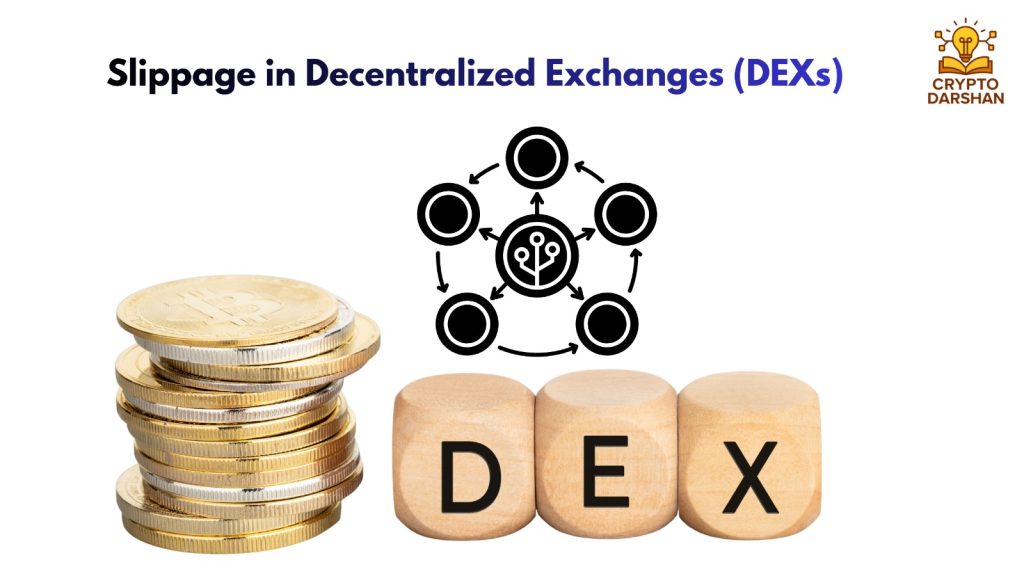
Price deviation is particularly relevant in decentralized exchanges (DEXs) like Uniswap, PancakeSwap, and SushiSwap. These platforms use automated market makers (AMMs) instead of traditional order books. In AMMs, prices are determined by liquidity pools and mathematical formulas.
When a trader swaps tokens on a DEX, this affects the token ratio in the pool, changing the price. Large trades or thin pools can cause significant execution gaps. DEXs often let users set a tolerance level to control acceptable price movement.
For example, if a trader sets a tolerance of 1%, the trade will only execute if the price stays within 1% of the expected rate. If the price moves beyond that, the transaction fails, preventing excessive losses.
Slippage and Trading Bots

Many traders use automated bots to execute trades quickly. However, bots can also experience unfavorable fills, especially in volatile markets. To minimize this, bots can be programmed to:
Use limit orders instead of market orders.
Monitor liquidity and avoid trading during low-volume periods.
Adjust the tolerance level dynamically based on market conditions.
Properly configured bots can help reduce price deviation and improve execution accuracy.
The Relationship Between Slippage and Spread
These concepts are related but distinct. The spread is the difference between the highest bid price (buy) and the lowest ask price (sell) in the market. It represents the cost of trading and is influenced by liquidity.
Price deviation occurs when the execution price moves beyond the spread due to market shifts. A wider spread raises the likelihood of it, as there is more room for price movement. In highly liquid markets, spreads are tight and execution gaps are lower.
Slippage in Different Order Types
Understanding how order types affect execution outcomes helps traders choose the right strategy.
1. Market Orders
Market orders execute immediately at the best available price. They are convenient but prone to price deviation, especially in volatile or low-liquidity markets.
2. Limit Orders
Limit orders specify a maximum or minimum price for execution. They protect against unfavorable fills but may not complete if the price target is never reached.
3. Stop Orders
Stop orders trigger a market order once a specific price is reached. They can experience adverse fills if the market moves quickly post-trigger.
4. Stop-Limit Orders
Stop-limit orders combine stop and limit features. They trigger a limit order instead of a market order, reducing execution risk but increasing the chance of non-execution.
Slippage in Futures and Margin Trading
Price deviation also affects futures and margin trading, where traders use leverage to amplify gains. In leveraged positions, even small gaps can have a large impact on profits and losses. For example, a 0.5% execution gap on a 10x leveraged trade means a 5% difference in returns.
Leveraged traders must be especially cautious about execution gaps, as these can trigger stop-loss orders prematurely or cause liquidation.
Real-World Examples

Example 1: Bitcoin Market Order
A trader places a market order to buy 1 Bitcoin at $40,000. Due to high volatility, the order executes at $40,200. The trader experiences $200 in negative price gap.
Example 2: Ethereum Limit Order
A trader sets a limit order to buy Ethereum at $2,000. The price briefly drops to $2,000, and the order executes exactly at that price. The trader experiences zero price deviation.
Example 3: DEX Token Swap
A trader swaps tokens on a DEX with a 2% tolerance. The price moves 1.5% during the transaction, and the trade executes successfully. If the price had moved 2.5%, the transaction would have failed.
The Psychological Impact of Slippage
Price deviation can affect traders psychologically, especially beginners unprepared for it. Unexpected losses from execution gaps can lead to frustration, overtrading, or emotional decisions. Knowing it is a normal part of trading helps maintain discipline and focus.
Experienced traders accept such gaps as a cost of doing business and plan accordingly. They use risk management techniques to minimize its impact and avoid emotional reactions.
Tools and Indicators to Manage Slippage
Several tools help traders monitor and manage execution gaps:
Order Book Depth Charts: Show liquidity levels and potential price impact.
Price Deviation Calculators: Estimate potential gaps before placing large orders.
Volatility Indicators: Help identify periods of high price movement.
Trading Volume Charts: Indicate liquidity and market activity.
Exchange Analytics: Data on execution speed and average price deviation.
Using these tools helps traders make informed decisions and reduce unexpected outcomes.
Risk Management

Managing price deviation is an essential part of risk management. Traders can incorporate it by:
- Setting realistic entry and exit points.
- Using stop-loss and take-profit orders with appropriate buffers.
- Calculating potential execution gaps when determining position size.
- Avoiding over-leveraging in volatile markets.
- By accounting for these execution gaps, traders better control risk and protect their capital.
The Future of Slippage in Crypto Trading

As the crypto market matures, price deviation is expected to decrease with improved liquidity, faster exchanges, and better technology. Innovations like layer-2 scaling, cross-chain liquidity, and DeFi protocols are enhancing market efficiency.
However, this deviation will never disappear completely. It remains an inherent part of trading. The key is to understand it, anticipate it, and manage it effectively.
Frequently Asked Questions (FAQs)

1. What is slippage in crypto trading?
Slippage is the difference between the expected price of a trade and the actual price at which the trade is executed. It can occur when prices change quickly or when there is not enough liquidity in the market.
2. Why does slippage happen?
It occurs because cryptocurrency prices can move rapidly between the time you place an order and the time it is executed. Low liquidity and large trade sizes can also contribute to it.
3. Is slippage always bad?
Not necessarily. While traders often experience negative fills (getting a worse price), a favorable fill can occur when a trade executes at a better price than expected.
4. What is positive slippage?
Positive slippage happens when your order is filled at a more favorable price than the one you expected, allowing you to buy cheaper or sell at a higher price.
5. What is negative slippage?
Negative slippage occurs when your trade is executed at a less favorable price than expected, resulting in a higher purchase price or a lower selling price.
6. How does market volatility affect slippage?
High market volatility causes prices to change rapidly, increasing the likelihood of price deviation, especially during major news events or sudden market movements.
7. What role does liquidity play in slippage?
Markets with low liquidity have fewer buyers and sellers, making it harder to execute trades at the desired price. This often leads to greater deviation.
8. What is slippage tolerance?
Slippage tolerance is the maximum percentage difference between the expected and actual trade price that a trader is willing to accept before the transaction fails.
Conclusion
Slippage is a fundamental concept in crypto trading that every beginner must understand. It occurs when the execution price of a trade differs from the expected price, often due to volatility, liquidity, or order type. While it can be positive or negative, it usually represents an additional cost that affects profitability.
By learning how price deviation works and using strategies to minimize it—such as trading during high liquidity, using limit orders, and choosing reliable exchanges—traders can improve their performance and reduce unexpected losses. Slippage is not something to fear but to manage wisely.
In the fast-paced world of cryptocurrency, knowledge is power. Understanding it gives traders the confidence to navigate volatile markets, make informed decisions, and build a sustainable trading strategy.