

The cryptocurrency market is known for its volatility, with dramatic price swings that can create both immense opportunities and devastating losses. Every investor who has experienced a bear market understands the emotional and financial toll it can take. Prices fall, sentiment turns negative, and fear dominates the market. Yet, history shows that every bear market eventually ends, giving way to a new bull cycle filled with renewed optimism and growth.
Recognizing when a bear market is ending is one of the most valuable skills a crypto investor can develop. Timing the exact bottom is nearly impossible, but identifying the signals that indicate a shift in market momentum can help investors position themselves early for the next uptrend.
This guide explores five key signals that often precede the end of a crypto bear market. Each signal is supported by historical data, market psychology, and technical analysis principles. Understanding these indicators can help investors make informed decisions and avoid missing the next major rally.
Understanding the Crypto Bear Market

Bear markets are defined as a period of time where supply is greater than demand, confidence is low, and prices are falling. Unlike traditional markets, crypto bear markets can be more severe and last longer due to the speculative nature of digital assets and the absence of centralized regulation.
Characteristics of a Bear Market
- Falling Prices: The most obvious sign is a consistent decline in asset prices across the market.
- Low Trading Volume: As confidence fades, fewer participants trade, leading to reduced liquidity.
- Negative Sentiment: Fear, uncertainty, and doubt (FUD) dominate social media and news outlets.
- Capitulation: Investors sell at a loss, often out of panic or exhaustion.
- Extended Consolidation: Prices stabilize at low levels for months before recovery begins.
Historical Context
The crypto market has experienced several bear markets since Bitcoin’s inception in 2009. The 2014–2015 bear market followed the Mt. Gox collapse, while the 2018–2019 downturn came after the ICO bubble burst. The 2022–2023 bear market was triggered by macroeconomic tightening, exchange collapses, and over-leveraged positions.
Each of these cycles eventually ended, leading to new all-time highs. By studying these past transitions, investors can identify recurring patterns that signal the end of bearish phases.
Signal 1: Market Sentiment Reversal
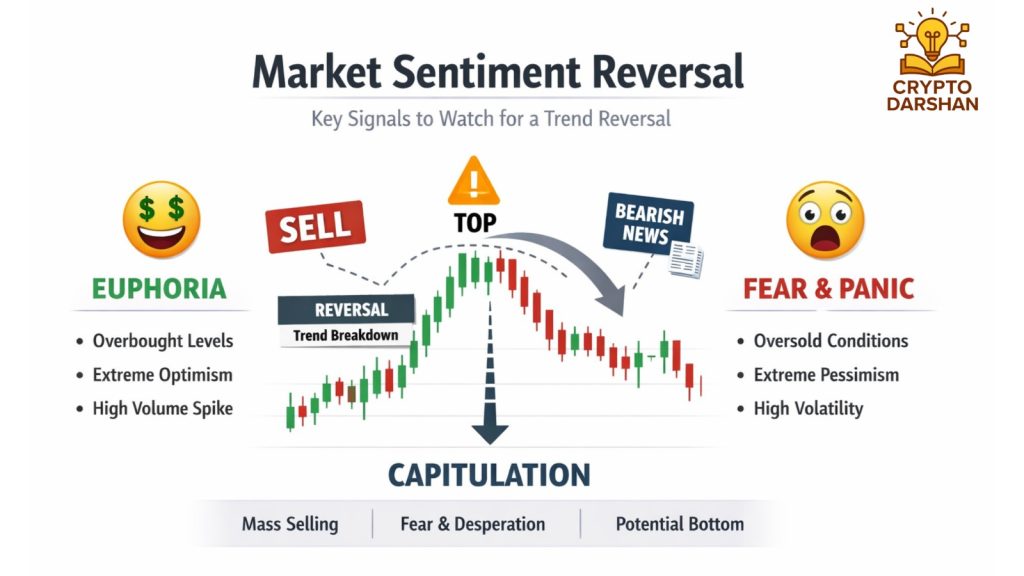
Market sentiment is one of the most powerful indicators of a bear market’s end. When fear dominates the market, prices often fall to unsustainable lows. As sentiment begins to shift from extreme pessimism to cautious optimism, it can signal the early stages of a new market cycle. Investor sentiment can also be observed through decentralized prediction platforms like Polymarket, where traders place bets on future crypto prices. This trend is explored in our analysis of Polymarket Crypto Bets 2026, which highlights some of the most confident Bitcoin price predictions.
Measuring Sentiment
Several tools and metrics help gauge crypto market sentiment:
- Fear and Greed Index: This index measures emotions driving the market, ranging from extreme fear to extreme greed. Historically, extreme fear levels have coincided with market bottoms.
- Social Media Analysis: Monitoring discussions on platforms like X (formerly Twitter), Reddit, and Telegram can reveal shifts in community mood.
- Google Trends: Rising search interest in terms like “buy Bitcoin” or “crypto recovery” often signals renewed retail curiosity.
Historical Example
In December 2018, Bitcoin’s price fell below $3,200, and the Fear and Greed Index hit extreme fear levels. Sentiment was overwhelmingly negative, yet this period marked the bottom before Bitcoin began its 2019 recovery.
Similarly, in late 2022, after the collapse of major exchanges, sentiment reached record lows. Within months, Bitcoin began to stabilize and recover, signaling the early stages of a new cycle.
Key Takeaway
When sentiment metrics show extreme fear but prices stop falling, it often indicates that sellers are exhausted. This emotional capitulation can be the first sign of a bear market ending.
Signal 2: On-Chain Data and Accumulation Patterns

On-chain analysis provides valuable insights into investor behavior by examining blockchain data directly. During bear markets, long-term holders often accumulate assets quietly while short-term traders exit.
Key On-Chain Metrics
- HODL Waves: These show the age distribution of coins. A growing share of older coins indicates long-term holders are not selling.
- Exchange Balances: Declining exchange reserves suggest investors are moving coins to cold storage, reducing selling pressure.
- Realized Cap vs. Market Cap: When the market cap falls below the realized cap, it often signals undervaluation and potential bottom formation.
- Whale Activity: Large holders (whales) accumulating during downturns can indicate confidence in future price appreciation.
Accumulation Phases
The accumulation phase typically follows capitulation. Prices stabilize within a range as smart money—experienced investors and institutions—begin buying. This phase can last several months, creating a foundation for the next bull run.
Historical Example
In early 2019, on-chain data showed a sharp decline in Bitcoin held on exchanges and an increase in long-term holder activity. This accumulation preceded the mid-2019 rally that saw Bitcoin rise from $3,200 to over $13,000.
A similar pattern emerged in 2023, when exchange balances dropped significantly, and whale wallets increased their holdings, signaling renewed confidence.
Key Takeaway
When on-chain data shows accumulation by long-term holders and declining exchange balances, it often indicates that the market is transitioning from fear to accumulation—a strong sign of a bear market bottom.
Signal 3: Technical Breakouts and Market Structure Shifts
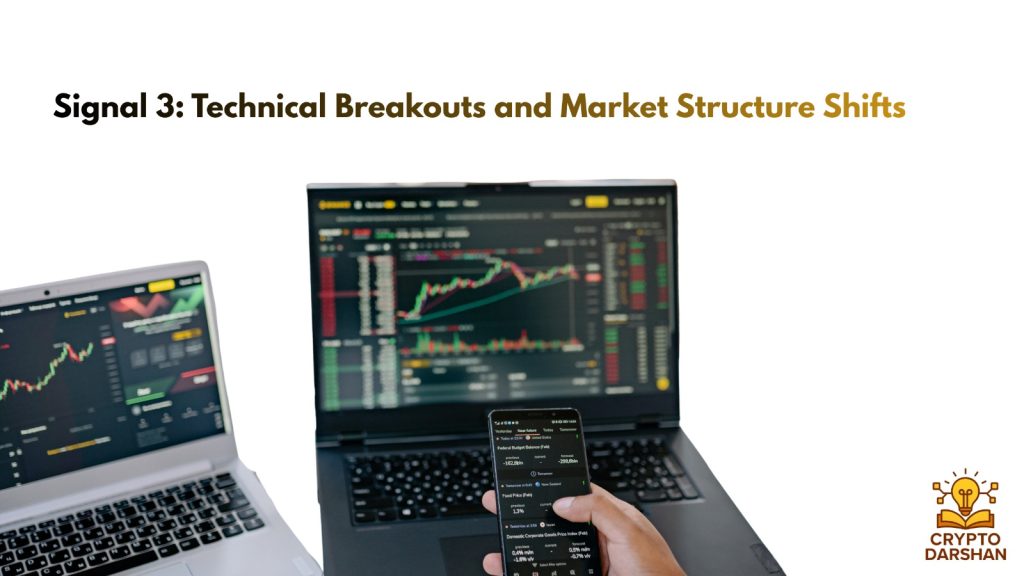
Technical analysis helps identify changes in market structure that often precede trend reversals. While no indicator is foolproof, certain patterns consistently appear near the end of bear markets.
Key Technical Indicators
- Higher Lows and Higher Highs: A shift from lower lows to higher lows indicates that buyers are gaining control.
- Moving Averages Crossovers: When shorter-term moving averages (like the 50-day) cross above longer-term ones (like the 200-day), it signals a potential trend reversal.
- Volume Confirmation: Rising trading volume during upward moves confirms genuine buying interest.
- Relative Strength Index (RSI): An RSI moving from oversold levels (below 30) toward neutral or bullish territory suggests momentum recovery.
Chart Patterns to Watch
- Double Bottom: Two similar lows followed by a breakout often mark the end of a downtrend.
- Falling Wedge: A narrowing downward pattern that breaks upward signals a reversal.
- Rounded Bottom: A slow, curved recovery pattern indicating gradual accumulation.
Historical Example
In April 2019, Bitcoin broke above its 200-day moving average for the first time in over a year, confirming a structural shift. This breakout was accompanied by rising volume and a double-bottom pattern, signaling the end of the 2018 bear market.
In 2023, Ethereum displayed a similar pattern, forming higher lows and breaking key resistance levels, suggesting the market was preparing for a new bullish phase.
Key Takeaway
Technical breakouts supported by volume and structural changes in price action are strong indicators that a bear market is ending. These signals often appear before mainstream sentiment turns positive.
Signal 4: Macro and Regulatory Environment Stabilization

Cryptocurrency markets are heavily influenced by global macroeconomic conditions and regulatory developments. During bear markets, tightening monetary policy, rising interest rates, and regulatory uncertainty often exacerbate price declines. Conversely, stabilization in these areas can signal the beginning of recovery.
Macroeconomic Factors
- Interest Rates: Lower or stable interest rates increase liquidity and risk appetite, benefiting crypto assets.
- Inflation Trends: Declining inflation reduces pressure on central banks, encouraging investment in risk assets.
- Dollar Strength: A weakening U.S. dollar often correlates with rising crypto prices, as investors seek alternative stores of value.
Regulatory Clarity
Regulatory uncertainty can suppress market growth. However, when governments introduce clear frameworks for digital assets, institutional confidence increases.
For example, the approval of Bitcoin ETFs or the establishment of clear tax guidelines can attract new capital inflows.
Historical Example
In 2020, global monetary easing and stimulus measures following the pandemic crash created a favorable environment for risk assets. Bitcoin surged from $4,000 to over $60,000 within a year.
Similarly, in 2024, as inflation cooled and regulatory clarity improved in major markets, institutional adoption accelerated, signaling renewed confidence in the crypto sector.
Key Takeaway
When macroeconomic conditions stabilize and regulatory clarity improves, the crypto market often transitions from fear to optimism. These external factors can act as catalysts for the end of a bear market.
Signal 5: Institutional and Retail Re-Entry

The final and often most visible signal of a bear market exit is the return of both institutional and retail investors. After months of fear and inactivity, renewed participation indicates growing confidence in the market’s future.
Institutional Involvement
Institutions play a crucial role in driving liquidity and legitimacy. Their re-entry can be observed through:
- ETF Approvals and Fund Launches: New investment vehicles attract large-scale capital.
- Corporate Treasury Allocations: Companies adding Bitcoin or other crypto assets to their balance sheets.
- Venture Capital Activity: Increased funding for blockchain startups and infrastructure projects.
Retail Participation
Retail investors typically return after early signs of recovery. Indicators include:
- Rising trading volumes on exchanges.
- Increased downloads of crypto apps.
- Growing social media engagement and search interest.
Historical Example
In late 2020, institutional adoption surged as companies like MicroStrategy and Tesla announced Bitcoin purchases. This institutional confidence triggered a wave of retail participation, fueling the 2021 bull market.
In 2024, renewed interest from asset managers and retail traders following ETF approvals signaled a similar pattern, marking the transition from accumulation to expansion.
Key Takeaway
When both institutional and retail investors begin re-entering the market, it confirms that confidence has returned. This influx of capital and attention often marks the official end of a bear market and the start of a new bull cycle.
Combining the Signals: A Holistic Approach to Identifying a Crypto Bear Market

No single indicator can perfectly predict the end of a bear market. However, when multiple signals align, the probability of a market reversal increases significantly.
The Confluence Strategy
- Sentiment Reversal: Fear metrics stabilize or improve.
- On-Chain Accumulation: Long-term holders increase positions.
- Technical Breakouts: Price breaks key resistance levels.
- Macro Stability: Economic and regulatory conditions improve.
- Investor Re-Entry: Institutional and retail participation rises.
When these factors occur simultaneously, it often marks the transition from a bear market to a new bull phase.
Example of Confluence
In early 2019, Bitcoin displayed all five signals:
- Sentiment improved from extreme fear.
- On-chain data showed accumulation.
- Technical charts broke key resistance.
- Global liquidity increased.
- Retail and institutional interest returned.
This alignment led to a sustained rally, confirming the end of the bear market.
Risk Management During Transition Phases
Even when signals point to recovery, volatility remains high. Managing risk is essential to protect capital and maximize gains.
Key Strategies
- Dollar-Cost Averaging (DCA): Gradually investing over time reduces the risk of mistiming the market.
- Portfolio Diversification: Holding a mix of assets (Bitcoin, Ethereum, stablecoins, and altcoins) balances risk.
- Stop-Loss Orders: Protects against sudden downturns.
- Long-Term Perspective: Focusing on multi-year trends rather than short-term fluctuations.
Avoiding Common Mistakes
- Chasing Pumps: Entering after large price spikes often leads to losses.
- Ignoring Fundamentals: Always assess project utility, adoption, and development activity.
- Over-Leverage: Excessive borrowing amplifies risk during volatile periods.
The Psychology of Market Cycles

Understanding investor psychology is crucial for interpreting market signals. Markets move through emotional cycles that repeat across timeframes.
The Emotional Cycle
- Optimism: Early uptrend begins.
- Euphoria: Prices surge; greed dominates.
- Anxiety: Market slows; uncertainty grows.
- Denial: Investors ignore warning signs.
- Panic: Sharp declines trigger fear.
- Capitulation: Investors sell at a loss.
- Despair: Market bottoms; apathy sets in.
- Hope: Early recovery begins.
Recognizing these emotional stages helps investors act rationally when others are fearful, positioning themselves for the next bull run.
Preparing for the Next Bull Market

Once the bear market shows signs of ending, preparation becomes key. Investors who plan strategically can maximize returns during the next cycle.
Steps to Prepare
- Reassess Portfolio: Focus on high-quality projects with strong fundamentals.
- Set Clear Goals: Define profit targets and risk tolerance.
- Stay Informed: Follow credible sources for market updates and regulatory news.
- Secure Assets: Use hardware wallets and strong security practices.
- Monitor Key Metrics: Keep tracking sentiment, on-chain data, and macro trends.
Long-Term Vision
The crypto market continues to evolve, with innovations in decentralized finance (DeFi), non-fungible tokens (NFTs), and blockchain infrastructure. Investors who maintain a long-term perspective and adapt to new trends are best positioned to benefit from future growth.
Additional Insights: Emerging Trends That Influence Market Recovery

While traditional signals remain reliable, new trends are shaping how bear markets end and bull markets begin. Understanding these emerging factors can provide an edge in anticipating future recoveries.
1. The Role of Layer 2 Solutions
Layer 2 technologies, such as the Lightning Network for Bitcoin and rollups for Ethereum, are improving scalability and reducing transaction costs. These innovations attract developers and users back to the ecosystem, signaling renewed network activity—a leading indicator of recovery.
When transaction volumes on Layer 2 networks rise, it often reflects growing confidence in blockchain usability and adoption, which historically precedes price appreciation.
2. Stablecoin Growth as a Liquidity Indicator
Stablecoins like USDT, USDC, and DAI serve as a bridge between fiat and crypto. During bear markets, stablecoin supply often contracts as investors exit. However, when stablecoin issuance begins to rise again, it indicates fresh capital entering the ecosystem.
Tracking stablecoin market capitalization can therefore provide early clues about renewed liquidity and investor readiness to re-enter risk assets.
3. Institutional Infrastructure Development
Beyond direct investment, institutions are building critical infrastructure that supports long-term crypto adoption, including custody solutions, compliance tools, and blockchain-based financial products. These developments create a stronger foundation for sustainable growth and signal that the market is maturing beyond speculation.
Infrastructure improvements are also strengthening the broader crypto ecosystem. For example, safer interoperability solutions and secure multichain wallets are helping reduce security risks, a challenge explored in our analysis of cross-chain bridges and the technologies designed to make them more secure.
4. The Impact of Halving Events
Bitcoin halving events, which occur approximately every four years, reduce the block reward for miners and historically precede major bull runs. The reduced supply pressure combined with growing demand often triggers upward momentum.
Monitoring miner behavior before and after halving events can reveal whether accumulation is occurring, offering another layer of confirmation for a bear market exit.
5. Global Adoption and Real-World Use Cases
The expansion of crypto payments, decentralized identity systems, and tokenized assets in emerging markets contributes to long-term demand. When adoption metrics—such as wallet creation, transaction count, and merchant integration—begin to rise after a downturn, it often signals that the market is regaining real-world traction.
Crypto Bear Market Exit: 5 Signals to Watch – FAQ

1. What signals indicate the end of a crypto bear market?
Several indicators can suggest the end of a crypto bear market, including rising trading volume, stronger price momentum, increasing institutional investment, and improved market sentiment. When major cryptocurrencies begin forming consistent higher highs and higher lows, it often signals the beginning of a recovery phase.
2. How long does a crypto bear market usually last?
Crypto bear markets can last anywhere from several months to a few years. The duration often depends on macroeconomic conditions, regulatory developments, and investor sentiment. Historically, major cryptocurrencies like Bitcoin have experienced bear markets lasting around one to two years before the next bull cycle begins.
3. Why is Bitcoin important when predicting market recovery?
Bitcoin is the largest cryptocurrency by market capitalization and often sets the overall market trend. When Bitcoin begins a sustained upward trend, it typically signals that confidence is returning to the crypto market.
4. Can trading volume signal the end of a bear market?
Yes, increasing trading volume is one of the most important signals. When buying activity starts to outweigh selling pressure across major cryptocurrencies such as Ethereum and Bitcoin, it often indicates that investors are accumulating assets in anticipation of a market rebound.
5. Do institutional investors influence crypto market recoveries?
Institutional investors can significantly impact the market. When large financial institutions or investment funds begin accumulating assets like Bitcoin, it often reflects growing long-term confidence in the crypto industry.
6. What role does market sentiment play in ending a bear market?
Market sentiment reflects the overall attitude of investors toward cryptocurrencies. Positive developments such as regulatory clarity, technological upgrades, and increased adoption can shift sentiment from fear to optimism, helping the market transition into a bullish phase.
7. Are altcoins a reliable sign of a new bull market?
Altcoins often surge after Bitcoin begins a strong recovery. Cryptocurrencies like Solana and Cardano typically perform well once confidence returns to the broader crypto market.
8. What is the accumulation phase in crypto markets?
The accumulation phase occurs when experienced investors quietly buy cryptocurrencies while prices remain relatively low. This stage often happens toward the end of a bear market before a strong upward trend begins.
Conclusion
Bear markets are an inevitable part of the crypto cycle, but they also present opportunities for those who can identify the signs of recovery. By monitoring sentiment shifts, on-chain accumulation, technical breakouts, macro stability, and investor re-entry, it becomes possible to recognize when the market is preparing for its next bull phase.
Patience, discipline, and data-driven analysis are the keys to navigating these transitions successfully. While no one can predict the exact bottom, understanding these five signals—along with emerging trends like Layer 2 growth, stablecoin expansion, and institutional infrastructure—provides a powerful framework for anticipating the end of a crypto bear market and positioning for the next wave of growth.