
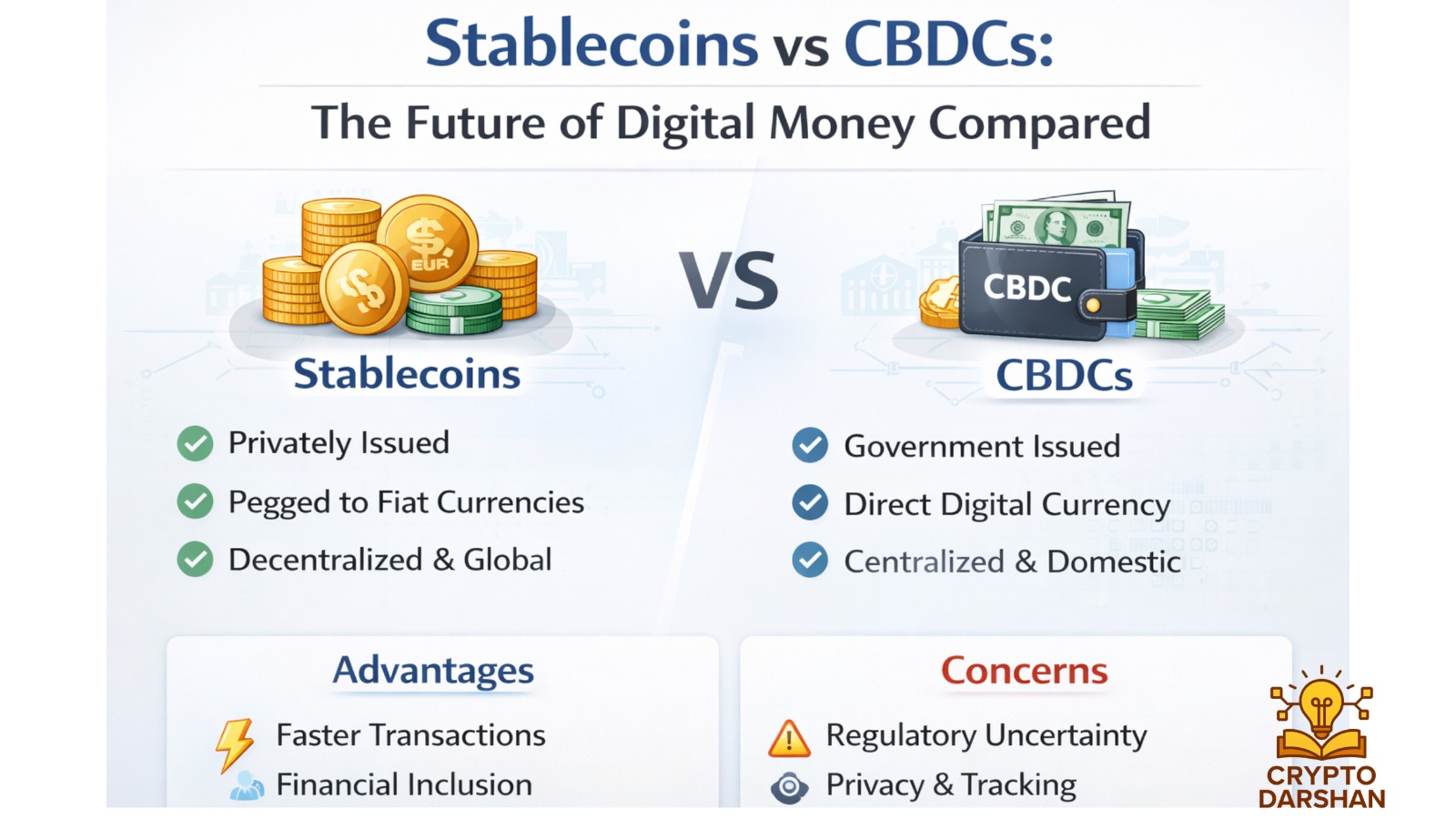
Stablecoins vs CBDCs reveals private, reserve-backed tokens dominating $250-300B markets with instant blockchain speeds, while government-issued CBDCs prioritize monetary sovereignty. The world of money is changing faster than ever. As digital payments become the norm, two major innovations are shaping the future of finance: stablecoins and central bank digital currencies (CBDCs). Both aim to modernize how money moves, but they come from very different origins and philosophies. Stablecoins are born from the private sector and the crypto ecosystem, while CBDCs are government-backed digital versions of national currencies.
The debate between stablecoins and CBDCs is not just about technology it’s about control, trust, privacy, and the future of global finance. Will the future of money be decentralized and open, or centralized and regulated?
This article explores both sides in depth, comparing their structures, benefits, risks, and long-term implications for economies, businesses, and individuals.
Understanding the Basics of Digital Money
What Is Digital Money?
Digital money refers to any form of currency that exists electronically. It can be stored, transferred, and used for transactions without physical cash. Examples include online bank balances, cryptocurrencies, stablecoins, and CBDCs.
Digital money has several advantages:
- Faster and cheaper transactions
- Easier cross-border payments
- Reduced reliance on physical cash
- Greater financial inclusion
However, not all digital money is the same. The key difference lies in who issues it and how it maintains value.
What Are Stablecoins?

A stablecoin is a type of cryptocurrency designed to maintain a stable value by being pegged to a reserve asset, such as the US dollar, euro, or gold. Unlike volatile cryptocurrencies like Bitcoin or Ethereum, stablecoins aim to combine the stability of traditional money with the efficiency of blockchain technology.
How Stablecoins Work
Stablecoins achieve price stability through different mechanisms:
- Fiat-Collateralized Stablecoins:
Backed 1:1 by fiat currency reserves held in banks.
Example: USDC, USDT, BUSD. - Crypto-Collateralized Stablecoins:
Backed by other cryptocurrencies, often over-collateralized to absorb volatility.
Example: DAI (backed by ETH and other assets). - Algorithmic Stablecoins:
Use algorithms and smart contracts to control supply and demand, maintaining the peg without direct collateral.
Example: The now-defunct TerraUSD (UST).
Popular Stablecoins
| Stablecoin | Type | Peg | Issuer |
| USDT (Tether) | Fiat-backed | USD | Tether Limited |
| USDC | Fiat-backed | USD | Circle |
| DAI | Crypto-backed | USD | MakerDAO |
| BUSD | Fiat-backed | USD | Binance/Paxos |
| EURC | Fiat-backed | Euro | Circle |
Use Cases of Stablecoins
- Payments: Fast, low-cost transactions across borders.
- DeFi (Decentralized Finance): Used for lending, borrowing, and yield farming.
- Trading: Acts as a stable medium of exchange between volatile crypto assets.
- Remittances: Enables cheaper international money transfers.
- Hedging: Protects against crypto market volatility.
What Are CBDCs?

Central bank digital currencies (CBDCs) are digital forms of a country’s fiat currency issued and regulated by its central bank, and are fixed in value by the government. Unlike cryptocurrencies, which are decentralized and volatile, CBDCs aim to provide stability and are government-backed
CBDCs are not cryptocurrencies. They are centralized, government-controlled digital currencies designed to modernize payment systems and maintain monetary sovereignty in a digital economy.
Types of CBDCs
- Retail CBDCs:
Designed for public use, allowing individuals and businesses to hold and transact directly with central bank money.
Example: The digital yuan (China), eNaira (Nigeria). - Wholesale CBDCs:
Used by financial institutions for interbank settlements and large-scale transactions.
Example: Project Helvetia (Switzerland), Project Jasper (Canada).
Key Features of CBDCs
- Issued and backed by a central bank
- Legal tender status
- Operates on a centralized or permissioned blockchain
- Can be programmable for specific policy goals
- Subject to government oversight and regulation
Global CBDC Initiatives
| Country | CBDC Name | Status |
| China | Digital Yuan (e-CNY) | Pilot |
| Bahamas | Sand Dollar | Launched |
| Nigeria | eNaira | Launched |
| Sweden | e-Krona | Pilot |
| India | Digital Rupee | Pilot |
| European Union | Digital Euro | Development |
| United States | Digital Dollar | Research |
Stablecoins vs CBDCs

| Aspect | Stablecoins | CBDCs |
| Issuer | Private companies or decentralized protocols | Central banks |
| Backing | Fiat, crypto, or algorithmic mechanisms | Sovereign currency |
| Regulation | Varies by jurisdiction | Fully regulated |
| Control | Decentralized or semi-centralized | Centralized |
| Transparency | Depends on issuer | High (government-controlled) |
| Privacy | Higher (depending on design) | Lower (traceable by authorities) |
| Adoption | Driven by crypto and DeFi users | Driven by governments and banks |
| Use Case | Cross-border payments, DeFi, trading | Domestic payments, monetary policy |
| Technology | Public or hybrid blockchains | Private or permissioned blockchains |
Advantages of Stablecoins

1. Financial Inclusion
Stablecoins allow anyone with internet access to store and transfer value globally, bypassing traditional banking systems. This is especially valuable in regions with limited access to financial services.
2. Fast and Low-Cost Transactions
Stablecoins enable near-instant transfers across borders without intermediaries. Traditional remittance systems can take days and charge high fees, while stablecoin transfers cost a fraction of that.
3. Integration with DeFi
Stablecoins are the backbone of decentralized finance. They provide liquidity for lending, borrowing, and trading platforms, enabling a new financial ecosystem without banks.
4. Transparency and Programmability
Many stablecoins operate on public blockchains, allowing transparent tracking of transactions. Smart contracts can automate payments, escrow, and other financial functions.
5. Hedge Against Volatility
Stablecoins offer a haven for crypto investors during market downturns, maintaining value while other assets fluctuate.
Advantages of CBDCs

1. Monetary Sovereignty
CBDCs allow governments to maintain control over their monetary systems in a digital world. They prevent private stablecoins or foreign currencies from dominating domestic economies.
2. Financial Stability
Unlike private stablecoins, CBDCs are fully backed by the central bank, eliminating default risk. Users can trust that their digital currency will always hold its value.
3. Efficient Payment Systems
CBDCs can streamline domestic and cross-border payments, reducing settlement times and costs. They can also improve financial inclusion by providing digital access to central bank money.
4. Policy Implementation
CBDCs can be programmable, allowing governments to implement targeted monetary policies, such as stimulus payments or negative interest rates.
5. Reduced Fraud and Tax Evasion
CBDCs can enhance transparency and traceability, helping authorities combat money laundering, tax evasion, and illicit transactions.
Disadvantages of Stablecoins

1. Lack of Regulation
Many stablecoins operate in regulatory gray areas. Without clear oversight, users face risks related to transparency, reserve management, and compliance.
2. Counterparty Risk
Fiat-backed stablecoins depend on the issuer’s ability to maintain reserves. If reserves are mismanaged or not fully backed, users could lose confidence.
3. Centralization Concerns
Despite being part of the crypto ecosystem, most stablecoins are issued by centralized entities that can freeze accounts or block transactions.
4. Algorithmic Failures
Algorithmic stablecoins have proven unstable. The collapse of TerraUSD (UST) in 2022 wiped out billions of dollars, highlighting the risks of uncollateralized models.
5. Regulatory Pressure
Governments are increasingly scrutinizing stablecoins, especially those pegged to major fiat currencies, due to concerns about financial stability and money laundering.
Disadvantages of CBDCs

1. Privacy Concerns
CBDCs could give governments unprecedented visibility into citizens’ financial activities. Every transaction could be traceable, raising concerns about surveillance and data misuse.
2. Centralization Risks
CBDCs are fully controlled by central banks, which could lead to censorship, account freezes, or misuse of monetary power.
3. Technological Challenges
Building a secure, scalable, and interoperable CBDC infrastructure is complex. Cybersecurity threats and system failures could have national-level consequences.
4. Impact on Banks
If citizens hold CBDCs directly with central banks, commercial banks could lose deposits, affecting their ability to lend and operate profitably.
5. Limited Global Interoperability
Different countries are developing CBDCs independently, which could create fragmentation and limit cross-border usability.
Stablecoins vs CBDCs in the Global Economy

The Role of Stablecoins in Global Finance
Stablecoins have become essential in the crypto economy, facilitating billions in daily transactions. They bridge the gap between traditional finance and decentralized systems, enabling seamless movement of value across borders.
Stablecoins like USDT and USDC are now used for:
- International trade settlements
- Remittances in developing countries
- On-chain savings and lending
- DeFi liquidity pools
The Role of CBDCs in National Economies
CBDCs aim to modernize national payment systems and strengthen monetary control. Governments see them as tools to:
- Reduce reliance on cash
- Improve payment efficiency
- Enhance financial inclusion
- Counter the influence of private stablecoins
Countries like China are leading the way with the digital yuan, which has already processed billions in transactions. The European Union and the United States are also exploring digital versions of their currencies.
Stablecoins vs CBDCs: The Battle for Trust

Trust in Stablecoins
Trust in stablecoins depends on the issuer’s transparency and reserve management. Fiat-backed stablecoins like USDC publish regular audits, while others like USDT have faced criticism for lack of clarity.
Decentralized stablecoins like DAI rely on smart contracts and over-collateralization, reducing reliance on centralized entities but introducing technical risks. The broader financial disruption is covered in Stablecoins vs Traditional Banking: The Silent Revolution, where we examine how digital dollars challenge legacy banking systems.
Trust in CBDCs
CBDCs derive trust from the central bank’s authority. However, this trust comes at the cost of privacy and autonomy. Users must rely on government institutions to manage and monitor their digital money.
Privacy and Surveillance: A Key Difference

Privacy is one of the most debated aspects of digital money.
- Stablecoins: Depending on the blockchain, transactions can be pseudonymous. Users have more privacy, though regulators can still trace activity through analytics tools.
- CBDCs: Governments can design CBDCs with full traceability, allowing them to monitor every transaction. While this helps prevent crime, it raises concerns about financial surveillance and freedom.
Some countries are exploring tiered privacy models, where small transactions remain private, but large ones are traceable.
The Technology Behind Stablecoins vs CBDCs

Stablecoin Infrastructure
Stablecoins typically operate on public blockchains like Ethereum, Solana, or Tron. They use smart contracts to manage issuance, redemption, and transfers. This open infrastructure allows integration with DeFi, wallets, and exchanges. To understand the structural differences within the stablecoin market, read our breakdown in Fiat-Backed vs Algorithmic Stablecoins: Which One Wins?.
CBDC Infrastructure
CBDCs often use permissioned blockchains or centralized databases. These systems prioritize control, scalability, and compliance over decentralization. Some CBDCs may use hybrid models that combine blockchain features with traditional systems.
Interoperability Challenges
For both stablecoins and CBDCs to succeed globally, interoperability is crucial. Projects like Ripple’s CBDC platform and Chainlink’s CCIP aim to connect different digital currencies and payment networks.
Economic and Policy Implications

For Governments
CBDCs give governments new tools for monetary policy. They can distribute stimulus payments instantly, track spending, and even implement programmable money with expiration dates.
However, widespread CBDC adoption could disrupt banking systems and require new regulatory frameworks.
For Businesses
Stablecoins offer businesses faster, cheaper cross-border payments and access to DeFi liquidity. CBDCs could simplify tax collection and compliance but may introduce new reporting requirements.
For Consumers
Stablecoins provide financial freedom and global access, while CBDCs offer safety and government backing. The trade-off lies between freedom and control.
The Future of Payments: Coexistence or Competition?

The rise of stablecoins and central bank digital currencies (CBDCs) has sparked a global debate about the future of digital payments. Both aim to modernize how money moves, but their goals, structures, and governance differ. The key question is whether these two forms of digital money will coexist in harmony or compete for dominance in the global financial system.
Below are the key points and explanations that outline this dynamic future.
1. Coexistence Is the Most Likely Scenario
Explanation:
Stablecoins and CBDCs serve different purposes and target different audiences.
- CBDCs are designed for domestic use, providing a government-backed digital version of national currencies.
- Stablecoins are more global, operating across borders and within decentralized ecosystems like DeFi.
Rather than replacing each other, they can complement one another CBDCs ensuring stability and regulation, while stablecoins drive innovation and global accessibility.
2. Different Use Cases Will Define Their Roles
Explanation:
Each form of digital money will likely dominate specific areas:
- CBDCs: Everyday retail payments, government disbursements, and regulated financial systems.
- Stablecoins: Cross-border payments, decentralized finance (DeFi), and crypto trading.
This division of use cases allows both to thrive without direct competition.
3. Governments Will Use CBDCs to Maintain Monetary Control
Explanation:
CBDCs give central banks direct control over digital money issuance and circulation. This helps governments:
- Implement monetary policy more effectively.
- Track transactions to prevent fraud and tax evasion.
- Reduce reliance on private payment systems.
However, this control may limit privacy and innovation compared to stablecoins.
4. Stablecoins Will Continue to Drive Innovation
Explanation:
Stablecoins are built on open blockchain networks, allowing developers to create new financial products and services. They enable:
- Instant global payments.
- Integration with DeFi protocols.
- Programmable money through smart contracts.
This innovation will keep stablecoins relevant, even as CBDCs expand.
5. Interoperability Will Be Crucial for Coexistence
Explanation:
For stablecoins and CBDCs to coexist effectively, they must be interoperable able to interact seamlessly across networks and borders.
- Cross-chain bridges and interoperability protocols will connect different digital currencies.
- Governments and private issuers may collaborate on shared standards for digital payments.
Without interoperability, fragmentation could limit adoption and efficiency.
6. Competition Will Arise in Cross-Border Payments
Explanation:
The biggest area of competition will likely be international transactions.
- Stablecoins already dominate cross-border crypto payments due to their speed and low cost.
- CBDCs are being tested for cross-border use, but most remain limited to domestic systems.
If CBDCs become interoperable globally, they could challenge stablecoins in this space.
Case Studies

1. China’s Digital Yuan (e-CNY)
China’s digital yuan is the most advanced CBDC project. It aims to enhance payment efficiency, reduce cash usage, and strengthen government control over the financial system. The e-CNY operates on a centralized infrastructure with limited privacy.
2. USDC and Global Adoption
USDC, issued by Circle, has become one of the most trusted stablecoins due to its transparency and regulatory compliance. It’s widely used in DeFi, remittances, and institutional finance.
3. The Bahamas’ Sand Dollar
The Sand Dollar is the world’s first fully launched CBDC. It provides digital access to central bank money for citizens across the islands, improving financial inclusion.
4. DAI and Decentralized Finance
DAI, governed by MakerDAO, represents a decentralized approach to stablecoins. It’s backed by crypto assets and managed through community governance, showcasing how decentralized systems can maintain stability.
The Road Ahead: Challenges and Opportunities

Challenges
- Regulatory uncertainty for stablecoins
- Privacy and surveillance concerns for CBDCs
- Interoperability between digital currencies
- Cybersecurity threats
- Public trust and adoption
Opportunities
- Financial inclusion for billions of unbanked people
- Faster, cheaper global payments
- New financial products and services
- Enhanced transparency and efficiency
Frequently Asked Questions (FAQs)

1. What is the main difference between stablecoins and CBDCs?
Stablecoins are privately issued digital assets typically pegged to fiat currencies like the US dollar, while CBDCs (Central Bank Digital Currencies) are government-issued digital versions of national currencies backed by central banks.
2. Who controls stablecoins?
Stablecoins are issued and managed by private companies such as Tether and Circle. Their reserves and operations depend on company policies and regulatory frameworks.
3. Who issues CBDCs?
CBDCs are issued and regulated by central banks such as the Federal Reserve, the European Central Bank, and the People’s Bank of China.
4. Are stablecoins safer than CBDCs?
Safety depends on context. CBDCs are backed directly by governments, reducing counterparty risk. Stablecoins, however, depend on reserve transparency, audits, and smart contract security.
5. Can stablecoins replace CBDCs?
Stablecoins are already widely used in crypto trading and DeFi, but full replacement of CBDCs is unlikely since governments maintain monetary control and legal authority over national currencies.
6. Do CBDCs offer more privacy than stablecoins?
In most cases, CBDCs may allow governments to track transactions more closely. Stablecoins operating on public blockchains offer transparency, but user identity depends on exchange and wallet compliance rules.
7. Why are stablecoins important for crypto adoption?
Stablecoins reduce volatility risk and act as a bridge between traditional finance and crypto markets, making them essential for trading, remittances, and decentralized finance applications.
8. Are CBDCs built on blockchain technology?
Some CBDCs use distributed ledger technology, while others use centralized digital systems. Not all CBDCs operate on public blockchains like Bitcoin or Ethereum.
9. Which is better for global payments: stablecoins or CBDCs?
Stablecoins currently dominate cross-border crypto payments due to accessibility and speed. CBDCs may become competitive once fully launched and interoperable internationally
10. What is the future of digital money: stablecoins or CBDCs?
The future will likely include both. Stablecoins may dominate decentralized finance and crypto markets, while CBDCs may strengthen government-controlled digital payment systems.
Conclusion
The future of digital money is being shaped by two powerful forces: stablecoins and CBDCs. Stablecoins bring innovation, speed, and decentralization, while CBDCs offer stability, regulation, and government backing. Each has strengths and weaknesses, and their coexistence could define the next era of global finance.
Stablecoins may continue to thrive in open, borderless ecosystems like DeFi and global commerce. CBDCs, on the other hand, will likely dominate domestic economies and regulated financial systems. The outcome will depend on how governments, businesses, and users balance innovation with trust, privacy, and control.
As the world moves toward a cashless future, one thing is clear: digital money, whether decentralized or centralized, is here to stay. The question is not if it will replace traditional money, but how it will shape the financial systems of tomorrow.