
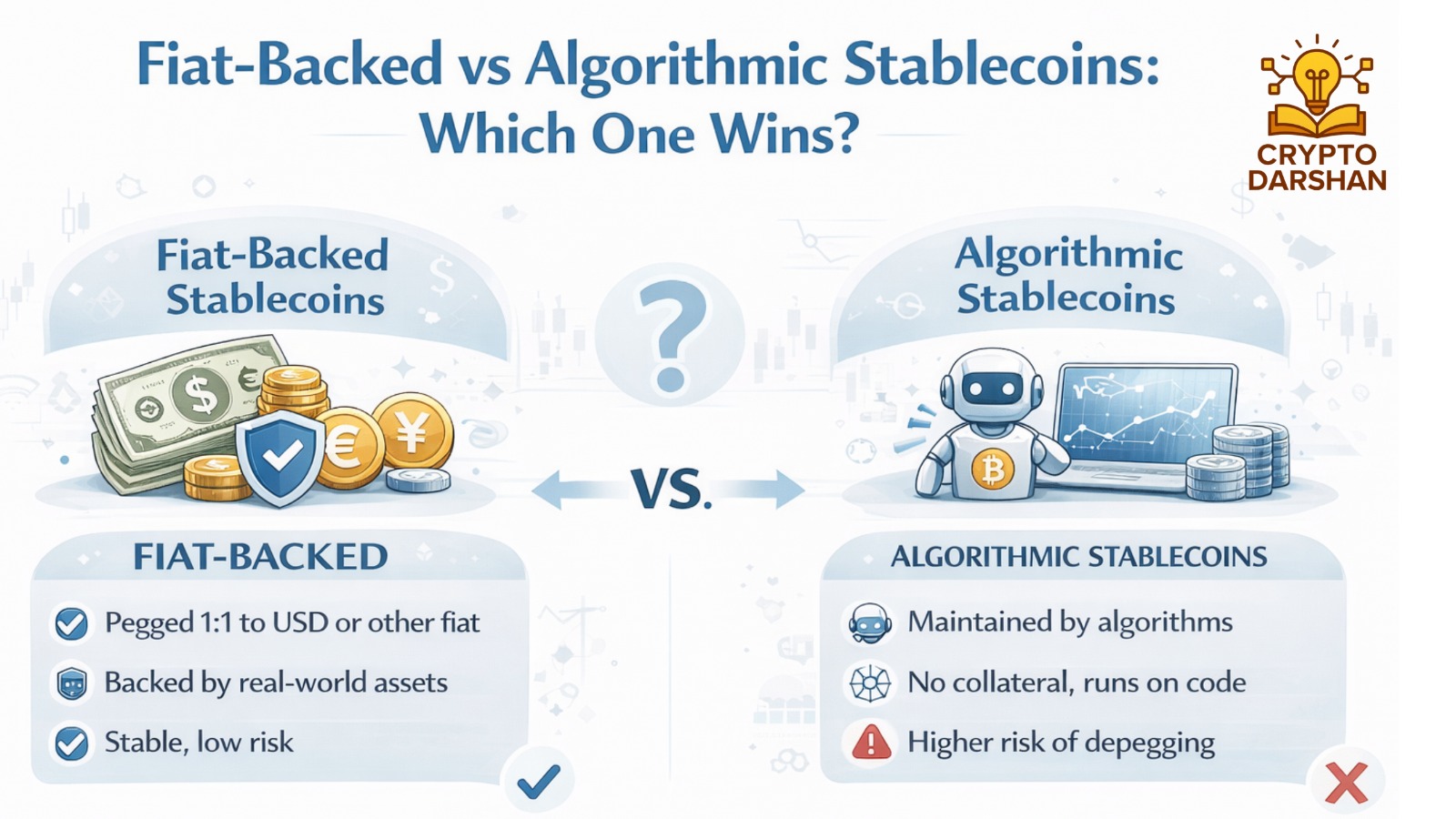
Fiat-backed vs algorithmic stablecoins debate centers on reliability: fiat-backed like USDT and USDC maintain pegs through real reserves, outperforming algorithmic models prone to depegging failures like TerraUSD. The cryptocurrency market is known for its volatility. Prices of digital assets like Bitcoin and Ethereum can fluctuate dramatically within hours, making them risky for everyday transactions and long-term savings. To solve this problem, stablecoins were created as digital currencies designed to maintain a stable value.
However, not all stablecoins are built the same. Two major types dominate the market: fiat-backed stablecoins and algorithmic stablecoins. Both aim to achieve price stability, but they use very different methods.
This article explores how each type works, their advantages and disadvantages, and which one might be the better choice for investors, traders, and the future of decentralized finance (DeFi).
What Are Stablecoins?

Stablecoins are cryptocurrencies pegged to a stable asset, such as the US dollar, euro, or gold. Their main goal is to reduce volatility while maintaining the benefits of blockchain technology speed, transparency, and decentralization.
For example, 1 USDT (Tether) or 1 USDC (USD Coin) is designed to always equal 1 USD. This stability makes stablecoins ideal for trading, payments, and storing value in the crypto ecosystem.
Stablecoins can be categorized into several types:
- Fiat-backed stablecoins
- Crypto-backed stablecoins
- Algorithmic stablecoins
- Commodity-backed stablecoins
Among these, fiat-backed and algorithmic stablecoins represent two opposite ends of the stability spectrum; one relies on real-world reserves, while the other depends on code and algorithms.
To fully understand the differences between fiat-backed and algorithmic stablecoins, it helps to start with the basics. Our guide, Stablecoins 101: Smart Way to Survive Crypto Volatility, explains how stablecoins work, why they exist, and how they help investors and businesses manage crypto volatility effectively.
Understanding Fiat-Backed Stablecoins.

Fiat-backed stablecoins are digital tokens backed by traditional currencies like the US dollar, euro, or yen. For every stablecoin issued, an equivalent amount of fiat currency is held in reserve by a trusted institution.
This means that if a user holds 100 USDC, there should be $100 stored in a bank account or equivalent assets to back it.
How Fiat-Backed Stablecoins Work
- A user deposits fiat currency (e.g., USD) with the stablecoin issuer.
- The issuer mints an equivalent amount of stablecoins (e.g., 1 USDC = $1).
- When the user redeems the stablecoins, the issuer burns them and returns the fiat currency.
This process ensures that the stablecoin maintains a 1:1 peg with the underlying fiat currency.
Popular Fiat-Backed Stablecoins

| Stablecoin | Issuer | Peg | Reserve Type |
| USDT (Tether) | Tether Ltd. | USD | Cash, bonds, and other assets |
| USDC (USD Coin) | Circle | USD | Cash and short-term US Treasuries |
| BUSD (Binance USD) | Binance & Paxos | USD | Cash and cash equivalents |
| TUSD (TrueUSD) | TrustToken | USD | Fully audited fiat reserves |
Advantages of Fiat-Backed Stablecoins
- High Stability: Pegged directly to fiat currencies, ensuring minimal price fluctuations.
- Simplicity: Easy to understand and use, making them ideal for beginners.
- Liquidity: Widely accepted across exchanges and DeFi platforms.
- Transparency: Many issuers provide regular audits and reserve reports.
- Regulatory Compliance: Often operate under financial regulations, increasing trust.
Disadvantages of Fiat-Backed Stablecoins
- Centralization: Controlled by companies that hold reserves, reducing decentralization.
- Counterparty Risk: Users must trust that issuers actually hold the claimed reserves.
- Regulatory Pressure: Subject to government oversight and potential restrictions.
- Limited Innovation: Dependence on traditional banking systems can slow innovation.
Understanding Algorithmic Stablecoins
An algorithmic stablecoin is a digital asset that mirrors the price of a fiat currency (usually, the U.S. dollar). Using mechanisms that adjust the circulating token supply, these types of stablecoins attempt to maintain their peg with the underlying currency. They automatically adjust supply and demand to keep the price close to a target value, usually $1.
How Algorithmic Stablecoins Work
Algorithmic stablecoins use supply elasticity expanding or contracting the number of tokens in circulation based on market conditions.
- If the price rises above $1, the system mints new tokens to increase supply and bring the price down.
- If the price falls below $1, the system burns tokens or incentivizes users to remove them from circulation, reducing supply and pushing the price up.
This mechanism is similar to how central banks manage national currencies but executed automatically through code.
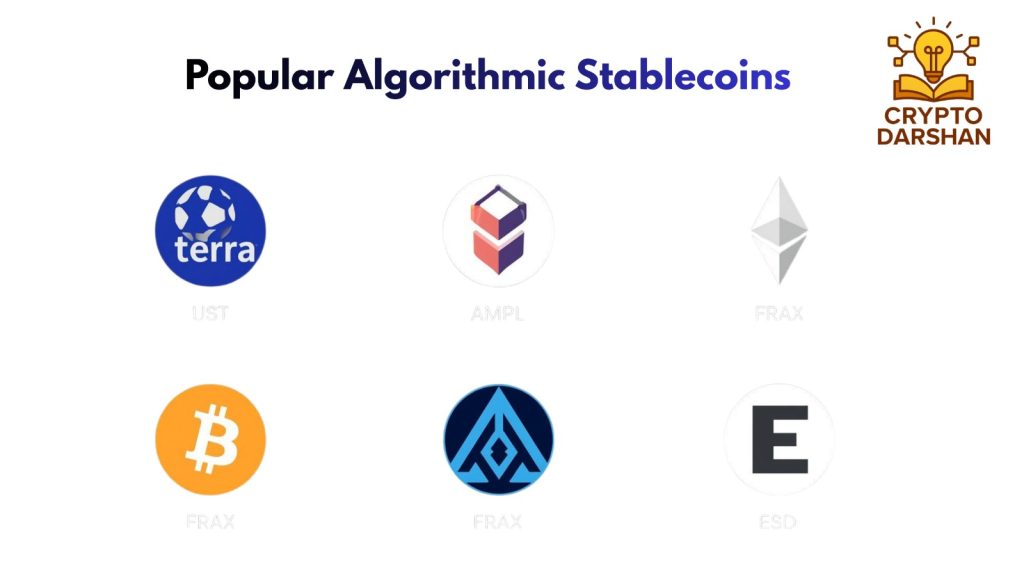
Popular Algorithmic Stablecoins
| Stablecoin | Mechanism | Peg | Status |
| FRAX | Partially collateralized + algorithmic | USD | Active |
| AMPL (Ampleforth) | Supply rebasing | USD | Active |
| UST (TerraUSD) | Algorithmic + LUNA collateral | USD | Collapsed in 2022 |
| USDD | Algorithmic + TRX collateral | USD | Active |
Advantages of Algorithmic Stablecoins
- Decentralization: Operate without centralized control or custodians.
- Scalability: No need for physical reserves, allowing unlimited growth.
- Innovation: Represent a new frontier in decentralized monetary systems.
- Transparency: All operations are governed by open-source smart contracts.
Disadvantages of Algorithmic Stablecoins
- High Volatility Risk: Can lose their peg during extreme market conditions.
- Complexity: Difficult for average users to understand.
- Lack of Trust: Many algorithmic stablecoins have failed due to poor design or market manipulation.
- Market Dependence: Stability relies on continuous demand and confidence.
Fiat-Backed Vs Algorithmic Stablecoins.
| Feature | Fiat-Backed Stablecoins | Algorithmic Stablecoins |
| Backing | Fiat currency reserves | Algorithms and smart contracts |
| Control | Centralized (issuer-controlled) | Decentralized (code-controlled) |
| Stability | High and predictable | Variable and experimental |
| Transparency | Audited reserves | On-chain algorithmic data |
| Scalability | Limited by fiat reserves | Unlimited supply potential |
| Risk | Counterparty and regulatory risk | De-pegging and market risk |
| Examples | USDT, USDC, BUSD | FRAX, AMPL, USDD |
The Rise and Fall of Algorithmic Stablecoins
Algorithmic stablecoins were once seen as the future of decentralized finance (DeFi). They promised stability without relying on banks, custodians, or fiat reserves. However, their journey has been turbulent marked by innovation, hype, and dramatic collapses. Below is a breakdown of their rise and fall, explained point by point.
1. The Vision of Decentralized Stability
Algorithmic stablecoins were created to achieve price stability through code rather than collateral. The idea was to maintain a $1 peg using algorithms that automatically adjusted supply and demand.
If the price went above $1, new tokens were minted to bring it down. If it fell below $1, tokens were burned to reduce supply. This mechanism aimed to mimic how central banks manage money supply, but in a decentralized, automated way.
2. Early Success and Innovation
Projects like Ampleforth (AMPL) and Basis introduced the concept of “elastic supply,” where token balances expanded or contracted based on market conditions.
Later, Frax combined partial collateralization with algorithmic control, creating a hybrid model that improved stability. These innovations attracted developers and investors who believed algorithmic stablecoins could replace fiat-backed ones.
3. The Boom of TerraUSD (UST)

The real turning point came with TerraUSD (UST), launched by Terraform Labs. UST used a dual-token system with LUNA to maintain its peg. When UST’s price dropped, users could burn UST to mint LUNA, reducing supply and restoring balance.
This model worked well during the bull market of 2021, driving massive adoption in DeFi platforms and earning billions in total value locked (TVL). UST became one of the top stablecoins by market cap, and its success fueled optimism about algorithmic stability.
4. The Illusion of Stability
While UST appeared stable, its system depended heavily on continuous demand and market confidence. The peg was maintained as long as users believed in the mechanism and kept participating in arbitrage opportunities.
However, this created a fragile structure if confidence dropped, the system could spiral out of control. The stability was more psychological than structural.
5. The Collapse of TerraUSD (UST)
In May 2022, UST lost its peg after large withdrawals from the Anchor Protocol, where users earned high yields on UST deposits. As investors rushed to redeem UST for LUNA, the supply of LUNA exploded, causing its price to crash.
This triggered a “death spiral” UST’s value fell further, leading to more redemptions and even more LUNA being minted. Within days, both tokens collapsed, wiping out over $40 billion in market value and shaking the entire crypto industry.
6. The Aftermath and Market Impact

The UST collapse destroyed trust in algorithmic stablecoins. Many investors lost confidence in the idea that stability could be achieved without collateral.
Regulators also took notice, calling for stricter oversight of stablecoins. The event became one of the biggest failures in crypto history, often compared to a financial system crash within the blockchain world.
7. Surviving Projects and Lessons Learned
Despite the setbacks, some algorithmic stablecoins survived by adopting hybrid models. Frax (FRAX), for example, uses a mix of collateral and algorithmic control to maintain stability.
The key lesson learned is that purely algorithmic systems are too fragile in volatile markets. A combination of collateralization, transparency, and algorithmic mechanisms may offer a more sustainable path forward.
8. The Shift Toward Hybrid Models
After the UST collapse, developers began exploring hybrid stablecoins that combine the best of both worlds partial fiat or crypto collateral with algorithmic adjustments.
This approach reduces the risk of de-pegging while maintaining decentralization. It represents the next evolution of algorithmic stablecoins, focusing on resilience rather than pure automation.
9. Regulatory Scrutiny and Future Outlook
Governments and regulators now closely monitor stablecoins, especially algorithmic ones. The failures highlighted the need for transparency, audits, and risk management.
While algorithmic stablecoins may return in improved forms, they will likely face stricter compliance requirements and more cautious adoption.
10. The Legacy of Algorithmic Stablecoins
The rise and fall of algorithmic stablecoins taught the crypto industry valuable lessons about trust, design, and sustainability. They proved that decentralization alone cannot guarantee stability, confidence, and collateral still matter.
Even though many failed, their innovations paved the way for future experiments in decentralized finance and monetary systems.
Why Fiat-Backed Stablecoins Dominate the Market

Fiat-backed stablecoins have become the backbone of the cryptocurrency ecosystem. They account for the majority of the stablecoin market capitalization, with tokens like USDT (Tether) and USDC (USD Coin) leading the way. Their dominance is not accidental, it’s the result of trust, simplicity, and strong integration with both traditional finance and decentralized systems.
Many users compare USDT vs USDC to evaluate safety and transparency. Understanding these major fiat-backed stablecoins provides a clear benchmark against algorithmic alternatives, helping investors decide which stablecoin aligns best with their risk tolerance.
1. Trust and Simplicity
Fiat-backed stablecoins are easy to understand. Each token is backed by a real-world asset, usually a fiat currency like the US dollar. This 1:1 backing gives users confidence that their digital coins can always be redeemed for the same amount of fiat money.
In contrast, algorithmic stablecoins rely on complex mechanisms that many users find difficult to grasp. The simplicity of fiat-backed models makes them more appealing to both beginners and institutions.
2. Stability and Reliability
Because they are backed by tangible reserves, fiat-backed stablecoins maintain a stable value even during market turbulence. This reliability makes them ideal for trading, payments, and storing value.
Algorithmic stablecoins, on the other hand, can lose their peg if market confidence drops, as seen in the collapse of TerraUSD (UST) in 2022.
3. Regulatory Acceptance
Regulators and financial institutions are more comfortable with fiat-backed stablecoins because they operate under clear frameworks. Issuers like Circle (USDC) and Paxos (BUSD) comply with financial regulations, conduct audits, and maintain transparent reserve reports.
This compliance builds credibility and encourages institutional adoption, something algorithmic stablecoins still struggle to achieve.
4. Liquidity and Market Adoption

Fiat-backed stablecoins are widely accepted across centralized exchanges (CEXs), decentralized exchanges (DEXs), and DeFi platforms. Their high liquidity ensures smooth trading and minimal slippage.
Because of this widespread adoption, they serve as the primary medium of exchange and settlement in the crypto market.
5. Integration with Traditional Finance
Fiat-backed stablecoins act as a bridge between traditional banking and blockchain technology. They allow users to move funds quickly between crypto exchanges and bank accounts without relying on slow, expensive wire transfers.
This interoperability makes them essential for businesses, traders, and payment providers.
6. Institutional Confidence
Large corporations, payment processors, and financial institutions prefer fiat-backed stablecoins because they are backed by audited reserves and regulated entities. This trust has led to partnerships with major companies and even discussions about integrating stablecoins into mainstream payment systems.
7. Proven Track Record
Fiat-backed stablecoins have been around longer and have proven their resilience through multiple market cycles. Their consistent performance during bull and bear markets has strengthened user confidence and cemented their dominance.
The Case for Algorithmic Stablecoins
Despite their challenges, algorithmic stablecoins represent the future of decentralized finance. They embody the true spirit of crypto independence from centralized control.
If designed correctly, algorithmic stablecoins could:
- Enable fully decentralized economies
- Reduce reliance on traditional banking systems
- Offer scalable, borderless financial solutions
Projects like Frax are experimenting with hybrid models that combine collateralization and algorithmic control, aiming to achieve both stability and decentralization.
Which One Wins?(Fiat-backed vs algorithmic stablecoins)

The answer depends on perspective and purpose.
For Traders and Investors
Fiat-backed stablecoins are the clear winner. They offer reliability, liquidity, and minimal risk, making them ideal for trading, hedging, and storing value.
For DeFi Enthusiasts
Algorithmic stablecoins offer innovation and decentralization. They align with the ethos of blockchain but come with higher risk.
For the Future of Finance
A hybrid approach may win in the long run. Combining the stability of fiat reserves with the flexibility of algorithms could create a new generation of resilient stablecoins.
The Future of Stablecoins
The stablecoin landscape is evolving rapidly. Governments are exploring Central Bank Digital Currencies (CBDCs), while private companies continue to innovate.
Future trends include:
- Hybrid stablecoins blending fiat and algorithmic models
- Cross-chain interoperability for seamless transfers
- Regulatory clarity to boost institutional adoption
- Integration with Web3 and DeFi ecosystems
As technology and regulation mature, stablecoins will likely become a cornerstone of global digital finance.
How to Choose Between Fiat-Backed and Algorithmic Stablecoins
Choosing between fiat-backed and algorithmic stablecoins depends on your goals, risk tolerance, and how you plan to use them. Both types serve the same purpose, maintaining price stability, but they differ in how they achieve it and the level of trust or decentralization they offer.
1. Purpose of Use
- For trading and payments:
Fiat-backed stablecoins like USDT or USDC are better because they maintain a consistent 1:1 peg with fiat currency. They’re ideal for storing value, transferring funds, or trading on exchanges without worrying about volatility. - For DeFi and experimentation:
Algorithmic stablecoins like FRAX or AMPL are suitable if you want to explore decentralized finance (DeFi) protocols or support innovative blockchain projects. They often offer higher yields but come with more risk.
2. Risk Tolerance
- Low risk:
Fiat-backed stablecoins are safer since they’re backed by real-world assets and often audited. - High risk:
Algorithmic stablecoins rely on code and market dynamics. If the algorithm fails or demand drops, the coin can lose its peg.
3. Transparency and Trust
- Fiat-backed:
Trust depends on the issuer’s transparency. Look for stablecoins that publish regular audit reports and comply with regulations. - Algorithmic:
Trust is built through open-source smart contracts. You can verify how the algorithm works directly on the blockchain.
4. Liquidity and Adoption
- Fiat-backed stablecoins dominate the market and are accepted on almost every exchange and DeFi platform.
- Algorithmic stablecoins may have limited liquidity and fewer trading pairs, which can affect usability.
5. Regulatory Compliance
- Fiat-backed stablecoins are more likely to comply with financial regulations, making them suitable for institutional and large-scale use.
- Algorithmic stablecoins operate in a gray area, which can pose legal or compliance risks in some regions.
6. Long-Term Goals
- If you value stability, trust, and ease of use, go with fiat-backed stablecoins.
- If you value decentralization, innovation, and potential high returns, algorithmic stablecoins might be worth exploring but only with funds you can afford to risk.
Frequently Asked Questions (FAQ)

What is the difference between fiat-backed and algorithmic stablecoins(Fiat-backed vs algorithmic stablecoins)?
Fiat-backed stablecoins are supported by reserves of real-world currencies like the US dollar, while algorithmic stablecoins rely on code and market mechanisms to maintain their value without direct collateral.
Which type of stablecoin is safer?
Fiat-backed stablecoins are generally safer because their value is backed by real assets and regularly audited. Algorithmic stablecoins carry higher risk due to market fluctuations and past failures.
Can algorithmic stablecoins fail?
Yes. Algorithmic stablecoins can lose their peg if the underlying mechanisms fail or the market behaves unpredictably, as seen in several high-profile collapses.
Are fiat-backed stablecoins centralized?
Yes, most fiat-backed stablecoins are issued by centralized companies. This makes them more reliable in maintaining their peg but introduces some centralization risk.
Can algorithmic stablecoins be decentralized?
Some algorithmic stablecoins aim for decentralization using smart contracts and governance tokens. However, decentralization doesn’t eliminate market or technical risks.
Which stablecoin type is better for beginners?
For beginners, fiat-backed stablecoins like USDT or USDC are recommended because they are widely adopted, transparent, and less likely to experience sudden price drops.
Can businesses use algorithmic stablecoins for payments?
Due to their instability risk, algorithmic stablecoins are rarely used for business payments. Fiat-backed stablecoins are preferred for predictable transactions.
Do regulators treat fiat-backed and algorithmic stablecoins differently?
Yes. Fiat-backed stablecoins often fall under financial regulations and compliance rules, while algorithmic stablecoins operate in a more uncertain regulatory environment.
Conclusion
Both fiat-backed and algorithmic stablecoins aim to solve the same problem: crypto volatility, but they take very different paths.
Fiat-backed stablecoins offer stability, trust, and widespread adoption, making them the backbone of today’s crypto economy. Algorithmic stablecoins, on the other hand, represent innovation and decentralization, pushing the boundaries of what’s possible in digital finance.
In the current landscape, fiat-backed stablecoins clearly lead in reliability and adoption. However, as technology evolves, algorithmic and hybrid models may redefine the future of stable value in the crypto world.
The real winner may not be one or the other but a combination of both, creating a balanced, decentralized, and stable digital economy.