
The blockchain industry has grown rapidly over the past decade, evolving from a single-chain ecosystem into a vast network of interconnected blockchains. Each chain offers unique features, consensus mechanisms, and communities. However, this diversity has also created fragmentation. Users face challenges moving assets, data, and applications across different blockchains. Developers struggle with interoperability, liquidity silos, and inconsistent user experiences.
To solve these challenges, Polygon—one of the leading blockchain scaling platforms—has introduced AggLayer, a groundbreaking protocol designed to unify all of Web3. Polygon AggLayer aims to connect multiple blockchains into a single, seamless ecosystem where users and developers can interact across networks as easily as they do within one.
This article explores what Polygon AggLayer is, how it works, its architecture, benefits, and why it could become the foundation for a unified Web3. It also examines its potential impact on developers, users, and the broader blockchain landscape in 2026 and beyond.
Understanding the Problem: Fragmentation in Web3

1. The Multi-Chain Reality
The blockchain ecosystem has evolved into a multi-chain world. Ethereum, Solana, Avalanche, Binance Smart Chain, and many others coexist, each optimized for different use cases. While this diversity fosters innovation, it also creates islands of liquidity and data.
Users often need to bridge tokens between chains, which can be slow, expensive, and risky. Developers must deploy their applications separately on multiple chains, fragmenting their user base and liquidity. This fragmentation limits the potential of decentralized applications (dApps) and slows down Web3 adoption.
2. The Interoperability Challenge
Interoperability—the ability for different blockchains to communicate and share data—is one of the biggest challenges in Web3. Current solutions, such as cross-chain bridges, often rely on centralized intermediaries or complex mechanisms that introduce security risks.
The lack of a trust-minimized, scalable, and unified interoperability layer prevents Web3 from functioning as a cohesive ecosystem. Without seamless communication between chains, the vision of a truly decentralized internet remains incomplete.
3. The User Experience Problem
For mainstream adoption, Web3 must offer a user experience comparable to Web2. However, interacting with multiple chains currently requires:
- Managing different wallets and tokens
- Paying gas fees in various currencies
- Using bridges and swaps to move assets
- Understanding complex technical details
This complexity discourages new users and limits the growth of decentralized applications.
What Is Polygon AggLayer?

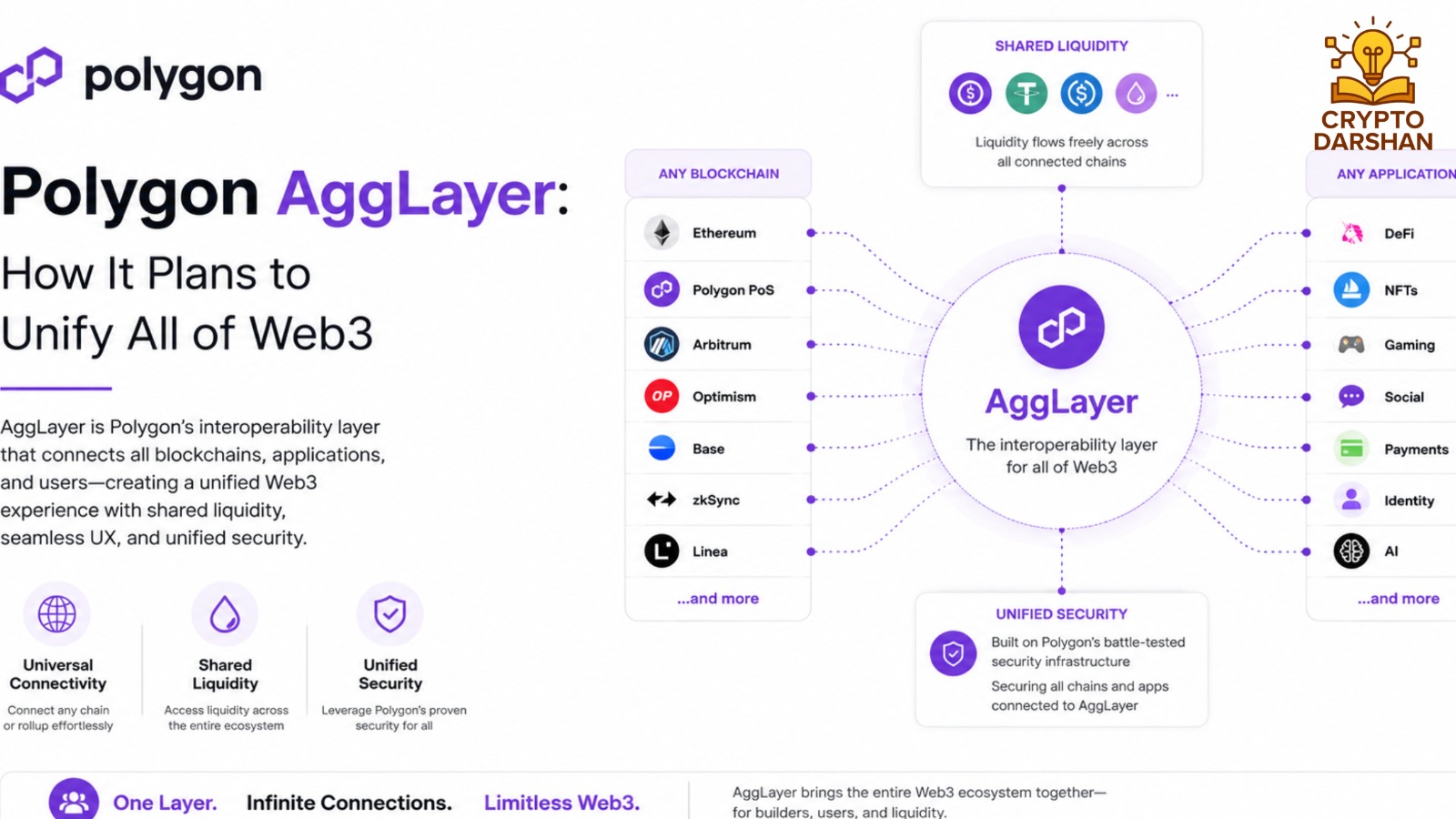
Polygon AggLayer is a new interoperability protocol developed by Polygon Labs. It is designed to aggregate multiple blockchains into a single, unified network while maintaining their sovereignty and scalability.
AggLayer acts as a coordination layer that connects different chains, especially those built using Polygon’s Chain Development Kit (CDK), and enables them to share liquidity, data, and security seamlessly. Agglayer is the interoperability layer built into every Polygon Chain Development Kit (CDK) chain. When you deploy a CDK chain, it connects to Agglayer by default — the cross-chain capabilities described here come as part of the infrastructure, not as a separate integration step.
In essence, AggLayer transforms a fragmented multi-chain ecosystem into a cohesive,interconnected Web3 network.
Key Goals of Polygon AggLayer
- Unify Web3 ecosystems by connecting multiple blockchains into one network.
- Enable seamless cross-chain transactions without relying on centralized bridges.
- Preserve chain sovereignty, allowing each blockchain to maintain its own governance and rules.
- Enhance user experience by making cross-chain interactions feel like single-chain operations.
- Leverage zero-knowledge (ZK) technology for secure and efficient interoperability.
The Vision Behind Polygon AggLayer
Polygon’s vision for AggLayer is to create a “unified liquidity layer” for Web3. Instead of isolated blockchains competing for users and capital, AggLayer allows them to collaborate and share resources.
This vision aligns with Polygon’s broader mission to scale Ethereum and make it the foundation of a decentralized internet. By connecting Ethereum-compatible chains through AggLayer, Polygon aims to create a network of networks—a Web3 ecosystem that functions as one.
How Polygon AggLayer Works

Polygon AggLayer is built on advanced cryptographic and architectural principles that enable secure, efficient, and scalable interoperability. Its design combines zero-knowledge proofs, aggregation mechanisms, and cross-chain messaging to unify multiple blockchains.
1. Zero-Knowledge Proofs (ZKPs)
At the core of AggLayer lies zero-knowledge technology, which allows one party to prove the validity of information without revealing the underlying data. Polygon has been a pioneer in ZK research, developing solutions like Polygon zkEVM and Polygon Miden.
AggLayer uses ZK proofs to verify transactions and state changes across connected chains. This ensures that cross-chain operations are trustless, secure, and verifiable without relying on centralized intermediaries.
2. Aggregation Mechanism
AggLayer aggregates proofs and data from multiple chains into a single layer. Each connected chain periodically submits cryptographic proofs of its state to AggLayer. These proofs are then aggregated and verified collectively.
This aggregation process allows Polygon AggLayer to maintain a global view of all connected chains, enabling seamless cross-chain communication and liquidity sharing.
3. Cross-Chain Messaging
AggLayer introduces a secure messaging protocol that allows smart contracts on different chains to communicate directly. Developers can build applications that span multiple chains without deploying separate versions.
For example, a decentralized exchange (DEX) on one chain can interact with liquidity pools on another chain through AggLayer, creating a unified trading experience.
4. Shared Liquidity Layer
One of AggLayer’s most powerful features is its ability to unify liquidity across chains. Instead of fragmented pools, liquidity can flow freely between connected networks. This benefits decentralized finance (DeFi) applications, which rely heavily on liquidity depth and efficiency.
5. Chain Sovereignty
Unlike some interoperability solutions that require chains to sacrifice autonomy, AggLayer preserves chain sovereignty. Each connected blockchain maintains its own consensus mechanism, governance, and tokenomics. AggLayer simply provides the infrastructure for them to interoperate securely.
The Architecture of Polygon AggLayer

AggLayer’s architecture is modular and designed for scalability. It consists of several key components that work together to unify multiple blockchains.
1. Connected Chains
These are the individual blockchains that integrate with AggLayer. They can be:
- Polygon CDK-based chains
- Ethereum Layer 2s
- Other compatible blockchains
Each chain submits ZK proofs of its state to AggLayer.
2. Aggregation Layer
This is the core of AggLayer. It collects proofs from connected chains, aggregates them, and submits a combined proof to Ethereum. This ensures that all connected chains are cryptographically verified and synchronized.
3. Messaging Layer
The messaging layer handles cross-chain communication. It ensures that messages between chains are authenticated, ordered, and executed correctly. This layer enables smart contracts to interact across chains seamlessly.
4. Liquidity Layer
The liquidity layer manages shared liquidity pools and facilitates cross-chain asset transfers. It ensures that users can move assets between chains instantly and securely.
5. Settlement Layer
AggLayer uses Ethereum as its settlement layer. All aggregated proofs are ultimately verified on Ethereum, ensuring the highest level of security and decentralization.
How Polygon AggLayer Plans to Unify All of Web3

Let me break down the key strategies and mechanisms that Polygon AggLayer uses to unify the fragmented blockchain ecosystem:
1. Zero-Knowledge Proof Aggregation
AggLayer uses advanced zero-knowledge (ZK) cryptography to create a trustless connection between blockchains. Each connected chain submits cryptographic proofs of its transactions and state changes to AggLayer.
This approach ensures that cross-chain interactions are mathematically secure without requiring trust in centralized intermediaries. It’s like having a universal translator that can verify what’s happening on every blockchain without exposing sensitive details.
2. Unified Liquidity Layer
One of the biggest problems in Web3 is fragmented liquidity—assets trapped on different chains can’t interact efficiently. AggLayer solves this by creating shared liquidity pools that span multiple blockchains.
Instead of having separate pools on each chain, DeFi protocols can access a unified pool of capital. This means better trading prices, lower slippage, and more efficient capital usage.
3. Cross-Chain Messaging Protocol
AggLayer introduces a native messaging system that allows smart contracts on different blockchains to communicate directly and securely. This is revolutionary because it means:
- A smart contract on Chain A can call functions on Chain B
- Data can flow seamlessly between ecosystems
- Developers can build applications that span multiple chains without deploying separate versions
Think of it as creating a universal communication standard for blockchains—like how email works across different providers.
4. Preserving Chain Sovereignty
Unlike some interoperability solutions that force chains to give up control, AggLayer allows each blockchain to maintain complete independence. Connected chains keep their own:
- Governance systems
- Consensus mechanisms
- Token economics
- Rules and policies
Polygon AggLayer acts purely as a coordination layer, not a control layer. This makes it attractive for diverse blockchain projects that want interoperability without sacrificing autonomy.
5. Ethereum as the Security Foundation

Polygon AggLayer anchors all connected chains to Ethereum’s security. The aggregated proofs from all chains are ultimately verified on Ethereum, which provides:
- The highest level of decentralization
- Battle-tested security
- Credible neutrality
- Network effects from Ethereum’s ecosystem
This means smaller chains can inherit Ethereum’s security without running their own validator sets, making them more secure and cost-effective.
6. Seamless User Experience
AggLayer makes interacting with multiple blockchains feel like using a single network. Users benefit from:
- One wallet that works across all connected chains
- Instant transactions between chains without waiting for bridges
- Unified balances that show assets across all networks
- No manual bridging or complex token swaps
- Single gas token experience (no need to hold different currencies)
The technical complexity is hidden, making Web3 accessible to mainstream users who don’t want to understand blockchain architecture.
7. Integration with Polygon CDK
Polygon’s Chain Development Kit (CDK) allows anyone to create custom Layer 2 blockchains optimized for specific use cases—gaming, DeFi, enterprise, etc. AggLayer automatically connects all CDK-based chains, creating a network effect:
- New chains instantly gain interoperability
- They share liquidity with the entire ecosystem
- Developers can build cross-chain apps from day one
- Users can access all chains through one interface
Benefits of Polygon AggLayer

1. Unified Web3 Experience
AggLayer eliminates the friction of interacting with multiple blockchains. Users can move assets, interact with dApps, and access liquidity across chains as if they were on a single network.
2. Enhanced Security
By leveraging zero-knowledge proofs and Ethereum’s security, AggLayer provides a trust-minimized interoperability solution. It removes the need for centralized bridges, which have historically been vulnerable to hacks.
3. Improved Liquidity Efficiency
DeFi applications benefit from unified liquidity pools that span multiple chains. This increases capital efficiency, reduces slippage, and enhances trading opportunities.
4. Developer Flexibility
Developers can build cross-chain applications without managing multiple deployments. AggLayer’s messaging protocol allows smart contracts to interact across chains effortlessly.
5. Scalability and Performance
AggLayer’s aggregation mechanism allows it to scale horizontally. As more chains connect, the network becomes more robust without compromising performance.
6. Chain Independence
Each connected chain retains full control over its governance, consensus, and tokenomics. Polygon AggLayer acts as a coordination layer, not a control layer.
7. Ecosystem Growth
By connecting multiple chains, AggLayer fosters collaboration and innovation. Projects can share users, liquidity, and data, accelerating the growth of the entire Web3 ecosystem. Polygon’s ecosystem growth is one reason analysts remain bullish, as explored in Polygon Price Prediction 2026: Will POL Hit $5 After zk Upgrades?
Polygon CDK and AggLayer: A Perfect Match

Polygon’s Chain Development Kit (CDK) allows developers to create custom Layer 2 blockchains powered by zero-knowledge technology. These chains can be optimized for specific use cases, such as gaming, DeFi, or enterprise applications.
AggLayer complements CDK by connecting all these chains into a unified network. Every CDK-based chain automatically gains interoperability, shared liquidity, and access to the broader Polygon ecosystem.
Together, CDK and AggLayer form the foundation of Polygon 2.0, a vision for a unified, scalable, and interconnected Web3.
Use Cases of Polygon AggLayer

1. Cross-Chain DeFi
DeFi protocols can operate across multiple chains without fragmenting liquidity. For example:
- A lending protocol on one chain can accept collateral from another chain.
- A DEX can aggregate liquidity from multiple networks.
- Yield farming strategies can span several ecosystems seamlessly.
2. Gaming and NFTs
Polygon AggLayer enables cross-chain gaming economies where assets, tokens, and NFTs move freely between games and platforms. Players can use their NFTs across different ecosystems without manual bridging.
3. Enterprise Solutions
Enterprises can deploy private or permissioned chains connected to AggLayer, allowing secure data sharing and interoperability with public networks.
4. Cross-Chain DAOs
Decentralized autonomous organizations (DAOs) can operate across multiple chains, coordinating governance and treasury management through AggLayer’s messaging system.
5. Data and Identity Networks
Polygon AggLayer can unify decentralized identity systems and data networks, enabling users to maintain a single identity across multiple blockchains.
Comparison with Other Interoperability Solutions

| Feature | Polygon AggLayer | Cosmos IBC | Polkadot | Bridges |
| Security Model | ZK proofs + Ethereum security | Shared security | Relay chain | Varies (often centralized) |
| Chain Sovereignty | Preserved | Preserved | Limited | Preserved |
| Cross-Chain Messaging | Native and trustless | Native | Native | Limited |
| Liquidity Sharing | Unified | Partial | Partial | Fragmented |
| Scalability | High | Moderate | Moderate | Varies |
| User Experience | Seamless | Complex | Moderate | Fragmented |
Polygon AggLayer stands out for combining Ethereum-level security, ZK-based trustlessness, and seamless user experience—a combination unmatched by existing solutions.
The Role of Zero-Knowledge Technology
Zero-knowledge proofs are central to AggLayer’s design. They provide:
- Security: Verifiable proofs ensure that cross-chain transactions are valid.
- Efficiency: Aggregated proofs reduce computational overhead.
- Privacy: Sensitive data can be verified without being exposed.
- Scalability: ZK rollups enable high throughput and low fees.
Polygon’s deep expertise in ZK technology gives AggLayer a strong competitive advantage in building a secure and scalable interoperability layer.
The Roadmap for Polygon AggLayer

Polygon Labs has outlined a multi-phase roadmap for AggLayer’s development and deployment.
Phase 1: Launch and Integration
- Initial integration with Polygon zkEVM and CDK-based chains.
- Basic cross-chain messaging and proof aggregation.
Phase 2: Liquidity Unification
- Implementation of shared liquidity pools.
- Integration with major DeFi protocols.
Phase 3: Ecosystem Expansion
- Support for non-Polygon chains.
- Developer tools and SDKs for cross-chain dApps.
Phase 4: Full Web3 Unification
- Seamless interoperability across all major blockchains.
- Unified user experience across wallets and applications.
The Impact on Developers

For developers, Polygon AggLayer simplifies multi-chain development:
- Build once, deploy everywhere.
- Access unified liquidity and user bases.
- Use familiar Ethereum tools and standards.
- Create cross-chain applications without managing bridges.
This reduces development time, costs, and complexity, allowing developers to focus on innovation.
The Impact on Users

For users, Polygon AggLayer transforms the Web3 experience:
- One wallet for all chains.
- Instant cross-chain transactions.
- Unified liquidity and lower fees.
- Simplified onboarding and usability.
Users no longer need to worry about which chain they are on—Web3 becomes as seamless as using a single app. As blockchain ecosystems expand globally, interoperability solutions could become increasingly important in regions discussed in Middle East Crypto Hubs: Dubai, Riyadh, and New Players
The Future of Web3 with Polygon AggLayer

Polygon AggLayer represents a major step toward realizing the vision of a unified, decentralized internet. By connecting multiple blockchains into a single network, it eliminates fragmentation and unlocks new possibilities for innovation.
In the coming years, AggLayer could become the backbone of Web3, enabling:
- Global-scale DeFi ecosystems
- Interconnected gaming worlds
- Cross-chain social networks
- Decentralized data and identity systems
As more chains integrate with AggLayer, the boundaries between blockchains will fade, giving rise to a truly interconnected digital economy.
FAQ: Polygon AggLayer: How It Plans to Unify All of Web3

1. What is Polygon AggLayer?
Polygon AggLayer is an interoperability protocol designed to connect different blockchains into one unified network. Its goal is to make moving assets and data across chains feel seamless, almost like using a single blockchain.
2. Why did Polygon create AggLayer?
Polygon created AggLayer to solve blockchain fragmentation. Today, users and liquidity are spread across many isolated chains, making Web3 complicated and inefficient. AggLayer aims to unify liquidity, users, and applications across networks.
3. How is AggLayer different from traditional crypto bridges?
Traditional bridges often rely on wrapped assets and third-party validators. AggLayer instead uses cryptographic proofs and unified liquidity so assets can move natively between connected chains without wrapped tokens.
4. What does “unified liquidity” mean in AggLayer?
Unified liquidity means assets keep the same identity across all connected chains. For example, ETH on one AggLayer-connected chain remains the same ETH on another chain, reducing fragmentation and improving user experience.
5. What are atomic cross-chain transactions?
Atomic transactions mean a cross-chain operation either completes fully across all chains or fails completely. This removes partial transaction risks that often happen with traditional bridging systems.
6. How does AggLayer improve Web3 user experience?
AggLayer aims to eliminate complicated bridging steps, multiple wallets, and long waiting times. Users could interact with apps across several chains as if everything existed on one network.
7. Is AggLayer only for Polygon chains?
No. While AggLayer is integrated with Polygon CDK chains by default, the vision extends beyond Polygon. The protocol is designed to support many blockchain ecosystems and create broader interoperability across Web3.
Conclusion
Polygon AggLayer is more than just an interoperability protocol—it is the foundation for a unified Web3. By combining zero-knowledge technology, aggregation mechanisms, and Ethereum security, AggLayer enables seamless communication, liquidity sharing, and collaboration across blockchains.
It solves one of the biggest challenges in the blockchain industry: fragmentation. With AggLayer, users and developers can interact across multiple chains as easily as within one, paving the way for mass adoption of decentralized technologies.
As 2026 unfolds, Polygon AggLayer stands out as a transformative innovation that could redefine how Web3 operates. It embodies the next evolution of blockchain—a world where all chains are connected, all liquidity is unified, and all users share a single, seamless experience.