The digital economy is evolving beyond virtual assets and blockchain speculation. A new movement is emerging that bridges the gap between the physical and digital worlds: Decentralized Physical Infrastructure Networks (DePIN). This concept represents a paradigm shift in how physical infrastructure is built, owned, and operated. Instead of relying on centralized corporations or governments, DePIN leverages blockchain technology, token incentives, and community participation to create decentralized networks for real-world services.
In 2026, DePIN is poised to become one of the most transformative trends in the Web3 ecosystem. It combines the power of decentralized finance (DeFi), the Internet of Things (IoT), and tokenized economies to reshape industries such as telecommunications, energy, mobility, and cloud computing. This article explores the fundamentals of Decentralized Physical Infrastructure, its key components, leading projects, challenges, and the reasons it is being hailed as the sleeper trend of 2026.
What Is Decentralized Physical Infrastructure(DePIN)?

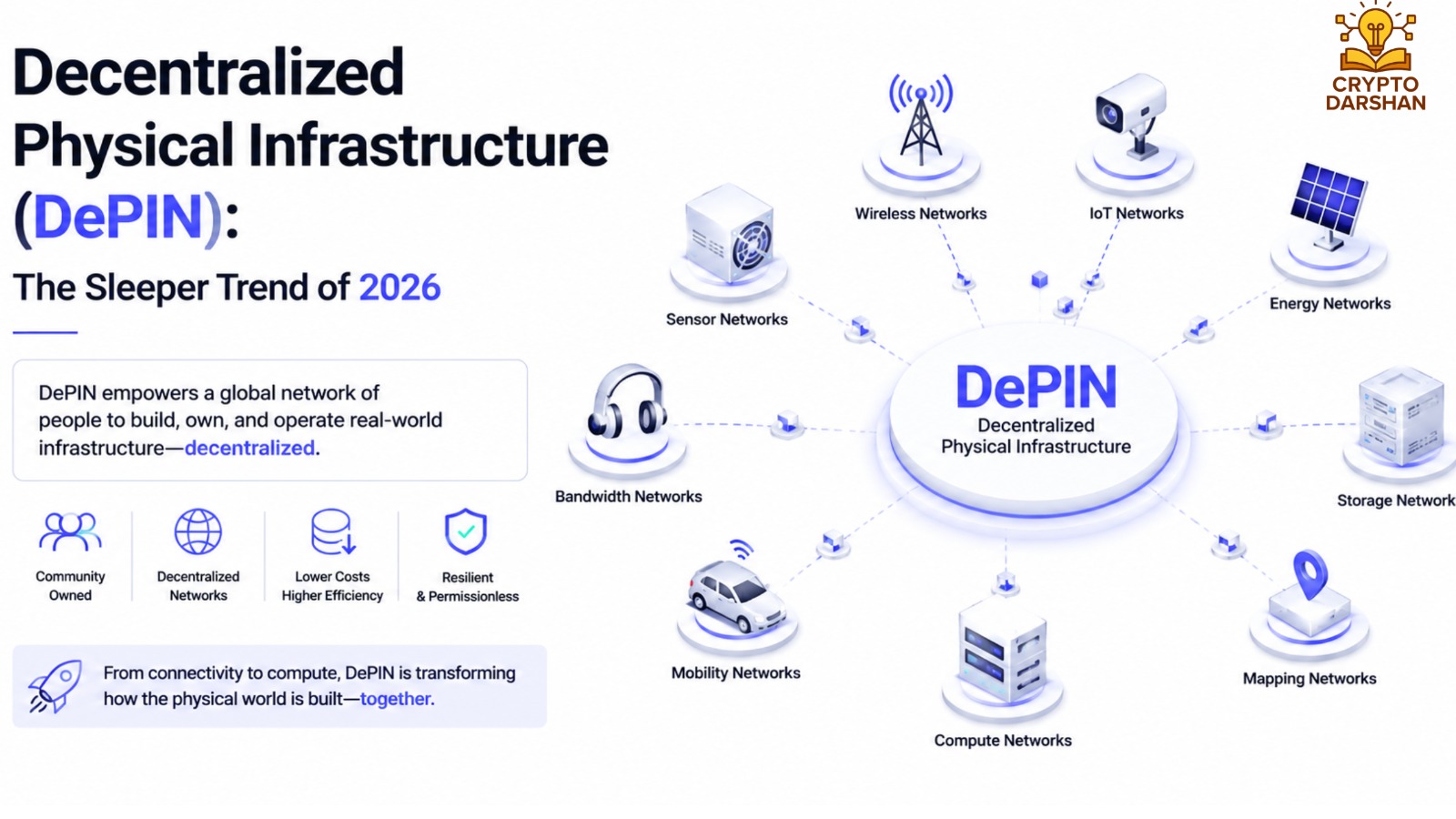
Decentralized Physical Infrastructure Networks (DePINs) connect the physical world to blockchain technology by incentivizing the contribution of digital or physical resources, such as computing power or storage, to a decentralized network. Contributors earn cryptocurrency tokens based on their contributions. DePIN networks rely on individuals and organizations to contribute resources, such as hardware, bandwidth, storage, or energy, in exchange for tokens or other rewards.
DePIN represents a new model for building real-world networks. It decentralizes ownership, governance, and value distribution, allowing communities to collectively create and benefit from infrastructure that supports essential services.
Key Characteristics of DePIN
- Decentralization: No single entity controls the network. Governance and decision-making are distributed among participants.
- Token Incentives: Participants are rewarded with tokens for contributing resources or services.
- Physical Infrastructure: Unlike purely digital networks, Decentralized Physical Infrastructure involves tangible assets such as routers, sensors, vehicles, or solar panels.
- Blockchain Coordination: Smart contracts and decentralized ledgers ensure transparency, trust, and automated reward distribution.
- Community Ownership: Users and contributors share in the network’s growth and value creation.
The Evolution of Infrastructure Models

To understand the significance of Decentralized Physical Infrastructure, it helps to trace how infrastructure models have evolved.
1. Centralized Infrastructure
Traditional infrastructure—such as telecommunications, energy grids, and logistics networks—has been built and managed by centralized entities. These organizations invest heavily in capital expenditures, maintain control over operations, and capture most of the economic value. While efficient at scale, centralized systems often suffer from inefficiencies, monopolistic behavior, and limited accessibility.
2. Platform-Based Infrastructure
The rise of the internet introduced platform-based models. Companies like Uber, Airbnb, and Amazon Web Services (AWS) created digital platforms that coordinate distributed resources. However, these platforms remain centralized intermediaries that extract significant value from participants.
3. Decentralized Infrastructure (DePIN)
DePIN represents the next evolution. It removes the central intermediary entirely, replacing it with blockchain-based coordination. Contributors directly interact with the network, and value flows transparently through tokenized incentives. This model democratizes infrastructure creation and aligns incentives between users, providers, and developers.
How DePIN Works

DePIN networks operate through a combination of blockchain protocols, smart contracts, and physical devices. The process typically involves four main components:
1. Resource Contribution
Participants contribute physical resources such as computing power, bandwidth, storage, or energy. For example, a user might install a wireless hotspot, run a storage node, or deploy a solar panel connected to the network.
2. Verification and Proof Mechanisms
To ensure that resources are genuinely provided, Decentralized Physical Infrastructure networks use cryptographic proofs or verification mechanisms. Examples include:
- Proof of Coverage (PoC): Used by networks like Helium to verify that hotspots provide wireless coverage.
- Proof of Storage: Used by decentralized storage networks to confirm that data is securely stored.
- Proof of Location: Used to validate the physical presence of devices or assets.
3. Token Incentives
Contributors earn tokens based on their participation and performance. These tokens can represent utility, governance rights, or economic value. The incentive structure encourages network growth and ensures that contributors are fairly compensated.
4. Governance and Upgrades
Decentralized Physical Infrastructure networks often use decentralized governance models, allowing token holders to vote on protocol upgrades, funding allocations, and policy changes. This ensures that the network evolves in alignment with community interests.
The Core Pillars of Decentralized Physical Infrastructure(DePIN)

1. Tokenomics
Tokenomics is the economic engine of Decentralized Physical Infrastructure. It defines how tokens are distributed, earned, and used within the ecosystem. Effective tokenomics align incentives between contributors, users, and developers. Key aspects include:
- Emission Schedule: Determines how new tokens are minted and distributed.
- Utility: Defines how tokens are used (e.g., paying for services, staking, or governance).
- Burn Mechanisms: Reduce supply to maintain token value.
- Reward Distribution: Ensures fair compensation for contributors.
2. Hardware Integration
DePIN relies on physical devices that interact with the blockchain. These devices can range from IoT sensors to energy meters or routers. Hardware integration ensures that real-world data and services are verifiable and connected to the digital economy.
3. Decentralized Governance
Governance mechanisms allow communities to make collective decisions. Through decentralized autonomous organizations (DAOs), participants can propose and vote on changes, ensuring transparency and inclusivity.
4. Data and Oracles
Reliable data is essential for Decentralized Physical Infrastructure networks. Oracles bridge the gap between on-chain logic and off-chain data, enabling smart contracts to respond to real-world events. For example, an oracle might verify energy output from a solar panel or bandwidth usage from a router.
Leading DePIN Projects

DePIN’s focus on real-world utility aligns closely with the innovations highlighted in 10 Blockchain Projects That Are Actually Changing the World. Several pioneering projects have demonstrated the potential of DePIN across different sectors.
1. Helium Network
Sector: Telecommunications
Overview: Helium is one of the earliest and most successful Decentralized Physical Infrastructure projects. It enables individuals to deploy wireless hotspots that provide connectivity for IoT devices. Participants earn HNT tokens for providing coverage and transferring data.
Impact: Helium has built one of the largest decentralized wireless networks globally, with hundreds of thousands of active nodes.
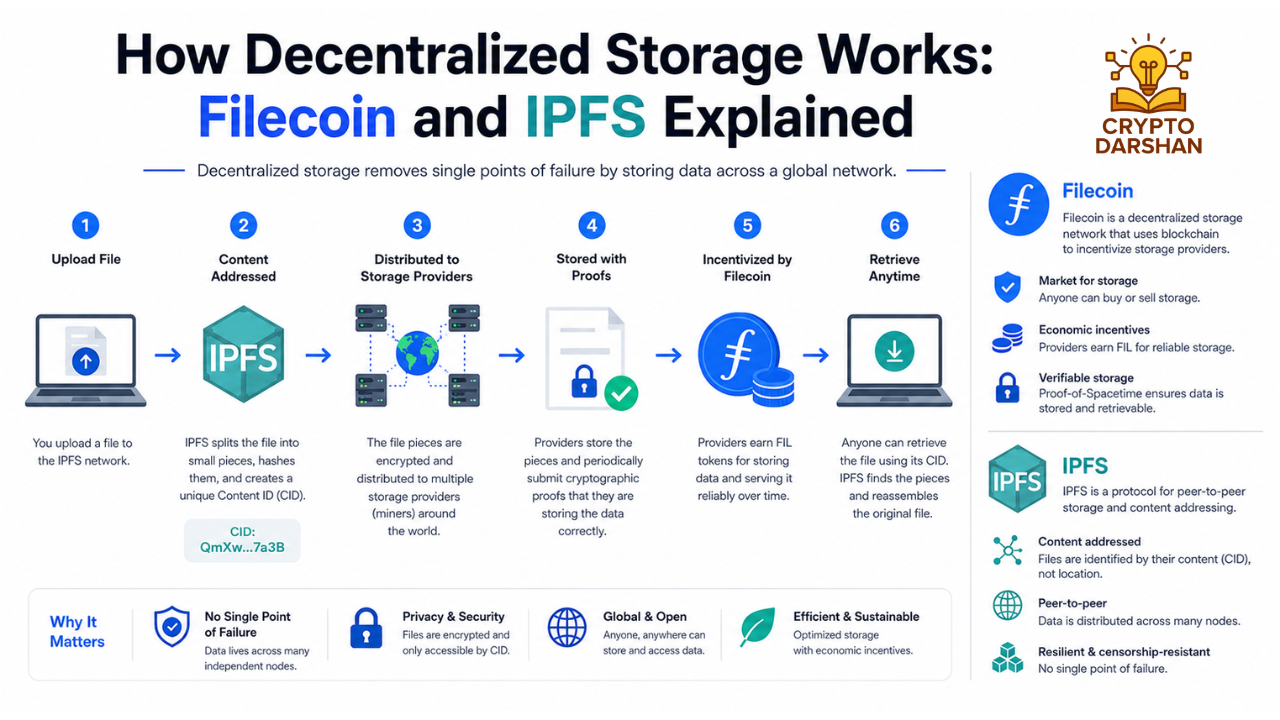
2. Filecoin
Sector: Decentralized Storage
Overview: Filecoin allows users to rent out unused storage space on their devices. The network uses Proof of Storage to verify that data is securely stored.
Impact: Filecoin has created a decentralized alternative to cloud storage providers like AWS and Google Cloud. DePIN projects focused on decentralized cloud computing could reshape blockchain’s utility beyond finance, mirroring trends outlined in Crypto Insurance Protocols: Protecting Your DeFi Positions.
3. Render Network
Sector: GPU Computing
Overview: Render connects artists and developers with decentralized GPU resources for rendering and AI workloads. Participants earn RNDR tokens for contributing computing power.
Impact: Render democratizes access to high-performance computing, reducing costs and centralization.
4. DIMO
Sector: Mobility and Automotive Data
Overview: DIMO enables vehicle owners to share data from their cars in exchange for tokens. This data can be used for insurance, maintenance, and analytics.
Impact: DIMO creates a decentralized ecosystem for automotive data, empowering drivers to monetize their information.
5. Power Ledger
Sector: Energy
Overview: Power Ledger facilitates peer-to-peer energy trading using blockchain technology. Participants can buy and sell renewable energy directly.
Impact: The project promotes sustainable energy use and decentralizes power distribution.
6. WeatherXM
Sector: Environmental Data
Overview: WeatherXM incentivizes individuals to deploy weather stations that collect local climate data. The data is verified and stored on-chain for use in forecasting and research.
Impact: WeatherXM creates a decentralized network of weather data providers, improving accuracy and accessibility.
The Economic Model of Decentralized Physical Infrastructure(DePIN)

DePIN introduces a new economic paradigm known as “Proof of Physical Work” (PoPW). This model rewards participants for performing verifiable physical tasks that contribute to network functionality. Unlike traditional mining, which consumes computational energy, PoPW ties rewards to real-world utility.
Key Economic Principles
- Value Creation Through Utility: Tokens are earned by providing useful services, not by speculation.
- Network Effects: As more participants join, the network becomes more valuable and efficient.
- Sustainable Incentives: Token rewards are designed to balance supply, demand, and long-term sustainability.
- Community Ownership: Economic value is distributed among contributors rather than centralized corporations.
Why Decentralized Physical Infrastructure Is the Sleeper Trend of 2026

Let me break down the key reasons why DePIN is emerging as a major trend this year:
1. Real-World Utility Over Speculation
Unlike many cryptocurrency projects that focus on trading and speculation, DePIN delivers actual, tangible value. It connects blockchain technology to physical infrastructure that people use every day, wireless networks, energy grids, storage systems, and transportation. This practical application makes it more sustainable and valuable than purely digital assets.
2. Perfect Timing with Technology Convergence
DePIN sits at the intersection of three major technological trends:
- Blockchain maturity: The technology is now stable and scalable enough to handle real-world applications
- IoT expansion: Billions of smart devices need decentralized coordination
- AI integration: Artificial intelligence can optimize these networks automatically
This convergence creates a powerful ecosystem where technologies amplify each other’s strengths.
3. Growing Distrust of Centralized Systems

People are increasingly concerned about:
- Big tech monopolies controlling essential services
- Data privacy violations
- Lack of transparency in infrastructure management
- Unequal value distribution
DePIN offers an alternative where communities own and control their infrastructure, addressing these concerns directly.
4. Economic Empowerment Model
Traditional infrastructure is built by corporations that capture all the profits. Decentralized Physical Infrastructure flips this model:
- Individuals earn tokens for contributing resources (bandwidth, storage, energy)
- Communities share ownership of the networks they build
- Value flows to participants, not just shareholders
- Lower barriers to entry allow anyone to participate
This democratization of infrastructure creates new income opportunities for regular people.
5. Institutional Investment Awakening
In 2026, venture capital firms and institutional investors are finally recognizing DePIN’s potential:
- It combines the innovation of crypto with real-world assets
- It offers diversification beyond purely digital investments
- It aligns with ESG (Environmental, Social, Governance) goals
- Early projects like Helium have proven the model works
This institutional interest brings credibility, funding, and mainstream attention.
6. Sustainability Alignment
DePIN naturally supports environmental goals:
- Promotes renewable energy through peer-to-peer trading
- Optimizes resource usage through decentralized coordination
- Reduces waste by utilizing existing hardware
- Enables transparent tracking of environmental impact
As climate concerns intensify, DePIN’s green credentials make it increasingly attractive.
Decentralized Physical Infrastructure(DePIN) networks become exponentially more valuable as they grow:
7. Network Effects Are Accelerating
- More participants = better coverage and service
- Better service = more users willing to pay
- More revenue = higher token value
- Higher rewards = more participants joining
Several networks have reached critical mass in 2026, triggering rapid expansion.
8. Solving Real Infrastructure Gaps
Traditional infrastructure development is slow and expensive, leaving many areas underserved. DePIN enables:
- Rural connectivity: Communities can build their own wireless networks
- Developing regions: Lower costs make infrastructure accessible
- Niche services: Networks can form around specific needs
- Rapid deployment: No need for massive capital expenditure upfront
9. Regulatory Clarity Emerging
Governments are beginning to understand and create frameworks for Decentralized Physical Infrastructure:
- Clearer legal status for decentralized infrastructure
- Recognition of token incentives as legitimate business models
- Support for community-owned networks
- Integration with existing regulatory structures
This clarity reduces risk and encourages participation.
10. Proven Success Stories
By 2026, multiple Decentralized Physical Infrastructure projects have demonstrated viability:
- Helium: Built a global wireless network with hundreds of thousands of nodes
- Filecoin: Created a decentralized alternative to cloud storage giants
- Render Network: Democratized access to GPU computing power
These successes prove the concept works and inspire new projects across industries.
Challenges Facing Decentralized Physical Infrastructure

Despite its promise, Decentralized Physical Infrastructure faces several challenges that must be addressed for widespread adoption.
1. Hardware Costs and Accessibility
Deploying physical devices requires upfront investment. Ensuring affordability and accessibility is crucial for scaling participation.
2. Regulatory Uncertainty
DePIN operates at the intersection of blockchain and physical infrastructure, raising complex regulatory questions about ownership, liability, and compliance.
3. Network Security
Physical devices can be vulnerable to tampering or fraud. Robust verification mechanisms and security protocols are essential.
4. Token Volatility
Fluctuating token prices can affect participant incentives and network stability. Sustainable tokenomics must mitigate these risks.
5. User Education
DePIN introduces new concepts that may be unfamiliar to mainstream users. Clear communication and user-friendly interfaces are necessary for adoption.
The Future of Decentralized Physical Infrastructure(DePIN)

1. Expansion Across Industries
DePIN’s model can be applied to nearly any sector involving physical infrastructure. Future applications may include:
- Transportation: Decentralized ride-sharing and logistics networks.
- Healthcare: Distributed medical data and sensor networks.
- Agriculture: Decentralized monitoring of crops and soil conditions.
- Construction: Tokenized funding for community-built infrastructure.
2. Integration with Real-World Assets (RWA)
Decentralized Physical Infrastructure will increasingly intersect with tokenized real-world assets. Combining physical infrastructure with digital ownership creates new forms of value and liquidity.
3. AI-Driven Optimization
Artificial intelligence will enhance DePIN networks by analyzing data, predicting demand, and optimizing resource allocation. This synergy will make decentralized infrastructure more efficient and adaptive.
4. Cross-Network Interoperability
Future DePIN ecosystems will be interconnected, allowing data and resources to flow seamlessly between networks. Interoperability protocols will enable collaboration across sectors.
5. Community-Led Governance
As DePIN matures, governance will become more decentralized and community-driven. DAOs will play a central role in decision-making, funding, and innovation.
Case Study: Helium’s Evolution

Helium’s journey illustrates both the potential and challenges of DePIN. Initially focused on IoT connectivity, Helium expanded into 5G and Wi-Fi networks. Its success demonstrated that decentralized models could compete with traditional telecom providers. However, the project also faced issues such as token inflation and hardware quality control. These lessons highlight the importance of sustainable tokenomics and robust verification systems.
The Role of Decentralized Physical Infrastructure in the Web3 Ecosystem
DePIN complements other pillars of Web3, including DeFi, NFTs, and DAOs. Together, they form a comprehensive decentralized economy.
- DeFi: Provides financial infrastructure for DePIN participants, enabling staking, lending, and liquidity.
- NFTs: Represent ownership of physical assets or devices within DePIN networks.
- DAOs: Govern network operations and funding decisions.
- Oracles: Connect DePIN to external data sources, ensuring accurate and reliable information.
This interconnected ecosystem creates a self-sustaining loop of value creation, where digital and physical assets reinforce each other.
Investment Outlook for 2026
Analysts predict that DePIN will attract significant investment in 2026 as the market recognizes its potential. Key factors driving investor interest include:
- Tangible Utility: DePIN projects generate measurable real-world value.
- Diversification: Exposure to physical infrastructure reduces correlation with purely digital assets.
- Long-Term Growth: As adoption increases, network effects amplify returns.
- Sustainability: DePIN aligns with ESG (Environmental, Social, and Governance) investment principles.
Venture capital firms are already funding Decentralized Physical Infrastructure startups, and institutional investors are exploring tokenized infrastructure as a new asset class.
Building a DePIN Project: Key Steps

- Identify a Physical Problem: Choose an industry where decentralized coordination can improve efficiency or accessibility.
- Design Tokenomics: Create a sustainable incentive model that rewards contributors fairly.
- Develop Hardware Integration: Ensure reliable and secure interaction between devices and the blockchain.
- Implement Verification Mechanisms: Use proofs to validate contributions and prevent fraud.
- Launch Governance Framework: Establish a DAO or similar structure for community decision-making.
- Scale Through Partnerships: Collaborate with local communities, businesses, and developers to expand the network.
Ethical and Social Implications
Decentralized Physical Infrastructure has the potential to democratize access to infrastructure, but it also raises ethical considerations.
- Equity: Ensuring that all participants, regardless of geography or income, can benefit from DePIN networks.
- Privacy: Protecting user data while maintaining transparency.
- Environmental Impact: Balancing hardware production with sustainability goals.
- Accountability: Defining responsibility in decentralized systems.
Addressing these issues will be critical for building trust and achieving long-term success.
FAQ: Decentralized Physical Infrastructure (DePIN): The Sleeper Trend of 2026

1. What is Decentralized Physical Infrastructure in crypto?
DePIN stands for Decentralized Physical Infrastructure Networks. These projects use blockchain technology to build and manage real-world infrastructure like wireless networks, cloud storage, AI computing power, mapping systems, and energy grids through community participation instead of centralized companies.
2. Why is DePIN becoming popular in 2026?
Decentralized Physical Infrastructure is gaining momentum because it connects blockchain with real-world utility. Investors and users are looking for crypto projects that generate actual services and revenue, not just speculation. Lower infrastructure costs and AI demand are also accelerating adoption.
3. How does DePIN work?
DePIN projects reward users with crypto tokens for contributing physical resources such as internet bandwidth, storage space, GPUs, sensors, or energy. These resources are combined into decentralized networks that anyone can access.
4. What are some popular Decentralized Physical Infrastructure projects?
Well-known DePIN projects include:
- Helium for decentralized wireless coverage
- Render for GPU computing
- Filecoin for decentralized storage
- Akash Network for cloud infrastructure
5. Is DePIN only about internet networks?
No. DePIN covers many sectors including wireless networks, cloud computing, AI infrastructure, data storage, mapping, transportation, energy sharing, and IoT sensor systems.
6. Why are investors excited about Decentralized Physical Infrastructure?
Investors see DePIN as one of the few crypto sectors with real-world demand and long-term business models. Many believe it could become a multi-trillion-dollar industry as decentralized infrastructure expands globally.
7. How does DePIN differ from traditional infrastructure companies?
Traditional infrastructure is usually controlled by large corporations with high setup costs. DePIN allows communities to build and maintain infrastructure collectively while earning rewards through blockchain incentives.
8. Can normal users participate in DePIN projects?
Yes. Many DePIN platforms allow users to contribute hardware like routers, storage devices, GPUs, or hotspot devices and earn tokens in return.
Conclusion
Decentralized Physical Infrastructure Networks (DePIN) represent one of the most promising frontiers in the evolution of Web3. By merging blockchain technology with real-world assets, DePIN creates a new model for building, owning, and operating infrastructure. It transforms passive consumers into active participants, redistributes economic value, and fosters innovation across industries.
In 2026, DePIN stands as the sleeper trend that could redefine how the world connects, powers, and sustains itself. From decentralized wireless networks to community-driven energy grids, the possibilities are vast. As adoption grows, DePIN will not only reshape industries but also redefine the relationship between technology, society, and the physical world.
The future of infrastructure is decentralized, and DePIN is leading the way.