
The CLARITY Act, the most comprehensive U.S. crypto regulation bill to date, has moved from the Senate floor to the campaign trail after failing to advance in mid-September 2026. With midterm elections looming, the legislation is now being used as a political talking point rather than advancing through Congress this year.
What happened to the CLARITY Act in the Senate?
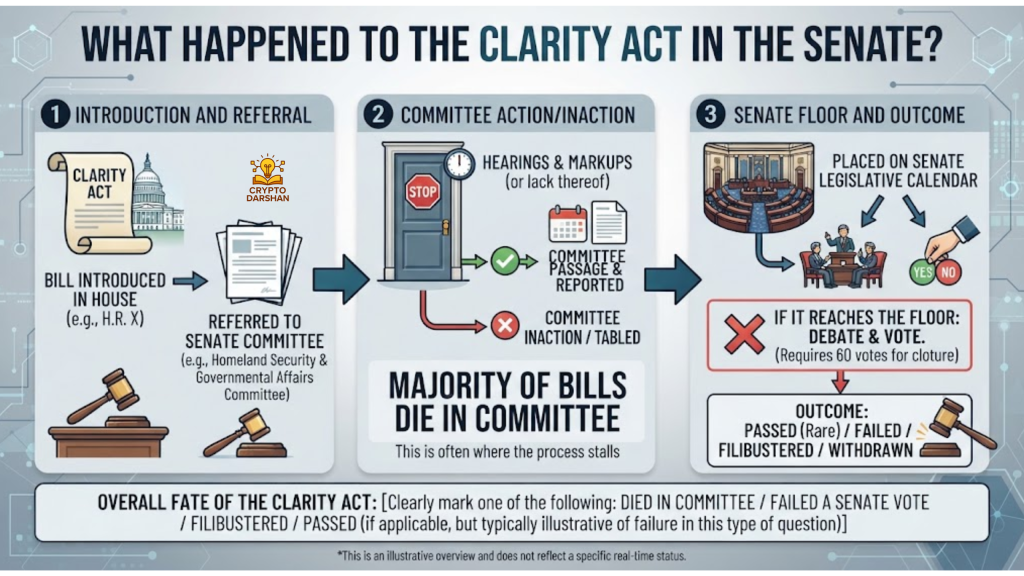
On September 15, 2026, the Senate failed to clear a key procedural hurdle (cloture) needed to begin formal debate on the Digital Asset Market Clarity Act, commonly called the CLARITY Act. The vote was 50–49 in favor, but the bill needed 60 votes to move forward.
All Democrats opposed the measure, and four Republicans—Susan Collins (Maine), Josh Hawley (Missouri), Jerry Moran (Kansas), and Thom Tillis (North Carolina)—also voted against it. Senator Tillis later switched his vote to “no” so he could file a motion to reconsider, keeping the bill technically alive but effectively shelved until at least 2027.
Why the CLARITY Act matters for crypto
For years, the crypto industry has asked a simple but unresolved question: when is a token a security, and when is it a commodity? The CLARITY Act aimed to answer that by creating the first federal market-structure framework for digital assets.
Key elements of the bill include:
- Split oversight between the SEC and CFTC. The legislation would formally divide regulatory authority, giving the Commodity Futures Trading Commission (CFTC) more control over “digital commodities” while the Securities and Exchange Commission (SEC) retains jurisdiction over “investment contract assets.”
- Three statutory categories for digital assets. The text classifies tokens as digital commodities, investment contract assets, or permitted payment stablecoins, with a path for some tokens to “graduate” from securities treatment as their networks decentralize.
- Registration and anti–money laundering rules. It sets registration requirements for intermediaries and strengthens AML protections, aiming to bring more clarity and compliance structure to crypto markets.
- Developer and ethics provisions. Recent drafts added a safe harbor for non-custodial developers and ethics rules barring certain public officials and their spouses from issuing or sponsoring digital assets until 2029.
If passed, the bill would give Bitcoin, Ethereum, and other mature networks clearer statutory status and reduce the regulatory uncertainty that has long hampered U.S. crypto innovation.
Why the bill stalled
Despite backing from President Donald Trump and many Republicans, the CLARITY Act ran into entrenched Democratic opposition and concerns from some GOP senators.
Major sticking points included:
- Regulatory balance. Critics argued the bill gives too much power to the CFTC, a smaller regulator, at the expense of the SEC and state securities authorities.
- State authority. A bipartisan coalition of state attorneys general urged the Senate Banking Committee to oppose the bill, saying it could displace states’ ability to regulate securities markets.
- Political timing. With Congress set to break for the November midterms, many lawmakers were unwilling to push through a complex, 600+ page bill without stronger bipartisan support.
The result was a procedural defeat that left the crypto industry waiting for clear federal rules.
From the Senate floor to the campaign trail

With the vote failed and Congress heading into election mode, the CLARITY Act has shifted from active legislation to a campaign issue.
Republicans are using the stall to argue that Democrats are blocking much-needed clarity for the crypto sector, framing the vote as anti-innovation and anti-jobs. Democrats, meanwhile, highlight concerns about investor protection, regulatory overreach by the CFTC, and the influence of crypto money in politics.
In practical terms, this means:
- No comprehensive federal crypto law before 2027. Unless lawmakers bring the bill back quickly, the earliest realistic path for a full market-structure law is next year, after the midterms.
- Regulators stepping in anyway. In the absence of new legislation, the SEC and CFTC are rushing to write rules under existing authority, shaping the market without Congress.
- Election-driven messaging. Both parties are now using the CLARITY Act to appeal to crypto voters, donors, and industry workers, making it a visible part of the 2026 midterm narrative.
What this means for crypto users and businesses

For everyday crypto users, the stall means continued uncertainty about which tokens are securities, how platforms must register, and what protections apply. For businesses, it delays the clear “rules of the road” that could reduce legal risk and encourage more institutional participation in U.S. markets.
In the short term, expect:
- More SEC enforcement actions and rulemaking under current laws.
- Increased political advertising and statements about crypto regulation as candidates court the digital-asset vote.
- Ongoing lobbying to revive some version of the CLARITY Act in the next Congress, potentially with revised compromises on SEC/CFTC balance and state authority.
The CLARITY Act’s journey from the Senate floor to the campaign trail shows how crypto regulation has become both a policy battleground and a political weapon—with real consequences for how the U.S. digital-asset economy will evolve over the next few years.