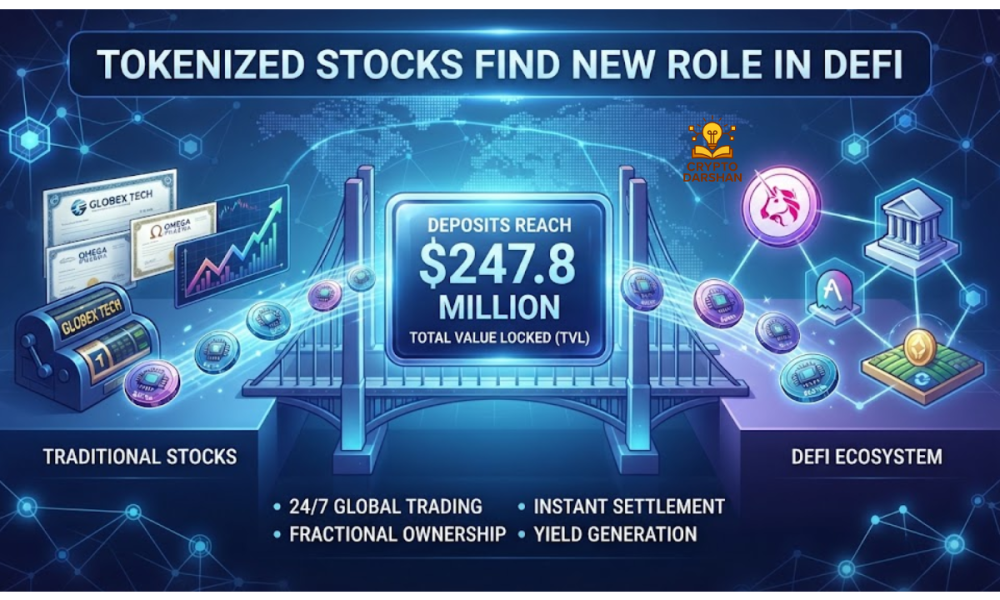
Tokenized stocks are gaining a larger role in decentralized finance (DeFi), with the value of equity-linked tokens deposited across DeFi protocols reaching $247.8 million. The figure represents a 1,960.8% increase over the past year, showing that investors are moving beyond simply holding blockchain-based versions of traditional shares.
These tokens are now being used in liquidity pools, lending markets, yield products, and crypto-native trading pairs. However, their growing presence does not mean that tokenized stocks have replaced traditional equity markets. Instead, it shows how blockchain networks are beginning to make stocks and exchange-traded funds (ETFs) more useful inside onchain financial applications.
Tokenized Stock DeFi Value Surges

Tokenized stocks are digital assets designed to represent the economic value or ownership rights connected to publicly traded companies and ETFs. Depending on the issuer and structure, the underlying securities may be held by a custodian while the blockchain token tracks their value.
According to data from Token Terminal, tokenized stock deposits in DeFi climbed to $247.8 million in September 2026. This total includes tokens deposited into decentralized exchanges, lending protocols, and other onchain applications.
The increase is notable because the wider tokenized-equity market is much larger. RWA.xyz data cited in the report placed the total distributed value of tokenized stocks near $2.9 billion in mid-September. This means only a portion of issued tokenized shares is currently being used in DeFi.
The difference highlights an important shift. Issuing a tokenized stock is only the first step. The larger opportunity may come from allowing that asset to operate inside an open financial system.
Liquidity Pools Take the Largest Share
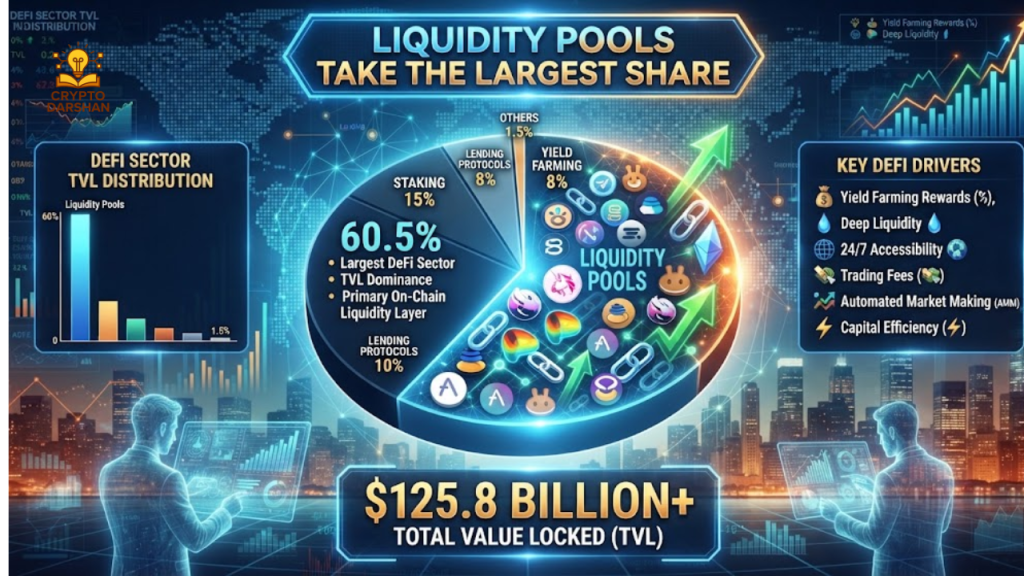
Liquidity pools account for 65.4% of tokenized stock DeFi activity, making them the largest use case by a wide margin. In these pools, users deposit two or more assets so traders can swap between them without relying on a traditional order book.
For example, a pool may contain a tokenized ETF alongside a stablecoin. Traders can use the pool to buy or sell the tokenized ETF, while liquidity providers earn a share of transaction fees.
Several major DeFi platforms hold a significant portion of the market. Token Terminal data showed that Uniswap v4 held $65.4 million in tokenized stock deposits, while Uniswap v3 accounted for $41.8 million. Kamino Lend followed with $43.1 million.
Liquidity providers may earn income from trading fees, but they also face risks. If the price of the tokenized stock changes sharply compared with the paired asset, providers can suffer impermanent loss. Smart contract failures, weak liquidity, and problems with the underlying asset can add further risks.
Lending Creates a New Financial Use
Lending markets represent 28.1% of tokenized stock DeFi deposits. This allows users to supply tokenized shares as collateral or lend them to other participants.
A holder may deposit a tokenized stock and borrow stablecoins without selling the asset. This structure can provide access to liquidity while allowing the investor to maintain exposure to the stock. In theory, it works in a similar way to securities-backed lending in traditional finance.
Borrowing against tokenized equities has also increased. Outstanding borrowing against bStocks rose from 5.5% of deposited collateral at the end of June to 46.2% by September 10, according to the data cited in the report.
The growth suggests that tokenized stocks are becoming more useful as financial collateral. Still, lending protocols must manage major risks, including price volatility, liquidation events, oracle failures, and legal uncertainty surrounding the underlying shares.
Tokenized Stocks Become Trading Assets

Tokenized stocks are also appearing in trading markets that do not involve direct stock-token swaps. On Robinhood Chain and BNB Chain, stock-paired meme coin markets generated approximately $2.49 billion and $2.90 billion in volume, respectively, between July 26 and September 9.
This activity shows that tokenized stocks can function as quote assets in crypto-native markets. A quote asset is the asset used to price another token. For instance, traders could exchange a meme coin against a tokenized stock rather than against a stablecoin.
SQD examined a sample of activity on Robinhood Chain and found that $711.2 million, or 32.1% of cumulative stock-token volume through August 30, came from trades against other tokens. Most of those trades involved meme coin.
This type of activity can increase turnover even when users are not buying tokenized stocks as long-term investments. It also demonstrates how quickly traditional financial assets can become part of crypto market structures once they are represented onchain.
Three Networks Hold Most Deposits
Tokenized stock DeFi activity is concentrated across a small number of blockchain networks. Robinhood Chain held $98.2 million, Solana held $87.4 million, and BNB Chain held $36.3 million. Together, the three networks represented 89.5% of total tokenized stock DeFi value.
Robinhood-issued stock tokens accounted for $98.2 million, or 39.6% of the market, while xStocks represented $68 million, or 27.4%.
This concentration could help these networks build deeper liquidity and stronger applications around tokenized equities. At the same time, it creates dependence on a limited number of chains, issuers, bridges, and protocols. Technical problems or regulatory restrictions affecting one major platform could therefore have an outsized impact on the sector.
Growth Comes With Significant Risks

The rapid increase in DeFi deposits does not remove the risks linked to tokenized stocks. Investors must understand that a blockchain token may not provide the same rights as directly owning a share through a regulated brokerage account.
Key risks include:
- The token may track an asset without granting voting rights or direct legal ownership.
- Trading may stop if the issuer, custodian, or platform faces regulatory restrictions.
- Smart contract exploits can lead to permanent losses.
- Thin liquidity can make it difficult to exit a position during market stress.
- Oracles may report incorrect prices, causing unfair liquidations.
- Token holders may face restrictions based on their country or investor status.
There is also a difference between deposits and real economic demand. A tokenized stock held in a liquidity pool shows that capital is being used in DeFi, but it does not necessarily prove that investors want long-term exposure to the underlying company.
A Broader Shift for Real-World Assets
The rise of tokenized stock deposits suggests that real-world assets are beginning to move from passive issuance toward active onchain use. Instead of simply representing shares on a blockchain, these tokens can now serve as trading assets, collateral, liquidity instruments, and components of yield strategies.
The $247.8 million figure remains small compared with the total value of global equities and traditional securities-backed lending. Even so, the rapid year-over-year increase points to growing interest in combining regulated financial assets with programmable blockchain infrastructure.
The next stage of development will likely depend on clearer rules, stronger custody systems, deeper liquidity, and better protection for users. If those conditions improve, tokenized stocks could become a more important part of DeFi. For now, their main role is not replacing traditional shares, but giving investors new ways to use equity exposure inside onchain markets.