

In recent years, the term decentralized has become a buzzword across industries. From finance and technology to governance and social media, decentralization is often portrayed as the ultimate solution to inefficiency, corruption, and control. The idea of removing intermediaries and distributing power among participants sounds appealing. However, decentralized does not always mean better. While decentralization offers transparency, autonomy, and resilience, it also introduces complexity, inefficiency, and accountability challenges. Understanding both sides of decentralization is essential to determine when it truly adds value and when it becomes a burden.
This article explores the concept of decentralization, its advantages, limitations, and real-world implications. It also examines why decentralized systems are not inherently superior to centralized ones and how balance often leads to better outcomes.
Understanding Decentralization
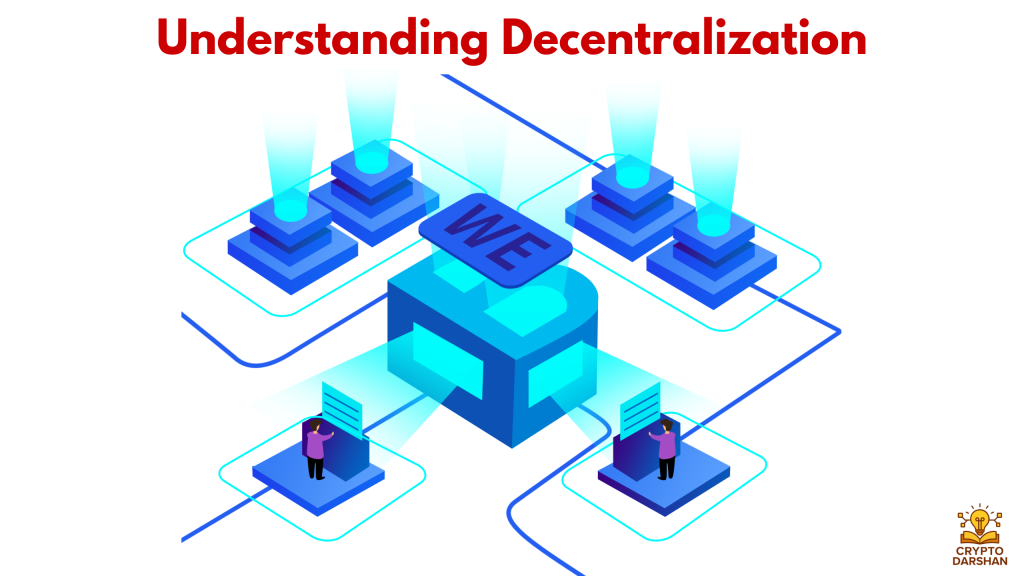
Decentralization refers to the distribution of authority, control, or decision-making across multiple entities rather than concentrating it in a single central authority. In a decentralized system, participants operate independently but follow shared rules or protocols. This structure contrasts with centralized systems, where a single entity manages operations, decisions, and data.
Types of Decentralization
- Political Decentralization – Power is distributed among local governments or regional authorities instead of being concentrated in a national government.
- Administrative Decentralization – Decision-making responsibilities are delegated to lower levels of management or local offices.
- Economic Decentralization – Market forces and private entities play a larger role in resource allocation rather than a central authority.
- Technological Decentralization – Systems like blockchain distribute data and control across multiple nodes instead of relying on a central server.
Each type of decentralization serves a different purpose, but all share the same goal: reducing dependence on a single point of control. Understanding the history of digital currencies provides valuable context for today’s decentralization debate. Read Before Bitcoin: The Failed Digital Currencies That Paved the Way.
The Appeal of Decentralization
The popularity of decentralized systems stems from several perceived benefits. Advocates argue that decentralization promotes fairness, transparency, and innovation. Below are some of the main reasons why decentralization is often seen as desirable.
1. Transparency and Trust
In a decentralized network, transactions and decisions are often recorded publicly, making it difficult for any single participant to manipulate data. Blockchain technology, for example, ensures that all participants can verify transactions independently. This transparency builds trust among users who might not know or trust each other.
2. Reduced Single Points of Failure
Centralized systems are vulnerable to failures or attacks targeting the central authority. A decentralized system distributes control across multiple nodes, making it more resilient. If one node fails, others can continue operating, ensuring continuity and reliability. Not every decentralized application succeeds. See how sustainable ecosystems are built in BNB Chain Ecosystem: The Fastest-Growing Hub in Crypto.
3. Empowerment and Autonomy
Decentralization gives individuals and communities more control over their assets, data, and decisions. In this financial system, for instance, users can transact directly without relying on banks or intermediaries. This autonomy aligns with the growing demand for personal freedom and privacy.
4. Innovation and Competition
By removing central control, decentralized systems encourage open participation and innovation. Developers can build new applications or services without seeking permission from a central authority. This openness fosters creativity and competition, leading to faster technological progress.
5. Global Accessibility
Decentralized platforms often operate globally, allowing anyone with internet access to participate. This inclusivity can empower people in regions with limited access to traditional financial or governance systems.
While these benefits are significant, they do not guarantee that decentralization is always the best approach. The same features that make systems appealing can also create serious challenges.
The Hidden Costs of Decentralization
Despite its advantages, decentralization introduces trade-offs that can undermine efficiency, security, and accountability. Understanding these drawbacks is crucial to evaluating whether a decentralized approach is appropriate for a given context.
1. Complexity and Inefficiency
Decentralized systems often require complex coordination among participants. Without a central authority to make quick decisions, reaching consensus can be slow and resource-intensive. For example, blockchain networks like Bitcoin consume vast amounts of energy to maintain consensus through mining. This inefficiency can make systems less practical for large-scale or time-sensitive operations.
2. Lack of Accountability
In a decentralized environment, identifying responsibility can be difficult. When no single entity is in charge, who is accountable when something goes wrong? This ambiguity can lead to disputes, fraud, or negligence without clear mechanisms for resolution. Centralized systems, by contrast, have defined leadership structures that can be held responsible for decisions.
3. Security Risks
While decentralization reduces single points of failure, it also introduces new vulnerabilities. Those networks can be susceptible to majority attacks, in which a group of participants gains control of the system. Additionally, users are often responsible for securing their own assets, which increases the risk of loss due to human error or hacking.
4. Governance Challenges
Decision-making in decentralized systems can be chaotic. Without a central authority, participants must rely on voting or consensus mechanisms that may be slow or easily manipulated. Disagreements can lead to forks or splits, as seen in blockchain communities. These governance issues can fragment communities and weaken the system’s stability.
5. Scalability Limitations
Many systems struggle to scale efficiently. As the number of participants grows, maintaining consensus and processing transactions becomes more difficult. Centralized systems, on the other hand, can scale more easily by upgrading infrastructure or optimizing processes.
6. User Responsibility and Complexity
In a decentralized ecosystem, users must manage their own keys, data, and security. This responsibility can be overwhelming for non-technical users. Losing a private key in a blockchain system, for example, can result in permanent loss of assets. Centralized systems offer customer support and recovery options that decentralized systems often lack.
Case Studies: When Decentralization Works and When It Fails

Examining real-world examples helps illustrate the strengths and weaknesses of decentralized systems.
Case 1: Bitcoin – The Pioneer of Decentralized Finance
Bitcoin introduced the world to digital currency. It operates without a central bank, allowing peer-to-peer transactions verified by a distributed network. This model has proven resilient and transparent, inspiring countless innovations in finance.
However, Bitcoin’s decentralized nature also limits its scalability and efficiency. Transaction speeds are slow, and energy consumption is enormous. Moreover, governance disputes have led to forks, creating competing versions of the network. While Bitcoin demonstrates the power of decentralization, it also highlights its practical limitations.
Case 2: Decentralized Autonomous Organizations (DAOs)
DAOs are organizations governed by smart contracts rather than human managers. Decisions are made collectively by token holders. This decentralized governance model promises transparency and fairness.
Yet, DAOs face significant challenges. The infamous 2016 DAO hack exploited vulnerabilities in the code, leading to massive financial losses. Because the system was decentralized, there was no central authority to intervene quickly. The incident revealed that decentralization can amplify risks when governance and security are not carefully designed.
Case 3: Centralized vs. Decentralized Social Media
Decentralized social media platforms like Mastodon and Bluesky aim to give users control over their data and content moderation. They offer freedom from corporate control and censorship. However, these platforms struggle with user adoption, moderation consistency, and scalability. Centralized platforms like Facebook or X (formerly Twitter) remain dominant because they provide smoother user experiences and efficient moderation.
Case 4: Supply Chain Management
In supply chains, decentralized systems can enhance transparency by allowing all participants to track goods in real time. However, full decentralization can complicate coordination and data standardization. A hybrid model—where central oversight ensures compliance while decentralized tracking ensures transparency—often works best.
The Myth of Absolute Decentralization

The Necessity of Coordination:
Even in highly decentralized networks, some level of central coordination is required to maintain protocols, update software, and ensure interoperability. Without a core group or foundation to guide development, systems often struggle to evolve or fix critical bugs in a timely manner.
Concentration of Influence:
While a system may be technically decentralized in its architecture, power often concentrates among a small group of early adopters, large token holders, or core developers. This “hidden centralization” means that decision-making power is rarely as distributed as the system’s marketing might suggest.
Dependency on Centralized Infrastructure:
Most decentralized applications rely on centralized services to function, such as cloud hosting providers, domain name registries, or centralized exchanges. If these underlying services fail or choose to restrict access, the “decentralized” application effectively ceases to operate as intended.
The Efficiency Trade-off:
Absolute decentralization requires every participant to reach consensus on every action, which is inherently slow and resource-heavy. To achieve the speed and scalability required for real-world use, developers almost always introduce centralized shortcuts or “trusted” nodes, moving the system away from a purely decentralized state.
Governance Realities:
Human organizations, even those built on this technology, eventually require some form of leadership or dispute resolution. When conflicts arise, communities often revert to centralized voting mechanisms or defer to influential leaders, proving that total, leaderless decentralization is difficult to sustain in complex environments.
For example, the internet itself is decentralized in structure but relies on centralized services like domain registries and cloud providers. Similarly, blockchain networks depend on centralized exchanges and development teams. Pure decentralization is rare because coordination, efficiency, and accountability often require some level of centralization.
Balancing Centralization and Decentralization
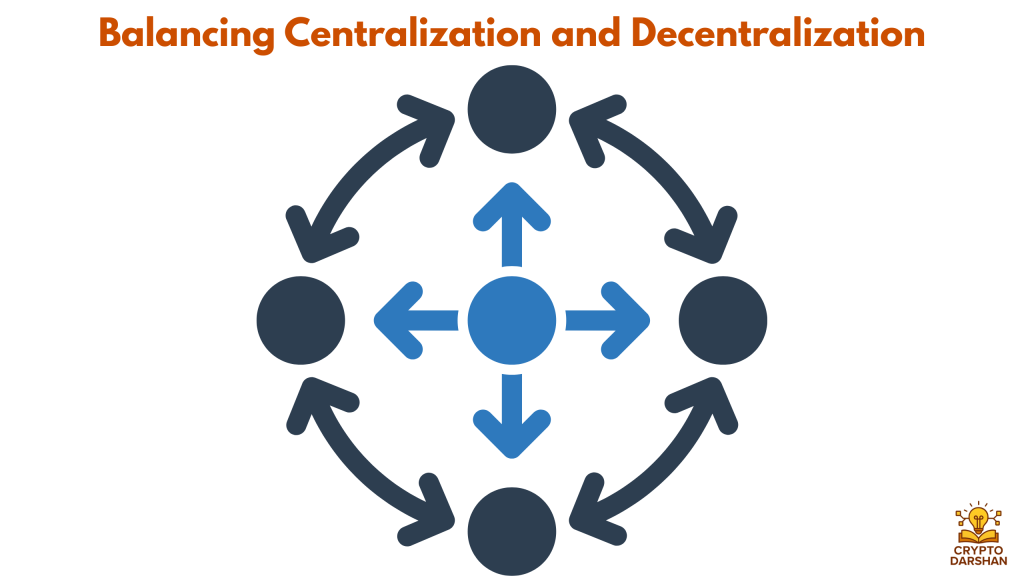
The key to effective system design lies in finding the right balance between centralization and decentralization. Each approach offers unique strengths that can complement the other.
When Decentralization Works Best
- When transparency and trust are critical.
- When censorship resistance is necessary.
- When participants are globally distributed and independent.
- When innovation and open participation are desired.
When Centralization Works Best
- When efficiency and speed are priorities.
- When accountability and regulation are essential.
- When user experience and support are important.
- When coordination and consistency are required.
A decentralized system should not be adopted simply for ideological reasons. Instead, it should be chosen when its benefits outweigh its costs in a specific context. Mass adoption requires balancing decentralization with usability. Read What Web3 Builders Need Before Mass Adoption Happens to learn more.
The Role of Hybrid Models

Optimizing Efficiency and Transparency:
Hybrid models allow organizations to keep core operations centralized for speed and consistency, while using decentralized ledgers or protocols for transparent, verifiable record-keeping. This ensures that critical business processes remain fast without sacrificing the trust that comes from distributed data.
Enhancing Security and Resilience:
By combining a decentralized infrastructure with centralized oversight, these models mitigate the risks of single points of failure. If a central server goes down, the distributed components can maintain essential functions, providing a robust safety net that purely centralized systems lack.
Simplifying Regulatory Compliance:
One of the biggest hurdles for decentralized systems is legal accountability. Hybrid models solve this by designating a central entity responsible for compliance, taxation, and consumer protection, while still allowing the underlying network to benefit from the innovation and autonomy of a decentralized architecture.
Improving User Experience:
Purely decentralized platforms often suffer from steep learning curves and complex security requirements for average users. Hybrid models integrate centralized interfaces—such as customer support, account recovery, and intuitive dashboards—to make advanced decentralized technology accessible to a mainstream audience.
Scalable Governance:
Decision-making in a fully decentralized environment can be slow and prone to gridlock. Hybrid models implement tiered governance, where routine decisions are handled by centralized management for efficiency, while major strategic changes are put to a decentralized vote, ensuring both agility and community representation.
The Human Factor in Decentralization
Technology alone cannot guarantee the success of a decentralized system. Human behavior, governance, and incentives play crucial roles. Without proper incentives, participants may act selfishly, undermining the system’s integrity. Effective decentralized governance requires clear rules, accountability mechanisms, and community engagement.
Moreover, decentralization can shift power rather than eliminate it. In many decentralized networks, a small group of developers, miners, or validators still holds significant influence. This concentration of power contradicts the ideal of equal participation and highlights the need for continuous oversight.
Economic and Environmental Implications

The economic and environmental costs of decentralized systems are often overlooked. Maintaining distributed networks requires significant computational resources. Proof-of-work blockchains, for example, consume vast amounts of electricity, raising sustainability concerns. While newer consensus mechanisms like proof-of-stake are more efficient, they still face challenges related to fairness and centralization of wealth.
Economically, decentralized systems can disrupt traditional industries but also create instability. The volatility of cryptocurrencies and the lack of regulation in DeFi markets demonstrate how decentralization can lead to speculative bubbles and financial risks.
Regulation and Legal Challenges
Regulating decentralized systems is complex. Traditional laws are designed for centralized entities with identifiable leaders. In a decentralized network, there may be no single party to hold accountable. This creates legal gray areas around issues like taxation, consumer protection, and data privacy.
Governments are increasingly exploring ways to regulate decentralized technologies without stifling innovation. Striking this balance is essential to ensure that decentralization serves the public good rather than enabling fraud or exploitation.
The Future of Decentralization

The future of decentralized systems lies in refinement rather than expansion. As technology evolves, new models will emerge that combine decentralization with practical governance and efficiency. Interoperability between centralized and decentralized systems will become more common, allowing users to enjoy the best of both worlds.
Decentralized AI(artificial intelligence), edge computing, and Web3 technologies will further blur the lines between centralization and decentralization. The focus will shift from ideology to functionality—choosing the right structure for the right purpose.
Key Takeaways
- Decentralized does not automatically mean better; it depends on context and goals.
- Decentralization enhances transparency, autonomy, and resilience but can reduce efficiency and accountability.
- Pure decentralization is rare; most systems operate on a spectrum between centralized and decentralized models.
- Hybrid systems often provide the best balance of transparency, efficiency, and control.
- The success of decentralized systems depends on governance, incentives, and human behavior.
- Regulation, scalability, and sustainability remain major challenges for decentralized technologies.
FAQ

1. What does decentralization mean in crypto?
Decentralization refers to distributing control, decision-making, and data across multiple participants rather than relying on a single central authority.
2. Why is decentralization considered important in blockchain?
Decentralization helps improve transparency, censorship resistance, security, and user control over assets and data.
3. Can centralized systems sometimes be more efficient than decentralized ones?
Yes. Centralized systems often provide faster transactions, simpler governance, lower costs, and a smoother user experience compared to fully decentralized alternatives.
4. What are the disadvantages of decentralization?
Common drawbacks include slower decision-making, governance disputes, scalability challenges, higher operational complexity, and potential security risks from poorly managed protocols.
5. Does decentralization guarantee better security?
Not always. While decentralization can reduce single points of failure, vulnerabilities in smart contracts, governance systems, or network participation can still create security risks.
6. Why do some crypto projects choose partial centralization?
Many projects use a hybrid approach to improve scalability, regulatory compliance, customer support, and product development while still maintaining some decentralized features.
7. How does decentralization affect user experience?
Highly decentralized platforms may require users to manage private keys, wallets, and governance participation, which can create a steeper learning curve for newcomers.
8. Are decentralized applications (dApps) always better than traditional apps?
Not necessarily. dApps offer transparency and user ownership, but traditional applications may provide better speed, convenience, and customer support in certain situations.
9. What is the difference between decentralization and decentralization theater?
Decentralization theater occurs when a project claims to be decentralized while a small group still controls governance, token supply, infrastructure, or decision-making.
10. How should investors evaluate a project’s level of decentralization?
Investors should examine validator distribution, governance structure, token ownership concentration, network infrastructure, and the team’s control over protocol upgrades.
Conclusion
The rise of decentralized systems marks a significant shift in how societies organize information, power, and resources. While decentralization offers undeniable benefits—such as transparency, autonomy, and resilience—it is not a universal solution. The assumption that decentralized automatically means better overlooks the complexities of coordination, accountability, and efficiency.
True progress lies in understanding when and how to apply decentralization effectively. By combining the strengths of both centralized and decentralized models, organizations and communities can build systems that are not only fair and transparent but also practical and sustainable. The future will not be entirely decentralized or centralized—it will be intelligently balanced.