

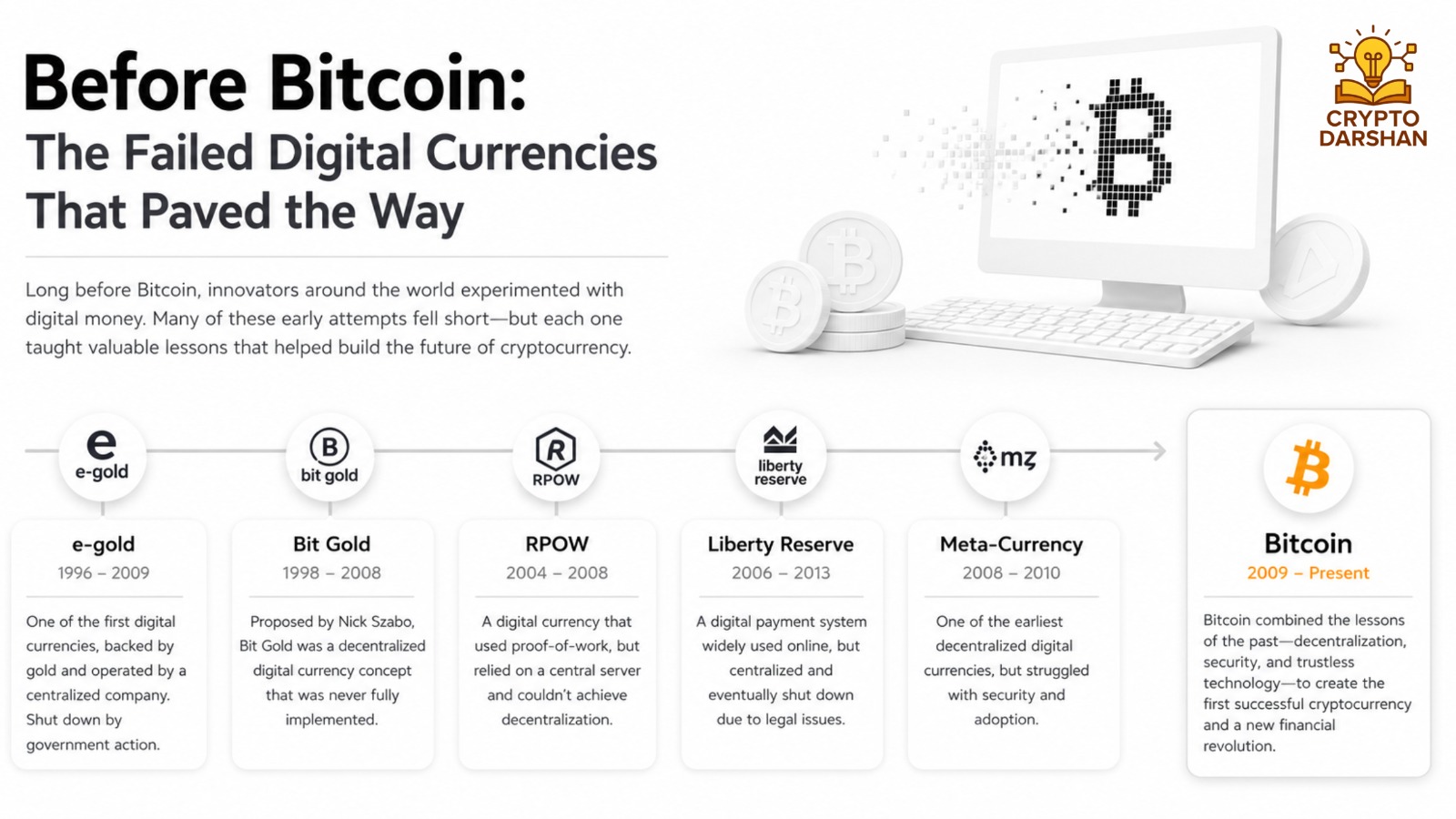
The story of digital currencies didn’t begin with Bitcoin in 2009. Long before Satoshi Nakamoto’s groundbreaking whitepaper revolutionized the financial world, numerous visionaries attempted to create electronic money systems that could operate independently of traditional banking institutions. These pioneering digital currencies, though ultimately unsuccessful, laid the crucial groundwork for the cryptocurrency revolution we witness today. Understanding these early attempts provides invaluable context for appreciating Bitcoin’s innovations and the broader evolution of digital currencies.
Why Digital Currencies Were Needed

As the digital revolution transformed commerce in the 1980s and 1990s, traditional payment systems proved ill-suited for online transactions. Credit cards carried high fees, privacy concerns, and fraud vulnerabilities. Early internet pioneers envisioned a native digital money — one that could move as freely as information itself, enabling instant, low-cost, borderless transactions without intermediaries.
The technical challenges were immense. Unlike physical cash, digital information can be copied infinitely at zero cost. Creating digital currencies required solving the “double-spending problem”, ensuring tokens couldn’t be duplicated and spent multiple times — while balancing anonymity with accountability and decentralization with security.
DigiCash and eCash: The Cryptographic Pioneer

In 1989, cryptographer David Chaum founded DigiCash, introducing one of the first serious attempts at digital currency. His system, eCash, used blind signature technology, a cryptographic technique Chaum invented, that allowed users to obtain digital coins from a bank without the bank knowing their serial numbers. When spent, merchants could verify authenticity and prevent double-spending, but couldn’t trace coins back to their origin. This provided unprecedented transactional privacy.
Users installed digital wallet software, withdrew eCash from participating banks, and spent it at accepting merchants. The blind signature ensured even the bank couldn’t link withdrawals to purchases. DigiCash partnered with several banks in the mid-1990s, including Mark Twain Bank, and mainstream adoption seemed possible. But the system still relied on centralized banks as trusted intermediaries, limiting its revolutionary potential. Banks hesitated, fearing regulatory complications and disruption to existing business models. DigiCash eventually went bankrupt in 1998.
DigiCash’s legacy proved invaluable. Chaum demonstrated that cryptography could solve fundamental problems in digital payments. His work on blind signatures, digital signatures, and cryptographic protocols influenced an entire generation of cryptographers and computer scientists. Many concepts from eCash would later resurface in Bitcoin and subsequent cryptocurrencies, proving that DigiCash was simply ahead of its time.
E-gold: Digital Currency Backed by Precious Metals

Founded in 1996 by oncologist Douglas Jackson and attorney Barry Downey, e-gold took a different approach: backing digital currency with physical gold stored in vaults. Users opened accounts and purchased e-gold units representing specific weights of gold, which could be transferred instantly to anyone worldwide. The system combined gold’s stability with digital convenience.
E-gold achieved remarkable success compared to other early digital currencies. At its peak in the mid-2000s, it processed over $2 billion in transactions annually and had millions of users worldwide , particularly popular in countries with unstable national currencies and among early internet commerce adopters who valued low fees and instant settlement. It also tapped into a libertarian philosophy questioning fiat currencies and central banking.
However, e-gold’s weak identity verification made it a magnet for fraudsters and criminals. In 2007, the Department of Justice indicted its operators for running an unlicensed money transmitting business and facilitating money laundering. The legal battle effectively destroyed e-gold as a viable payment system.
E-gold’s failure highlighted a crucial lesson: digital currencies couldn’t simply ignore existing laws and regulations, no matter how philosophically opposed their creators were to government oversight. Technological innovation could solve many problems, but regulatory compliance wasn’t optional.
Liberty Reserve: The Dark Side of Digital Currencies

Founded in 2006 by Arthur Budovsky and based in Costa Rica, Liberty Reserve allowed users to open accounts with minimal identification and transfer funds globally with few restrictions. It processed billions in transactions and served millions of users. But unlike e-gold, which had legitimate use cases alongside its problems, Liberty Reserve became notorious as a haven for criminal activity. The platform’s deliberate lack of oversight made it the payment system of choice for cybercriminals, drug traffickers, and money launderers.
In 2013, U.S. authorities shut it down in what they called one of the largest money laundering prosecutions in history. The indictment alleged over $6 billion in suspicious transactions, calling Liberty Reserve the “financial hub of the cybercrime world.” The case illustrated how digital currencies could be weaponized for illegal purposes when designed without adequate safeguards — and that operators actively marketing anonymity from government scrutiny would attract exactly the wrong kind of users.
B-Money and Bit Gold: The Theoretical Foundations

Not all failed digital currencies were actual implementations. Some of the most important contributions came from theoretical proposals never fully realized but providing crucial conceptual frameworks.
In 1998, computer engineer Wei Dai published a proposal for “b-money,” an anonymous, distributed electronic cash system. Dai outlined a system where digital currency would be created through computational work and transactions recorded in a distributed database maintained by all participants, one of the first descriptions of what would later be called a blockchain. He proposed that currency be created through “proof of work,” requiring participants to solve computational puzzles. These ideas directly influenced Bitcoin; Satoshi Nakamoto cited b-money in the Bitcoin whitepaper.
Around the same time, computer scientist Nick Szabo developed “bit gold,” a theoretical framework sharing many similarities with b-money and Bitcoin. Bit gold would be created through proof-of-work computations, with each unit representing a solution to a cryptographic puzzle, timestamped and chained together in a public registry. Szabo’s proposal was remarkably prescient — anticipating Bitcoin’s blockchain structure, proof-of-work mining, and decentralized consensus. Some cryptocurrency historians have speculated that Szabo might be Satoshi Nakamoto, though he has consistently denied this. Like b-money, bit gold was never implemented, but it provided critical theoretical groundwork for what followed.
The evolution from early digital currencies to modern crypto assets has helped pave the way for today’s institutional interest in the market. Read our guide on Why Institutional Investors Are Buying Crypto.
Hashcash: Enabling Digital Scarcity

In 1997, British cryptographer Adam Back proposed Hashcash, a proof-of-work system originally designed to combat email spam and denial-of-service attacks. While not itself a currency, Hashcash introduced the proof-of-work concept central to Bitcoin and many other digital currencies.
The system required email senders to perform a small computation before sending, trivial for legitimate users but prohibitively expensive for spammers sending millions of messages. Back’s key insight was recognizing that computational work could serve as a scarce resource in digital systems. Just as physical resources like gold require effort to obtain, computational work requires time and energy. This scarcity could back digital currencies, providing value derived from resources expended to create them. Hashcash demonstrated that proof-of-work could prevent abuse, create scarcity, and distribute resources, insights that proved crucial for making decentralized digital currencies practical.
Bitcoin directly incorporated Hashcash’s proof-of-work algorithm into its mining process. Miners must solve Hashcash-style puzzles to add new blocks to the blockchain and earn newly created bitcoins. This connection between computational work and currency creation solved the problem of how to fairly distribute digital currencies without a central authority deciding who receives them.
Hashcash demonstrated that proof-of-work could serve multiple purposes in digital systems: preventing abuse, creating scarcity, and distributing resources. These insights proved crucial for making decentralized digital currencies practical rather than merely theoretical.
RipplePay: Early Peer-to-Peer Credit Networks

Before the Ripple cryptocurrency we know today, Ryan Fugger created RipplePay in 2004, a peer-to-peer payment network focusing on credit relationships between individuals rather than creating new forms of money. Users could extend credit to trusted contacts and make payments through chains of those trust relationships. If Alice trusted Bob and Bob trusted Carol, Alice could pay Carol through Bob, even without direct trust between them.
This approach didn’t require new tokens or asset backing — it leveraged existing trust relationships and IOUs. In theory, this could enable a global payment network without requiring everyone to adopt a single currency or trust a central authority. But the system proved too complex for average users, and the network effects necessary for success never materialized. Despite limited adoption, RipplePay introduced important concepts about payment paths through networks that influenced later developments, including Bitcoin’s Lightning Network. In 2012, the concept was reimagined with the XRP cryptocurrency and a new consensus mechanism, leading to Ripple as we know it today.
Why These Digital Currencies Failed: Common Themes

Examining these failures reveals recurring challenges:
Centralization vulnerabilities.
Systems like DigiCash, e-gold, and Liberty Reserve relied on central authorities or companies to operate. This created single points of failure that governments could shut down or that could collapse due to business problems. None could survive when their central operators faced legal challenges or bankruptcy.
Regulatory challenges.
Nearly all early digital currencies struggled with compliance. Some attempted to operate within existing frameworks but failed to implement adequate safeguards. Others deliberately avoided compliance and attracted criminal users. None found the right balance between innovation and regulation.
Adoption barriers.
Even technically sound systems failed to achieve critical mass. DigiCash’s eCash was too complex for average users in the 1990s. RipplePay’s trust network was difficult to understand and implement. Without sufficient users and merchants, these systems couldn’t provide enough value to justify adoption.
Technical limitations.
The double-spending problem, distributed consensus, and scalability posed significant obstacles. Theoretical proposals like b-money and bit gold remained unimplemented partly because the necessary technology didn’t yet exist.
Timing.
Many digital currencies were simply ahead of their time. DigiCash launched when internet commerce barely existed. The infrastructure, user base, and cultural readiness weren’t present in the 1990s and early 2000s.
Trust and security.
Building confidence in new digital currencies proved extremely difficult. Users needed assurance that their money was safe, that the system wouldn’t be shut down, and that the currency would retain value — especially after high-profile failures and criminal associations had damaged the entire category’s reputation.
The Legacy: How Failures Enabled Bitcoin’s Success

These failed digital currencies weren’t merely historical footnotes — they were essential stepping stones. Each failure taught important lessons and contributed crucial innovations that Satoshi Nakamoto synthesized into Bitcoin’s design.
From DigiCash, Bitcoin inherited sophisticated cryptographic techniques and the vision of privacy-preserving digital transactions. From e-gold, it learned the importance of decentralization and the dangers of centralized operators. From Liberty Reserve, it understood the necessity of designing systems that resisted criminal exploitation while preserving user privacy. The theoretical proposals of b-money and bit gold provided the conceptual framework for Bitcoin’s blockchain and proof-of-work mining. Hashcash contributed the specific algorithm that makes Bitcoin mining possible.
Bitcoin succeeded where its predecessors failed by combining their best ideas while avoiding their pitfalls — using cryptography for security and privacy, proof-of-work to create scarcity, and a decentralized blockchain to eliminate single points of failure. It launched when internet infrastructure, cryptographic tools, and cultural readiness had matured sufficiently. The 2008 financial crisis had also created widespread distrust of traditional financial institutions, making people more receptive to alternative monetary systems. Crucially, by 2009 there was already a community of people who understood digital currencies, had experienced their failures, and were ready to try again.
The Evolution Continues

Bitcoin’s success in 2009 vindicated the decades of work that preceded it — but it was just the beginning. Ethereum, launched in 2015, extended the concept to include programmable “smart contracts” enabling complex decentralized applications. Other cryptocurrencies have focused on transaction speed, enhanced privacy, energy efficiency, or industry-specific use cases. Central banks have entered the space too, developing Central Bank Digital Currencies (CBDCs) that blend digital currency efficiency with government-backed stability — a fascinating convergence of the innovations pioneered by early cryptographers and the traditional monetary systems they sought to replace.
One key lesson from failed digital currency projects is that long-term success depends on real utility rather than speculation alone. Explore this further in Why Token Utility Matters More Than Hype in 2026.
Lessons for the Future

The history of pre-Bitcoin digital currencies offers enduring lessons:
Revolutionary technologies rarely succeed on the first attempt. The failed experiments of the 1990s and 2000s were necessary to make Bitcoin possible, and Bitcoin itself may be just one step in the ongoing evolution of money.
Technology alone isn’t enough. Even brilliant innovations can fail without proper timing, regulatory strategy, and user adoption. Successful digital currencies must balance technical sophistication with practical usability and legal compliance.
Decentralization matters. Centralized systems proved vulnerable. Bitcoin’s decentralized design has proven more resilient, though it brings its own governance and scalability challenges.
Regulation is inevitable. Digital currencies that achieve significant scale will face scrutiny. Successful systems must find ways to comply with legitimate regulatory concerns while preserving their innovations.
Network effects are critical. Payment systems derive much of their value from adoption. Digital currencies must achieve critical mass — solving the chicken-and-egg problem of attracting users before the network is valuable, and making the network valuable before it has enough users.
FAQ: Before Bitcoin: The Failed Digital Currencies That Paved the Way

1. What digital currencies existed before Bitcoin?
Several digital currency projects existed before Bitcoin, including DigiCash, e-gold, Hashcash, b-money, and Bit Gold. These projects introduced ideas that later influenced Bitcoin.
2. Why did early digital currencies fail?
Most early digital currencies struggled with regulatory challenges, centralization issues, limited adoption, technical limitations, or security concerns. Many depended on a central authority, making them vulnerable to shutdowns.
3. What was DigiCash?
DigiCash was a privacy-focused electronic payment system created by David Chaum in the 1990s. It introduced cryptographic techniques that inspired future digital payment systems but failed to gain widespread commercial adoption.
4. What was e-gold?
e-gold was a digital payment platform backed by physical gold reserves. It gained millions of users but faced legal and regulatory challenges that ultimately led to its decline.
5. How did Bit Gold influence Bitcoin?
Bit Gold proposed a decentralized digital asset secured through cryptographic proof-of-work. Although it was never fully implemented, many of its concepts closely resemble Bitcoin’s design.
6. What is b-money?
b-money was a theoretical digital currency system introduced by Wei Dai in 1998. It outlined ideas for decentralized money and smart contracts that later influenced cryptocurrency development.
7. Did Bitcoin copy these earlier projects?
Bitcoin did not directly copy any single project. Instead, it combined and improved ideas from multiple predecessors, including proof-of-work, cryptography, decentralization, and peer-to-peer networking.
8. What made Bitcoin succeed where others failed?
Bitcoin solved the double-spending problem without requiring a central authority. Its decentralized network, transparent blockchain, strong security model, and growing community helped it achieve widespread adoption.
9. What lessons can modern crypto projects learn from these failures?
Modern projects can learn the importance of decentralization, regulatory awareness, security, real-world utility, and sustainable adoption rather than relying solely on innovation or hype.
Conclusion
The story of digital currencies before Bitcoin is one of brilliant innovations, ambitious visions, and instructive failures. From Chaum’s cryptographic breakthroughs to the theoretical frameworks of b-money and bit gold, from e-gold’s gold-backed approach to Hashcash’s proof-of-work innovation — each attempt contributed essential pieces to the puzzle.
These pioneers faced enormous challenges: technical problems that seemed insurmountable, regulatory frameworks designed for traditional money, and a world not yet ready for digital currencies. They made mistakes, encountered unexpected obstacles, and ultimately fell short of their visions. Yet their failures were productive, teaching the lessons and developing the technologies that made Bitcoin possible.
As digital currencies become increasingly mainstream and central banks develop their own initiatives, it’s worth remembering these early pioneers. They worked in obscurity, often without recognition or reward, driven by visions of money reimagined for the digital age. Their failed digital currencies weren’t really failures at all — they were necessary experiments in a long process of monetary innovation, the essential steppingstones that made progress possible.