Crypto has always been more than technology. It’s identity, ideology, and community—often wrapped in memes and sharpened into rivalry. People don’t just use a chain; they belong to it. That’s why “crypto tribalism” and “maximalism” have become defining features of the industry.
But a new design philosophy is gaining momentum: chain abstraction—the idea that users shouldn’t need to care which blockchain they’re on. If apps can route transactions across networks automatically, if wallets can hide bridges and gas tokens, and if liquidity can be accessed seamlessly, then the chain becomes infrastructure rather than a badge.
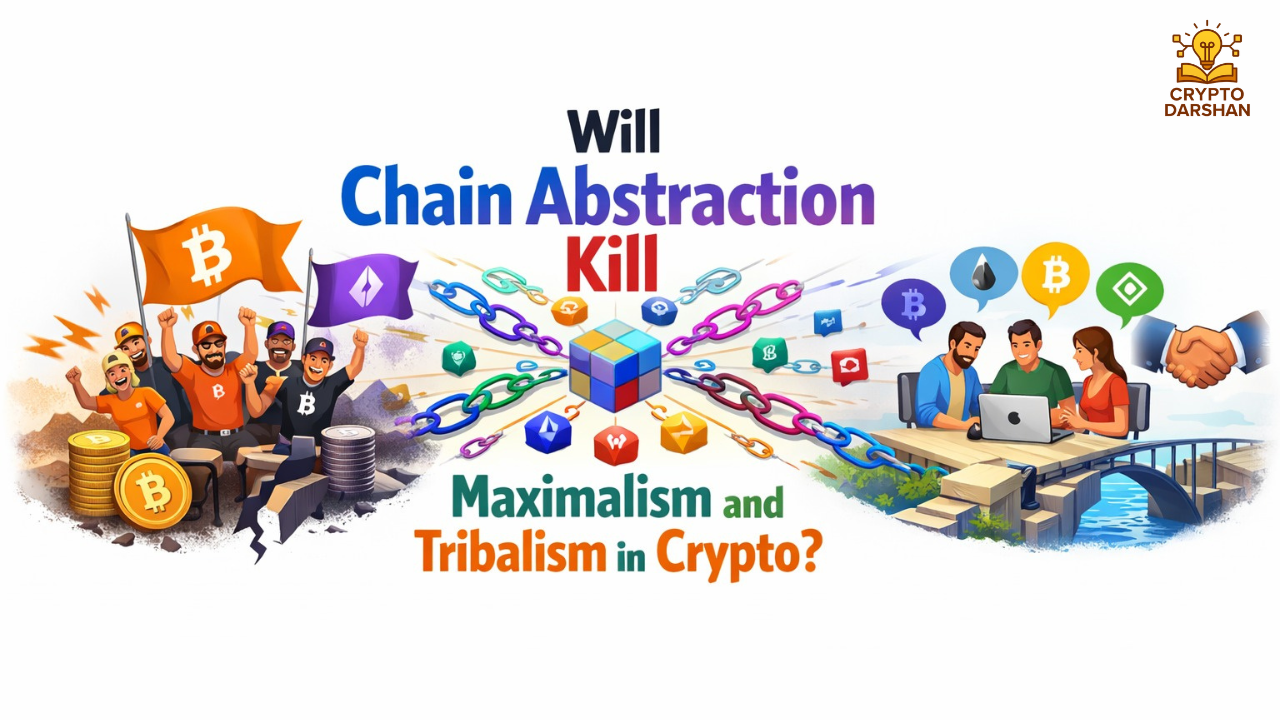
So the big question is: Will chain abstraction kill maximalism and tribalism in crypto? Or will it simply move tribalism up a layer—from chains to apps, wallets, and ecosystems?
This article explores what chain abstraction really means, why tribalism exists, how maximalism is sustained, and what happens when the user experience stops reinforcing chain identity.
What Is Crypto Tribalism?

Crypto tribalism is the tendency for communities to form strong in-groups around a blockchain, protocol, or ideology—and to treat competing groups as rivals or enemies. It shows up as:
- “My chain is faster/cheaper/more decentralized.”
- “Your chain is centralized / VC-controlled / insecure.”
- “We’re building; they’re just marketing.”
- “We’re the future; they’re a dead end.”
Tribalism persists because it’s not only about tech. It’s about:
A) Financial Incentives
Most participants hold tokens. If you own ETH, SOL, BTC, or an L2 token, you’re financially exposed to narratives. Tribalism becomes a form of portfolio defense.
B) Social Belonging
Crypto communities provide identity and status. Being “early,” being “aligned,” being “part of the mission” matters. People want to feel like they’re on the winning team.
C) Ideological Differences
Some chains represent different philosophies:
- Bitcoin: sound money, minimal change, censorship resistance
- Ethereum: programmable settlement, composability, credible neutrality (aspirational)
- Solana: performance-first, integrated design, consumer-scale throughput
- Cosmos/Polkadot: sovereignty and interoperability as first principles
These aren’t just engineering choices—they’re worldviews.
D) UX Reinforcement
Today’s UX forces users to constantly confront chain boundaries:
- Choose a network
- Switch RPCs
- Hold gas tokens
- Bridge assets
- Manage multiple wallets
- Deal with incompatible standards
Every friction point reminds users: chains are separate nations, not invisible plumbing.
That’s where chain abstraction enters the story.
What Is Chain Abstraction?

Chain abstraction is a user experience framework that unifies fragmented blockchain networks into a single interface. This push toward simpler crypto onboarding is also visible in wallet design, where innovations like social authentication are emerging, as discussed in Social Logins for Crypto Wallets: Are Seed Phrases Finally Dying?
Instead of asking users to:
- pick a chain,
- bridge manually,
- acquire the right gas token,
- and understand network-specific quirks,
…a chain-abstracted system tries to do it automatically.
Chain abstraction aims to make this true:
In practice, chain abstraction can include:
- Unified balances across chains (wallet shows “you have $500 USDC” not “$200 on Arbitrum, $300 on Base”)
- Automatic routing to the best chain for cost, speed, liquidity, or security
- Gas abstraction (pay fees in any token, or fees handled by the app)
- Cross-chain swaps without the user touching a bridge UI
- Intent-based transactions (“swap 1 ETH to USDC and deposit into lending” as one action)
- Account abstraction (smart accounts that can batch, sponsor gas, recover keys, and automate)
Chain abstraction is not one product. It’s a direction: make crypto usable without chain literacy.
Maximalism vs Tribalism: Related, But Not the Same

People often mix these terms, but they’re different.
Tribalism
- Emotional and social
- “My group vs your group”
- Can exist across many chains and apps
Maximalism
- Ideological and strategic
- “Only one chain (or one asset) truly matters long-term”
- Often framed as a moral or security argument
Examples:
- Bitcoin maximalism: BTC is the only truly decentralized money; everything else is a distraction or scam.
- Ethereum maximalism: Ethereum is the credible neutral settlement layer; other L1s are either centralized or unnecessary.
- Solana maximalism: monolithic high-throughput design wins; fragmented L2 ecosystems are inferior.
Maximalism is tribalism with a thesis.
Chain abstraction threatens tribalism by reducing chain visibility. But maximalism might survive because it can shift from UX to deeper claims: security, decentralization, censorship resistance, and monetary premium.
Why Chain Identity Exists Today: The “Borders” Are Real

To understand whether chain abstraction can reduce tribalism, we need to see why chains feel like separate worlds.
A) Liquidity Fragmentation
Assets and liquidity pools are scattered across chains. Even “the same” asset (like USDC) can behave differently depending on issuance model, bridge wrappers, or canonical versions.
B) Security Domains
Each chain has its own consensus and security assumptions. Moving value across chains introduces new trust models (bridges, relayers, light clients, etc.).
C) Developer Ecosystems
Different tooling, languages, standards, and culture:
- EVM vs non-EVM
- Solidity vs Rust vs Move
- Different wallet standards and signing flows
D) Network Effects
Apps cluster where users and liquidity are. Users go where apps are. This creates self-reinforcing ecosystems.
Tribalism is partly a reflection of these real borders. Chain abstraction tries to make borders invisible—but it can’t pretend they don’t exist.
The Case for “Yes”: Chain Abstraction Could Reduce Tribalism

Chain abstraction can weaken tribalism in several ways.
It Removes the Daily Ritual of Chain Allegiance
Right now, users constantly “choose sides”:
- Which chain to bridge to
- Which gas token to buy
- Which wallet to use
- Which DEX has liquidity on that chain
If chain abstraction works, users stop performing these identity-affirming actions. They just use apps.
When the chain becomes invisible, the emotional attachment can fade—especially for mainstream users who never wanted to learn chains in the first place.
It Shifts Competition from “Chain vs Chain” to “Experience vs Experience”
If users can access the same assets and apps across networks, then chains compete less on narrative and more on:
- latency
- reliability
- cost
- finality
- developer tooling
- uptime
- censorship resistance
That’s healthier competition. It’s harder to meme your way out of poor reliability.
This shift is already visible in emerging crypto sectors where projects prioritize utility over chain loyalty. For example, many AI-powered tokens now operate across multiple networks, a trend discussed in Top AI Crypto Coins in 2026: Where Smart Money Is Going.
It Encourages Multichain Normalcy
When wallets and apps treat multichain as default, users become less likely to identify with a single chain. They’ll hold assets across networks without thinking of it as betrayal.
This is similar to how most people don’t identify as “Visa maximalists” or “TCP/IP maximalists.” They just use services.
It Makes “Maximalism” Less Useful as a User Strategy
Many users adopt maximalist positions because it simplifies decisions:
- “I only use Ethereum.”
- “I only hold BTC.”
- “I only build on Solana.”
If chain abstraction makes it safe and easy to operate across chains, the practical need for maximalism declines. Users can diversify without friction.
The Case for “No”: Tribalism Will Mutate, Not Die

Even if chain abstraction succeeds, tribalism may simply move to new battlegrounds.
Tribalism Will Shift to Wallets and Super-Apps
If the wallet becomes the “operating system” that routes across chains, then the wallet becomes the new identity anchor.
People may become:
- Wallet maximalists
- Aggregator loyalists
- “My intent engine is better than yours” partisans
Instead of “Solana vs Ethereum,” it becomes “Wallet A vs Wallet B,” “Aggregator X vs Aggregator Y.”
Chains Still Differ in Values and Guarantees
Even if UX hides chains, the underlying differences remain:
- censorship resistance
- validator decentralization
- governance capture risk
- MEV dynamics
- upgrade policies
- liveness under stress
Maximalists will argue that abstraction is cosmetic: settlement quality still matters.
In other words:
Abstraction Layers Create New Centralization Risks
Many chain abstraction systems rely on:
- solvers
- relayers
- routing engines
- cross-chain messaging networks
- liquidity networks
If these become concentrated, users may be exposed to:
- censorship at the routing layer
- hidden fees
- preferential routing
- opaque execution
- new attack surfaces
That can fuel new tribal narratives:
- “Our chain is pure; your abstraction layer is centralized.”
- “Your wallet is a gatekeeper.”
- “Solvers are the new banks.”
Communities Are Not Just UX—They’re Culture
Tribalism is also entertainment. It’s memes, rivalry, and social bonding. Even if chains become less visible, communities will still form around:
- founders
- influencers
- conferences
- token cultures
- governance battles
- “build vs hype” narratives
Humans form tribes. Crypto just gives them tokens and timelines.
How Chain Abstraction Actually Works

To judge whether chain abstraction can reshape tribalism, it helps to understand the mechanisms.
A) Intent-Based Transactions
Instead of signing a specific transaction on a specific chain, the user signs an intent:
- “Swap 100 USDC to ETH and send to this address.”
- “Bridge and deposit into protocol X.”
- “Buy NFT Y under price Z.”
A network of solvers competes to fulfill the intent.
Why it reduces tribalism: users stop thinking in chain-specific steps.
Where it breaks: solver trust, censorship, and transparency. If users feel exploited, they’ll retreat to chain-native flows.
B) Gas Abstraction
Apps sponsor gas or allow paying fees in any token.
Why it reduces tribalism: users stop holding chain-specific gas tokens, which are a constant reminder of chain borders.
Where it breaks: fee sponsorship can be abused, limited, or used as a growth lever that centralizes power in large apps.
C) Unified Wallet Balances
Wallets show aggregated balances and handle bridging behind the scenes.
Why it reduces tribalism: users stop thinking “I’m on Base” and start thinking “I have USDC.”
Where it breaks: bridging risk and asset canonicality. If users get burned by a hidden bridge, they’ll demand explicit chain control again.
D) Cross-Chain Liquidity Networks
Liquidity is made accessible across chains via routing and messaging.
Why it reduces tribalism: users can chase best execution without caring where liquidity sits.
Where it breaks: cross-chain security remains hard. Bridges and messaging layers have historically been attacked.
What Happens to Bitcoin Maximalism Under Chain Abstraction?

Bitcoin maximalism is a special case because Bitcoin is not primarily competing on app UX. It competes on:
- monetary premium
- immutability
- conservative governance
- censorship resistance
- simplicity
Chain abstraction might reduce tribalism among smart contract users, but Bitcoin maximalism can remain strong because it’s not dependent on chain switching friction.
However, chain abstraction could still influence Bitcoin culture in two ways:
- If BTC becomes a “universal collateral” across chains, users may hold BTC while using apps elsewhere. That could soften the “everything else is useless” stance for some.
- If abstraction makes alt ecosystems feel like one big casino, maximalists may feel vindicated and become louder, not quieter.
So chain abstraction doesn’t necessarily “kill” Bitcoin maximalism. It may either marginalize it in app-centric circles or intensify it as a counterculture.
What Happens to Ethereum vs Solana Tribalism?
This rivalry is partly technical and partly cultural.
If chain abstraction succeeds:
- Users may not care whether an app settles on Ethereum L2s or Solana.
- Apps may deploy everywhere and route users automatically.
- The “where” becomes less important than “does it work.”
But the rivalry can persist because:
- Developers still choose ecosystems.
- Liquidity and composability still cluster.
- Performance and reliability differences still matter.
- Social capital and narratives still drive funding and attention.
Chain abstraction can reduce user-level tribalism faster than builder-level tribalism.
The Likely Outcome: Tribalism Declines for Users, Persists for Power Users

A realistic forecast is not “tribalism dies,” but:
Mainstream users
- Will become chain-agnostic
- Will care about apps, brands, and outcomes
- Will treat chains like infrastructure
Power users and builders
- Will still debate settlement guarantees
- Will still argue about decentralization and governance
- Will still form tribes around technical philosophies
This mirrors other tech domains:
- Most people don’t care about operating systems kernels.
- Engineers still argue about Linux vs BSD vs Windows internals.
- The debate doesn’t disappear; it becomes specialized.
Will Maximalism Survive as a Security Thesis?

Maximalism can survive chain abstraction because it can reframe itself:
- “Abstraction is fine, but settlement must be on the most secure chain.”
- “You can route anywhere, but finality and censorship resistance matter.”
- “Your wallet hides risk; my chain minimizes it.”
In that sense, chain abstraction may actually increase maximalist messaging as a corrective force—especially after the next major cross-chain exploit or routing-layer scandal.
Maximalism thrives when people get hurt.
The New Tribalism: “Abstraction Maxis” vs “Sovereignty Maxis”
Chain abstraction could create a new ideological split:
Abstraction Maxis
- Want seamless UX
- Prefer automation and routing
- Believe users shouldn’t manage complexity
- Optimize for adoption
Sovereignty Maxis
- Want explicit control
- Prefer chain-native transparency
- Believe hidden routing hides risk
- Optimize for trust minimization
This is a classic tradeoff:
- convenience vs control
- product growth vs security purity
- mainstream adoption vs cypherpunk values
So yes, chain tribalism might fade—but it may be replaced by philosophy tribalism.
What Needs to Happen for Chain Abstraction to Actually Reduce Tribalism?

Chain abstraction won’t reduce tribalism if it’s fragile, unsafe, or opaque. For it to reshape culture, it needs:
A) Trust-Minimized Cross-Chain Infrastructure
The more trust-minimized the routing and messaging, the less ammunition maximalists have.
B) Transparent Execution and Pricing
Users must be able to see:
- where the transaction executed
- what fees were paid
- what route was chosen and why
- what risks were involved
C) Strong Defaults + Escape Hatches
Mainstream users want “just work.” Power users want “let me choose.”
The best abstraction systems will offer:
- simple default mode
- advanced mode with explicit chain control
D) Reliability Under Stress
If abstraction fails during volatility, users will revert to tribal safe zones. Reliability is cultural power.
What This Means for “Crypto Tribalism” in 2026 and Beyond

From an SEO perspective, “crypto tribalism” is increasingly tied to UX evolution:
- As wallets improve and chain abstraction spreads, tribalism becomes less about “which chain” and more about “which experience.”
- Maximalism remains as a narrative layer focused on security and values.
- The next wave of tribal conflict may center on abstraction infrastructure: solvers, wallets, and routing networks.
If you’re building or investing, the key question becomes:
That’s where the next tribes will form.
FAQs

1. What is chain abstraction in crypto?
Chain abstraction is a technology that hides the complexity of different blockchains from users. Instead of interacting with multiple chains separately, users can access services, assets, and applications across blockchains through a unified interface. This makes the experience feel like using one ecosystem rather than many fragmented networks.
2. How does chain abstraction work?
Chain abstraction works by using tools such as smart accounts, cross-chain messaging, bridges, and middleware protocols. These systems allow transactions, assets, and data to move across different blockchains without requiring users to manually switch networks or manage multiple wallets.
3. What is crypto maximalism?
Crypto maximalism is the belief that one blockchain—such as Bitcoin or Ethereum—will ultimately dominate the entire crypto ecosystem. Maximalists often argue that their preferred chain offers the best security, decentralization, or scalability compared to others.
4. Why does tribalism exist in the crypto community?
Tribalism in crypto often comes from financial incentives, ideological differences, and community identity. Investors who hold tokens from a specific blockchain tend to support and promote that network, which can lead to rivalry and strong opinions against competing ecosystems.
5. Can chain abstraction reduce blockchain tribalism?
Chain abstraction has the potential to reduce tribalism by making blockchain infrastructure less visible to end users. When people interact with applications rather than specific chains, the focus shifts from “which chain is better” to “which product works best.”
6. Will chain abstraction eliminate maximalism completely?
Probably not. Even if users no longer care which chain they use, developers, investors, and core communities may still support specific ecosystems. Ideological beliefs around decentralization, security, and governance will likely keep some level of maximalism alive.
7. How does chain abstraction improve the user experience in crypto?
Chain abstraction simplifies the crypto experience by removing the need to manage multiple wallets, switch networks, or pay gas fees in different tokens. Users can interact with decentralized applications more easily, which helps crypto products feel closer to traditional web apps.
8. Which projects are working on chain abstraction?
Several projects are exploring chain abstraction solutions, including account abstraction wallets, cross-chain infrastructure protocols, and interoperability layers. These technologies aim to create a seamless multi-chain ecosystem where users don’t have to think about the underlying blockchain.
Conclusion: Chain Abstraction Won’t Kill Tribalism—But It Will Change Its Shape
Chain abstraction is one of the most important UX shifts in crypto because it attacks the daily friction that reinforces chain identity. It can absolutely reduce user-level tribalism by making chains feel like interchangeable infrastructure.
But tribalism is not only a product of friction. It’s also:
- financial incentive,
- ideology,
- culture,
- and human nature.
So chain abstraction is unlikely to “kill” maximalism and tribalism outright. Instead, it will relocate them:
- from chains to wallets and apps,
- from network slogans to settlement guarantees,
- from “my chain” to “my execution layer,” “my router,” “my community.”
In the end, crypto may become more usable and less chain-obsessed for most people—while still remaining a battlefield of narratives for those closest to the metal.