
Artificial intelligence (AI) and blockchain technology are two of the most transformative innovations of the 21st century. When combined, they create a powerful synergy that is reshaping industries, redefining data ownership, and unlocking new investment opportunities. As 2026 unfolds, AI-driven cryptocurrencies are emerging as some of the most promising assets in the digital economy. Investors, developers, and institutions are increasingly turning their attention to AI crypto coins that integrate machine learning, automation, and decentralized intelligence into blockchain ecosystems.
This comprehensive guide explores the top AI crypto coins in 2026, analyzing their technology, market potential, and investment outlook. It also examines the broader trends driving the AI-blockchain revolution and where smart money is flowing in this rapidly evolving sector.
However, understanding crypto market cycles is essential before investing in emerging technologies like AI tokens. Recognizing early warning indicators discussed in our guide on Crypto Bear Market Signals can help investors avoid entering the market during unfavorable conditions and make more informed investment decisions.
Understanding AI Crypto Coins

Artificial Intelligence (AI) coins refer to digital or cryptocurrency tokens that are integrated with artificial intelligence technologies. These projects use AI to enhance blockchain performance, automate decision-making, improve security, and enable predictive analytics. In return, blockchain provides AI systems with transparency, decentralization, and immutable data storage.
Key Features of AI Crypto Coins
- Decentralized Intelligence: AI models operate on decentralized networks, reducing reliance on centralized data centers.
- Data Monetization: Users can securely share and monetize their data for AI training without losing ownership.
- Automation: Smart contracts powered by AI can execute complex tasks autonomously.
- Predictive Analytics: AI algorithms analyze blockchain data to forecast trends, detect fraud, and optimize trading.
- Scalability and Efficiency: AI optimizes blockchain operations, improving transaction speed and reducing energy consumption.
Why AI and Blockchain Are Converging
The convergence of AI and blockchain is driven by mutual benefits. AI requires vast amounts of high-quality data, while blockchain ensures data integrity and traceability. Blockchain networks, in turn, benefit from AI’s ability to analyze data, detect anomalies, and automate governance.
Major Drivers of AI-Blockchain Integration
- Data Privacy and Ownership: Blockchain enables secure data sharing for AI training without compromising privacy.
- Automation of Smart Contracts: AI enhances smart contracts with adaptive logic and predictive capabilities.
- Fraud Detection: AI algorithms identify suspicious transactions in real time.
- Decentralized AI Marketplaces: Blockchain allows developers to share and monetize AI models transparently.
- Tokenized Incentives: AI projects use tokens to reward data providers, validators, and model trainers.
The AI Crypto Market in 2026

By 2026, the AI crypto market has matured significantly. Institutional investors, venture capital firms, and tech giants are actively funding AI-blockchain startups. The total market capitalization of AI-related cryptocurrencies has surpassed $100 billion, with several projects achieving mainstream adoption.
Key Market Trends
- AI-Powered DeFi: Decentralized finance platforms are using AI for risk assessment, yield optimization, and automated trading.
- AI Data Marketplaces: Platforms that tokenize and trade data for AI training are gaining traction.
- AI Infrastructure Tokens: Projects offering decentralized computing power for AI model training are in high demand.
- AI Governance Models: DAOs (Decentralized Autonomous Organizations) are integrating AI to improve decision-making.
- Cross-Chain AI Solutions: Interoperability between AI blockchains is becoming a major focus.
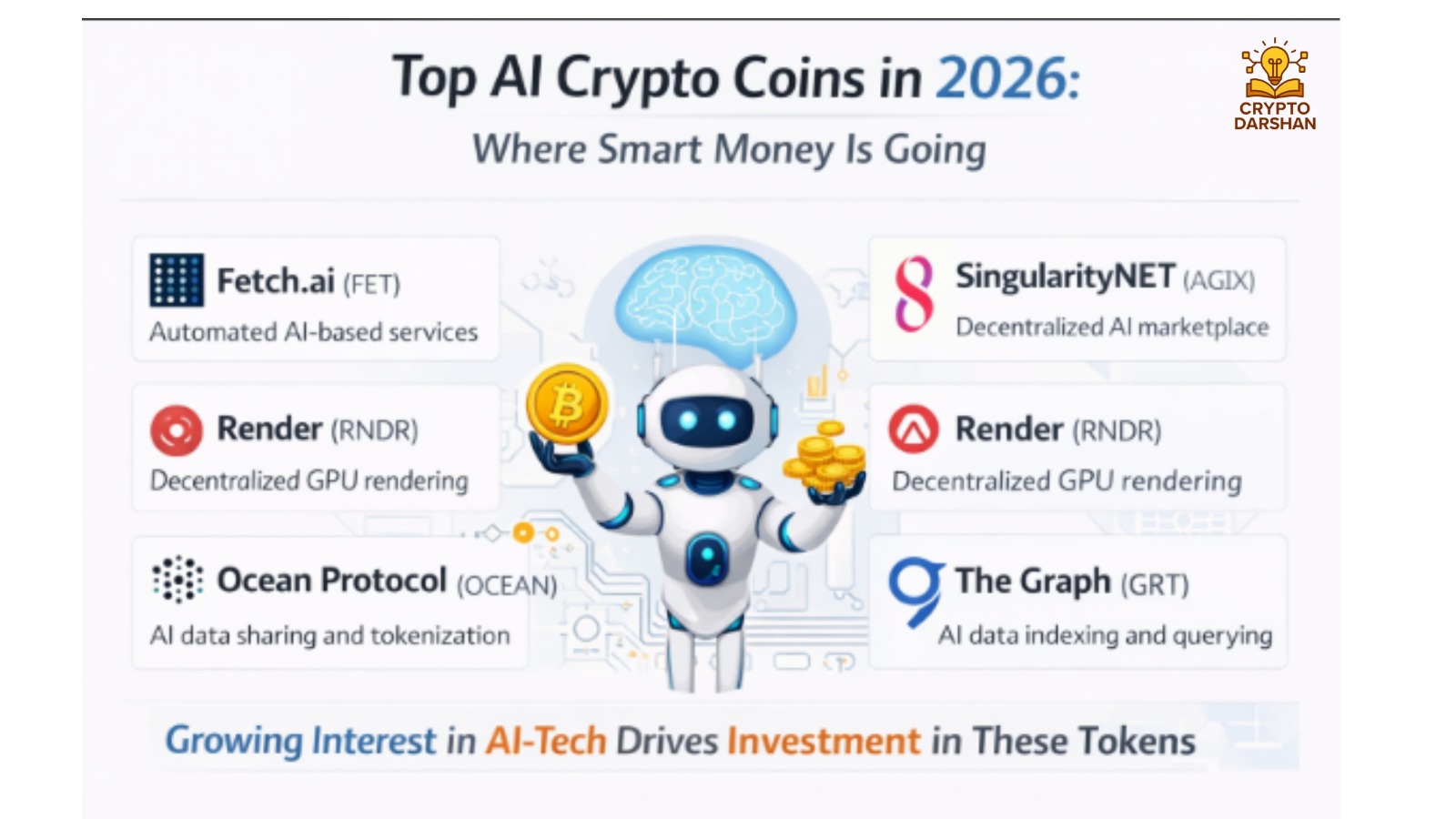
Top AI Crypto Coins in 2026

1. Fetch.ai (FET)
Overview: Fetch.ai is one of the pioneers in combining AI and blockchain. It provides a decentralized platform for autonomous agents that perform tasks such as data sharing, logistics optimization, and trading.
Key Features:
- Autonomous economic agents (AEAs) that execute tasks without human intervention.
- Machine learning integration for predictive analytics.
- Decentralized marketplace for AI services.
Use Cases:
- Smart city infrastructure.
- Supply chain optimization.
- Decentralized finance automation.
Investment Outlook: Fetch.ai continues to expand partnerships with enterprises and governments. Its focus on real-world AI applications positions it as a long-term leader in the AI crypto space.
2. SingularityNET (AGIX)
Overview: SingularityNET is a decentralized marketplace for AI services, founded by Dr. Ben Goertzel. It allows developers to create, share, and monetize AI algorithms using blockchain technology.
Key Features:
- Open marketplace for AI models.
- Interoperability with multiple blockchains.
- Governance through the AGIX token.
Use Cases:
- AI model sharing and monetization.
- Decentralized AI research collaboration.
- Integration with robotics and IoT.
Investment Outlook: SingularityNET’s vision of creating a global AI network aligns with the growing demand for decentralized intelligence. Its partnerships with robotics and biotech firms enhance its long-term potential.
3. Ocean Protocol (OCEAN)
Overview: Ocean Protocol focuses on data tokenization and decentralized data marketplaces. It enables individuals and organizations to share and monetize data securely for AI training.
Key Features:
- Data tokenization for secure sharing.
- AI-driven data curation and pricing.
- Privacy-preserving data access.
Use Cases:
- AI model training datasets.
- Healthcare and scientific research.
- Enterprise data monetization.
Investment Outlook: As data becomes the new oil of the digital economy, Ocean Protocol’s role in enabling ethical data sharing makes it a cornerstone of the AI-blockchain ecosystem.
4. Numerai (NMR)
Overview: Numerai is a hedge fund powered by a decentralized network of data scientists. Participants use AI models to predict financial markets, and the best models are rewarded with NMR tokens.
Key Features:
- Crowdsourced AI trading models.
- Encrypted data for secure collaboration.
- Token-based incentive system.
Use Cases:
- Quantitative trading.
- Predictive analytics.
- Decentralized hedge fund management.
Investment Outlook: Numerai’s unique model of combining AI, data science, and blockchain continues to attract institutional interest. Its consistent performance in financial prediction gives it strong credibility.
5. Cortex (CTXC)

Overview: Cortex integrates AI models directly into smart contracts, enabling on-chain AI inference. Developers can upload AI models to the blockchain, allowing decentralized applications to use them.
Key Features:
- On-chain AI model execution.
- Decentralized AI model marketplace.
- Integration with Ethereum Virtual Machine (EVM).
Use Cases:
- AI-powered dApps.
- Automated decision-making.
- Predictive smart contracts.
Investment Outlook: Cortex’s ability to bring AI computation on-chain gives it a unique advantage. As demand for intelligent dApps grows, CTXC is positioned for significant adoption.
6. Render Token (RNDR)
Overview: Render Token provides decentralized GPU rendering power for AI, 3D graphics, and metaverse applications. It connects users needing computational power with those offering it.
Key Features:
- Decentralized GPU network.
- AI and 3D rendering support.
- Token-based payment system.
Use Cases:
- AI model training.
- Metaverse and gaming graphics.
- Visual effects rendering.
Investment Outlook: With the rise of AI-generated content and metaverse development, Render Token’s decentralized GPU infrastructure is becoming increasingly valuable.
7. Artificial Liquid Intelligence (ALI)
Overview: ALI powers the Alethea AI ecosystem, which focuses on creating intelligent NFTs (iNFTs). These NFTs use AI to interact, learn, and evolve over time.
Key Features:
- AI-driven NFT personalities.
- Decentralized AI training.
- Integration with metaverse platforms.
Use Cases:
- Interactive digital avatars.
- AI-driven storytelling.
- Personalized virtual assistants.
Investment Outlook: As AI merges with digital identity and entertainment, ALI’s innovative approach to intelligent NFTs positions it as a leader in the AI-metaverse intersection.
8. Bittensor (TAO)
Overview: Bittensor is a decentralized network that rewards participants for contributing to AI model training. It creates an open-source, tokenized AI ecosystem.
Key Features:
- Decentralized AI training network.
- Token incentives for model contributions.
- Open-source AI collaboration.
Use Cases:
- AI model development.
- Decentralized machine learning.
- Collaborative AI research.
Investment Outlook: Bittensor’s decentralized approach to AI training challenges traditional AI monopolies. Its growing developer community and innovative tokenomics make it a standout project in 2026.
9. DeepBrain Chain (DBC)
Overview: DeepBrain Chain provides decentralized computing power for AI training. It reduces the cost of AI computation by distributing workloads across a blockchain network.
Key Features:
- Decentralized AI computing.
- Privacy-preserving data sharing.
- Cost-efficient AI model training.
Use Cases:
- AI startups and research labs.
- Cloud computing alternatives.
- Enterprise AI solutions.
Investment Outlook: As AI computation costs rise, DeepBrain Chain’s decentralized infrastructure offers a scalable and affordable alternative, attracting both developers and enterprises.
10. SingularityDAO (SDAO)
Overview: SingularityDAO is a DeFi platform that uses AI to manage crypto portfolios. It leverages machine learning to optimize yield farming and risk management.
Key Features:
- AI-driven portfolio management.
- Dynamic asset rebalancing.
- Integration with SingularityNET ecosystem.
Use Cases:
- Automated DeFi investment.
- Risk-adjusted yield optimization.
- AI-based trading strategies.
Investment Outlook: SingularityDAO’s combination of AI and DeFi appeals to investors seeking intelligent asset management solutions. Its integration with AGIX enhances its ecosystem value.
Emerging AI Crypto Projects to Watch

While established projects dominate the market, several emerging AI crypto coins are gaining attention for their innovation and potential.
1. Oraichain (ORAI)
A data oracle platform that integrates AI into smart contracts, enabling intelligent data feeds for decentralized applications.
2. Velas (VLX)
A high-speed blockchain that uses AI to optimize consensus and improve transaction throughput.
3. Matrix AI Network (MAN)
Combines AI and blockchain to create self-optimizing smart contracts and adaptive governance systems.
4. GNY (GNY)
Focuses on machine learning for predictive analytics in blockchain networks, particularly for market forecasting.
5. AIOZ Network (AIOZ)
A decentralized content delivery network that uses AI to optimize bandwidth and storage allocation.
How AI Crypto Coins Are Changing the Industry

1. Revolutionizing Data Ownership
AI crypto projects empower individuals to control and monetize their data, shifting power away from centralized tech giants.
2. Enhancing Blockchain Efficiency
AI optimizes consensus mechanisms, reduces energy consumption, and improves scalability.
3. Automating Financial Systems
AI-driven DeFi platforms automate trading, lending, and portfolio management, reducing human error.
4. Enabling Decentralized AI Research
Blockchain-based AI networks foster open collaboration, accelerating innovation in machine learning.
5. Creating Intelligent Digital Assets
AI-powered NFTs and metaverse avatars are redefining digital identity and entertainment.
Investment Strategies for AI Crypto Coins

1. Diversification
Invest across multiple AI crypto projects to balance risk and exposure to different use cases.
2. Long-Term Holding
AI and blockchain integration is still in its early stages, meaning that long-term holding could yield substantial returns as adoption grows. However, securing your assets should be a top priority for any long-term investor. Following the best practices outlined in How to Store Your Crypto Offline: Complete Hardware Wallet Setup Guide can help protect your AI crypto investments from online threats and hacking attempts.
3. Fundamental Analysis
Evaluate project teams, partnerships, tokenomics, and real-world use cases before investing.
4. Staking and Yield Farming
Many AI tokens offer staking rewards or yield farming opportunities, providing passive income.
5. Monitoring Market Trends
Stay updated on AI and blockchain developments, as technological breakthroughs can significantly impact valuations.
Risks and Challenges

1. Regulatory Uncertainty
AI and blockchain regulations are still evolving, which may affect project operations and token classifications.
2. Technical Complexity
Integrating AI with blockchain requires advanced infrastructure and expertise, posing scalability challenges.
3. Data Privacy Concerns
Despite blockchain’s transparency, managing sensitive data for AI training remains a challenge.
4. Market Volatility
AI crypto coins, like all digital assets, are subject to high price fluctuations.
5. Competition
The growing number of AI-blockchain projects increases competition for market share and developer talent.
The Future of AI Crypto Coins

By 2030, AI and blockchain are expected to become foundational technologies for the digital economy. AI crypto coins will play a central role in enabling decentralized intelligence, powering autonomous systems, and democratizing access to AI tools.
Key Predictions:
- Mainstream Adoption: Enterprises will integrate AI crypto solutions for automation and data management.
- AI-Powered DAOs: Governance systems will increasingly rely on AI for decision-making and resource allocation.
- Cross-Chain AI Networks: Interoperability between AI blockchains will create a unified decentralized intelligence layer.
- AI-Driven Metaverse: Intelligent avatars and environments will dominate virtual worlds.
- Institutional Investment Growth: Hedge funds and corporations will allocate significant capital to AI crypto assets.
The Role of AI Crypto in the Global Economy

AI crypto coins are not just reshaping the blockchain industry—they are influencing the global economy. As automation and decentralized intelligence expand, AI crypto projects are becoming essential infrastructure for digital transformation.
1. Empowering Small Businesses
AI crypto platforms allow small enterprises to access advanced AI tools without expensive infrastructure. Decentralized AI marketplaces enable affordable model training and data analytics.
2. Driving Financial Inclusion
AI-powered DeFi platforms provide access to financial services for unbanked populations. Smart contracts automate lending and insurance, reducing barriers to entry.
3. Enhancing Supply Chain Transparency
AI and blockchain together improve traceability, reduce fraud, and optimize logistics. Projects like Fetch.ai and Ocean Protocol are already enabling smarter supply chains.
4. Supporting Sustainable Development
AI crypto networks optimize energy usage and promote green computing. Decentralized AI training reduces the carbon footprint of centralized data centers.
5. Transforming Digital Identity
AI-driven NFTs and decentralized identity systems allow users to control their digital personas, paving the way for secure, personalized online experiences.
How to Evaluate AI Crypto Investments

Investing in AI crypto coins requires careful analysis. Beyond hype, investors should focus on tangible metrics that indicate long-term viability.
1. Technology and Innovation
Assess the project’s technical foundation, scalability, and AI integration. Projects with real AI functionality, not just branding, are more sustainable.
2. Team and Partnerships
Strong leadership and credible partnerships with AI or blockchain institutions signal reliability and growth potential.
3. Token Utility
Tokens should have clear use cases within the ecosystem—such as governance, staking, or payment for AI services.
4. Community and Ecosystem Growth
Active developer communities and user engagement indicate healthy project momentum.
5. Market Positioning
Projects that solve real-world problems or have enterprise adoption are more likely to succeed long-term.
The Intersection of AI, Web3, and the Metaverse

AI crypto coins are becoming the backbone of Web3 and metaverse ecosystems. Intelligent agents, decentralized data, and AI-driven avatars are transforming how users interact in virtual environments.
AI in the Metaverse
AI enhances realism, personalization, and interactivity in virtual worlds. Intelligent NFTs powered by tokens like ALI create dynamic, evolving digital beings.
Web3 and AI Integration
Web3’s decentralized architecture complements AI’s need for secure, distributed data. AI crypto projects are enabling smart governance, adaptive content, and predictive analytics across decentralized applications.
The Rise of AI-Powered DAOs
AI-driven DAOs use machine learning to analyze proposals, allocate resources, and optimize community decisions. This evolution marks a shift toward self-governing, intelligent organizations.
Institutional Adoption and Smart Money Trends

Institutional investors are increasingly recognizing the potential of AI crypto coins. Hedge funds, venture capital firms, and tech corporations are allocating capital to AI-blockchain ventures.
1. Venture Capital Inflows
AI crypto startups are attracting record funding rounds, with investors focusing on infrastructure, data marketplaces, and decentralized AI training.
2. Corporate Partnerships
Tech companies are collaborating with AI crypto projects to integrate decentralized intelligence into enterprise solutions.
3. Government Interest
Governments are exploring AI-blockchain applications for public data management, smart cities, and digital identity systems.
4. Hedge Fund Strategies
Quantitative funds are using AI crypto tokens like Numerai to enhance predictive trading models and diversify portfolios.
Long-Term Outlook: The Decentralized AI Economy

The decentralized AI economy represents the next phase of digital evolution. It envisions a world where AI models, data, and computing power are shared across open networks, governed by tokenized incentives.
1. AI as a Public Utility
AI services will become accessible to everyone through decentralized platforms, reducing dependence on centralized tech giants.
2. Tokenized Data Ecosystems
Data will be treated as a tradable asset, with blockchain ensuring ownership and transparency.
3. Collaborative AI Development
Developers worldwide will contribute to open-source AI models, earning tokens for their contributions.
4. Autonomous Digital Economies
AI agents will transact, negotiate, and collaborate autonomously, creating self-sustaining digital ecosystems.
FAQs: Top AI Crypto Coins in 2026

1. What are AI crypto coins?
AI crypto coins are cryptocurrencies that combine blockchain technology with artificial intelligence. These projects use AI for tasks such as data analysis, machine learning model training, automation, and decentralized computing. The tokens typically power ecosystems where users can access AI services, share data, or provide computing resources.
2. Which AI crypto coins are considered the top projects in 2026?
Some of the most discussed AI crypto projects in 2026 include Bittensor (TAO), Fetch.ai (FET), Render (RNDR), SingularityNET (AGIX), Ocean Protocol (OCEAN), and The Graph (GRT). These projects focus on areas such as decentralized AI training, GPU computing, data marketplaces, and AI service marketplaces.
3. Why is AI becoming a major narrative in the crypto market?
AI is transforming many industries, and blockchain provides a decentralized infrastructure for data sharing, computing power, and automated decision-making. Combining AI with crypto allows developers to build decentralized AI networks without relying on centralized cloud providers.
4. What makes Bittensor (TAO) unique in the AI crypto sector?
Bittensor is a decentralized network that incentivizes machine learning contributions. Developers train AI models and are rewarded with TAO tokens based on the value of their models to the network. This creates a collaborative marketplace for AI intelligence.
5. How does Fetch.ai use artificial intelligence in blockchain?
Fetch.ai uses autonomous AI agents that can perform tasks such as trading, supply-chain optimization, and data sharing. These agents interact and transact on the network using the FET token, creating automated economic systems.
6. What role does Render (RNDR) play in AI infrastructure?
Render Network provides decentralized GPU computing power that can be used for 3D rendering, AI model training, and AI inference. Users pay with RNDR tokens to access distributed GPU resources from network participants.
7. Are AI crypto coins a good long-term investment?
AI crypto coins may have long-term potential because they combine two rapidly growing sectors—artificial intelligence and blockchain. However, the market is highly volatile, and investors should evaluate each project’s real-world use case, team, and ecosystem before investing.
8. What risks should investors consider before buying AI crypto coins?
Investors should consider risks such as market volatility, regulatory uncertainty, technological challenges, and the possibility that some projects may not achieve real adoption. Not every token labeled “AI” has meaningful AI technology behind it.
Conclusion
The fusion of artificial intelligence and blockchain is creating a new frontier in digital innovation. AI crypto coins are not just speculative assets—they represent the foundation of a decentralized, intelligent economy. From data marketplaces and decentralized computing to AI-powered DeFi and NFTs, these projects are redefining how technology interacts with value, trust, and automation.
In 2026, smart money is flowing toward AI crypto coins that combine strong fundamentals, real-world utility, and visionary leadership. Projects like Fetch.ai, SingularityNET, Ocean Protocol, and Bittensor are leading the charge, while emerging players like Oraichain and Matrix AI Network are pushing the boundaries of what’s possible.
As the AI-blockchain ecosystem continues to evolve, investors who understand the synergy between these technologies will be best positioned to capitalize on the next wave of digital transformation. The future belongs to intelligent, decentralized systems—and AI crypto coins are at the heart of that revolution.