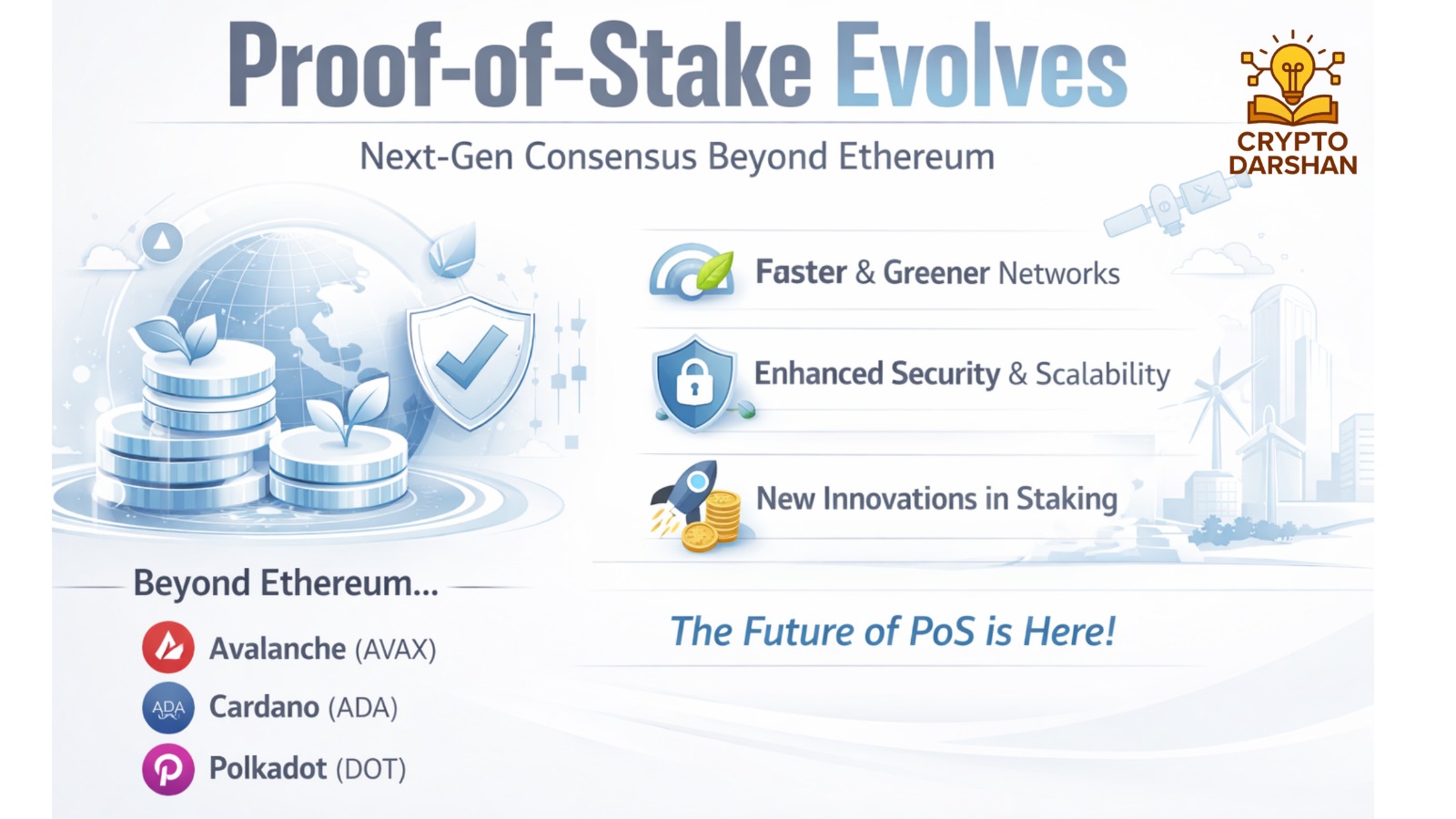
The blockchain ecosystem has undergone a remarkable transformation since the introduction of Bitcoin’s Proof-of-Work (PoW) consensus mechanism. While PoW established the foundation for decentralized trust, it also introduced challenges related to scalability, energy consumption, and accessibility. The emergence of Proof-of-Stake (PoS) marked a pivotal shift toward more sustainable and efficient consensus models. Ethereum’s transition from PoW to PoS through the Merge in 2022 was a defining moment, signaling the maturity of staking-based systems. Yet, the evolution of PoS is far from complete. A new generation of consensus protocols is emerging, pushing the boundaries of security, decentralization, and performance.
This article explores the evolution of Proof-of-Stake beyond Ethereum, examining how next-generation consensus mechanisms are redefining blockchain technology. It delves into the origins of PoS, its advantages and limitations, and the innovative approaches shaping the future of decentralized networks. From hybrid models and delegated systems to novel cryptographic techniques and cross-chain interoperability, the next era of PoS is poised to transform how blockchains achieve consensus.
The Origins of Proof-of-Stake

The Limitations of Proof-of-Work
Bitcoin’s Proof-of-Work mechanism revolutionized digital trust by enabling decentralized consensus without intermediaries. However, PoW’s reliance on computational power led to several inefficiencies:
- High Energy Consumption: Mining requires vast amounts of electricity, raising environmental concerns.
- Centralization Risks: Mining pools and specialized hardware (ASICs) concentrate power among a few entities.
- Limited Scalability: Block confirmation times and throughput are constrained by computational difficulty.
These challenges motivated researchers and developers to explore alternative consensus mechanisms that could maintain security while improving efficiency.
The Birth of Proof-of-Stake
The concept of Proof of Stake was first introduced in 2011 by a developer named QuantumMechanic on the BitcoinTalk forum. The idea was to address a growing concerns about high energy consumption and computational power required by the Proof of Work mining. PoS was proposed as a more energy-bill friendly alternative.
Instead of relying on computational work, PoS selects validators based on the amount of cryptocurrency they “stake” as collateral. The concept was first implemented in Peercoin (2012), followed by projects like NXT and BlackCoin. These early systems demonstrated that consensus could be achieved through economic incentives rather than raw computing power.
The core idea behind PoS is simple: validators have a financial stake in the network’s integrity. If they act maliciously, they risk losing their staked assets. This alignment of incentives creates a self-regulating system that promotes honest participation.
Ethereum’s Transition to Proof-of-Stake

The Merge: A Milestone in Blockchain History
Ethereum’s transition from PoW to PoS, known as “The Merge,” was one of the most anticipated events in blockchain history. Completed in September 2022, it replaced energy-intensive mining with staking, reducing Ethereum’s energy consumption by over 99%. The new consensus mechanism, known as the Beacon Chain, introduced a system where validators are randomly selected to propose and attest to blocks.
Key Features of Ethereum’s PoS
- Validator Selection: Validators are chosen pseudo-randomly based on their stake and other factors.
- Slashing Mechanism: Misbehavior, such as double-signing or downtime, results in penalties or loss of stake.
- Finality through Casper FFG: The Casper Friendly Finality Gadget ensures that once blocks are finalized, they cannot be reverted without significant economic cost.
- Staking Rewards: Validators earn rewards for securing the network, creating a sustainable incentive model.
Ethereum’s PoS model demonstrated that large-scale networks could transition to staking without compromising security or decentralization. However, it also revealed new challenges, such as validator centralization, liquidity constraints, and governance complexities.
The Next Generation of Proof-of-Stake

As blockchain technology matures, developers are exploring new variations of PoS to address its limitations. These next-generation consensus mechanisms aim to enhance scalability, security, and inclusivity while maintaining decentralization.
1. Delegated Proof-of-Stake (DPoS)
Delegated Proof-of-Stake, introduced by projects like BitShares and EOS, refines traditional PoS by allowing token holders to elect a limited number of delegates (or witnesses) who validate transactions and produce blocks. This model improves transaction throughput and governance efficiency.
Advantages:
- High scalability and fast block times.
- Democratic governance through voting.
- Reduced hardware requirements for participants.
Challenges:
- Risk of centralization among top delegates.
- Potential for voter apathy and collusion.
Despite these concerns, DPoS remains a popular choice for high-performance blockchains that prioritize speed and usability.
2. Nominated Proof-of-Stake (NPoS)
Polkadot introduced Nominated Proof-of-Stake, a hybrid model combining delegation with robust security guarantees. In NPoS, nominators back validators with their stake, sharing both rewards and risks. The system uses sophisticated algorithms to ensure fair validator selection and minimize centralization.
Key Innovations:
- Balanced Validator Distribution: Ensures stake is evenly spread across validators.
- Slashing for Both Validators and Nominators: Encourages careful selection and accountability.
- Cross-Chain Compatibility: Supports Polkadot’s multi-chain architecture.
NPoS represents a significant step forward in achieving scalable, secure, and interoperable consensus.
3. Liquid Proof-of-Stake (LPoS)
Tezos pioneered Liquid Proof-of-Stake, which allows token holders to delegate their staking rights without transferring ownership. This flexibility enhances liquidity and participation, enabling users to stake through custodial or non-custodial means.
Benefits:
- Greater accessibility for small holders.
- Dynamic delegation without locking tokens.
- On-chain governance integration.
LPoS combines decentralization with user-friendly participation, making it a model for adaptable blockchain ecosystems.
4. Hybrid Proof-of-Stake Models
Some blockchains combine PoS with other consensus mechanisms to balance trade-offs. For example, Decred uses a hybrid PoW/PoS model where miners and stakers share governance responsibilities. This dual-layer approach enhances security and decentralization.
Examples:
- Decred: Combines PoW mining with PoS voting for governance.
- Elrond (now MultiversX): Uses Secure Proof-of-Stake (SPoS) for high throughput and adaptive sharding.
- Harmony: Implements Effective Proof-of-Stake (EPoS) to balance validator distribution.
Hybrid models demonstrate that consensus can evolve beyond binary classifications, blending mechanisms for optimal performance.
Innovations Driving Next-Gen PoS
1. Sharding and Parallelization
Sharding divides the blockchain into smaller segments (shards) that process transactions in parallel. PoS systems like Ethereum 2.0 and Near Protocol use sharding to enhance scalability without compromising security. Validators are assigned to shards dynamically, ensuring balanced workloads and preventing collusion.
2. Randomness and Verifiable Delay Functions (VDFs)
Randomness is crucial for fair validator selection. Next-gen PoS systems employ cryptographic techniques like Verifiable Random Functions (VRFs) and VDFs to ensure unbiased and unpredictable selection. Algorand’s Pure Proof-of-Stake (PPoS) uses VRFs to randomly select committees, ensuring security and decentralization.
3. Cross-Chain Consensus
Interoperability is a defining feature of modern blockchain ecosystems. Cross-chain PoS protocols enable communication and consensus across multiple networks. Cosmos’ Tendermint and Polkadot’s Relay Chain exemplify this approach, allowing independent blockchains to share security and data seamlessly.
4. Zero-Knowledge Proofs and Privacy Enhancements
Integrating zero-knowledge proofs (ZKPs) into PoS systems enhances privacy and scalability. ZKPs allow validators to prove the validity of transactions without revealing sensitive data. Projects like Mina Protocol and zkSync are pioneering this integration, paving the way for confidential and efficient consensus.
5. Decentralized Validator Infrastructure
Next-gen PoS networks emphasize decentralization at the infrastructure level. Decentralized staking pools, distributed validator technology (DVT), and multi-party computation (MPC) reduce single points of failure. These innovations make staking more resilient and accessible to a broader audience.
Economic and Governance Implications

Staking Economics
Staking introduces new economic dynamics within blockchain ecosystems. Validators and delegators earn rewards for securing the network, but they also face risks such as slashing and opportunity costs. The balance between reward rates, inflation, and network participation determines the long-term sustainability of PoS systems.
Key Factors Influencing Staking Economics:
- Reward Distribution: Balancing incentives between validators and delegators.
- Inflation Control: Preventing excessive token issuance.
- Liquidity Solutions: Enabling liquid staking derivatives to unlock capital efficiency.
Platforms like Lido, Rocket Pool, and StakeWise have popularized liquid staking, allowing users to earn rewards while maintaining liquidity through tokenized staking positions.
Governance and Decentralization
PoS systems often integrate on-chain governance, enabling token holders to propose and vote on protocol upgrades. This democratizes decision-making but also introduces challenges related to voter participation and plutocracy. Balancing governance power between large and small stakeholders remains a critical design consideration.
Examples of Governance Models:
- Tezos: On-chain amendment process with community voting.
- Cardano: Project Catalyst for decentralized funding and governance.
- Polkadot: Multi-tier governance with referenda and councils.
Effective governance ensures that PoS networks evolve transparently and adapt to community needs. As these systems increasingly rely on validator reputation and governance participation, identity primitives like Soulbound Tokens become highly relevant, as explored in Soulbound Tokens: Non-Transferable NFTs for Identity and Credentials, which examines decentralized identity in blockchain ecosystems.
Security Considerations in Next-Gen PoS

The “Nothing at Stake” Problem
Early critics of PoS argued that validators could sign multiple competing chains without cost, undermining consensus. Modern PoS systems address this through slashing penalties and finality mechanisms that make equivocation economically irrational.
Long-Range Attacks
In long-range attacks, adversaries attempt to rewrite history by acquiring old private keys. To mitigate this, PoS networks implement checkpointing and weak subjectivity, requiring nodes to periodically synchronize with trusted checkpoints.
Sybil Resistance
PoS achieves Sybil resistance by tying validator influence to economic stake rather than identity. However, ensuring fair distribution of stake remains essential to prevent centralization.
Validator Centralization
Large staking pools and custodial services can accumulate significant influence, threatening decentralization. Solutions include:
- Encouraging solo staking through user-friendly tools.
- Implementing stake caps or dynamic reward adjustments.
- Promoting decentralized validator networks.
Security in PoS is not solely technical—it also depends on economic and social incentives that align participants toward honest behavior.
Environmental and Social Impact

One of the most celebrated advantages of PoS is its environmental efficiency. By eliminating energy-intensive mining, PoS reduces carbon emissions and hardware waste. This aligns blockchain technology with global sustainability goals and enhances its public perception.
Environmental Benefits:
- Over 99% reduction in energy consumption compared to PoW.
- Lower hardware turnover and e-waste.
- Accessibility for participants without specialized equipment.
Beyond environmental impact, PoS fosters financial inclusion by lowering entry barriers. Anyone with a modest stake can participate in network security and governance, democratizing access to blockchain ecosystems.
The Role of Interoperability and Layer-2 Solutions

As blockchain networks proliferate, interoperability becomes essential for scalability and user experience. Proof-of-Stake systems are increasingly integrated with Layer-2 solutions and cross-chain bridges to enhance performance. While PoS focuses on improving consensus efficiency, alternative scaling solutions like Bitcoin Lightning Network take a different approach, as discussed in Lightning Network Wallets: Top Picks for Bitcoin’s Layer-2 Blockchain, highlighting how scalability can be achieved without altering base-layer consensus.
Layer-2 Scaling
Layer-2 technologies like rollups and sidechains complement PoS by offloading transactions from the main chain. This combination achieves high throughput while maintaining security guarantees.
Examples:
- Optimistic Rollups: Used by Arbitrum and Optimism for Ethereum scalability.
- ZK-Rollups: Employed by zkSync and StarkNet for privacy and efficiency.
Cross-Chain Bridges
Bridges enable assets and data to move between PoS networks, fostering a connected blockchain ecosystem. However, they also introduce security risks, making robust bridge design a priority for next-gen consensus systems.
The Future of Proof-of-Stake

Toward Adaptive and Modular Consensus
Future PoS systems are likely to adopt modular architectures, separating consensus, execution, and data availability layers. This modularity allows networks to upgrade components independently, improving flexibility and innovation.
Integration with Artificial Intelligence
AI-driven optimization could enhance validator selection, network monitoring, and governance. Machine learning models may predict validator reliability, detect anomalies, and optimize staking strategies.
Quantum-Resistant Cryptography
As quantum computing advances, PoS systems must adopt quantum-resistant cryptographic algorithms to safeguard validator keys and signatures. Research into lattice-based and hash-based cryptography is already underway.
Decentralized Identity and Reputation Systems
Integrating decentralized identity (DID) frameworks with PoS could enhance trust and accountability. Validators could build verifiable reputations, reducing reliance on pure economic stake.
Case Studies: Leading Next-Gen PoS Networks

Cardano (Ouroboros)
Cardano’s Ouroboros protocol is a mathematically verified PoS system emphasizing security and formal verification. It divides time into epochs and slots, with slot leaders selected to produce blocks. Ouroboros ensures provable security against adaptive adversaries.
Polkadot (NPoS)
Polkadot’s Nominated Proof-of-Stake enables scalable multi-chain interoperability. Its relay chain coordinates consensus across parachains, allowing diverse blockchains to share security and communicate seamlessly.
Algorand (PPoS)
Algorand’s Pure Proof-of-Stake uses cryptographic sortition to randomly select committees for block proposal and validation. This ensures fairness, instant finality, and high throughput without compromising decentralization.
Cosmos (Tendermint)
Cosmos employs the Tendermint BFT consensus engine, combining PoS with Byzantine Fault Tolerance. Validators stake ATOM tokens to secure the network, while the Inter-Blockchain Communication (IBC) protocol enables cross-chain interoperability.
Tezos (LPoS)
Tezos’ Liquid Proof-of-Stake allows flexible delegation and on-chain governance. Its self-amending protocol enables seamless upgrades without hard forks, ensuring long-term adaptability.
Emerging Trends and Research Directions in PoS

Sustainable Staking and Green Finance Integration
The environmental benefits of PoS are attracting attention from sustainable finance sectors. Green funds and ESG-focused investors are exploring PoS-based assets as environmentally responsible investments. Future PoS networks may integrate carbon offset mechanisms, allowing validators to contribute to sustainability initiatives directly through staking rewards.
Tokenomics Evolution and Dynamic Staking Models
Next-generation PoS systems are experimenting with dynamic staking models that adjust reward rates based on network conditions. Adaptive tokenomics can stabilize inflation, encourage long-term participation, and prevent excessive centralization. Some projects are exploring “progressive staking,” where rewards increase with validator longevity and reliability.
Decentralized Autonomous Validators (DAVs)
A new concept emerging in PoS research is the idea of Decentralized Autonomous Validators—AI-driven validator nodes that operate autonomously using smart contracts and predictive algorithms. These validators could self-optimize performance, manage slashing risks, and participate in governance without human intervention, creating a self-sustaining consensus ecosystem.
Integration with Real-World Assets (RWA)
PoS networks are increasingly being used to tokenize and secure real-world assets such as real estate, commodities, and carbon credits. Staking mechanisms can be tied to asset-backed tokens, ensuring that validators maintain transparency and compliance. This integration bridges decentralized finance (DeFi) with traditional financial systems, expanding the utility of PoS beyond digital assets.
Multi-Layer Consensus and Cross-Domain Security
Future PoS architectures may employ multi-layer consensus systems, where different layers handle specific tasks—such as transaction validation, data availability, and governance. This layered approach enhances modularity and allows specialized consensus algorithms to coexist. Cross-domain security frameworks will ensure that interconnected PoS networks maintain consistent trust across chains.
Community-Driven Validator Ecosystems
The next phase of PoS evolution emphasizes community participation. Validator cooperatives, decentralized staking guilds, and community-owned infrastructure are emerging to counteract centralization. These initiatives distribute rewards more equitably and strengthen the social fabric of blockchain ecosystems.
Regulatory Adaptation and Institutional Integration
As PoS networks gain mainstream adoption, regulatory clarity becomes essential. Governments and financial institutions are beginning to recognize staking as a legitimate economic activity. Future frameworks may define standardized staking disclosures, taxation models, and compliance protocols, paving the way for institutional participation in PoS ecosystems.
Challenges and Opportunities Ahead
Challenges
- Validator Centralization: Concentration of stake among large entities.
- Regulatory Uncertainty: Legal classification of staking rewards and validator responsibilities.
- Complexity of Governance: Balancing efficiency with inclusivity.
- Security of Cross-Chain Systems: Preventing exploits in bridges and interoperability layers.
Opportunities
- Sustainable Finance Integration: PoS aligns with ESG investment principles.
- Institutional Adoption: Lower energy costs attract enterprises and governments.
- Global Accessibility: Reduced hardware requirements enable participation from developing regions.
- Innovation in Staking Derivatives: Expanding DeFi integration and liquidity options.
Proof-of-Stake Evolves: Next-Gen Consensus – FAQs

1. What is Proof-of-Stake (PoS) and why is it evolving?
Proof-of-Stake (PoS) is a consensus mechanism where validators secure the network by staking tokens instead of using energy-intensive mining. It is evolving to address challenges like scalability, decentralization, and security that still exist even after Ethereum’s transition.
2. What are the limitations of traditional PoS systems?
Traditional PoS systems face issues such as:
- Validator centralization (large holders dominate)
- Limited scalability under heavy demand
- Geographic concentration of validators
New models aim to solve these problems with improved fairness and efficiency.
3. What is Delegated Proof-of-Stake (DPoS)?
Delegated Proof-of-Stake (DPoS) allows token holders to vote for a small group of validators (delegates) who produce blocks. This improves speed and governance but may reduce decentralization.
4. How is Nominated Proof-of-Stake (NPoS) different?
NPoS, used by networks like Polkadot, lets users nominate trusted validators rather than directly validating themselves. This enhances security and participation while maintaining efficiency.
5. What is Ouroboros and why is it important?
Ouroboros is a research-driven PoS protocol used by Cardano. It divides time into epochs and slots, selecting leaders to produce blocks, offering provable security and energy efficiency.
6. What are DAG-based consensus systems?
DAG (Directed Acyclic Graph) systems replace traditional blockchain structures with parallel transaction validation. This enables:
- Faster throughput
- Lower latency
- Better scalability
Examples include protocols like IOTA’s Tangle and Fantom’s Lachesis.
7. What is Byzantine Fault Tolerance (BFT) in next-gen consensus?
BFT-based systems ensure networks function correctly even if some nodes act maliciously. Modern PoS chains integrate BFT (like PBFT or HotStuff) for faster finality and stronger security guarantees.
8. What is Pure Proof-of-Stake (PPoS)?
Pure Proof-of-Stake, used by Algorand, randomly selects validators based on stake, ensuring fairness and minimizing the risk of centralization while maintaining high speed.
Conclusion
Proof-of-Stake has evolved from a theoretical alternative to Proof-of-Work into the dominant consensus mechanism shaping the future of blockchain technology. Ethereum’s transition marked a turning point, but the journey continues as next-generation PoS systems push the boundaries of scalability, security, and decentralization. Innovations such as sharding, zero-knowledge proofs, and cross-chain consensus are redefining what is possible in decentralized networks.
The next era of PoS will not be defined by a single protocol but by a diverse ecosystem of interoperable, adaptive, and sustainable systems. As blockchain technology continues to mature, Proof-of-Stake stands as a testament to the power of innovation, collaboration, and the relentless pursuit of a decentralized future.