In the volatile world of cryptocurrency, few terms carry as much emotional and financial weight as capitulation. It’s a word that surfaces during the darkest hours of a market downturn, when fear dominates, prices plummet, and investors begin to lose hope. Yet, paradoxically, capitulation often signals that the worst may be over — that a market bottom could be near. Understanding what capitulation means, how it manifests, and how to identify it can help traders and investors make informed decisions during turbulent times.
This comprehensive guide explores the concept in crypto markets, its psychological and technical aspects, historical examples, and strategies for navigating these extreme market conditions. By the end, readers will have a clear understanding of why it is both a moment of despair and a potential opportunity.
Understanding Capitulation in Crypto

Definition of Capitulation
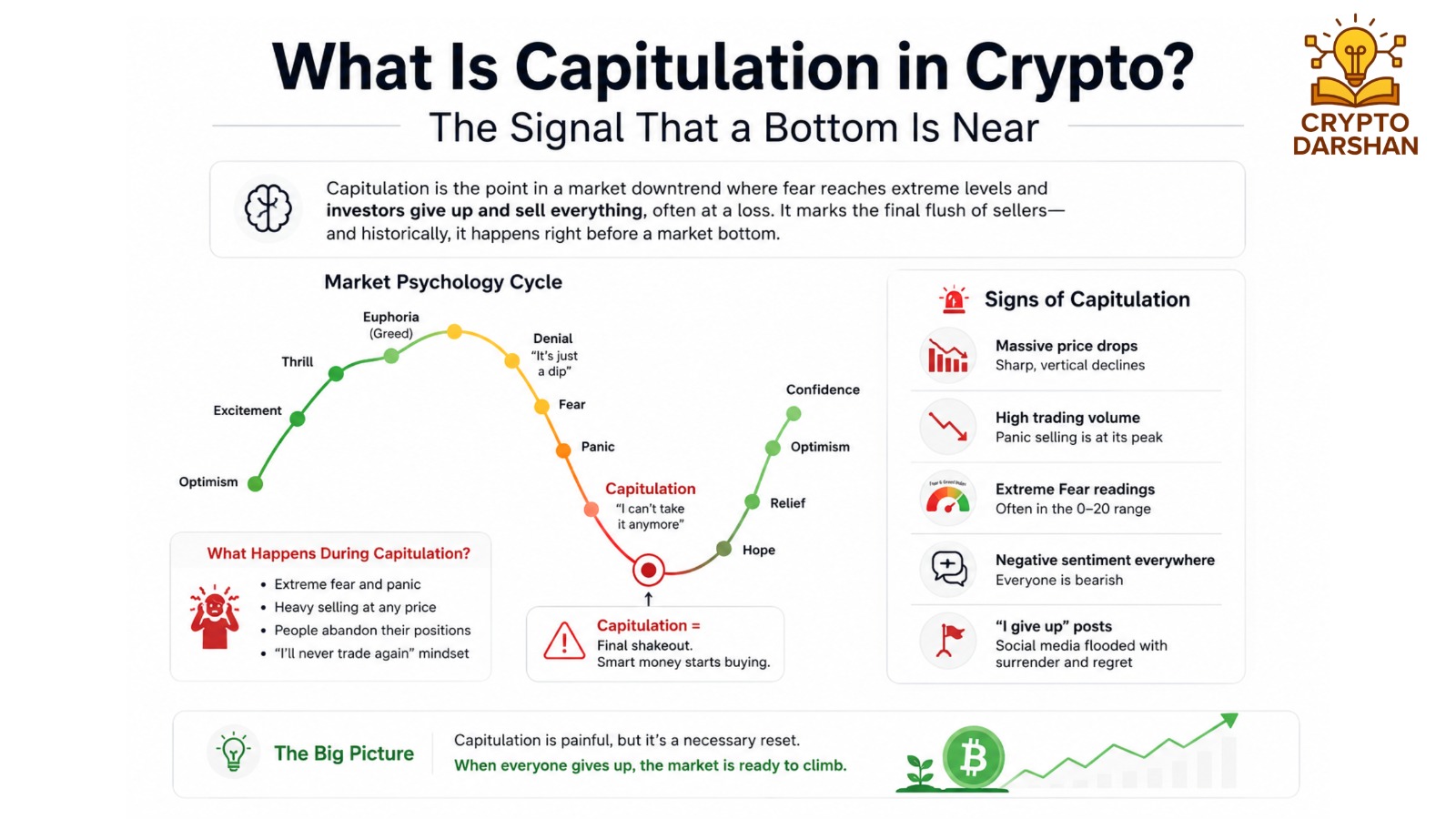
In financial markets, capitulation refers to the point at which investors give up on trying to recoup losses and sell their holdings in a panic. It’s the moment when fear overrides logic, and selling pressure reaches its peak. In the context of cryptocurrencies, it occurs when a large number of traders and investors simultaneously decide to exit their positions, often at significant losses, driving prices sharply lower.
This mass selling typically follows a prolonged downtrend or a series of negative events that erode confidence. The result is a steep, often short-lived decline that flushes out weak hands — those who can no longer tolerate the pain of holding depreciating assets.
The Psychology Behind Capitulation
At its core, capitulation is a psychological phenomenon. It represents the collective emotional surrender of market participants. During a bear market, investors experience a range of emotions — denial, anger, bargaining, depression, and finally, acceptance. It occurs at the acceptance stage, when investors resign themselves to losses and sell out of fear that prices will never recover.
This emotional surrender is what makes capitulation such a powerful market signal. When most investors have sold, there are few sellers left, and the market becomes primed for a reversal. In other words, it often marks the transition from fear to opportunity.
The Mechanics of Capitulation in Crypto Markets

How Capitulation Unfolds
Capitulation in crypto markets typically unfolds in several stages:
- Prolonged Decline: Prices fall steadily over weeks or months, eroding investor confidence.
- Trigger Event: A major negative event — such as an exchange collapse, regulatory crackdown, or macroeconomic shock — accelerates selling.
- Panic Selling: Fear spreads rapidly, leading to a surge in sell orders and a sharp price drop.
- Volume Spike: Trading volume skyrockets as investors rush to exit positions.
- Price Bottom: Prices reach extreme lows, often overshooting fair value.
- Stabilization: Selling pressure subsides, and prices begin to stabilize.
- Recovery: Confidence slowly returns, and prices start to recover.
Indicators of Capitulation
Identifying capitulation in real time is challenging, but several indicators can help:
- Volume Surge: A sudden spike in trading volume often accompanies capitulation, signaling mass selling.
- Sharp Price Drop: Prices fall rapidly, sometimes by double-digit percentages in a single day.
- High Volatility: Extreme price swings indicate panic and uncertainty.
- Negative Sentiment: Social media and news outlets are dominated by fear, pessimism, and despair.
- Oversold Conditions: Technical indicators like the Relative Strength Index (RSI) show extreme oversold readings.
- Liquidations: In leveraged markets, mass liquidations of long positions can accelerate capitulation.
Historical Examples of Capitulation in Crypto

The 2018 Bitcoin Crash
After reaching an all-time high near $20,000 in December 2017, Bitcoin entered a brutal bear market. Throughout 2018, prices steadily declined, but the true capitulation occurred in November when Bitcoin plunged from around $6,000 to below $3,200 in a matter of weeks. Trading volume spiked, sentiment hit rock bottom, and many investors abandoned the market. Yet, this marked the bottom of the cycle, and Bitcoin began a slow recovery that eventually led to new highs in 2020 and 2021.
The March 2020 COVID-19 Crash
In March 2020, global markets collapsed due to the onset of the COVID-19 pandemic. Bitcoin fell from around $9,000 to under $4,000 in just two days. This event was a textbook example — panic selling, massive liquidations, and extreme fear. However, it also marked the beginning of a historic bull run that took Bitcoin to over $60,000 within a year.
The 2022 Crypto Winter
The collapse of major crypto projects like Terra (LUNA) and the bankruptcy of FTX triggered widespread capitulation across the crypto market in 2022. Bitcoin dropped below $16,000, Ethereum fell under $1,000, and investor sentiment was overwhelmingly negative. Once again, this period of capitulation set the stage for a gradual recovery in 2023 and beyond.
The Role of Fear and Greed in Capitulation

The Fear and Greed Index
The Fear and Greed Index is a popular tool for gauging market sentiment. It ranges from 0 (extreme fear) to 100 (extreme greed). During capitulation, the index often hits single digits, reflecting widespread panic. Historically, such extreme fear has coincided with market bottoms.
Emotional Cycles of Investing
Investors often follow predictable emotional cycles:
- Optimism: Confidence grows as prices rise.
- Euphoria: Greed takes over; investors believe prices will never fall.
- Anxiety: Prices start to decline; investors rationalize losses.
- Fear: Losses deepen; confidence erodes.
- Desperation: Investors panic and sell.
- Capitulation: The final surrender; selling at any price.
- Despondency: The market bottoms; few buyers remain.
- Hope: Prices stabilize; early buyers return.
- Relief: Recovery begins.
- Optimism: The cycle repeats.
Understanding this cycle helps investors recognize capitulation as a natural part of market psychology.
Technical Analysis and Capitulation

Volume and Price Action
During capitulation, volume and price action provide critical clues. A massive spike in volume combined with a sharp price drop often indicates panic selling. When volume remains high but prices stop falling, it suggests that sellers are exhausted — a potential sign that it has occurred.
RSI and Oversold Conditions
The Relative Strength Index (RSI) measures momentum and identifies overbought or oversold conditions. An RSI below 30 typically signals oversold conditions, but during those time, RSI can drop below 20, indicating extreme selling pressure. Such readings often precede a rebound.
Moving Averages
When prices fall far below long-term moving averages (such as the 200-day MA), it can indicate capitulation. Historically, these moments have coincided with market bottoms.
On-Chain Metrics
In crypto, on-chain data provides unique insights into it:
- Realized Losses: A surge in realized losses indicates that investors are selling at a loss.
- Exchange Inflows: Increased inflows to exchanges suggest that holders are preparing to sell.
- Dormant Coins Moving: Long-term holders moving coins to exchanges can signal panic.
- MVRV Ratio: The Market Value to Realized Value ratio below 1 often indicates capitulation and undervaluation.
The Aftermath of Capitulation

Market Stabilization
After capitulation, markets typically enter a stabilization phase. Prices stop falling, volatility decreases, and trading volume normalizes. This phase can last weeks or months as confidence slowly returns.
Accumulation Phase
Smart money — institutional investors and experienced traders — often begin accumulating assets during or after capitulation. They recognize that prices are undervalued and that the risk-reward ratio is favorable.
Recovery and Bull Market
As selling pressure diminishes and demand increases, prices begin to recover. Over time, this recovery can evolve into a new bull market. Historically, every major capitulation in crypto has been followed by a significant rally.
How to Identify Capitulation in Real Time

Monitoring Market Sentiment
Tracking sentiment indicators such as the Fear and Greed Index, social media trends, and news headlines can help identify capitulation. When fear dominates and optimism disappears, the market may be near a bottom.
Watching Volume and Volatility
A sudden surge in trading volume and extreme volatility are classic signs of capitulation. These conditions indicate that panic selling is underway.
Analyzing On-Chain Data
On-chain metrics like realized losses, exchange inflows, and long-term holder behavior provide valuable clues. A spike in realized losses and exchange inflows often coincides with this.
Observing Liquidations
In leveraged markets, mass liquidations of long positions can trigger capitulation. Monitoring liquidation data on major exchanges can help identify these events.
Strategies for Navigating Capitulation

1. Stay Calm and Avoid Panic Selling
The most important rule during this is to remain calm. Panic selling locks in losses and often occurs just before a market bottom. Maintaining a long-term perspective can prevent emotional decisions.
2. Use Dollar-Cost Averaging (DCA)
Dollar-cost averaging involves investing a fixed amount at regular intervals, regardless of price. This strategy helps mitigate the risk of buying at the wrong time and allows investors to accumulate assets during this time at lower prices.
3. Focus on Fundamentals
During capitulation, prices often disconnect from fundamentals. Evaluating the long-term potential of projects can help identify undervalued opportunities.
4. Manage Risk
Setting stop-loss orders, diversifying portfolios, and avoiding excessive leverage are essential risk management practices during volatile periods.
5. Look for Confirmation Signals
Before assuming that capitulation has ended, look for confirmation signals such as stabilization in price, declining volume, and improving sentiment.
The Opportunity in Capitulation

Why Capitulation Can Be Bullish
While capitulation feels catastrophic, it often marks the end of a bear market. When most investors have sold, the market becomes oversold and undervalued. This creates an opportunity for those who can remain patient and disciplined.
Contrarian Investing
Contrarian investors thrive during capitulation. They buy when others are fearful and sell when others are greedy. This approach requires courage and conviction but can yield substantial rewards.
Historical Returns After this
Historically, buying during or shortly after capitulation has produced significant returns. For example:
- After the 2018 capitulation, Bitcoin rose from $3,200 to over $60,000.
- Following the March 2020 capitulation, Bitcoin surged from $4,000 to $64,000.
- Post-2022 capitulation, Bitcoin recovered from $15,500 to over $30,000 within a year.
These examples highlight the potential upside of recognizing capitulation as a buying opportunity.
Common Misconceptions About Capitulation

Capitulation Equals the End of Crypto
Many believe that capitulation signals the death of the crypto market. In reality, it’s a recurring phase in every market cycle. Each has been followed by recovery and growth.
It Can Be Timed Perfectly
Timing capitulation precisely is nearly impossible. Even experienced traders struggle to identify the exact bottom. The goal should be to recognize the signs and position accordingly, not to predict the exact moment.
This Only Happens Once Per Cycle
While major capitulation events often mark the end of a bear market, smaller phases can occur within broader trends. Recognizing these mini capitulations can provide additional trading opportunities.
The Role of Media During Capitulation
During capitulation, media coverage tends to amplify fear. Headlines focus on losses, bankruptcies, and failures, reinforcing negative sentiment. This feedback loop can accelerate selling. Savvy investors understand that when mainstream media declares the end of crypto, it may actually signal that capitulation is near.
Institutional Behavior During Capitulation
Institutional investors often view capitulation as a buying opportunity. While retail investors panic and sell, institutions accumulate assets at discounted prices. This behavior contributes to market stabilization and eventual recovery.
The Relationship Between Capitulation and Market Cycles

The Four Phases of a Market Cycle
- Accumulation: Smart money buys after capitulation when prices are low.
- Markup: Prices rise as optimism returns.
- Distribution: Smart money sells to latecomers during euphoria.
- Markdown: Prices fall as fear returns, leading to it.
Understanding these phases helps investors anticipate capitulation and position themselves accordingly.
Tools for Tracking Capitulation

1. Glassnode and CryptoQuant
These platforms provide on-chain analytics that help identify them through metrics like realized losses, exchange inflows, and MVRV ratios.
2. TradingView
Charting tools on TradingView allow traders to monitor volume, RSI, and moving averages to spot its patterns.
3. Alternative.me Fear and Greed Index
This index quantifies market sentiment and helps identify extreme fear, a hallmark of capitulation.
How Long Does Capitulation Last?
The duration of capitulation varies. In some cases, it lasts only a few days, as in March 2020. In others, it can extend for weeks or months, as seen in late 2018. The key factor is how quickly selling pressure subsides and confidence returns.
The Importance of Patience During Capitulation

Patience is crucial during capitulation. Markets can remain irrational longer than expected, and recovery takes time. Investors who remain disciplined and avoid emotional decisions are better positioned to benefit from the eventual rebound.
Lessons from Past Capitulations
- Fear Creates Opportunity: Extreme fear often precedes major rallies.
- Market Cycles Repeat: Every capitulation is followed by recovery.
- Emotions Drive Markets: Understanding psychology is as important as technical analysis.
- Long-Term Perspective Wins: Those who hold through capitulation often outperform panic sellers.
Preparing for Future Capitulations

Diversify Investments
Diversification across assets and sectors reduces the impact in any single market.
Maintain Liquidity
Keeping cash reserves allows investors to buy during this time when prices are low.
Set Realistic Expectations
Understanding that capitulation is part of every market cycle helps manage emotions and expectations.
Continuous Learning
Studying past capitulation events and market behavior improves decision-making during future downturns.
FAQ: What Is Capitulation in Crypto? The Signal That a Bottom Is Near

1. What does capitulation mean in crypto?
Capitulation in crypto refers to a period when investors panic and sell their assets en masse due to fear, causing a sharp decline in prices. It often occurs near the end of a prolonged downtrend.
2. Why is capitulation considered a sign of a market bottom?
It can signal a market bottom because most sellers have already exited their positions. Once selling pressure is exhausted, prices may stabilize and eventually begin to recover.
3. How can you identify crypto capitulation?
Common signs include extreme price drops, unusually high trading volume, widespread fear among investors, negative market sentiment, and significant liquidations of leveraged positions.
4. Does capitulation always mark the exact bottom?
No. While this often occurs near a market bottom, prices can continue to decline or move sideways before a sustained recovery begins.
5. What causes capitulation in cryptocurrency markets?
Capitulation can be triggered by factors such as regulatory concerns, macroeconomic uncertainty, exchange failures, security breaches, or prolonged bearish market conditions.
6. How is capitulation different from a normal market correction?
A correction is typically a moderate and temporary decline, while capitulation involves panic selling, intense fear, and much larger price drops accompanied by high trading volume.
7. What role does trading volume play during capitulation?
Trading volume often spikes during capitulation as large numbers of investors rush to sell their holdings, creating significant market activity.
8. Can Bitcoin capitulation affect the entire crypto market?
Yes. Since Bitcoin is the largest cryptocurrency by market capitalization, major capitulation events in Bitcoin often influence sentiment and price movements across the broader crypto market.
Conclusion
Capitulation in crypto is both a moment of despair and a signal of opportunity. It represents the emotional climax of a bear market, when fear and panic drive investors to sell at any price. Yet, history shows that it often marks the beginning of recovery. Recognizing the signs — from volume spikes and oversold indicators to extreme fear and negative sentiment — can help investors navigate these turbulent periods with confidence.
By understanding the psychology, mechanics, and historical patterns of capitulation, traders and investors can transform fear into foresight. While no one can predict the exact bottom, those who remain patient, disciplined, and informed are best positioned to seize the opportunities that inevitably creates.