
Ethereum has evolved into one of the most influential blockchain networks in the world. With the transition from Proof of Work (PoW) to Proof of Stake (PoS), Ethereum introduced a new era of energy efficiency, scalability, and participation through Ethereum Staking. This mechanism allows users to lock up their ETH to help secure the network and, in return, earn rewards. It has become one of the most popular ways to generate passive income in the crypto ecosystem.
However, beneath the surface of this seemingly safe and profitable system lies a set of hidden risks that few are openly discussing. While Ethereum Staking offers attractive yields and contributes to network security, it also exposes participants to technical, financial, and systemic vulnerabilities that could have long-term consequences. Understanding these risks is essential for anyone considering staking ETH, whether through solo staking, staking pools, or centralized platforms.
This article explores the hidden dangers of Ethereum Staking, analyzing its structure, potential pitfalls, and the broader implications for the Ethereum ecosystem. It also provides insights into how investors can mitigate these risks while still benefiting from the opportunities staking provides.
Understanding Ethereum Staking

What Is Ethereum Staking?
Ethereum staking is the process by which stakers lock up Ether (ETH) to activate a validator that participates in Ethereum’s proof-of-stake (PoS) consensus mechanism. Validators play a critical role in securing the Ethereum network by proposing and attesting to blocks, ensuring the integrity of transactions, and finalizing new data on the blockchain. In return for their participation, validators earn staking rewards. In return, they earn staking rewards, which are distributed based on the amount of ETH staked and the validator’s performance.
Unlike mining, which requires expensive hardware and high energy consumption, Ethereum Staking relies on capital commitment. Validators must deposit 32 ETH to run a node, though smaller holders can participate through staking pools or custodial services.
How Ethereum Staking Works
- Validator Setup
A validator deposits 32 ETH into the Ethereum deposit contract. This ETH is locked and cannot be withdrawn immediately. - Block Validation
Validators are randomly selected to propose and attest to new blocks. Honest behavior earns rewards, while dishonest or offline behavior results in penalties. - Rewards and Penalties
Validators earn ETH for participating correctly but can lose part of their stake through a process called “slashing” if they act maliciously or fail to perform duties. - Withdrawal Mechanism
After the Shanghai upgrade, stakers can withdraw rewards or their full stake, but the process is still subject to network queue times and validator exit limits.
Why Ethereum Staking Became Popular
- Passive Income: Stakers earn consistent rewards, often between 3% and 6% annually.
- Network Security: Staking strengthens Ethereum’s decentralization and security.
- Environmental Benefits: PoS consumes far less energy than PoW.
- Accessibility: Staking pools and exchanges make participation easier for smaller investors.
Despite these advantages, Ethereum Staking is not without risk. Many participants overlook the underlying vulnerabilities that could impact their funds or the network’s stability. Venture capital firms are increasingly funding blockchain infrastructure and staking services, a trend highlighted in Crypto Venture Capital Trends: Where Smart Money Is Investing Now.
The Hidden Risks of Ethereum Staking

1. Centralization Risk
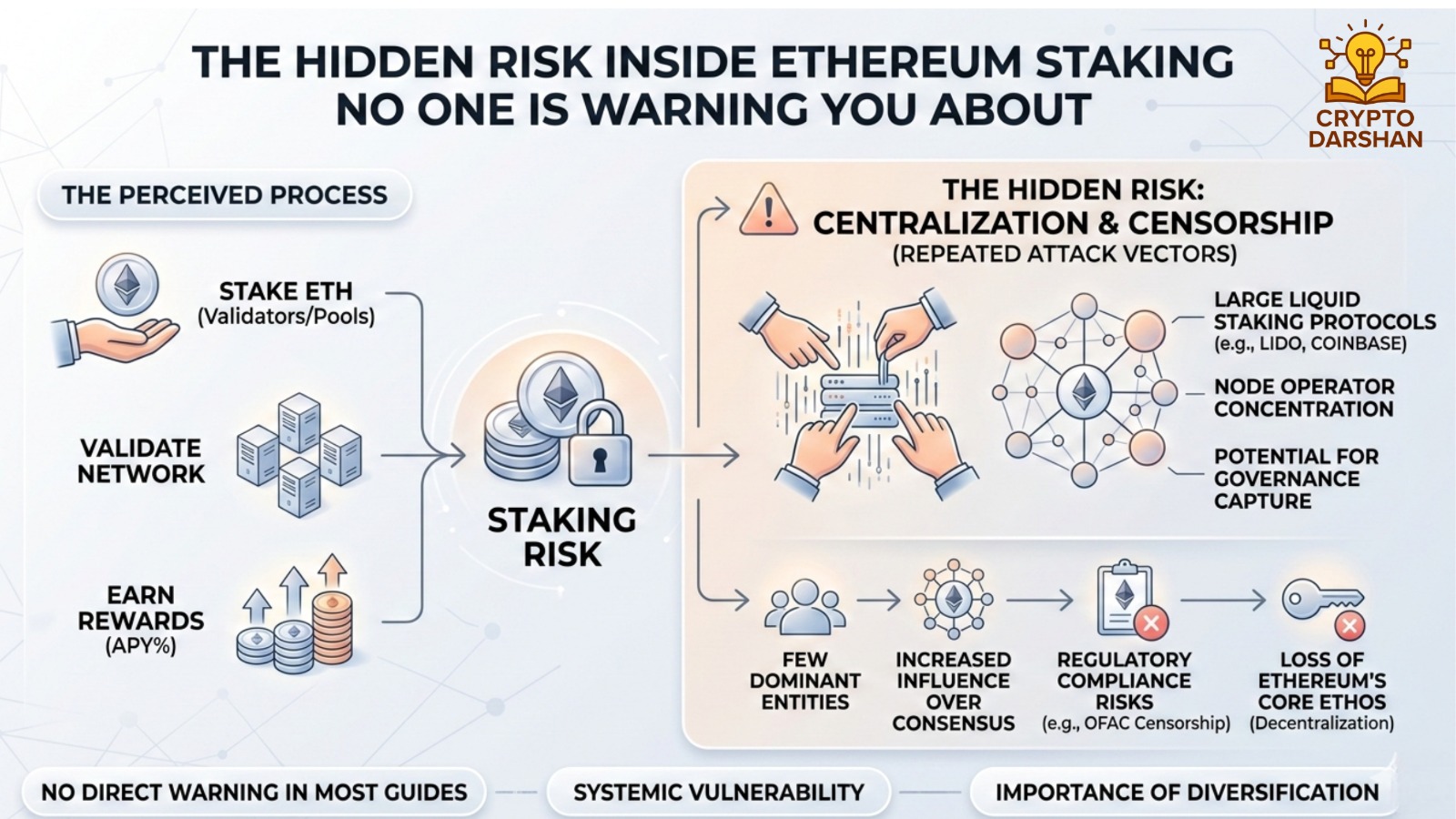
One of the biggest threats to Ethereum Staking is centralization. While staking was designed to promote decentralization, the reality is that a few large entities control a significant portion of staked ETH. Major exchanges and staking providers like Lido, Coinbase, and Binance collectively manage over half of all staked ETH.
This concentration of power undermines the decentralized ethos of Ethereum. If a small number of entities control validator nodes, they could influence governance decisions, censor transactions, or even collude to manipulate the network. Centralization also increases systemic risk — if one major provider experiences a technical failure or regulatory crackdown, it could destabilize the entire staking ecosystem.
2. Smart Contract Vulnerabilities
Most Ethereum Staking solutions rely on smart contracts to manage deposits, rewards, and withdrawals. While these contracts are audited, no code is entirely free from bugs or exploits. A single vulnerability could lead to massive losses, as seen in past DeFi hacks.
For example, staking pools and liquid staking protocols like Lido or Rocket Pool use complex smart contracts to issue derivative tokens (such as stETH). If these contracts are compromised, users could lose both their staked ETH and their derivative assets. The interconnected nature of DeFi amplifies this risk, as one exploit can cascade across multiple platforms.
3. Slashing and Validator Penalties

Validators in Ethereum Staking face penalties for misbehavior or downtime. Slashing occurs when a validator acts maliciously, such as proposing conflicting blocks or attempting to manipulate consensus. Even unintentional mistakes, like software bugs or network outages, can result in penalties.
For solo stakers, this risk is significant. Running a validator requires technical expertise, reliable hardware, and constant uptime. A single misconfiguration could lead to slashing, reducing the staker’s ETH balance. While staking pools mitigate this risk by distributing responsibilities, they also introduce trust and dependency issues.
4. Liquidity Risk
When ETH is staked, it becomes illiquid. Although the Shanghai upgrade enabled withdrawals, the process is not instantaneous. Validators must enter an exit queue, which can take days or even weeks during high demand. This lack of liquidity can be problematic during market volatility, as stakers cannot quickly sell or move their ETH.
Liquid staking solutions attempt to solve this by issuing derivative tokens like stETH or rETH, which represent staked ETH. However, these tokens are not always pegged 1:1 to ETH. During market stress, their value can deviate, leading to potential losses for holders. This liquidity mismatch is a hidden risk that many Ethereum Staking participants overlook.
5. Regulatory Uncertainty
The regulatory landscape surrounding Ethereum Staking remains unclear. Some jurisdictions may classify staking rewards as securities or taxable income, subjecting participants to legal and financial obligations. Centralized exchanges offering staking services have already faced scrutiny from regulators, leading to fines and restrictions.
If regulators impose stricter rules on staking providers, it could limit accessibility or force platforms to shut down. This would not only affect individual stakers but also impact Ethereum’s overall decentralization and security.
6. Dependence on Third-Party Providers

Many users prefer to stake through centralized exchanges or custodial platforms for convenience. However, this introduces counterparty risk. When staking through an exchange, users do not control their private keys or validator nodes. If the platform is hacked, mismanaged, or faces regulatory action, users could lose access to their staked ETH.
The collapse of major crypto platforms in the past has shown how dangerous this dependency can be. True decentralization requires self-custody, but most participants in Ethereum Staking rely on third parties, exposing themselves to unnecessary risk.
7. Network-Level Risks
While Ethereum’s PoS system is robust, it is not immune to network-level threats. A coordinated attack on validators, a critical bug in the consensus mechanism, or a major fork could disrupt the staking process. Additionally, if too many validators go offline simultaneously, the network’s security could weaken, leading to potential vulnerabilities.
The Illusion of Safety in Ethereum Staking

Many investors view Ethereum Staking as a low-risk, high-reward opportunity. The consistent yield and strong reputation of Ethereum create a sense of security. However, this perception can be misleading. The risks are not always visible, and the complexity of the staking ecosystem makes it difficult for average users to assess potential threats.
The Role of Liquid Staking Derivatives
Liquid staking has become one of the most popular forms of Ethereum Staking. Platforms like Lido issue tokens such as stETH, which represent staked ETH and can be traded or used in DeFi. While this adds flexibility, it also introduces systemic risk. If the derivative token loses its peg or the underlying protocol fails, the entire ecosystem could face liquidity crises similar to those seen in traditional finance.
The “Too Big to Fail” Problem
As large staking providers dominate the market, they become systemically important. If one of these entities experiences a failure, it could trigger a chain reaction across DeFi platforms, exchanges, and lending protocols. This concentration of risk mirrors the “too big to fail” problem seen in traditional banking a dangerous precedent for a decentralized network.
Economic Implications of Ethereum Staking

Impact on ETH Supply and Demand
Ethereum Staking locks up a significant portion of ETH, reducing the circulating supply. This can create upward pressure on prices during Bull Markets. However, if large amounts of staked ETH are suddenly withdrawn, it could flood the market and drive prices down. The balance between staking and liquidity is delicate and can influence Ethereum’s long-term price stability.
Reward Sustainability
Staking rewards depend on network participation and transaction fees. As more ETH is staked, the reward rate decreases. This could lead to diminishing returns over time, making Ethereum Staking less attractive. If rewards fall too low, validators may exit, reducing network security.
Inflation and Tokenomics
Ethereum’s deflationary model, enhanced by EIP-1559, burns a portion of transaction fees. However, staking rewards introduce new ETH into circulation. The interplay between burning and issuance determines whether ETH remains deflationary. If staking participation grows too high, it could offset the deflationary effect, impacting long-term value.
Technical Risks in Ethereum Staking

Software Bugs and Client Diversity
Ethereum relies on multiple client implementations (such as Prysm, Lighthouse, and Teku) to maintain network resilience. However, if one client dominates, a bug in that software could affect a large portion of validators. Encouraging client diversity is essential to prevent single points of failure in Ethereum Staking.
Validator Downtime and Performance
Validators must remain online and responsive to earn rewards. Downtime results in missed rewards or penalties. Technical failures, internet outages, or hardware issues can all impact validator performance. For solo stakers, maintaining uptime requires constant monitoring and reliable infrastructure.
Forks and Protocol Upgrades
Ethereum’s frequent upgrades can introduce temporary instability. Validators must update their software promptly to remain compatible. Failure to do so can result in missed rewards or even slashing. Each upgrade also carries the risk of unforeseen bugs that could affect Ethereum Staking operations.
The Psychological Trap of Ethereum Staking

The Illusion of Safety
Many investors view Ethereum Staking as a safe and stable way to earn passive income. The consistent rewards and the reputation of Ethereum create a sense of security that can be misleading. This illusion of safety often causes participants to overlook the underlying risks, such as smart contract vulnerabilities, slashing penalties, or liquidity issues. Believing that staking is “risk-free” can lead to complacency and poor risk management.
Complacency from Passive Income
The steady flow of staking rewards can make investors overly comfortable. When returns are automatic and predictable, people tend to stop monitoring their investments closely. This complacency can be dangerous, especially in a rapidly changing environment like crypto. Technical issues, regulatory changes, or network updates can affect staking performance, but many stakers fail to react in time because they assume everything will continue smoothly.
Herd Mentality and Social Influence

As more people participate in Ethereum Staking, social proof reinforces the idea that it’s the right thing to do. Investors see others earning rewards and fear missing out, leading to herd behavior. This collective mindset can inflate participation beyond sustainable levels and increase systemic risk. When everyone follows the same strategy without understanding the risks, the entire ecosystem becomes more vulnerable to shocks.
Overconfidence in the Ethereum Network
Ethereum’s strong reputation and history of innovation give investors confidence, but this can turn into overconfidence. Many assume that because Ethereum is a leading blockchain, nothing can go wrong with Ethereum Staking. This belief can prevent investors from diversifying or preparing for potential failures. Overconfidence blinds participants to the fact that even robust systems can face technical bugs, governance issues, or market disruptions.
Emotional Attachment and Inaction
Once investors commit to Ethereum Staking, they often develop an emotional attachment to their decision. The combination of sunk cost and loyalty to Ethereum can make them reluctant to withdraw or adjust their strategy, even when warning signs appear. This emotional bias leads to inaction, where investors hold onto positions despite changing conditions, increasing their exposure to potential losses
Mitigating the Risks of Ethereum Staking

1. Diversify Staking Methods
Instead of relying on a single provider, spread staked ETH across multiple platforms or consider a mix of solo staking, pooled staking, and liquid staking. This reduces exposure to any one point of failure.
2. Use Decentralized Staking Solutions
Opt for decentralized protocols that distribute validator control among many participants. Platforms like Rocket Pool promote decentralization and reduce centralization risk in Ethereum Staking.
3. Maintain Control of Private Keys
Whenever possible, stake through non-custodial methods. Retaining control of private keys ensures that funds remain secure even if a platform experiences issues.
4. Monitor On-Chain Metrics
Track validator performance, staking participation rates, and network health. On-chain analytics can provide early warnings of potential problems in the Ethereum Staking ecosystem.
5. Stay Informed About Regulations
Keep up with evolving regulatory developments. Understanding local laws regarding staking rewards, taxation, and compliance can prevent legal complications.
The Future of Ethereum Staking

Technological Advancements
Future upgrades may improve the efficiency and security of Ethereum Staking. Innovations like distributed validator technology (DVT) aim to reduce slashing risk and enhance decentralization. These developments could make staking safer and more accessible.
Institutional Involvement
As institutions continue to adopt Ethereum, their participation in staking will grow. While this adds legitimacy, it also increases centralization risk. Balancing institutional participation with decentralized governance will be crucial for Ethereum’s long-term health.
Integration with DeFi
Ethereum Staking is becoming deeply integrated with DeFi protocols. Staked ETH derivatives are used as collateral, liquidity, and yield-generating assets. This interconnectedness enhances utility but also amplifies systemic risk if one component fails .New mechanisms like restaking can increase rewards but also introduce extra layers of risk, which we explored in detail in Ethereum Restaking Explained: Is It Safe to Earn More Yield?
Frequently Asked Questions (FAQ)

1. What is Ethereum staking?
Ethereum staking is the process of locking ETH to help secure the network and validate transactions. In return, participants earn staking rewards for supporting the blockchain.
2. What are the main risks associated with Ethereum staking?
Some common risks include validator slashing, smart contract vulnerabilities, liquidity limitations when funds are locked, and potential centralization if large staking providers control too much of the network.
3. What is slashing in Ethereum staking?
Slashing occurs when a validator behaves incorrectly or maliciously, such as validating conflicting transactions. When this happens, a portion of the staked ETH can be automatically penalized and removed.
4. Is liquid staking safer than traditional staking?
Liquid staking allows users to receive tokenized versions of their staked assets, enabling them to trade or use them in DeFi while still earning rewards. However, it introduces additional smart contract and platform risks.
5. How much ETH is required to run a validator?
To operate a full validator node on Ethereum, users must stake 32 ETH. Those with smaller amounts can still participate through staking pools or exchanges.
6. Can Ethereum staking affect network decentralization?
Yes. If a few large providers dominate staking, it could increase centralization risks and potentially influence governance or block validation processes.
7. Are staking rewards guaranteed?
No. Rewards depend on network conditions, validator performance, and protocol rules. Poor validator performance or penalties can reduce expected returns.
8. How can users reduce staking risks?
Investors can minimize risk by using reputable staking providers, diversifying across platforms, maintaining proper validator uptime, and understanding the technical requirements before staking.
Conclusion
Ethereum Staking represents a revolutionary shift in how blockchain networks achieve consensus and reward participation. It offers a sustainable, energy-efficient alternative to mining and provides investors with an opportunity to earn passive income. However, beneath its appeal lies a complex web of hidden risks — from centralization and smart contract vulnerabilities to liquidity constraints and regulatory uncertainty.
Understanding these risks is essential for anyone involved in Ethereum Staking. The system’s long-term success depends on maintaining decentralization, transparency, and resilience. By approaching staking with caution, diversification, and awareness, participants can enjoy its benefits while minimizing exposure to potential pitfalls.
The future of Ethereum Staking will depend on how well the community addresses these challenges. As the network evolves, so too must the strategies for securing and participating in it. Awareness is the first step toward building a safer, more sustainable staking ecosystem — one that truly reflects the decentralized vision of Ethereum.