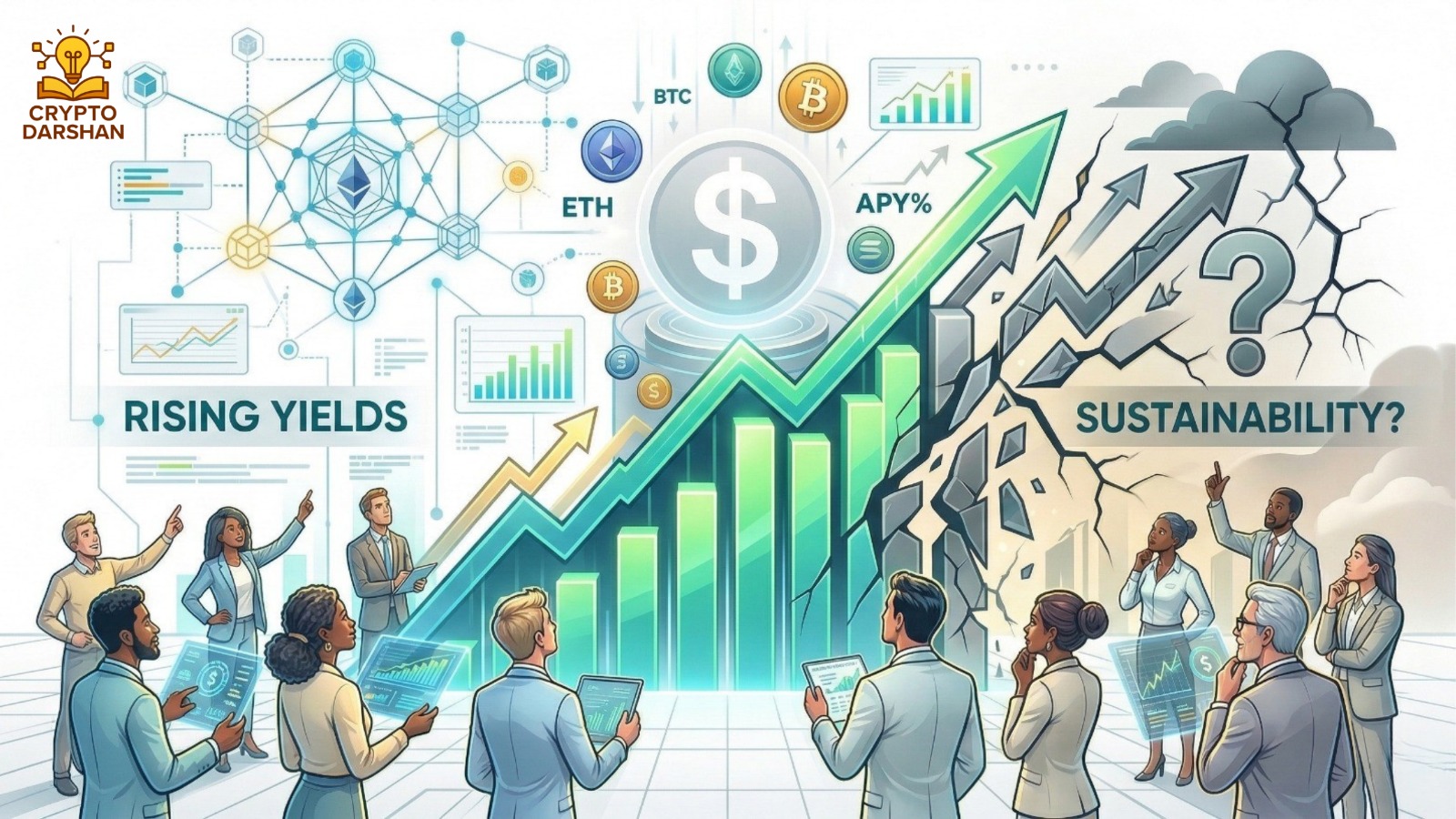
DeFi yields rising in 2026 are driven by institutional yield rails and GitHub-active protocols, though scam trends and market corrections challenge true sustainability. Decentralized Finance (DeFi) has once again captured the spotlight as yields across major protocols begin to climb. After a prolonged bear market that saw liquidity dry up and returns plummet, investors are now witnessing a resurgence in yield opportunities across lending platforms, liquidity pools, and staking protocols. However, the question remains: are these rising DeFi yields sustainable, or are they a temporary byproduct of renewed speculation and short-term capital inflows?
This comprehensive analysis explores the factors driving the current rise in DeFi yields, the underlying risks, and the long-term sustainability of these returns. It also examines how macroeconomic conditions, tokenomics, and user behavior influence yield dynamics in decentralized ecosystems.
Understanding DeFi Yields
What Are DeFi Yields?
Yield farming in DeFi refers to the process of staking or lending crypto assets in return for interest or additional tokens. These yields are typically expressed as an annual percentage yield (APY) and can vary widely depending on the platform, asset, and market conditions.
Common sources of DeFi yields include:
- Lending and Borrowing: Users lend assets to earn interest while borrowers pay fees to access liquidity.
- Liquidity Provision: Investors supply tokens to decentralized exchanges (DEXs) and earn trading fees or incentive rewards.
- Staking: Token holders lock their assets to secure networks or participate in governance, earning staking rewards.
- Yield Farming: Users move assets across protocols to maximize returns from incentives and arbitrage opportunities.
The Evolution of DeFi Yields
During the 2020–2021 bull run, DeFi yields soared as protocols competed for liquidity through aggressive token incentives. However, as the market cooled in 2022 and 2023, yields collapsed due to declining token prices, reduced trading volumes, and waning investor interest. The recent resurgence in 2025–2026 suggests a renewed appetite for risk and innovation in the DeFi space.
DeFi Yields Rising: What’s Driving the Current Surge?
1. Increased On-Chain Activity
The revival of DeFi yields coincides with a broader uptick in on-chain activity. Transaction volumes on major blockchains like Ethereum, Arbitrum, and Solana have surged, driven by new applications, NFT integrations, and cross-chain interoperability. As more users interact with DeFi protocols, liquidity pools deepen, and fee generation increases, leading to higher yields for participants.
Similar patterns of liquidity concentration were analyzed in Crypto Market Makers in 2026, showing how market-making strategies influence transaction volumes and available capital.
2. Token Incentive Programs
Many DeFi projects have reintroduced or expanded liquidity mining programs to attract users. These incentives, often paid in native governance tokens, temporarily boost yields. For example, protocols like Aave, Curve, and Uniswap have launched new reward structures to stimulate participation, while emerging platforms on Layer 2 networks offer double-digit APYs to capture market share.
3. Stablecoin Demand and Supply Dynamics
Stablecoins remain the backbone of DeFi. As demand for decentralized stablecoins like DAI, FRAX, and USDe grows, lending rates for these assets have increased. Borrowers seeking leverage or yield opportunities are willing to pay higher interest, pushing up returns for lenders.
4. Institutional Interest
Institutional players are cautiously re-entering the DeFi ecosystem. With improved regulatory clarity and the rise of permissioned DeFi platforms, funds and asset managers are exploring yield opportunities in tokenized treasuries and on-chain money markets. This influx of capital contributes to higher liquidity and more competitive yield environments.
Institutional inflows discussed in Ethereum ETF Developments & Institutional Buying: The Setup for an ETH Rally? can increase on-chain activity, resulting in higher staking demand and improved yield opportunities across DeFi protocols.
5. Macro Factors
Global macroeconomic conditions also play a role. As traditional interest rates stabilize and inflation moderates, investors are once again seeking alternative yield sources. DeFi, with its transparent and programmable financial infrastructure, offers an attractive option for yield generation outside traditional banking systems.
The Mechanics Behind DeFi Yields Rising
Supply and Demand Imbalance
DeFi yields are fundamentally driven by the balance between supply (liquidity providers) and demand (borrowers or traders). When borrowing demand outpaces supply, interest rates rise. Conversely, when liquidity floods the market, yields decline. The current environment suggests that borrowing demand particularly for stablecoins and blue-chip assets has increased faster than liquidity supply.
Protocol Revenue Growth
Higher yields can also result from genuine revenue growth. As decentralized exchanges and lending platforms process more transactions, they generate more fees. When these fees are distributed to liquidity providers or stakers, yields rise organically without relying on inflationary token rewards.
Token Emissions and Inflation
Many DeFi protocols still rely on token emissions to subsidize yields. While this can attract users in the short term, it often leads to unsustainable inflation and token price depreciation. Sustainable yield growth requires a shift from emission-based incentives to revenue-based rewards.
Are DeFi Yields Rising Sustainably?

1. The Role of Token Incentives
Token incentives are a double-edged sword. They can rapidly bootstrap liquidity but often create unsustainable yield environments. Once incentives taper off, liquidity providers tend to exit, causing yields to collapse. Sustainable yields must be supported by real economic activity rather than token inflation.
2. Dependence on Market Cycles
DeFi yields are highly cyclical. During bull markets, speculative trading and borrowing drive up yields. In bear markets, capital outflows and reduced activity cause yields to shrink. The current rise may reflect early signs of a new market cycle, but sustainability depends on whether user growth and protocol revenues can persist through volatility.
3. Smart Contract and Security Risks
High yields often come with elevated risk. Protocol exploits, rug pulls, and smart contract vulnerabilities can wipe out returns overnight. Sustainable yield generation requires robust security audits, transparent governance, and risk management frameworks.
4. Liquidity Fragmentation
The proliferation of Layer 2 networks and alternative blockchains has fragmented liquidity across ecosystems. While this creates new opportunities, it also dilutes yield potential on individual platforms. Sustainable growth will depend on cross-chain interoperability and efficient liquidity aggregation.
5. Regulatory Uncertainty
Regulatory developments continue to shape the DeFi landscape. Stricter compliance requirements could limit access to certain yield strategies, while favorable regulations could legitimize and stabilize the sector. The sustainability of DeFi yields will hinge on how global regulators approach decentralized finance in the coming years.
Case Studies on DeFi Yields Rising Across Major Protocols

Aave
Aave remains one of the most trusted lending protocols in DeFi. Its recent integration with Layer 2 solutions like Optimism and Arbitrum has reduced transaction costs and attracted new users. Aave’s real-world asset (RWA) initiatives, including tokenized treasury bills, have introduced stable and sustainable yield sources backed by off-chain assets.
Curve Finance
Curve’s focus on stablecoin liquidity has positioned it as a cornerstone of DeFi yield generation. The introduction of veCRV tokenomics has aligned incentives between liquidity providers and long-term holders, creating a more sustainable yield model. Curve’s expansion into cross-chain liquidity pools further enhances its resilience.
Lido Finance
Lido’s liquid staking model has revolutionized Ethereum staking. As more users stake ETH through Lido, staking yields have stabilized around 3–5%, supported by network rewards rather than speculative incentives. This model demonstrates how yield sustainability can be achieved through protocol-level economics.
Pendle Finance
Pendle allows users to tokenize and trade future yield streams, enabling sophisticated yield management strategies. By separating principal and yield components, Pendle introduces a secondary market for yield speculation, improving capital efficiency and transparency.
The Role of Real-World Assets (RWAs)

The integration of real-world assets into DeFi represents a major step toward sustainable yield generation. Tokenized treasury bills, bonds, and invoices provide stable, yield-bearing instruments that are less dependent on speculative activity. Platforms like MakerDAO, Centrifuge, and Ondo Finance are leading this transformation by bridging traditional finance and DeFi.
RWAs offer several advantages:
- Stable Returns: Backed by real-world cash flows.
- Reduced Volatility: Less exposure to crypto market swings.
- Regulatory Alignment: Easier compliance with financial regulations.
As RWAs gain traction, they could anchor DeFi yields to more predictable and sustainable sources of income.
The Impact of Layer 2 and Cross-Chain Solutions
Layer 2 scaling solutions such as Arbitrum, Optimism, and zkSync have significantly reduced transaction costs and improved user experience. Lower fees encourage more frequent interactions, boosting protocol activity and yield opportunities. Cross-chain bridges and interoperability protocols further expand the DeFi ecosystem, allowing capital to flow seamlessly across networks.
However, these advancements also introduce new risks, including bridge exploits and liquidity fragmentation. Sustainable yield growth will depend on secure and efficient cross-chain infrastructure.
The Psychology of Yield Chasing

Investor behavior plays a crucial role in DeFi yield dynamics. The allure of high APYs often leads to herd behavior, where capital floods into trending protocols without proper risk assessment. This cycle of greed and fear amplifies volatility and undermines sustainability.
Educating users about risk-adjusted returns, diversification, and long-term yield strategies is essential for building a more resilient DeFi ecosystem. Sustainable yields require disciplined capital allocation rather than speculative yield chasing.
Emerging Trends Strengthening DeFi Yield Sustainability

The Rise of Modular Blockchains
Modular blockchain architectures are reshaping how DeFi protocols operate. By separating execution, consensus, and data availability layers, modular systems like Celestia and EigenLayer allow DeFi applications to scale efficiently while maintaining security. This modularity reduces operational costs and improves transaction throughput, enabling protocols to generate sustainable yields from real usage rather than speculative activity.
Decentralized Identity and Credit Scoring
The introduction of decentralized identity (DID) systems and on-chain credit scoring is transforming DeFi lending. Platforms like Arcx and Spectral Finance are developing credit models that assess borrower reliability without compromising privacy. This innovation allows protocols to offer differentiated interest rates based on risk profiles, improving capital efficiency and yield stability.
Sustainable Tokenomics and Governance
Protocols are increasingly adopting sustainable tokenomics that reward long-term participation over short-term speculation. Models like vote-escrowed tokens (veTokens) and revenue-sharing mechanisms align incentives between users and protocols. Governance-driven yield adjustments ensure that rewards reflect actual protocol performance, reducing dependency on inflationary emissions.
Integration of DeFi with Web3 Ecosystems
DeFi is expanding beyond finance into broader Web3 ecosystems, including gaming, social platforms, and metaverse economies. Yield opportunities are emerging from in-game assets, NFT lending, and decentralized social tokens. These integrations diversify yield sources and reduce reliance on traditional liquidity mining, contributing to a more balanced and sustainable yield environment.
The Role of Decentralized Insurance
Insurance protocols such as Nexus Mutual and InsurAce are becoming essential components of sustainable DeFi. By offering coverage against smart contract failures and hacks, they enhance investor confidence and encourage long-term participation. As insurance adoption grows, risk-adjusted yields will become more predictable and stable.
The Next Frontier: DeFi Yield Aggregation and Automation

Yield aggregation platforms are evolving rapidly, offering users automated strategies that optimize returns across multiple protocols. Platforms like Yearn Finance, Beefy, and Idle Finance use smart contracts to rebalance portfolios and reinvest rewards automatically. This automation reduces human error and maximizes compounding efficiency, making yield farming more accessible and sustainable.
The next generation of aggregators is integrating artificial intelligence and machine learning to predict yield fluctuations and adjust strategies in real time. These intelligent systems analyze on-chain data, liquidity flows, and market sentiment to identify optimal yield opportunities while minimizing risk exposure.
The Role of Governance in Yield Stability

Decentralized governance plays a critical role in maintaining yield sustainability. Protocols with active and transparent governance can adapt quickly to market changes, adjust reward rates, and implement risk controls. Community-driven decision-making ensures that yield policies align with long-term protocol health rather than short-term speculation.
Governance tokens are evolving beyond voting rights to include revenue-sharing and staking benefits. This shift encourages holders to participate actively in protocol management, fostering accountability and stability in yield distribution.
Global Regulation and Institutional Adoption

Regulatory clarity is emerging as a key factor in DeFi’s long-term sustainability. Jurisdictions such as Singapore, Switzerland, and the European Union are developing frameworks that recognize decentralized protocols as legitimate financial entities. This regulatory progress is attracting institutional investors who demand compliance, transparency, and risk management.
Institutional-grade DeFi platforms are integrating Know Your Customer (KYC) and Anti-Money Laundering (AML) features without compromising decentralization. These hybrid models bridge the gap between traditional finance and DeFi, paving the way for sustainable, large-scale yield generation.
The Rise of Restaking and Liquid Yield Derivatives
A new wave of innovation is emerging through restaking protocols and liquid yield derivatives. Platforms like EigenLayer and EtherFi allow users to restake their staked assets to secure additional networks, earning multiple layers of yield. This concept of “yield stacking” increases capital efficiency but also introduces new risk layers that must be managed carefully.
Liquid yield derivatives, such as stETH or rsETH, enable users to maintain liquidity while earning staking rewards. These assets can be used as collateral in lending markets, creating a circular economy of yield generation that enhances overall DeFi liquidity.
The Importance of Transparency and Data Analytics
Transparency is becoming a cornerstone of sustainable DeFi yields. On-chain analytics platforms like DeFiLlama, Token Terminal, and Nansen provide real-time insights into protocol revenues, liquidity flows, and user activity. This data-driven transparency allows investors to make informed decisions and identify which yields are supported by genuine economic activity.
Protocols that publish regular audits, revenue reports, and governance updates are gaining trust among users. As transparency improves, the DeFi ecosystem will naturally filter out unsustainable projects, leaving behind those built on solid fundamentals.
Risks to Watch
- Smart Contract Vulnerabilities: Exploits remain a persistent threat.
- Market Volatility: Sharp price swings can erode yields.
- Liquidity Crises: Sudden capital outflows can destabilize protocols.
- Regulatory Crackdowns: Unfavorable regulations could restrict access or reduce profitability.
- Token Inflation: Excessive emissions can dilute returns and undermine sustainability.
Strategies for Sustainable Yield Generation

- Diversification: Spread capital across multiple protocols and asset classes to reduce risk.
- Focus on Blue-Chip Protocols: Established platforms with proven track records offer more reliable yields.
- Monitor Tokenomics: Evaluate emission schedules and governance structures to assess sustainability.
- Leverage Real-World Assets: Incorporate tokenized RWAs for stable, predictable returns.
- Use Risk Mitigation Tools: Employ insurance and hedging strategies to protect against losses.
- Adopt Automated Yield Strategies: Utilize AI-driven aggregators for efficient yield optimization.
- Engage in Governance: Participate in protocol decisions to influence sustainable yield policies.
- Prioritize Transparency: Choose protocols with open data, audits, and verifiable revenue streams.
DeFi Yields Are Rising Again — But Is It Sustainable? – FAQ
1. Why are DeFi yields rising again in 2026?
DeFi yields are increasing due to higher on-chain activity, growing institutional participation, renewed leverage demand, and expansion in Real-World Asset (RWA) tokenization. As capital flows back into lending, staking, and liquidity markets, borrowing demand pushes rates higher.
2. What types of DeFi yields are currently increasing?
The main categories seeing higher returns include:
- Lending yields (on stablecoins and major crypto assets)
- Liquid staking rewards
- Liquidity provider (LP) fees on decentralized exchanges
- Perpetual futures funding rate strategies
- RWA-backed tokenized yield products
3. Are these yields based on real revenue or token incentives?
It depends. Some yields are generated from:
- Borrower interest payments
- Trading fees
- Protocol revenue sharing
Others rely on token emissions and reward programs. Emission-based yields are generally less sustainable because they depend on continuous token distribution rather than actual economic activity.
4. What is “real yield” in DeFi?
“Real yield” refers to returns generated from actual cash flow, such as:
- Interest paid by borrowers
- Trading fees on decentralized exchanges
- Revenue from tokenized Treasury or credit products
Real yield is considered more sustainable than inflationary token rewards.
5. How do stablecoin yields compare to previous cycles?
In earlier cycles, stablecoin yields sometimes exceeded 15–20%. Today, most stablecoin yields are more aligned with realistic market conditions, often ranging between 4–10%, depending on demand and risk level.
6. What risks could make rising yields unsustainable?
Key risks include:
- Smart contract vulnerabilities
- Regulatory intervention
- Liquidity drying up during market downturns
- Incentive programs ending
- Excessive leverage amplifying liquidations
High yields often mean higher risk exposure.
7. Does institutional participation make DeFi yields more stable?
Institutional capital can improve liquidity and efficiency, but it also increases competition. As more capital enters, yields often compress over time. Institutional participation may improve sustainability, but it usually reduces extreme APYs.
8. How can investors evaluate if a yield is sustainable?
Investors should examine:
- Source of yield (fees vs emissions)
- Protocol revenue metrics
- Total Value Locked (TVL) trends
- Audit history and security record
- Market demand for borrowing
If the yield depends mainly on new token rewards, sustainability is questionable.
Conclusion
The resurgence of DeFi yields marks an exciting chapter in the evolution of decentralized finance. While rising returns signal renewed confidence and innovation, sustainability remains the ultimate test. True, lasting yields will depend on real economic activity, sound tokenomics, robust security, and responsible user behavior.
DeFi’s future lies in balancing innovation with stability creating a financial ecosystem where yields are not just high, but sustainable. As the industry matures, protocols that prioritize transparency, revenue generation, and risk management will define the next era of decentralized finance.