Ethereum has become the backbone of decentralized finance (DeFi), non-fungible tokens (NFTs), and countless blockchain innovations. Since it transitioned to Proof of Stake (PoS) through the Merge, Ethereum has relied on validators who stake ETH to secure the network and earn rewards. This staking model has proven effective, but it also leaves a vast amount of capital locked and underutilized.
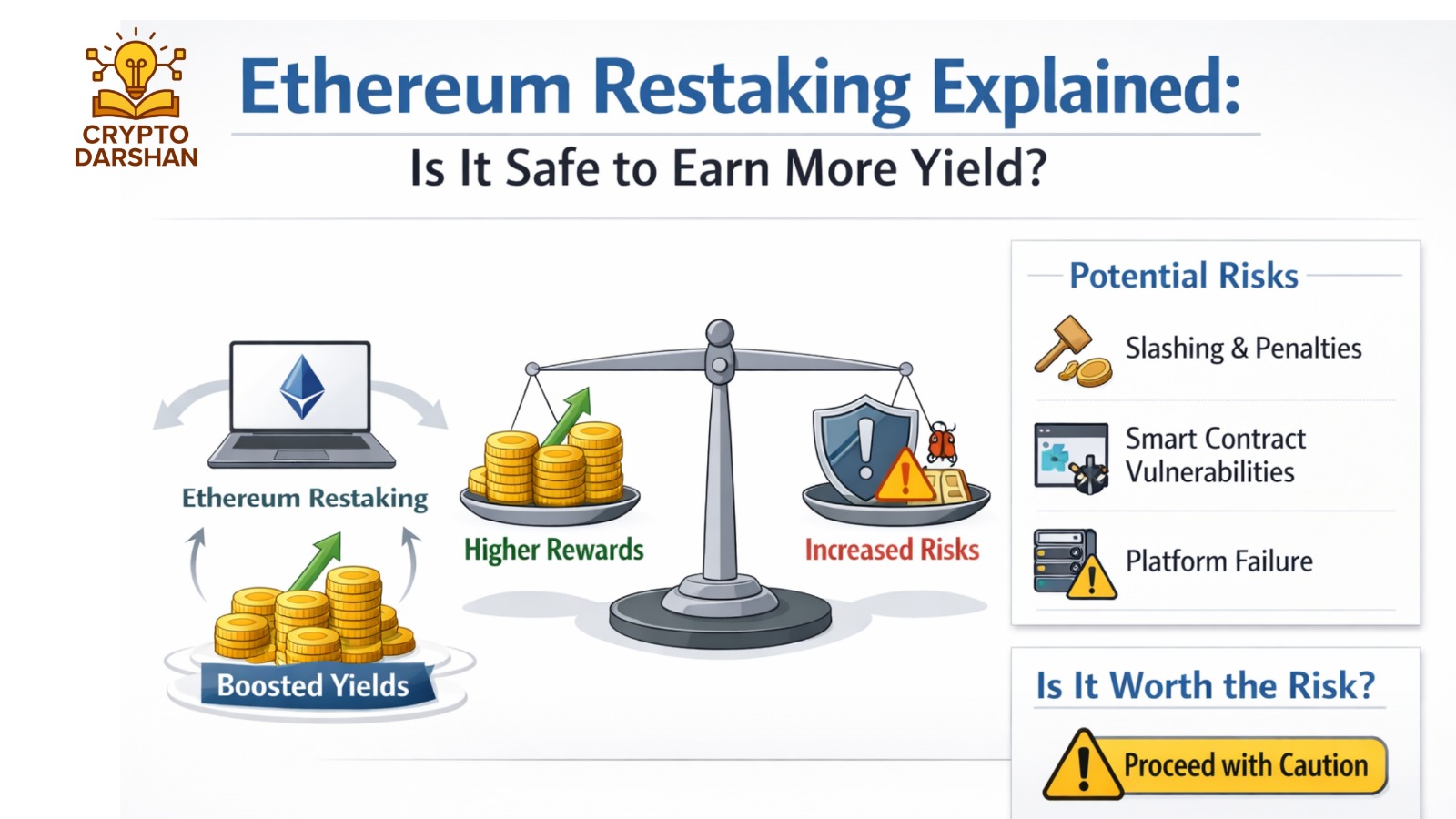
Enter Ethereum restaking, a new concept that promises to make staked ETH more productive by allowing it to secure multiple protocols simultaneously. Restaking, popularized by EigenLayer, enables stakers to reuse their staked ETH or liquid staking tokens to secure other decentralized services. In return, they can earn additional rewards, effectively stacking yields on top of their base staking income. However, this innovation also introduces new risks, including smart contract vulnerabilities, slashing penalties, and operator misbehavior.
This article explores Ethereum restaking in depth how it works, its benefits, risks, and whether it’s a safe way to earn more yield. It also examines the broader implications for Ethereum’s ecosystem, the rise of liquid restaking, and what the future might hold for this emerging sector.
Understanding Ethereum Staking
The Basics of Proof of Stake
Ethereum’s Proof of Stake (PoS) consensus mechanism replaced the energy-intensive Proof of Work (PoW) model. In PoS, validators are chosen to propose and attest to blocks based on the amount of ETH they have staked. This system is more energy-efficient and aligns incentives between validators and the network.
Validators must stake 32 ETH to run a node. In return, they earn rewards for helping secure the network. If they act maliciously or fail to perform their duties, they risk losing part of their stake through slashing.
Types of Ethereum Staking
- Solo Staking:
Running a personal validator node with 32 ETH. Offers full control and maximum rewards but requires technical expertise. - Pooled Staking:
Allows users with less than 32 ETH to combine their funds in a pool. Rewards are shared proportionally. - Liquid Staking:
Platforms like Lido, Rocket Pool, and Coinbase issue liquid tokens (e.g., stETH, rETH, cbETH) that represent staked ETH. These tokens can be used in DeFi while still earning staking rewards. - Centralized Exchange Staking:
Exchanges like Binance and Kraken offer staking services, though users must trust the exchange to manage their funds.
Each method has trade-offs between control, yield, and risk. Traditional staking locks ETH for long periods, limiting liquidity and capital efficiency issues that restaking aims to solve.
What Is Ethereum Restaking?
Restaking is a way to lock already-staked cryptocurrencies in a second network, thereby securing multiple protocols and generating additional rewards. Restaking allows stakers to reuse their staked ETH or liquid staking tokens to secure additional protocols beyond Ethereum. Instead of staking ETH once and leaving it idle, restaking enables the same capital to be “reused” to earn extra rewards.
This concept extends Ethereum’s security model to other decentralized systems, known as Actively Validated Services (AVSs). These can include oracles, bridges, rollups, and other middleware protocols that require validation and security.
The Role of EigenLayer
EigenLayer is the first and most prominent restaking protocol on Ethereum. It introduces a shared security marketplace, where stakers can opt-in to restake their ETH or liquid staking tokens to secure AVSs.
EigenLayer’s ecosystem includes three main participants:
- Restakers: Users who deposit ETH or liquid staking tokens into EigenLayer.
- Operators: Entities that run nodes and perform validation tasks for AVSs.
- AVSs (Actively Validated Services): Protocols that leverage EigenLayer’s shared security.
By participating, restakers earn additional rewards from AVSs while maintaining their base Ethereum staking rewards.
How Ethereum Restaking Works

Step 1: Staking ETH
The process begins with staking ETH on the Ethereum network, either directly or through a liquid staking provider. This ETH is locked and used to secure the Ethereum blockchain.
Step 2: Opting into Restaking
Once ETH is staked, users can choose to restake it through EigenLayer. They deposit their staked ETH or liquid staking tokens (like stETH, rETH, or cbETH) into EigenLayer’s smart contracts.
Step 3: Delegation to Operators
Restakers can delegate their restaked assets to operator entities responsible for running nodes and performing validation tasks for AVSs. Operators manage the technical aspects while restakers earn a share of the rewards.
Step 4: Securing AVSs
AVSs are decentralized services that require security and validation. Examples include:
- Cross-chain bridges
- Data availability layers
- Oracles
- Rollups
- Middleware protocols
By leveraging EigenLayer’s restaked ETH, these services gain access to Ethereum’s robust security without building their own validator networks.
Step 5: Earning Rewards
Restakers earn additional rewards from AVSs on top of their base Ethereum staking rewards. These rewards can come in the form of native tokens, fees, or other incentives.
Benefits of Ethereum Restaking
1. Enhanced Yield Opportunities
Restaking allows stakers to earn multiple layers of rewards from the same capital. Instead of earning only Ethereum staking rewards, restakers can also receive incentives from AVSs.
2. Capital Efficiency
Restaking maximizes the utility of staked ETH. It enables the same capital to secure multiple protocols, improving overall capital efficiency in the Ethereum ecosystem.
3. Strengthened Network Security

By extending Ethereum’s security to other protocols, restaking helps create a unified security layer across the ecosystem. This shared security model can make smaller protocols more resilient against attacks.
Restaking builds on Ethereum’s security foundation, the same infrastructure that powers advanced scaling technologies, as explained in our guide on Zero-Knowledge Proofs (ZK Rollups) Explained for Beginners
4. Innovation and Ecosystem Growth
Restaking encourages innovation by allowing new protocols to bootstrap security without launching their own tokens or validator networks. This lowers entry barriers for developers and fosters ecosystem growth.
5. Flexibility for Stakers
Restakers can choose which AVSs to support, allowing them to diversify their yield sources and manage risk exposure.
6. Decentralization Incentives
Restaking can promote decentralization by distributing security responsibilities across multiple operators and AVSs, reducing reliance on centralized entities.
Risks of Ethereum Restaking
While restaking offers attractive yields, it also introduces new risks that stakers must understand.
1. Smart Contract Risk
Restaking relies on complex smart contracts. Any vulnerability in EigenLayer or AVS contracts could lead to loss of funds. Since restaking involves multiple layers of contracts, the attack surface increases.
2. Slashing Risk
Restakers are exposed to double slashing penalties from both Ethereum and AVSs. If an operator misbehaves or fails to meet AVS requirements, restakers could lose part of their staked ETH.
3. Operator Risk
Delegating to unreliable operators can result in poor performance or slashing. Choosing trustworthy operators is crucial to minimize risk.
4. Liquidity Risk
Restaked assets may be locked for extended periods, reducing liquidity. While some protocols may introduce liquid restaking tokens, these can carry additional risks.
5. Regulatory and Compliance Risks

As restaking grows, regulators may scrutinize its structure, especially if it resembles financial derivatives or pooled investment products.
6. Market and Reward Volatility
AVS rewards may fluctuate based on demand, token prices, or network performance. Restakers could face unpredictable returns.
7. Complexity and User Error
Restaking involves multiple steps, contracts, and delegations. Mistakes in configuration or delegation could lead to losses.
Restaking vs. Traditional Staking
| Feature | Traditional Staking | Restaking |
| Primary Network | Ethereum only | Ethereum + AVSs |
| Rewards | Base staking rewards | Base + AVS rewards |
| Risk Level | Moderate | Higher (due to added layers) |
| Liquidity | Depends on staking method | Potentially lower |
| Complexity | Simple | More complex |
| Security Exposure | Ethereum only | Ethereum + AVS smart contracts |
Restaking offers higher potential returns but also higher complexity and risk. It’s suitable for advanced users who understand the technical and financial implications.
The Role of EigenLayer in Ethereum Restaking
EigenLayer’s Architecture
EigenLayer operates as a middleware protocol on Ethereum. It introduces a shared security marketplace, where restakers and AVSs interact.
Key components include:
- Restaking Contracts: Manage deposits of ETH or liquid staking tokens.
- Delegation Mechanism: Allows restakers to delegate to operators.
- AVS Integration Layer: Connects AVSs to EigenLayer’s security pool.
EigenDA: A Use Case Example
One of EigenLayer’s first AVSs is EigenDA, a data availability layer for rollups. It leverages restaked ETH to ensure data integrity and availability, demonstrating how restaking can secure real-world applications.
EigenLayer’s Economic Model
EigenLayer’s reward model is designed to align incentives among restakers, operators, and AVSs. Restakers earn additional yield, operators receive fees for their services, and AVSs gain access to Ethereum-grade security.
Liquid Restaking: The Next Evolution

As restaking gains traction, new protocols are introducing liquid restaking tokens (LRTs) that represent restaked positions. These tokens allow users to maintain liquidity while participating in restaking.
Benefits of Liquid Restaking
- Maintains liquidity for restakers.
- Enables participation in DeFi activities.
- Simplifies delegation and management.
- Allows composability across DeFi protocols.
Risks of Liquid Restaking
- Smart contract vulnerabilities.
- Depegging risks if LRTs lose parity with underlying assets.
- Additional protocol dependencies.
- Potential dilution of rewards due to token inflation.
How to Participate in Ethereum Restaking
Step 1: Stake ETH
Start by staking ETH directly or through a liquid staking provider like Lido or Rocket Pool.
Step 2: Choose a Restaking Platform
Select a restaking platform such as EigenLayer or a liquid restaking protocol like Ether.fi or Kelp DAO.
Step 3: Deposit or Delegate
Deposit staked ETH or liquid staking tokens into the restaking contract. Delegate to a trusted operator if required.
Step 4: Monitor Performance
Track rewards, operator performance, and AVS participation. Stay updated on protocol changes and slashing conditions.
Step 5: Claim Rewards
Collect rewards periodically from both Ethereum staking and AVS participation.
Step 6: Manage Risk
Diversify across multiple AVSs and operators to reduce exposure to single points of failure.
Is Ethereum Restaking Safe?
The safety of restaking depends on several factors:
1. Protocol Maturity
Restaking is still a new concept. Protocols like EigenLayer are in early stages, and their long-term security remains untested.
2. Smart Contract Audits
Audited contracts reduce risk, but no audit guarantees complete safety. Users should verify audit reports and security practices.
3. Operator Reliability
Choosing reputable operators minimizes slashing risk. Some platforms provide operator performance metrics to aid selection.
4. Diversification
Spreading restaked assets across multiple AVSs or operators can reduce exposure to single points of failure.
5. Risk Appetite
Restaking suits users comfortable with higher risk in exchange for higher yield. Conservative investors may prefer traditional staking.
Key Considerations Before Restaking

- Understand the Protocol: Read documentation and assess the technical design.
- Evaluate Rewards vs. Risks: Higher yields often come with higher risks.
- Check Smart Contract Audits: Ensure the platform has undergone reputable audits.
- Choose Reliable Operators: Delegate to operators with proven track records.
- Stay Informed: Follow updates from EigenLayer and AVS projects.
- Diversify Exposure: Avoid concentrating all assets in one restaking protocol.
- Assess Liquidity Needs: Consider how long assets will be locked.
- Review Tokenomics: Understand how AVS rewards are distributed and whether they are sustainable.
The Broader Impact of Restaking on Ethereum
1. Economic Efficiency
Restaking increases the productivity of staked ETH, turning idle capital into an active security resource. This could attract more participants to Ethereum’s PoS system.
2. Security Layer Expansion
By extending Ethereum’s security to other protocols, restaking could transform Ethereum into a security-as-a-service platform for the entire blockchain ecosystem.
3. Competitive Advantage
Ethereum’s restaking model could give it a competitive edge over other blockchains by offering shared security and composability.
Despite rising competition discussed in Is Solana Overtaking Ethereum in 2026? A Data-Driven Analysis, Ethereum continues innovating through mechanisms like restaking to strengthen its ecosystem.
4. Potential Centralization Risks
If a few operators or AVSs dominate restaking, it could lead to centralization of power and influence within the ecosystem.
5. Governance Challenges
Managing shared security across multiple protocols introduces governance complexities. Disputes over slashing, rewards, or operator behavior may require new governance frameworks.
Real-World Use Cases of Restaking

1. Cross-Chain Bridges
Bridges can use restaked ETH to secure cross-chain transactions, reducing the risk of exploits.
2. Oracles
Restaked ETH can secure oracle networks, ensuring reliable data feeds for DeFi applications.
3. Rollups
Layer 2 rollups can leverage restaked ETH for data availability and fraud-proof validation.
4. Middleware Services
Protocols providing indexing, messaging, or automation can use restaking to enhance reliability.
5. Decentralized AI and Compute Networks
Emerging decentralized AI platforms could use restaked ETH to secure computation and data integrity.
Challenges Facing Ethereum Restaking

Technical Complexity:
Restaking introduces multiple layers of smart contracts and delegation mechanisms that increase complexity.
Economic Sustainability:
AVS rewards must be sustainable to maintain long-term participation.
Regulatory Uncertainty:
Restaking may attract regulatory scrutiny if it resembles financial derivatives.
User Education:
Many users may not fully understand restaking’s risks, leading to uninformed participation.
Interoperability:
Ensuring seamless integration between AVSs, operators, and restakers is critical for scalability.
The Future of Ethereum Restaking
1. Expansion of AVSs
More AVSs are expected to join EigenLayer, expanding restaking opportunities across oracles, rollups, and middleware services.
2. Integration with DeFi
Liquid restaking tokens could become key assets in DeFi, enabling lending, borrowing, and yield farming with restaked ETH.
3. Institutional Adoption
Institutions may explore restaking as a way to enhance yield on staked assets, provided regulatory clarity improves.
4. Cross-Chain Security
Restaking could extend Ethereum’s security to other blockchains, creating a unified security layer across the crypto ecosystem.
5. Governance Evolution
As restaking grows, governance models will evolve to manage risks, operator accountability, and AVS participation.
6. Restaking Derivatives
The rise of LRTs could lead to new financial instruments, such as restaking derivatives, that allow users to hedge or speculate on restaking yields.
7. Layered Security Markets
Restaking could evolve into a multi-layered security marketplace, where different protocols compete for Ethereum’s shared security resources.
Frequently Asked Questions (FAQs)

1. What is Ethereum restaking?
Ethereum restaking is the process of using already staked ETH to secure additional protocols and earn extra rewards. Platforms like EigenLayer allow validators to “restake” their ETH or liquid staking tokens to increase yield.
2. How does restaking work on Ethereum?
Restaking works by reusing staked ETH (or liquid staking tokens such as Lido Finance’s stETH) to provide security for other decentralized services. In return, users earn additional rewards on top of regular Ethereum staking yields.
3. What is EigenLayer in Ethereum restaking?
EigenLayer is a protocol built on Ethereum that enables restaking. It allows stakers to extend Ethereum’s security to other applications called Actively Validated Services (AVSs) and earn extra income.
4. Is Ethereum restaking safe?
Ethereum restaking offers higher yield potential, but it also introduces additional risks such as:
- Smart contract vulnerabilities
- Slashing risks
- Protocol-level failures
- Liquidity risks
Higher rewards usually come with higher risk exposure.
5. What are the risks of Ethereum restaking?
The main risks include:
- Slashing risk if validators misbehave
- Smart contract risk from new protocols
- Centralization risk if too much ETH is controlled by few providers
- Liquidity risk during market volatility
Investors should understand these risks before restaking.
6. What is the difference between staking and restaking?
- Staking: Locking ETH to secure Ethereum and earn base rewards.
- Restaking: Reusing staked ETH to secure additional protocols and earn extra rewards.
Restaking builds on top of traditional staking.
7. Can you restake liquid staking tokens?
Yes. Liquid staking tokens like stETH from Lido Finance can be restaked through platforms such as EigenLayer to earn additional yield.
8. How much yield can you earn from Ethereum restaking?
Restaking yields vary depending on:
- The base Ethereum staking APR
- The AVS rewards offered
- Market demand
- Risk level
Returns are generally higher than standard staking but are not guaranteed.
Conclusion
Ethereum restaking represents a groundbreaking evolution in blockchain security and capital efficiency. By allowing stakers to reuse their staked ETH to secure additional protocols, restaking unlocks new yield opportunities and strengthens the Ethereum ecosystem. However, it also introduces new risks, such as smart contract vulnerabilities, slashing, and operator dependencies, which must be carefully managed.
For experienced users who understand these risks, restaking can be a powerful tool to maximize yield and contribute to Ethereum’s expanding security network. For others, traditional staking may remain the safer choice until restaking protocols mature further.
As the ecosystem evolves, restaking could redefine how blockchain security and yield generation coexisttransforming Ethereum into a shared security layer for the decentralized world