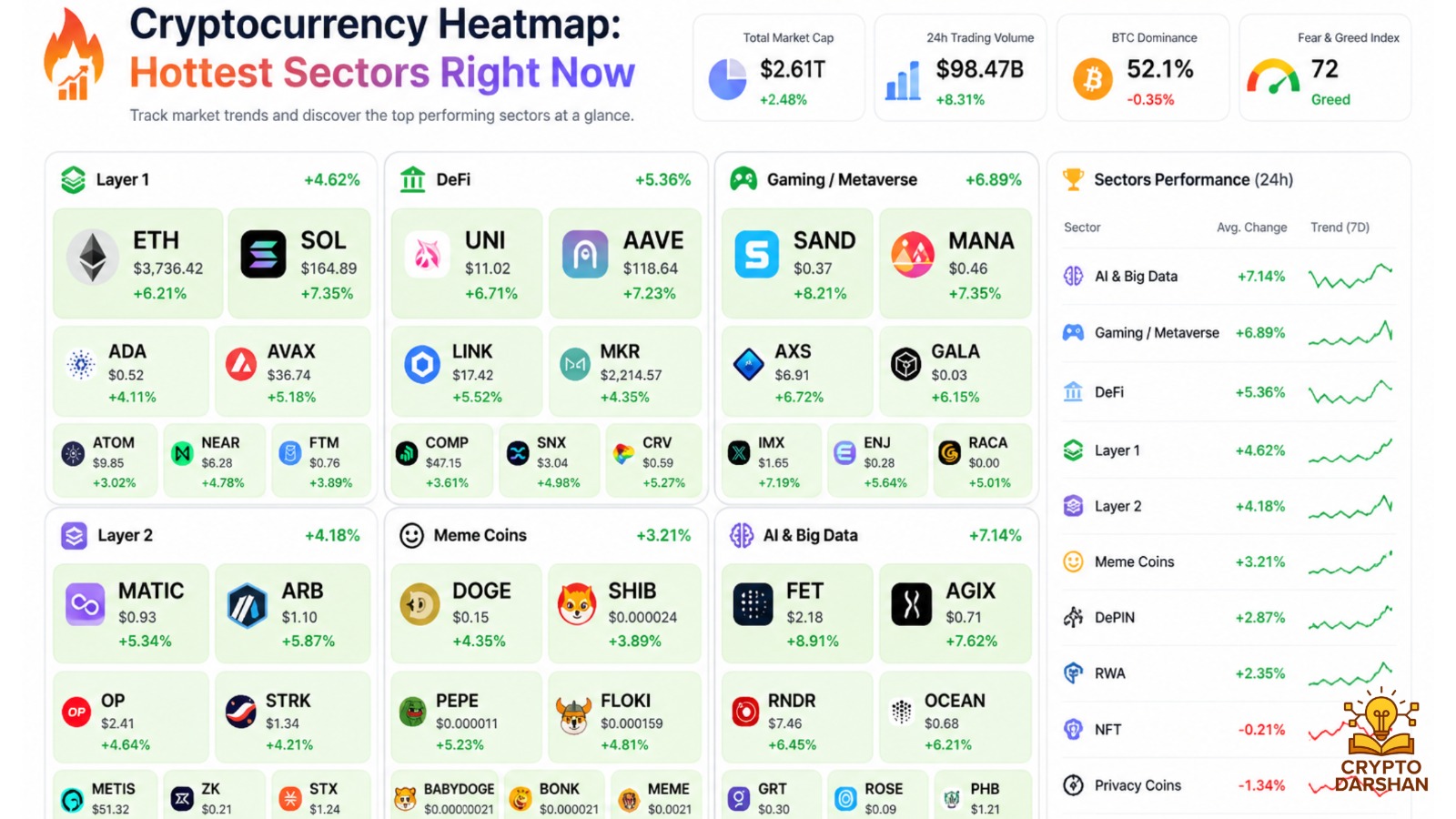
A Cryptocurrency Heatmap is one of the most powerful visual tools for analyzing the crypto market in real time. It provides a quick overview of how different cryptocurrencies and sectors are performing, using color-coded data to represent price movements, market capitalization, and trading volume. In a market as volatile and fast-paced as crypto, a Cryptocurrency Heatmap helps traders, investors, and analysts identify trends, spot opportunities, and make informed decisions.
The concept of a Cryptocurrency Heatmap is simple yet effective. Each coin or token is represented by a colored block, where green indicates price gains and red indicates losses. The size of each block often reflects the market capitalization of the asset, allowing users to see which cryptocurrencies dominate the market. Beyond individual coins, a Cryptocurrency Heatmap can also highlight entire sectors—such as DeFi, NFTs, gaming, or AI tokens—showing which areas of the market are heating up or cooling down.
This comprehensive guide explores how a Cryptocurrency Heatmap works, how to interpret it, and which sectors are currently the hottest in the crypto space. It also covers advanced strategies for using heatmaps in trading, common mistakes to avoid, and practical examples to help traders maximize their insights.
Understanding the Concept of a Cryptocurrency Heatmap

A Cryptocurrency Heatmap is a data visualization tool that uses color coding to represent different values. It provides a clear and intuitive way to see patterns and correlations in large datasets at a glance. Instead of analyzing charts for each coin individually, traders can use a heatmap to get an instant snapshot of market sentiment.
The heatmap uses colors to represent price changes over a specific period, usually 24 hours. Green shades indicate positive price movement, while red shades indicate negative movement. The intensity of the color reflects the magnitude of the change. For example, a dark green block might represent a 10% gain, while a deep red block might represent a 10% loss.
In addition to price changes, a Cryptocurrency Heatmap can display other metrics such as:
- Market Capitalization: The total value of a cryptocurrency’s circulating supply.
- Trading Volume: The total amount of a cryptocurrency traded within a given time frame.
- Dominance: The percentage share of a cryptocurrency’s market cap relative to the total crypto market.
- Sector Performance: The collective performance of coins within a specific category, such as DeFi or Layer 2 solutions.
By combining these data points, a Cryptocurrency Heatmap provides a complete picture of market dynamics at a glance.
How a Cryptocurrency Heatmap Works

A Cryptocurrency Heatmap collects real-time data from multiple exchanges and aggregates it into a single visual interface. The process involves several key steps:
- Data Aggregation: The heatmap pulls live data on prices, volumes, and market caps from major exchanges like Binance, Coinbase, and Kraken.
- Data Processing: The system calculates percentage changes, averages, and other metrics to determine performance.
- Color Coding: Each cryptocurrency is assigned a color based on its price movement. Green represents gains, red represents losses, and neutral colors like gray or yellow indicate minimal change.
- Visualization: The data is displayed as a grid or map, with each block representing a cryptocurrency. The size of the block corresponds to its market capitalization or trading volume.
This visual approach allows traders to identify patterns that might not be obvious from numerical data alone. For example, if most DeFi tokens are green while gaming tokens are red, it suggests that capital is flowing into the DeFi sector. A strong sector rotation visible on the heatmap is often one of the earliest altcoin season signals that traders watch closely.
Benefits of Using a Cryptocurrency Heatmap

Heatmaps are especially useful for traders using swing trading strategies to capture sector-wide momentum over several days. Using a Cryptocurrency Heatmap offers several advantages for traders and investors:
1. Quick Market Overview
A heatmap provides an instant snapshot of the entire crypto market. Instead of checking individual charts, traders can see which coins are performing well and which are under pressure.
2. Sector Analysis
A Cryptocurrency Heatmap can group assets by sector, allowing users to identify which areas of the market are gaining momentum. This helps traders focus on the hottest sectors and avoid lagging ones.
3. Identifying Market Sentiment
The overall color tone of the heatmap reflects market sentiment. A predominantly green heatmap indicates bullish sentiment, while a red one signals bearish conditions.
4. Spotting Correlations
Heatmaps reveal correlations between assets. For example, if Bitcoin and Ethereum are both red, it may indicate a broader market correction.
5. Time Efficiency
By summarizing complex data visually, a Cryptocurrency Heatmap saves time and simplifies decision-making for traders who need to act quickly.
Key Features of a Cryptocurrency Heatmap

A well-designed Cryptocurrency Heatmap includes several important features that enhance its usefulness:
Real-Time Data
The most valuable heatmaps update in real time, reflecting the latest market movements. This ensures that traders always have access to current information.
Customizable Timeframes
Users can adjust the timeframe to view performance over different periods—such as 1 hour, 24 hours, 7 days, or 30 days.
Sector Filters
Heatmaps often include filters that allow users to focus on specific sectors like DeFi, NFTs, Metaverse, or Layer 1 blockchains.
Market Cap Weighting
The size of each block is proportional to the cryptocurrency’s market capitalization, helping users identify dominant players.
Interactive Interface
Advanced heatmaps allow users to hover over or click on a block to view detailed information, including price, volume, and percentage change.
Exchange Integration
Some Cryptocurrency Heatmaps integrate directly with exchanges, allowing users to execute trades directly from the heatmap interface.
How to Read a Cryptocurrency Heatmap

Reading a Cryptocurrency Heatmap effectively requires understanding its visual cues and data representation. Here’s how to interpret it:
- Color Intensity: The deeper the color, the stronger the price movement. Bright green means strong gains, while dark red means heavy losses.
- Block Size: Larger blocks represent cryptocurrencies with higher market capitalization or trading volume.
- Grouping: Coins are often grouped by category or sector, making it easier to compare performance within a specific niche.
- Labels: Each block typically displays the coin’s ticker symbol, price change percentage, and sometimes market cap.
- Overall Tone: The general color balance of the heatmap provides a quick sense of market sentiment—green for bullish, red for bearish.
By mastering these visual cues, traders can quickly identify opportunities and risks in the market.
The Role of a Cryptocurrency Heatmap in Trading

A Cryptocurrency Heatmap is more than just a visual tool—it’s a strategic asset for traders. It helps in several key areas:
Spotting Entry and Exit Points
By identifying which sectors or coins are gaining momentum, traders can enter positions early. Conversely, when a sector turns red, it may signal a good time to take profits or exit.
Confirming Market Trends
Heatmaps can confirm broader market trends. If most major coins are green, it supports a bullish outlook. If they’re red, it confirms bearish sentiment.
Diversifying Portfolios
A Cryptocurrency Heatmap helps traders diversify by showing which sectors are performing well. For example, if DeFi is cooling down but AI tokens are heating up, traders can shift their focus accordingly.
Managing Risk
By monitoring sector performance, traders can reduce exposure to underperforming areas and allocate capital more efficiently.
Hottest Sectors on the Cryptocurrency Heatmap Right Now

The crypto market is constantly evolving, and different sectors rise and fall in popularity. Based on recent trends, the following sectors are currently dominating the Cryptocurrency Heatmap:
1. Decentralized Finance (DeFi)
DeFi remains one of the hottest sectors on the Cryptocurrency Heatmap. Platforms like Uniswap, Aave, and Curve Finance continue to attract massive liquidity. The growth of decentralized exchanges (DEXs) and lending protocols has made DeFi a cornerstone of the crypto ecosystem. The sector’s consistent innovation, such as liquid staking and yield optimization, keeps it in the spotlight.
2. Artificial Intelligence (AI) Tokens
AI-related cryptocurrencies have surged in popularity, driven by the global interest in artificial intelligence technology. Tokens like Fetch.ai, SingularityNET, and Ocean Protocol are leading this trend. The integration of AI with blockchain technology is creating new possibilities for data analysis, automation, and decentralized intelligence.
3. Layer 2 Scaling Solutions

Layer 2 solutions like Arbitrum, Optimism, and Polygon are among the top performers on the Cryptocurrency Heatmap. These projects aim to improve scalability and reduce transaction costs on major blockchains like Ethereum. As network congestion and gas fees remain challenges, Layer 2 solutions are becoming increasingly essential.
4. Gaming and Metaverse Tokens
The gaming and metaverse sectors continue to attract attention, with tokens like The Sandbox, Decentraland, and Gala Games showing strong performance. The rise of play-to-earn models and virtual economies has made this sector one of the most dynamic on the Cryptocurrency Heatmap.
5. Real-World Asset (RWA) Tokens
Tokenizing real-world assets such as real estate, commodities, and bonds is a growing trend. Projects like Centrifuge and MakerDAO are leading the charge, bridging traditional finance with blockchain technology. This sector’s growth is reflected in its increasing presence on the Cryptocurrency Heatmap.
6. Stablecoins and Payment Tokens
Stablecoins like USDT, USDC, and DAI remain crucial for liquidity and trading stability. Payment-focused tokens such as XRP and Stellar also show consistent activity, reflecting their importance in cross-border transactions.
7. Privacy Coins
Privacy-focused cryptocurrencies like Monero and Zcash are regaining attention as concerns about data security and surveillance grow. Their performance on the Cryptocurrency Heatmap often spikes during periods of regulatory uncertainty.
How to Use a Cryptocurrency Heatmap for Sector Rotation

A Cryptocurrency Heatmap is a valuable tool for identifying which sectors of the crypto market are gaining or losing momentum. Sector rotation is a trading strategy that involves shifting investments between different sectors based on their performance trends. By using a Cryptocurrency Heatmap, traders can visually track these shifts and make informed decisions about where to allocate their capital.
1. Identify Strong Sectors
The first step in using a Cryptocurrency Heatmap for sector rotation is to identify which sectors are currently performing well. On the heatmap, sectors with multiple green blocks indicate strong upward momentum. These green areas represent coins or tokens that are gaining value, suggesting that investor confidence and capital are flowing into those sectors. For example, if most DeFi tokens are green, it signals that decentralized finance is currently attracting attention and liquidity.
2. Monitor Weak Sectors
Just as it’s important to find strong sectors, it’s equally crucial to monitor weak ones. On a Cryptocurrency Heatmap, sectors dominated by red blocks indicate declining prices and reduced investor interest. These sectors may be experiencing profit-taking, negative sentiment, or fundamental challenges. For instance, if gaming or NFT tokens appear mostly red, it could mean that traders are rotating out of those areas.
3. Track Momentum Shifts
Momentum shifts occur when a sector transitions from weakness to strength or vice versa. A Cryptocurrency Heatmap helps visualize these changes in real time. When a previously red sector starts showing more green blocks, it may indicate that buying pressure is returning and a recovery is underway. Conversely, if a strong sector begins turning red, it could signal that momentum is fading.
4. Rebalance the Portfolio

Rebalancing is a key part of sector rotation. After identifying strong and weak sectors using a Cryptocurrency Heatmap, traders should adjust their portfolios to align with current market trends. This means reducing exposure to underperforming sectors and increasing investments in those showing strength. For example, if the heatmap shows that AI tokens are gaining momentum while DeFi tokens are cooling off, a trader might shift some capital from DeFi projects into AI-related assets. Regular rebalancing ensures that the portfolio remains optimized for changing market conditions and helps maintain consistent performance over time.
5. Combine Heatmap Insights with Other Analysis
While a Cryptocurrency Heatmap provides valuable visual insights, it should not be used in isolation. Combining heatmap data with technical and fundamental analysis increases accuracy. Traders can confirm sector strength by checking trading volume, price patterns, and on-chain metrics.
6. Stay Updated with Market Trends
The crypto market evolves rapidly, and sector performance can change within hours or days. Regularly monitoring a Cryptocurrency Heatmap helps traders stay updated with these shifts. Setting alerts or checking the heatmap at consistent intervals ensures that no major trend goes unnoticed. Staying informed allows traders to react quickly to new opportunities, such as emerging sectors like real-world asset tokens or Layer 2 solutions.
Advanced Strategies Using a Cryptocurrency Heatmap

1. Correlation Analysis
Use the heatmap to identify correlations between assets. If multiple coins in the same sector move together, it confirms sector-wide momentum.
2. Volume Confirmation
Combine price performance with trading volume data. A green block with high volume indicates strong buying interest, while low volume may suggest a weak rally.
3. Multi-Timeframe Analysis
Compare heatmaps across different timeframes (1 hour, 24 hours, 7 days) to identify short-term and long-term trends.
4. Sentiment Tracking
Monitor how the overall color balance changes over time. A shift from red to green across the heatmap often signals improving market sentiment.
5. Cross-Sector Comparison
Compare performance between sectors like DeFi, NFTs, and AI to identify where capital is flowing.
Common Mistakes When Using a Cryptocurrency Heatmap

- Relying Solely on Color: Always confirm heatmap signals with technical or fundamental analysis.
- Ignoring Timeframes: A coin may appear green on a 1-hour heatmap but red on a 7-day one.
- Overtrading: Frequent reactions to short-term changes can lead to losses.
- Neglecting Market Context: Heatmaps show performance, not reasons behind it. Always consider news and events.
- Lack of Diversification: Focusing too heavily on one sector increases risk.
Avoiding these mistakes ensures that a Cryptocurrency Heatmap remains a reliable decision-making tool.
Real-World Examples of Cryptocurrency Heatmap Insights

Example 1: Bitcoin Dominance Shift
When Bitcoin’s block on the heatmap turns deep green while altcoins remain red, it indicates capital rotation into Bitcoin. This often happens during market uncertainty.
Example 2: DeFi Sector Rally
A wave of green across DeFi tokens on the heatmap signals renewed investor interest. Traders can use this as a cue to explore DeFi projects showing strong fundamentals.
Example 3: NFT Market Correction
If NFT-related tokens turn red simultaneously, it suggests a sector-wide correction. This insight helps traders avoid entering at the wrong time.
These examples show how a Cryptocurrency Heatmap can provide actionable insights for both short-term and long-term strategies.
The Future of Cryptocurrency Heatmaps

As the crypto market matures, Cryptocurrency Heatmaps are becoming more advanced and data-driven. Future developments may include:
- AI-Powered Predictions: Integrating artificial intelligence to forecast sector performance.
- On-Chain Data Integration: Combining heatmap visuals with blockchain analytics for deeper insights.
- Customizable Dashboards: Allowing users to create personalized heatmaps based on their portfolios.
- Mobile Optimization: Enhancing accessibility for traders on the go.
These innovations will make Cryptocurrency Heatmaps even more essential for navigating the complex crypto landscape.
FAQ: Cryptocurrency Heatmaps and Trending Crypto Sectors

1. What is a cryptocurrency heatmap?
A cryptocurrency heatmap is a visual tool that displays the performance of different cryptocurrencies or sectors using colors. Typically, green indicates price gains, while red shows losses, helping traders quickly assess market trends.
2. How does a crypto heatmap work?
A heatmap groups cryptocurrencies by categories (like DeFi, AI, gaming, etc.) and uses color intensity to represent price changes, market cap, or trading volume. Platforms like CoinMarketCap and CoinGecko offer interactive heatmaps.
3. What are crypto sectors in a heatmap?
Crypto sectors are categories of projects based on use cases, such as:
- DeFi (Decentralized Finance)
- AI tokens
- Gaming (GameFi)
- Layer 1 blockchains
- NFTs
These sectors help traders identify where capital is flowing.
4. Why are heatmaps useful for traders?
Heatmaps help traders:
- Spot trending sectors quickly
- Identify strong and weak assets
- Make faster decisions without analyzing individual charts
They provide a big-picture view of the market.
5. Can heatmaps predict market trends?
Heatmaps don’t predict the future, but they highlight current momentum. When combined with analysis, they can help traders anticipate potential trend continuation or reversals.
6. Which sectors are usually “hot” in crypto markets?
Trending sectors change over time, but commonly hot sectors include:
- DeFi
- AI-related tokens
- Layer 2 solutions
- Meme coins (during hype cycles)
The “hottest” sector depends on market sentiment and news.
7. How often should you check a crypto heatmap?
Active traders may check heatmaps daily or even hourly, while long-term investors might review them weekly to track broader trends.
8. Are crypto heatmaps good for beginners?
Yes. Heatmaps are beginner-friendly because they simplify complex market data into an easy-to-understand visual format.
Conclusion
A Cryptocurrency Heatmap is an indispensable tool for understanding market dynamics and identifying the hottest sectors in real time. By visualizing price movements, market capitalization, and sector performance, it provides traders with a clear and actionable overview of the crypto ecosystem.
From DeFi and AI tokens to Layer 2 solutions and gaming projects, the Cryptocurrency Heatmap highlights where capital is flowing and which sectors are driving growth. When combined with sound analysis and risk management, it becomes a powerful ally for traders seeking to stay ahead of market trends.
In a world where information moves fast and opportunities appear in seconds, the Cryptocurrency Heatmap offers clarity, precision, and insight, helping traders spot the hottest sectors and make smarter, data-driven decisions in the ever-evolving world of cryptocurrency.