
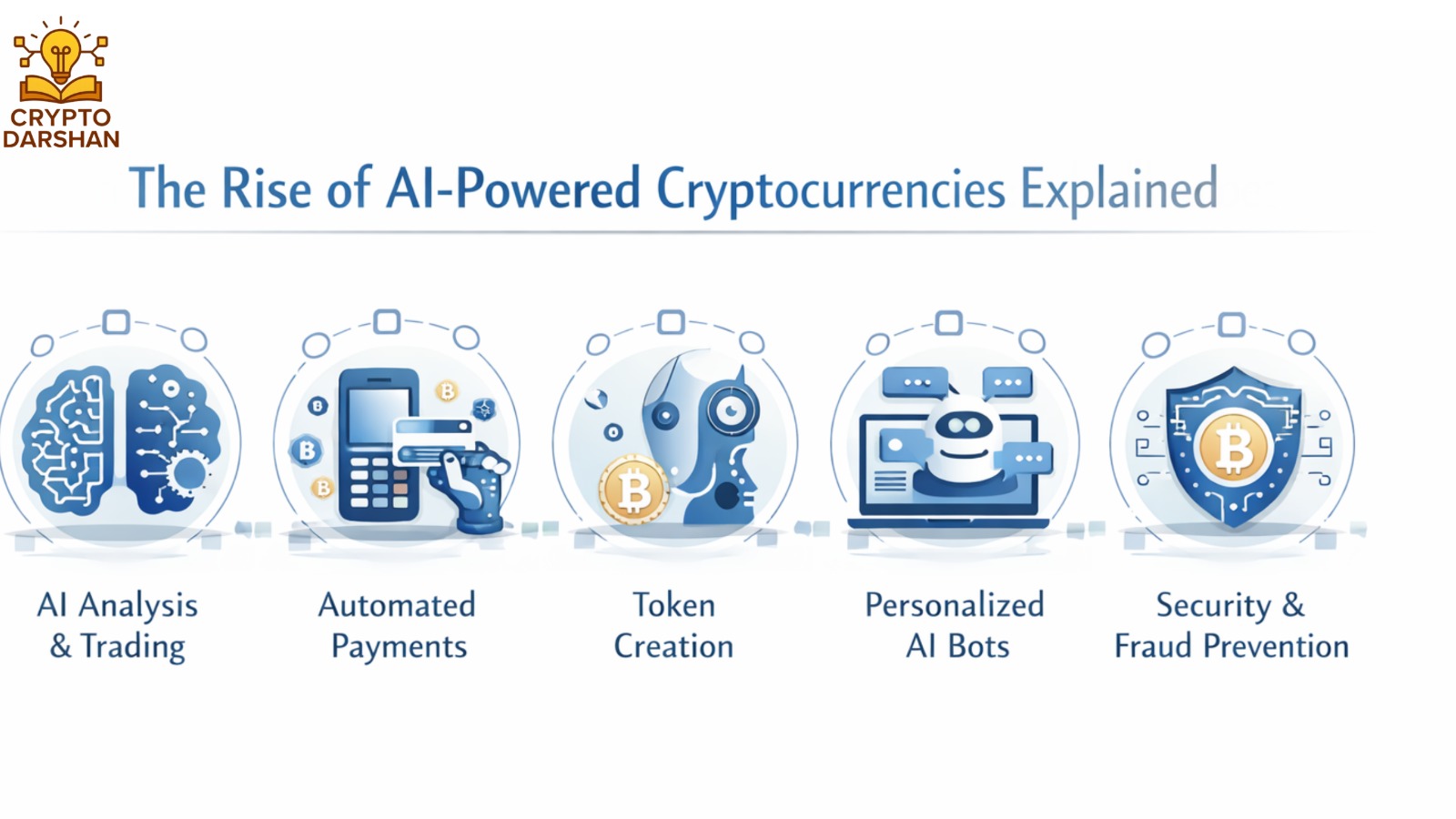
Artificial Intelligence (AI) and blockchain are two of the most transformative technologies of the 21st century. When combined, they create a powerful energy that is reshaping the digital economy. AI-powered cryptocurrencies represent the next evolution of blockchain innovation, merging machine learning, automation, and decentralized finance (DeFi) to create smarter, more efficient, and adaptive digital assets.
AI-powered cryptocurrencies are built on the same decentralized principles introduced by Bitcoin. Our Bitcoin Whitepaper Summary for Beginners explains how trustless networks and peer-to-peer systems laid the groundwork for advanced innovations like AI-driven blockchain platforms. This article explores the rise of AI-powered cryptocurrencies, how they work, their benefits, real-world examples, and the challenges they face. It also examines how AI and blockchain together are redefining the future of finance, data management, and digital ecosystems.
Understanding AI-Powered Cryptocurrencies

AI-powered cryptocurrencies are digital assets that integrate artificial intelligence into their blockchain networks or operational models. Unlike traditional cryptocurrencies that rely solely on pre-programmed algorithms, AI-powered coins use machine learning and data analytics to optimize performance, enhance security, and automate decision-making.
In simple terms, these cryptocurrencies “learn” from data. They can analyze market trends, predict price movements, detect fraud, and even manage decentralized systems autonomously. This makes them more adaptive and intelligent than conventional blockchain projects.
Key Components
- Artificial Intelligence (AI): Enables automation, prediction, and data-driven decision-making.
- Blockchain Technology: Provides transparency, decentralization, and security.
- Smart Contracts: Automate transactions and enforce rules without intermediaries.
- Machine Learning Models: Continuously improve performance by analyzing new data.
Together, these components create a self-improving ecosystem that can adapt to market conditions and user behavior.
How AI and Blockchain Work Together

AI and blockchain complement each other in several ways. Blockchain provides a secure and transparent environment for data storage, while AI uses that data to generate insights and automate processes.
1. Data Integrity and Security
AI systems require large amounts of data to function effectively. Blockchain ensures that this data is accurate, tamper-proof, and verifiable. This prevents manipulation and enhances the reliability of AI models.
2. Decentralized Intelligence
AI algorithms can be deployed across decentralized networks, allowing multiple nodes to contribute to learning and decision-making. This reduces bias and prevents single points of failure.
3. Automation Through Smart Contracts
AI can enhance smart contracts by enabling them to make dynamic decisions based on real-time data. For example, an AI-powered DeFi protocol can adjust interest rates automatically based on market conditions.
4. Predictive Analytics
AI can analyze blockchain data to predict trends, detect anomalies, and optimize network performance. This is particularly useful in trading, risk management, and fraud detection.
The Evolution of AI in the Crypto Space

Artificial Intelligence (AI) has gradually become one of the most influential forces in the cryptocurrency industry. Its integration into blockchain technology has evolved through several key stages, each bringing new levels of automation, intelligence, and efficiency to digital finance. From simple trading algorithms to fully autonomous blockchain ecosystems, AI’s role in crypto continues to expand rapidly.
1. The Early Stage: Algorithmic Trading
The first major use of AI in crypto appeared in algorithmic trading. Traders began using machine learning models to analyze market data, identify patterns, and predict price movements. These AI-driven trading bots could process massive amounts of information faster than humans, allowing them to execute trades automatically and capitalize on short-term opportunities.
This stage marked the beginning of AI’s influence in crypto focused mainly on improving trading accuracy and profitability.
2. The Growth Stage: AI-Enhanced Blockchain Networks
As blockchain technology matured, developers started embedding AI directly into blockchain infrastructure. Instead of just analyzing market data, AI began optimizing how blockchains operate.
AI was used to:
- Improve consensus mechanisms by predicting network congestion and adjusting parameters.
- Enhance security by detecting suspicious activities or potential attacks.
- Increase efficiency by automating data validation and transaction processing.
This stage showed that AI could do more than trade it could make blockchain systems smarter and more adaptive.
3. The Expansion Stage: AI-Powered Tokens and Ecosystems
The next phase saw the rise of AI-powered cryptocurrencies and decentralized ecosystems. These projects combined AI and blockchain to create platforms where AI models could be shared, trained, and monetized securely.
Examples include:
- SingularityNET (AGIX): A decentralized marketplace for AI services.
- Fetch.ai (FET): A network of autonomous agents that perform tasks like data sharing and logistics optimization.
- Ocean Protocol (OCEAN): A platform that uses AI to analyze and monetize data securely.
These ecosystems allowed AI to operate within decentralized environments, enabling autonomous decision-making and data-driven innovation.
4. The Current Stage: AI in DeFi, NFTs, and the Metaverse
Today, AI is deeply integrated into Decentralized Finance (DeFi), Non-Fungible Tokens (NFTs), and the metaverse.
- In DeFi, AI helps manage risk, predict market trends, and automate lending or yield farming strategies.
- In NFTs, AI generates unique digital art and interactive collectibles that evolve.
- In the metaverse, AI powers virtual assistants, avatars, and intelligent economies that respond to user behavior.
This stage represents the convergence of AI, blockchain, and digital identity, creating smarter, more immersive, and autonomous ecosystems.
Benefits of AI-Powered Cryptocurrencies

1. Smarter Decision-Making
AI can process vast amounts of data faster and more accurately than humans. In crypto markets, this means better predictions, optimized trading strategies, and improved portfolio management.
2. Enhanced Security
AI algorithms can detect suspicious activities, identify vulnerabilities, and prevent cyberattacks in real time. This strengthens blockchain networks against hacking and fraud.
3. Improved Efficiency
AI automates repetitive tasks such as transaction verification, data analysis, and system maintenance. This reduces operational costs and increases network efficiency.
4. Personalized Financial Services
AI can analyze user behavior to offer personalized investment recommendations, lending options, and risk assessments. This creates a more user-centric financial ecosystem.
5. Autonomous Ecosystems
AI-powered cryptocurrencies can operate autonomously, making decisions without human intervention. This leads to decentralized systems that are self-regulating and self-improving.
Real-World Examples of AI-Powered Cryptocurrencies

1. SingularityNET (AGIX)
SingularityNET is a decentralized marketplace for AI services, built on the Ethereum blockchain. It allows anyone to create, share, and monetize AI services at scale. The platform is designed to be open and democratic, enabling AI developers and companies to collaborate and access AI technologies more efficiently.
2. Fetch.ai (FET)
Fetch.ai combines AI, machine learning, and blockchain to create a decentralized digital economy. It uses autonomous agents that perform tasks such as data sharing, logistics optimization, and trading. The FET token facilitates transactions and governance within the ecosystem.
3. Ocean Protocol (OCEAN)
Ocean Protocol focuses on data sharing and monetization. It uses blockchain to ensure data privacy and AI to analyze and process data efficiently. The OCEAN token is used to buy and sell data services on the platform.
4. Numerai (NMR)
Numerai is a hedge fund powered by AI and blockchain. It crowdsources predictive models from data scientists worldwide, who use encrypted data to build trading algorithms. The NMR token rewards contributors based on the accuracy of their predictions.
5. Cortex (CTXC)
Cortex allows developers to upload AI models to the blockchain, enabling smart contracts to execute AI-powered tasks. This makes it possible to integrate machine learning directly into decentralized applications (dApps)
6. DeepBrain Chain (DBC)
DeepBrain Chain provides a decentralized AI computing platform that reduces the cost of training AI models. It uses blockchain to distribute computing resources securely and efficiently.
AI in Decentralized Finance (DeFi)

AI is revolutionizing DeFi by making financial systems more intelligent and adaptive. Traditional DeFi protocols rely on static algorithms, but AI introduces dynamic decision-making.
1. Predictive Market Analysis
AI models can analyze historical data, social media sentiment, and market trends to predict price movements. This helps traders and investors make informed decisions.
2. Automated Portfolio Management
AI-powered DeFi platforms can automatically rebalance portfolios based on risk tolerance and market conditions, maximizing returns while minimizing losses.
3. Credit Scoring and Lending
AI can assess creditworthiness using alternative data sources, enabling fairer and more inclusive lending systems. Blockchain ensures transparency and prevents data manipulation.
4. Fraud Detection
AI algorithms can detect unusual patterns in transactions, preventing fraud and money laundering in DeFi ecosystems.
AI and Crypto Trading Bots

AI and crypto trading bots are automated software programs that use artificial intelligence and machine learning to analyze cryptocurrency markets and execute trades on behalf of users. These bots are designed to make trading faster, more efficient, and less emotional. They can process massive amounts of data, identify profitable opportunities, and act instantlysomething human traders can’t do consistently.
1. What Are Crypto Trading Bots?
A crypto trading bot is a computer program that interacts with cryptocurrency exchanges to buy or sell assets automatically based on predefined strategies. Traditional bots follow fixed rules, but AI-powered bots go a step further: they learn from data, adapt to market changes, and improve their performance over time.
These bots use algorithms that analyze market indicators such as price trends, trading volume, volatility, and historical data. They can also incorporate external data like news sentiment or social media trends to make more informed decisions.
2. How AI Enhances Trading Bots

Artificial intelligence gives trading bots the ability to think and adapt. Instead of relying on static strategies, AI bots use machine learning to recognize patterns and predict future price movements.
For example, an AI bot can analyze thousands of past trades to identify what strategies worked best under certain market conditions. It then adjusts its trading behavior automatically when similar conditions appear again.
AI also helps bots detect anomalies such as sudden price spikes or unusual trading activity and respond instantly to minimize losses or capture profits.
3. Key Features of AI-Powered Trading Bots
- Data Analysis: AI bots can process large datasets from multiple exchanges in real time.
- Predictive Modeling: They use historical data to forecast price trends and volatility.
- Automated Execution: Trades are executed automatically when conditions match the bot’s strategy.
- Risk Management: AI adjusts position sizes and stop-loss levels to minimize risk.
- Continuous Learning: The bot improves its performance as it gathers more data.
4. Types of AI Trading Bots

a. Trend-Following Bots
These bots identify and follow market trends. If the price of a cryptocurrency is rising, the bot buys; if it’s falling, the bot sells or shorts.
b. Arbitrage Bots
They exploit price differences between exchanges. For example, if Bitcoin is cheaper on one exchange and more expensive on another, the bot buys low and sells high automatically.
c. Market-Making Bots
These bots provide liquidity by placing buy and sell orders around the current market price. They profit from the small difference (spread) between the two prices.
d. Sentiment Analysis Bots
Using AI and natural language processing (NLP), these bots analyze news articles, tweets, and online discussions to gauge market sentiment and predict price movements.
e. Portfolio Management Bots
These bots automatically rebalance a user’s portfolio based on risk tolerance, market conditions, and investment goals.
5. Popular AI-Powered Crypto Trading Bots
1. Commas
A cloud-based platform that uses AI to optimize trading strategies. It supports multiple exchanges and offers features like smart trading terminals and portfolio tracking.
2. CryptoHopper
Uses AI to analyze market signals and execute trades automatically. It allows users to copy successful strategies from other traders.
3. Bitsgap
Combines AI with arbitrage trading, helping users profit from price differences across exchanges. It also offers grid trading and portfolio management tools.
4. TradeSanta
An AI-driven bot that automates trading strategies for both beginners and professionals. It supports long and short strategies and integrates with major exchanges.
5. Shrimpy
Focuses on portfolio management and rebalancing using AI algorithms. It helps users maintain optimal asset allocation automatically.
The Role of AI in Blockchain Scalability and Security

1. Optimizing Consensus Mechanisms.
AI can improve blockchain scalability by optimizing consensus algorithms like Proof of Work (PoW) and Proof of Stake (PoS). It can predict network congestion and adjust parameters to maintain efficiency.
2. Detecting Network Threat.
AI continuously monitors blockchain networks for suspicious activities, such as double-spending or Sybil attacks. It can identify and neutralize threats before they cause damage.
3. Energy Efficiency
AI can optimize energy consumption in blockchain mining by predicting demand and adjusting resource allocation. This supports the development of greener blockchain systems.
AI-Powered NFTs and the Metaverse

AI is also transforming the world of non-fungible tokens (NFTs) and the metaverse. AI-powered NFTs can evolve, learn, and interact with users, creating dynamic digital assets.
AI enhances blockchain’s ability to process and secure online transactions. Our blog How Crypto Is Powering the Future of Online Payments explores how intelligent crypto systems improve transaction speed, fraud detection, and user experience.
1. Generative Art
AI algorithms can create unique digital artworks that are tokenized as NFTs. These artworks evolve over time based on user interactions or environmental data.
2. Virtual Companions
In the metaverse, AI-powered avatars and companions can learn from user behavior, offering personalized experiences and interactions.
3. Smart Virtual Economies
AI manages virtual economies by balancing supply and demand, setting prices, and preventing inflation within metaverse ecosystems.
Challenges Facing AI-Powered Cryptocurrencies

1. Data Privacy
AI requires large datasets, which can raise privacy concerns. Ensuring that data is collected and used ethically is a major challenge.
2. Regulatory Uncertainty
Governments are still developing frameworks for AI and blockchain. Unclear regulations can slow adoption and innovation.
3. Technical Complexity
Integrating AI with blockchain requires advanced technical expertise. Scalability, interoperability, and data processing remain major hurdles.
4. Bias in AI Models

AI systems can inherit biases from the data they are trained on, leading to unfair or inaccurate outcomes. Transparent and diverse data sources are essential to mitigate this risk.
5. Energy Consumption
Both AI and blockchain can be energy-intensive. Developing energy-efficient models and consensus mechanisms is crucial for sustainability.
The Future of AI-Powered Cryptocurrencies

The future of AI-powered cryptocurrencies looks promising. As technology advances, these systems will become more intelligent, efficient, and accessible. Several trends are shaping the next phase of growth:
1. Decentralized AI Marketplaces
Platforms like SingularityNET are paving the way for decentralized AI marketplaces where developers can share and monetize AI models securely.
2. AI Governance in DAOs
Decentralized Autonomous Organizations (DAOs) can use AI to make governance decisions, analyze proposals, and optimize resource allocation.
3. Integration with IoT
AI-powered cryptocurrencies will integrate with the Internet of Things (IoT) to enable autonomous machine-to-machine transactions, creating a fully connected digital economy.
4. Sustainable AI-Blockchain Systems
Future projects will focus on reducing energy consumption through efficient algorithms and renewable energy sources.
5. Cross-Chain AI Solutions
Interoperability between different blockchains will allow AI systems to access and analyze data across multiple networks, enhancing performance and scalability.
As AI enhances transaction efficiency and network scalability, crypto adoption continues to accelerate. Our article Is Crypto Becoming a Global Payment Standard? examines whether intelligent blockchain systems could power the future of global payments.
Investment Opportunities in AI-Powered Cryptocurrencies

Investors are increasingly drawn to AI-powered cryptocurrencies due to their growth potential and innovative use cases. However, as with any investment, due diligence is essential.
Factors to Consider
- Project Utility: Evaluate the real-world problem the project solves.
- Team Expertise: Assess the technical and business background of the team.
- Tokenomics: Understand the supply, demand, and utility of the token.
- Partnerships: Look for collaborations with reputable organizations.
- Community Support: Strong communities often indicate long-term sustainability.
AI-powered cryptocurrencies like AGIX, FET, and OCEAN have shown strong performance, but investors should remain cautious and diversify their portfolios.
Ethical and Social Implications

The rise of AI-powered cryptocurrencies also raises ethical questions. As AI becomes more autonomous, accountability and transparency become critical. Developers must ensure that AI systems operate fairly and do not exploit users or markets.
Blockchain’s transparency can help address these concerns by providing verifiable records of AI decisions and actions. However, continuous oversight and ethical guidelines are necessary to maintain trust.
Frequently Asked Questions (FAQ)
1. What are AI-powered cryptocurrencies?
AI-powered cryptocurrencies are blockchain projects that integrate artificial intelligence to improve automation, decision-making, and efficiency. They use AI for tasks like data analysis, predictive modeling, fraud detection, and optimizing network performance.
2. How does AI improve blockchain technology?
AI enhances blockchain by enabling smarter smart contracts, faster transaction validation, better security monitoring, and real-time data analysis. This combination helps networks scale more efficiently and respond intelligently to user activity.
3. Are AI-powered cryptocurrencies different from traditional cryptocurrencies?
Yes. Traditional cryptocurrencies mainly focus on secure value transfer, while AI-powered cryptocurrencies use machine learning and automation to deliver advanced features such as self-optimizing networks and intelligent decentralized applications.
4. What are common use cases of AI-powered cryptocurrencies?
Common use cases include automated trading, fraud detection, predictive supply chain management, healthcare data analysis, decentralized AI marketplaces, and intelligent financial services.
5. Are AI-powered cryptocurrencies safe to use?
AI-powered cryptocurrencies can be secure, but their safety depends on code quality, data transparency, and governance models. As with any emerging technology, risks such as bugs, data bias, and misuse still exist.
6. Can AI-powered cryptocurrencies replace traditional financial systems?
AI-powered cryptocurrencies are unlikely to fully replace traditional finance in the short term. However, they can complement existing systems by automating processes, reducing costs, and improving efficiency.
7. How do AI-powered cryptocurrencies affect crypto investors?
For investors, AI-powered cryptocurrencies introduce new growth opportunities but also higher volatility. Understanding the technology, use case, and long-term vision is essential before investing.
8. Are AI-powered cryptocurrencies regulated?
Regulation varies by country. While some regions are developing clear frameworks for AI and crypto, others are still exploring how to regulate these technologies together.
9. What is the future of AI-powered cryptocurrencies?
The future looks promising as AI continues to evolve. AI-powered cryptocurrencies are expected to play a key role in automation, decentralized intelligence, and next-generation digital economies.
Conclusion
AI-powered cryptocurrencies represent a groundbreaking fusion of artificial intelligence and blockchain technology. They are creating smarter, more efficient, and autonomous digital ecosystems that can transform finance, data management, and beyond.
By combining AI’s analytical power with blockchain’s transparency and security, these cryptocurrencies are paving the way for a new era of decentralized intelligence. While challenges remain, such as regulation, privacy, and technical complexity, the potential benefits are immense.
As innovation continues, AI-powered cryptocurrencies will play a central role in shaping the future of the digital economy, driving smarter systems, fairer markets, and more connected global networks.