

In 2008, an individual or group under the name Satoshi Nakamoto published a groundbreaking document titled “Bitcoin: A Peer-to-Peer Electronic Cash System.” This whitepaper introduced the concept of Bitcoin, a decentralized digital currency that operates without the need for banks or intermediaries. It laid the foundation for blockchain technology and the modern cryptocurrency ecosystem.
Newcomers may struggle to understand the Bitcoin whitepaper due to its technical nature. However, taking it down into simple words reveals a revolutionary concept: a system that allows people to send money directly to one another securely and transparently, without the need for centralized authorities.
This summary explores the key ideas of the Bitcoin whitepaper in detail, explaining each section in beginner-friendly language while maintaining the essence of Satoshi Nakamoto’s vision.
1. The Problem with Traditional Financial Systems

1.1 Centralization and Trust
Before Bitcoin, all digital payment systems relied on trusted third parties such as banks, payment processors, or governments. These intermediaries verified transactions, prevented fraud, and maintained account balances. While this system worked, it came with several drawbacks:
- Dependence on trust: Users had to trust banks and institutions to handle their money honestly.
- High transaction costs: Intermediaries charged fees for processing payments.
- Slow cross-border transactions: International transfers could take days due to multiple layers of verification.
- Censorship and control: Governments or banks could freeze accounts or block transactions.
Satoshi Nakamoto identified this dependence on trust as a fundamental flaw. The goal was to create a trustless system one where transactions could occur directly between users without needing to rely on any central authority.
1.2 The Double-Spending Problem
A major challenge in digital money systems is the double-spending problem. Unlike physical cash, digital files can be copied easily. Without a central authority, someone could attempt to spend the same digital coin twice.
For example, if Alice sends 1 digital coin to Bob, she could also send the same coin to Charlie unless there’s a mechanism to verify that the coin hasn’t already been spent. Traditional systems solve this by using centralized databases, but Bitcoin proposed a decentralized solution.
2. The Vision of Bitcoin

2.1 Peer-to-Peer Electronic Cash
Bitcoin’s core idea is a peer-to-peer electronic cash system. This means that two parties can send and receive payments directly, without intermediaries. The system relies on cryptographic proof instead of trust, ensuring that transactions are secure and verifiable by anyone.
2.2 Decentralization as the Foundation
Decentralization is the heart of Bitcoin. Instead of one central server, Bitcoin operates on a network of node computers that collectively maintain the system. Each node keeps a copy of the transaction history, known as the blockchain. This shared ledger ensures transparency and prevents manipulation.
2.3 The Role of Cryptography
Bitcoin uses cryptographic techniques to secure transactions and control the creation of new coins. Public-key cryptography allows users to have a pair of keys:
- A public key, which acts like an address for receiving funds.
- A private key, which is used to sign transactions and prove ownership.
Only the holder of the private key can authorize spending, ensuring security and ownership integrity.
3. How Bitcoin Works?

Understanding how Bitcoin works is essential to grasp why it’s such a revolutionary concept. At its core, Bitcoin is a digital payment system that allows people to send and receive money directly, without needing a bank or any central authority. It achieves this through a combination of cryptography, peer-to-peer networking, and a shared public ledger called the blockchain.
Let’s break down the process step by step.
3.1 Transactions: The Building Blocks of Bitcoin
A transaction in Bitcoin is simply a record that one person has sent a certain amount of Bitcoin to another. It’s similar to writing a check, but instead of paper, it’s a digital message secured by cryptography.
Each Bitcoin transaction contains three main parts:
- Input: This shows where the Bitcoin is coming from essentially, the previous transaction that gave the sender ownership of those coins.
- Output: This specifies where the Bitcoin is going the recipient’s address (public key).
- Amount: The number of bitcoins being transferred.
To make a transaction, the sender uses their private key to create a digital signature. This signature proves that the sender owns the coins and authorizes the transfer. Once signed, the transaction is broadcast to the Bitcoin network, where it awaits verification.
Example:
Imagine Alice wants to send 0.5 BTC to Bob.
- Alice creates a transaction that says, “Send 0.5 BTC from my address to Bob’s address.”
- She signs it with her private key.
- The transaction is then sent to the network for verification.
This digital signature ensures that only Alice can spend her Bitcoin, and no one can alter the transaction once it’s signed.
3.2 Verification Process: Ensuring Trust Without Banks
Once a transaction is broadcast, it doesn’t immediately become part of the blockchain. It first needs to be verified by the network. This verification process is what replaces the role of banks in traditional systems.
Every computer (called a node) in the Bitcoin network checks the transaction to ensure:
- The digital signature is valid.
- The sender actually owns the coins being spent.
- The same coins haven’t been spent elsewhere (preventing double-spending).
If the transaction passes all these checks, it’s considered valid. Valid transactions are then grouped
into a block by special nodes called miners.
3.3 Mining: The Process of Adding Transactions to the Blockchain
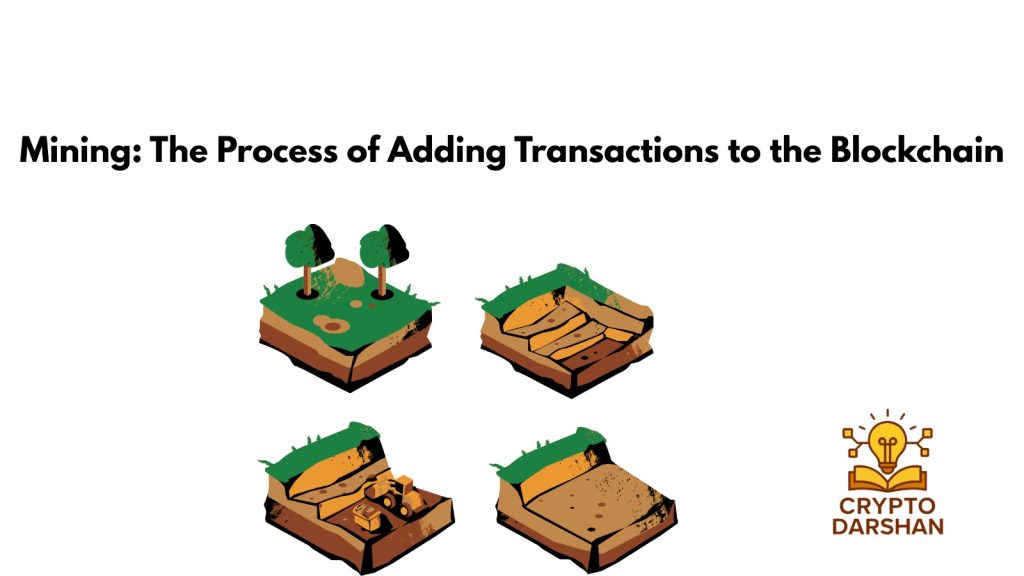
Mining is the process that keeps the Bitcoin network secure and synchronized. Miners collect verified transactions and bundle them into a block. But before a block can be added to the blockchain, miners must solve a complex mathematical puzzle, which is known as Proof of Work (PoW).
All over the world, thousands of Bitcoin miners race to be the first to complete a complex cryptographic “puzzle” using specialized computer equipment. The puzzle involves finding a special number (called a nonce) that, when combined with the block’s data and passed through a cryptographic function (SHA-256), produces a hash that meets specific criteria. This process requires immense computational power and energy.
The first miner to solve the puzzle gets to add the block to the blockchain and is rewarded with:
- Newly created bitcoins (the block reward).
- Transaction fees from all the transactions in that block.
Once a block is added, it becomes a permanent part of the blockchain. Every subsequent block strengthens the security of previous ones, making it nearly impossible to alter past transactions.
To understand how Bitcoin transactions are verified without a central authority, it helps to learn about mining. If you’re completely new, this beginner-friendly guide explains the concept step by step: Bitcoin Mining Explained Simply for Total Newbies.
3.4 The Blockchain: A Shared Public Ledger
The blockchain is the heart of Bitcoin a public, distributed ledger that records every transaction ever made. Each block contains:
- A list of verified transactions.
- A reference (hash) to the previous block.
- A timestamp and the miner’s Proof of Work.
Because each block is linked to the one before it, altering any transaction would require changing every subsequent block an almost impossible task given the computational power required.
3.5 Consensus: Agreement Without Central Authority
Bitcoin’s network operates on consensus, meaning all nodes agree on the state of the blockchain. This agreement is achieved through the Proof of Work mechanism.
When a miner adds a new block, other nodes verify it. If the block is valid, they accept it and continue building on top of it. If it’s invalid, they reject it. The longest valid chain the one with the most accumulated Proof of Work is considered the true version of the blockchain. This decentralized consensus ensures that no single entity can control or manipulate the system.
3.6 Ownership and Wallets
To use Bitcoin, users need a wallet, which stores their cryptographic keys:
- Public key (address): Used to receive Bitcoin.
- Private key: Used to sign transactions and prove ownership.
The wallet doesn’t store bitcoins; it stores the keys that allow access to them on the blockchain. Losing the private key means losing access to the Bitcoin associated with it forever.
3.7 Example: A Complete Bitcoin Transaction
Let’s walk through a simple example to tie everything together:
- Alice wants to pay Bob 0.5 BTC.
She creates a transaction using her wallet, specifying Bob’s address and the amount. - Alice signs the transaction.
Her private key generates a digital signature, proving she owns the coins. - The transaction is broadcast.
It’s sent to the Bitcoin network, where nodes verify it. - Miners include it in a block.
Once verified, miners add the transaction to a new block and begin solving the Proof of Work puzzle. - The block is added to the blockchain.
When a miner solves the puzzle, the block is added to the chain, and the transaction becomes permanent. - Bob receives the Bitcoin.
After a few confirmations (usually six blocks), Bob’s wallet shows the 0.5 BTC as received and spendable.
This entire process happens without any bank, government, or intermediary purely through cryptographic proof and decentralized consensus.
3.8 Why This System Works?
Bitcoin’s design elegantly solves the problems of digital money:
- No double-spending: The blockchain ensures each coin can only be spent once.
- No central authority: The network operates through consensus, not control.
- Security: Cryptography and Proof of Work make tampering nearly impossible.
- Transparency: Every transaction is publicly verifiable.
In essence, Bitcoin works because it combines mathematics, computer science, and economic incentives to create a self-sustaining, trustless financial system.
3.9 The Beauty of Bitcoin’s Mechanism
What makes Bitcoin whitepaper truly remarkable is how all these components’ transactions, mining, blockchain, and consensus work together seamlessly. Each part reinforces the others:
- Transactions create demand for verification.
- Mining secures the network and issues new coins.
- The blockchain records history immutably.
- Consensus ensures everyone agrees on the same truth.
This interlocking system forms the backbone of Bitcoin’s reliability and resilience. It’s not just a digital currency, it’s a living, decentralized network that operates 24/7, without borders or intermediaries.
4. The Blockchain: Bitcoin’s Public Ledger
4.1 What Is the Blockchain?
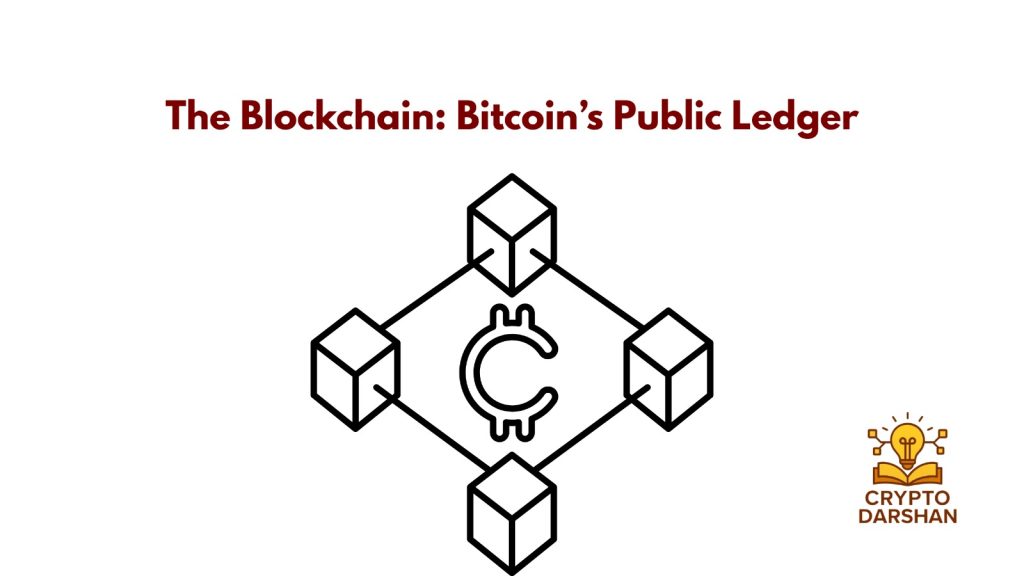
The blockchain is a chronological chain of blocks, each containing a list of verified transactions. Every block references the previous one through a cryptographic hash, forming an unbroken chain that traces back to the very first block, the genesis block.
This structure ensures that once a block is added, it cannot be altered without changing all subsequent blocks, making the system tamper-resistant.
4.2 Transparency and Immutability
Because every node has a copy of the blockchain, the system is transparent. Anyone can verify transactions and balances. The immutability of the blockchain its resistance to modification, ensures trust without central oversight.
4.3 Distributed Consensus
The blockchain achieves consensus through a mechanism called Proof of Work (PoW). Instead of relying on a central authority, nodes agree on the state of the ledger by solving complex mathematical puzzles. The first node to solve the puzzle gets to add the next block and is rewarded with newly created bitcoin whitepaper.
5. Proof of Work: The Engine of Bitcoin

5.1 The Concept of Proof of Work
Proof of Work (PoW) is a foundational consensus mechanism in blockchain technology. It requires substantial computational effort to validate transactions, ensuring the security and integrity of the blockchain network without reliance on a trusted third party.
5.2 Mining and Rewards
Miners compete to solve the PoW puzzle. The first to find a valid solution broadcasts the block to the network. Other nodes verify the solution, and if valid, the block is added to the blockchain. The miner receives two rewards:
- Block reward: Newly minted bitcoins.
- Transaction fees: Fees from the transactions included in the block.
This reward system incentivizes miners to maintain the network’s security and integrity.
5.3 Difficulty Adjustment
To ensure consistent block creation (approximately every 10 minutes), Bitcoin automatically adjusts the mining difficulty every 2016 blocks. If blocks are being mined too quickly, the difficulty increases; if too slowly, it decreases. This self-regulating mechanism keeps the network stable.
6. Security Through Decentralization
6.1 The 51% Attack
Bitcoin’s security relies on the assumption that no single entity controls more than 50% of the network’s computational power. If someone did, they could theoretically manipulate the blockchain, for example, by reversing transactions or double-spending coins. However, achieving such control is extremely costly and impractical, making the network secure in practice.
6.2 Honest Majority Assumption
The whitepaper assumes that the majority of participants act honestly. As long as most computational power is decentralized among honest nodes, the network remains secure, and transactions remain irreversible.
6.3 Incentive Alignment
Bitcoin’s design aligns incentives: miners are rewarded for honest behavior and penalized for dishonesty. Attempting to cheat the system would require enormous resources with little to no gain, making honesty the most profitable strategy.
7. Privacy and Anonymity
7.1 Pseudonymity in Bitcoin whitepaper
Bitcoin whitepaper transactions are pseudonymous, not fully anonymous. Users are identified by their public keys, not personal information. While transactions are visible on the blockchain, linking them to real-world identities requires additional data.
7.2 Privacy Through Key Reuse Avoidance
To enhance privacy, users can generate a new public key for each transaction. This makes it harder to trace multiple transactions back to a single user.
7.3 Transparency vs. Privacy Balance
Bitcoin strikes a balance between transparency and privacy. The blockchain is open for verification, ensuring trust, while pseudonymity protects user identities to a reasonable extent.
8. The Role of Nodes in the Network

8.1 Full Nodes
Full nodes store the entire blockchain and validate all transactions and blocks independently. They ensure that the rules of the Bitcoin protocol are followed.
8.2 Lightweight Nodes
Lightweight or SPV (Simplified Payment Verification) nodes do not store the full blockchain. Instead, they rely on full nodes to verify transactions. This allows users to participate in the network with less storage and bandwidth.
8.3 Network Communication
Nodes communicate using a peer-to-peer protocol. When a new transaction or block is created, it is broadcast to all connected nodes, which then propagate it further. This decentralized communication ensures resilience and redundancy.
9. The Economics of Bitcoin whitepaper

9.1 Limited Supply
Bitcoin’s total supply is capped at 21 million coins. This scarcity mimics precious metals like gold and prevents inflation caused by unlimited money printing.
9.2 Halving Events
Approximately every four years, the block reward given to miners is halved. This event, known as a halving, reduces the rate at which new bitcoins are created, gradually decreasing inflation and increasing scarcity.
9.3 Deflationary Nature
Unlike fiat currencies, which lose value over time due to inflation, Bitcoin’s limited supply and predictable issuance schedule make it deflationary. Over time, as demand increases and supply decreases, its value tends to rise.
10. Advantages of the Bitcoin whitepaper

10.1 Financial Freedom
Bitcoin allows anyone with internet access to send and receive money globally without needing a bank account. This empowers individuals in regions with limited access to financial services.
10.2 Censorship Resistance
No government or institution can block or reverse Bitcoin transactions. This makes it a powerful tool for preserving financial sovereignty.
10.3 Transparency and Security
Every transaction is recorded on the blockchain, ensuring transparency. The cryptographic foundation and decentralized structure make it highly secure against fraud and tampering.
10.4 Low Transaction Costs
By eliminating intermediaries, the Bitcoin whitepaper significantly reduces transaction fees, especially for cross-border payments, where traditional financial systems rely on multiple banks and payment processors. These intermediaries add extra charges and delays, whereas Bitcoin enables direct peer-to-peer transfers, making international transactions faster, cheaper, and more efficient.
11. Limitations and Challenges
11.1 Scalability
Bitcoin’s network can process only a limited number of transactions per second. As adoption grows, this limitation can lead to congestion and higher fees.
11.2 Energy Consumption
Proof of Work requires significant computational power, leading to high energy consumption. This has sparked debates about the Bitcoin whitepaper’s environmental impact.
11.3 Volatility
Bitcoin’s price is highly volatile, influenced by market speculation, regulatory developments, and global events. This volatility can make it challenging to use as a stable medium of exchange.
11.4 Regulatory Uncertainty
Governments worldwide are still developing frameworks for cryptocurrencies. Regulatory uncertainty can affect adoption and market stability.
12. The Broader Impact of the Bitcoin Whitepaper

12.1 Birth of Blockchain Technology
While Bitcoin introduced digital currency, its underlying technology, the blockchain, has found applications far beyond finance. Industries such as supply chain management, healthcare, and voting systems now explore blockchain for transparency and security.
12.2 Inspiration for Other Cryptocurrencies
Bitcoin’s success inspired thousands of alternative cryptocurrencies (altcoins), each experimenting with new features, consensus mechanisms, and use cases. Ethereum, for example, expanded the concept by introducing smart contracts.
12.3 Financial Inclusion
Bitcoin has opened financial opportunities for millions of unbanked individuals worldwide. It provides a decentralized alternative to traditional banking systems, especially in regions with unstable currencies.
13. The Powerful Philosophy Behind Bitcoin.
13.1 Freedom and Decentralization
At its core, Bitcoin represents a movement toward financial freedom and decentralization. It challenges the traditional power structures of money and empowers individuals to control their wealth independently.
13.2 Trust in Mathematics, Not Institutions
The Bitcoin whitepaper replaces institutional trust with mathematical proof. The system’s rules are enforced by code, not by human discretion, ensuring fairness and predictability.
13.3 A Response to the 2008 Financial Crisis
The timing of Bitcoin’s release shortly after the 2008 global financial crisis was no coincidence. The crisis exposed the vulnerabilities of centralized banking systems, motivating the creation of a decentralized alternative.
14. The Future of Bitcoin whitepaper

14.1 Layer 2 Solutions
To address scalability issues, developers are building Layer 2 solutions like the Lightning Network, which enables faster and cheaper transactions by processing them off-chain while maintaining Bitcoin’s security.
14.2 Institutional Adoption
Major corporations and financial institutions are increasingly adopting Bitcoin as a store of value and hedge against inflation. This growing acceptance strengthens its legitimacy and stability.
14.3 Integration with Global Finance
Bitcoin is gradually integrating into mainstream finance through ETFs, payment platforms, and digital wallets, bridging the gap between traditional and decentralized systems.
14.4 Environmental Innovations
Efforts are underway to make Bitcoin mining more sustainable through renewable energy sources and improved efficiency, addressing environmental concerns.
Conclusion
The Bitcoin whitepaper is more than a technical document; it is a manifesto for a new financial era. Satoshi Nakamoto’s vision of a decentralized, trustless, and transparent monetary system has transformed how the world perceives money and value exchange.
For beginners, understanding the Bitcoin whitepaper reveals the elegance of Bitcoin’s design: a system that combines cryptography, game theory, and economics to create digital scarcity and financial freedom. Despite challenges, Bitcoin continues to evolve, inspiring innovation and reshaping global finance.
The Bitcoin whitepaper’s legacy endures as a testament to human ingenuity, proving that trust can be replaced by mathematics and that freedom can be encoded in code. Bitcoin is not just a currency; it is a revolution in how society defines and controls value.