The cryptocurrency market is once again at a turning point. After years of dominance, Bitcoin is facing a new trend that is reshaping institutional investment strategies Bitcoin rotation. This term refers to the movement of capital from Bitcoin into other digital assets, sectors, or financial instruments. As institutions reassess their portfolios, the question arises: where is the money going, and what does this mean for the future of digital finance?
Over the past decade, Bitcoin has served as the gateway for institutional investors entering the crypto space. It was seen as digital gold a hedge against inflation and a store of value. However, as the market matures, institutions are diversifying beyond Bitcoin, seeking higher yields, innovation, and exposure to emerging blockchain ecosystems. This shift, known as Bitcoin rotation, is not a rejection of Bitcoin but rather a strategic reallocation of capital across the broader digital asset landscape.
This article explores the causes, patterns, and implications of Bitcoin rotation, analyzing where institutional money is flowing and how this trend could redefine the next phase of the crypto market.
Understanding Bitcoin Rotation
One of the most familiar patterns in the cryptocurrency sphere is capital rotation. Historically, fresh investment typically flows first into Bitcoin. As Bitcoin’s price appreciates, profits are then funneled into Ethereum and other major altcoins. This cyclical shift leads to broader rallies within the crypto ecosystem.
What Is Bitcoin Rotation?
Bitcoin rotation refers to the process where investors, particularly institutions, move their capital out of Bitcoin and into other assets. This can include Ethereum, altcoins, decentralized finance (DeFi) tokens, real-world asset (RWA) protocols, or even traditional financial instruments like bonds and equities. The goal is to optimize returns, manage risk, and capture opportunities in emerging sectors.
In traditional markets, rotation is common investors shift between asset classes such as stocks, bonds, and commodities based on market cycles. Similarly, Bitcoin rotation reflects a maturing crypto market where capital flows dynamically between different digital assets.
Why Institutions Are Rotating Out of Bitcoin
Several factors are driving Bitcoin rotation among institutional investors:
- Diminishing Returns: As Bitcoin matures, its volatility decreases, and its potential for exponential gains diminishes compared to earlier years.
- Diversification: Institutions are seeking exposure to other blockchain ecosystems that offer utility, innovation, and yield.
- Regulatory Clarity: Clearer regulations around Ethereum, stablecoins, and tokenized assets are encouraging diversification.
- Yield Opportunities: DeFi protocols and staking platforms offer higher returns than simply holding Bitcoin.
- Technological Evolution: New blockchain technologies are emerging, offering scalability, interoperability, and real-world applications that Bitcoin lacks.
These factors collectively contribute to the growing trend of Bitcoin rotation, signaling a shift in how institutions view digital assets.
The Institutional Perspective on Bitcoin Rotation
Bitcoin as a Mature Asset
For many institutions, Bitcoin has transitioned from a speculative asset to a core holding similar to gold in traditional portfolios. It remains a hedge against macroeconomic uncertainty, but its growth potential is now perceived as limited compared to newer sectors. This perception is fueling Bitcoin rotation, as investors look for the next wave of high-growth opportunities.
Portfolio Rebalancing Strategies
Institutional investors often follow structured portfolio management strategies. When Bitcoin’s dominance in the crypto market rises too high, they rebalance by rotating funds into other assets. This Bitcoin rotation helps maintain diversification and reduces exposure to a single asset’s volatility.
For example, a hedge fund that initially allocated 70% of its crypto portfolio to Bitcoin might reduce that exposure to 40%, reallocating the remaining 30% to Ethereum, Solana, or DeFi tokens. This strategic rebalancing is a hallmark of institutional discipline.
The Role of Risk Management
Institutions are also rotating out of Bitcoin to manage risk. As Bitcoin’s price stabilizes, its risk-reward ratio becomes less attractive compared to emerging assets. Bitcoin rotation allows investors to capture upside potential in sectors with higher growth prospects while maintaining overall portfolio stability.
Where Institutional Money Is Flowing

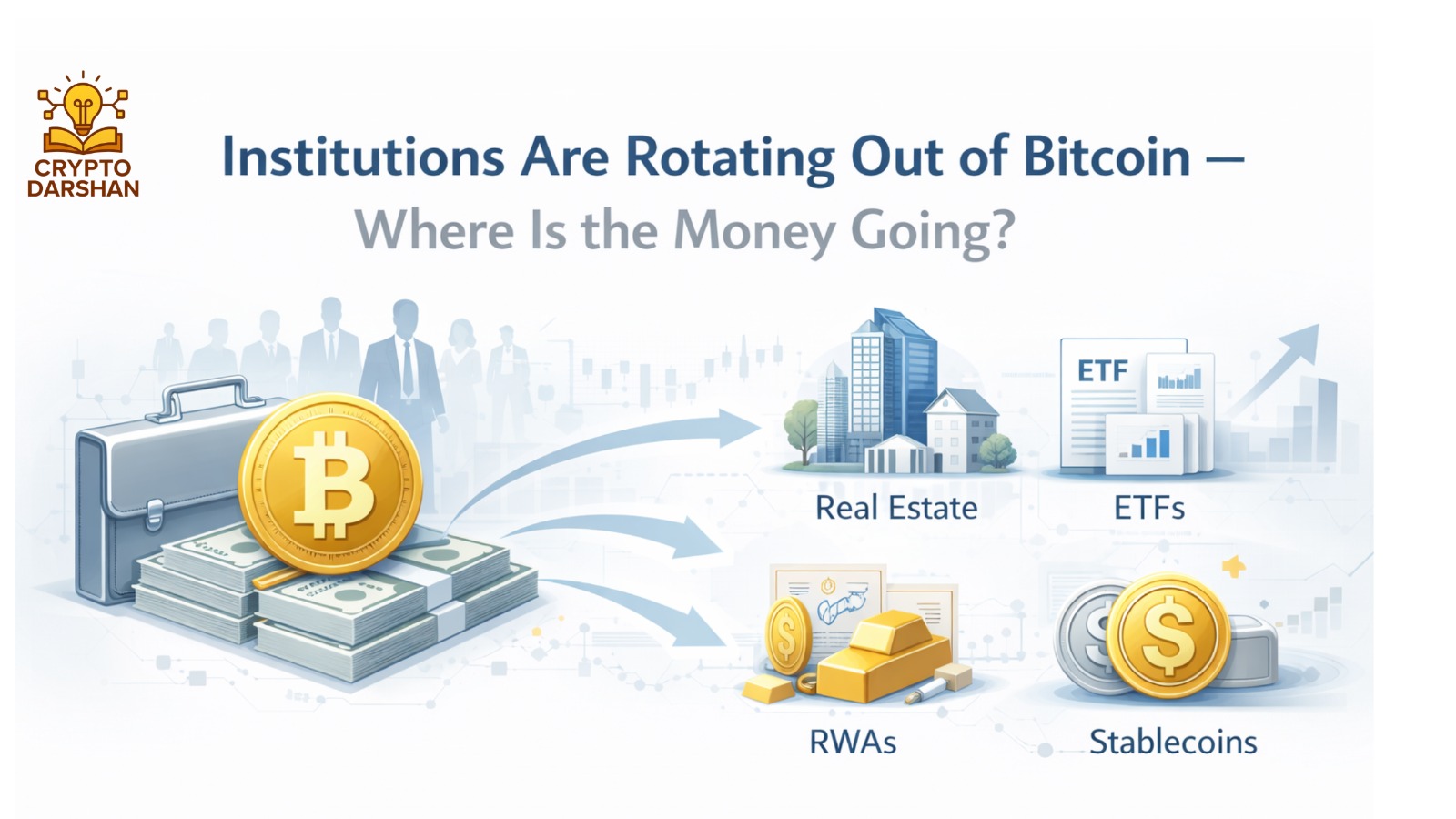
As institutions rotate out of Bitcoin, their capital is being strategically reallocated across a variety of digital asset sectors and blockchain-based opportunities. This movement, often referred to as Bitcoin rotation, reflects a more mature and diversified approach to crypto investing. Institutions are no longer focused solely on Bitcoin’s store-of-value narrative; they are now seeking yield, innovation, and exposure to real-world applications of blockchain technology.
Below are eight key areas where institutional money is flowing:
1. Ethereum and Smart Contract Platforms
Ethereum remains the primary destination for institutional capital after Bitcoin. Its robust ecosystem of decentralized applications (dApps), smart contracts, and token standards makes it the foundation of decentralized finance (DeFi) and non-fungible tokens (NFTs). Institutions view Ethereum as a long-term infrastructure play a digital economy layer that supports thousands of projects.
Beyond Ethereum, other smart contract platforms like Solana, Avalanche, and Cardano are also attracting institutional interest due to their scalability, lower transaction costs, and growing developer communities.
2. Decentralized Finance (DeFi) Protocols
DeFi has become one of the most significant beneficiaries of Bitcoin rotation. Institutions are drawn to DeFi because it offers yield-generating opportunities through lending, borrowing, and liquidity provision. Platforms such as Aave, Compound, and Curve allow investors to earn interest on idle assets or participate in liquidity pools that generate consistent returns.
For institutions, DeFi represents a new frontier of programmable finance transparent, efficient, and accessible 24/7 without intermediaries.
3. Real-World Asset (RWA) Tokenization

Tokenization of real-world assets is rapidly gaining traction among institutional investors. This involves converting traditional assets like treasury bills, real estate, and corporate bonds into blockchain-based tokens. These tokenized assets provide stable yields and regulatory compliance while leveraging blockchain’s efficiency.
Institutions see RWA tokenization as a bridge between traditional finance and decentralized finance, allowing them to diversify portfolios while maintaining exposure to familiar asset classes.
4. Stablecoins and On-Chain Liquidity Pools
Stablecoins such as USDC, USDT, and DAI are essential tools for institutions managing liquidity in the crypto ecosystem. They serve as a safe haven during market volatility and as a base asset for yield farming or trading strategies.
Institutional investors are also participating in on-chain liquidity pools, where they can earn fees by providing stablecoin liquidity to decentralized exchanges (DEXs). This approach offers predictable returns and reduces exposure to price fluctuations a key consideration in Bitcoin rotation strategies.
5. Layer-2 Scaling Solutions
As blockchain networks face scalability challenges, Layer-2 solutions like Arbitrum, Optimism, and zkSync are attracting institutional attention. These technologies improve transaction speed and reduce costs, making decentralized applications more efficient and user-friendly.
Institutions are investing in Layer-2 ecosystems because they represent the next phase of blockchain infrastructure one that can support mass adoption and enterprise-level applications.
6. Artificial Intelligence (AI) and Blockchain Integration

The convergence of AI and blockchain is emerging as a powerful investment theme. Institutions are funding projects that combine decentralized data storage, machine learning, and tokenized AI models. These innovations have applications in finance, healthcare, logistics, and cybersecurity.
By allocating capital to AI-integrated blockchain projects, institutions are positioning themselves at the intersection of two transformative technologies — a key driver of Bitcoin rotation toward high-growth sectors.
7. Gaming, Metaverse, and Digital Ownership
The gaming and metaverse sectors are becoming major destinations for institutional capital. Blockchain-based games and virtual worlds enable digital ownership through NFTs, creating new economic models.
Institutions are investing in metaverse infrastructure, gaming tokens, and NFT marketplaces to capture value from the growing digital economy. This diversification aligns with the broader Bitcoin rotation trend, as investors seek exposure to sectors with strong user engagement and long-term growth potential.
8. Tokenized Funds and Institutional DeFi Platforms
A growing number of regulated DeFi platforms and tokenized investment funds are emerging to meet institutional standards. These platforms combine blockchain transparency with compliance features such as Know Your Customer (KYC) and Anti-Money Laundering (AML) protocols.
Institutions are allocating capital to these platforms because they offer the benefits of DeFi efficiency, automation, and yield within a regulated framework. This hybrid model is becoming a cornerstone of institutional Bitcoin rotation, enabling large-scale participation in decentralized finance.
The Impact of Bitcoin Rotation on the Market

Shifting Market Dynamics
Bitcoin rotation is reshaping the structure of the crypto market. Bitcoin’s dominance the percentage of total crypto market capitalization it represents tends to decline during rotation phases. This allows altcoins and DeFi tokens to outperform, leading to what traders call “altcoin season.”
As institutions diversify, liquidity spreads across multiple assets, reducing Bitcoin’s influence on overall market movements. This decentralization of capital creates a more balanced and resilient ecosystem.
Increased Correlation with Traditional Markets
As institutions engage in Bitcoin rotation, their strategies often mirror traditional market behavior. For example, when risk appetite increases, funds flow into growth-oriented assets like DeFi and AI tokens. When risk aversion rises, capital rotates back into Bitcoin or stablecoins. This cyclical behavior aligns crypto markets more closely with global financial trends.
Enhanced Market Maturity
The rise of Bitcoin rotation signals a maturing market. Instead of speculative trading, institutional investors are now engaging in strategic asset allocation. This evolution brings greater stability, liquidity, and professionalism to the crypto ecosystem.
The Role of Regulation in Bitcoin Rotation

Regulatory Clarity Encouraging Diversification
Regulatory developments are playing a crucial role in Bitcoin rotation. As governments and financial authorities provide clearer guidelines for digital assets, institutions feel more confident exploring beyond Bitcoin. Ethereum’s classification as a commodity in some jurisdictions, for example, has encouraged institutional adoption.
Similarly, the approval of spot Bitcoin ETFs has legitimized Bitcoin as an asset class, freeing institutions to explore other opportunities. With compliance frameworks in place, Bitcoin rotation is accelerating as investors seek regulated exposure to diverse blockchain assets.
Compliance and Risk Management
Institutions must adhere to strict compliance standards, including Know Your Customer (KYC) and Anti-Money Laundering (AML) regulations. DeFi protocols and tokenization platforms that integrate compliance tools are becoming preferred destinations for Bitcoin rotation. This alignment between regulation and innovation is fostering sustainable growth.
Technological Drivers of Bitcoin Rotation

Layer-2 Scaling Solutions
Layer-2 technologies like Arbitrum, Optimism, and zkSync are enhancing blockchain scalability and reducing transaction costs. These innovations make DeFi and other blockchain applications more accessible, attracting institutional capital. As a result, Bitcoin rotation is increasingly directed toward ecosystems that offer scalability and efficiency.
Interoperability and Cross-Chain Solutions
Interoperability protocols such as Polkadot and Cosmos enable seamless communication between different blockchains. This connectivity allows institutions to diversify across multiple networks without sacrificing efficiency. The ability to move assets fluidly across ecosystems is a key enabler of Bitcoin rotation.
Tokenization Infrastructure
Advancements in tokenization infrastructure are making it easier to represent real-world assets on-chain. Institutional-grade custody solutions, compliance frameworks, and liquidity platforms are supporting the growth of tokenized markets. These developments are accelerating Bitcoin rotation into tokenized bonds, equities, and commodities.
The Psychology Behind Bitcoin Rotation

Profit-Taking and Reallocation
After significant Bitcoin rallies, institutions often take profits and reallocate funds to undervalued assets. This cyclical behavior drives Bitcoin rotation, as investors seek to maximize returns across different phases of the market cycle.
Fear of Missing Out (FOMO)
When new sectors like DeFi, NFTs, or AI tokens gain momentum, institutions fear missing out on potential gains. This sentiment fuels Bitcoin rotation, as capital flows into trending assets with higher short-term growth potential.
Long-Term Strategic Positioning
Beyond short-term gains, Bitcoin rotation also reflects long-term strategic positioning. Institutions are preparing for a future where blockchain technology underpins global finance, supply chains, and data systems. Diversifying early allows them to capture value across multiple sectors of this emerging economy.
Case Studies: Institutional Bitcoin Rotation in Action
Case Study 1: Hedge Funds Diversifying into DeFi
Several hedge funds that initially focused on Bitcoin have expanded into DeFi protocols. By allocating capital to lending platforms and liquidity pools, they generate consistent yields while maintaining exposure to blockchain innovation. This strategic Bitcoin rotation has improved portfolio performance and reduced volatility.
Case Study 2: Asset Managers Embracing Tokenization
Large asset managers are exploring tokenized treasury bills and corporate bonds as part of their digital asset strategies. By rotating out of Bitcoin and into tokenized real-world assets, they gain exposure to stable, yield-bearing instruments that align with institutional mandates.
Case Study 3: Family Offices Investing in Layer-1 Ecosystems
Family offices, known for their long-term investment horizons, are diversifying into Layer-1 and Layer-2 ecosystems. Their Bitcoin rotation reflects confidence in the broader blockchain economy and a desire to participate in infrastructure-level growth.
The Future of Bitcoin Rotation

A Multi-Asset Digital Economy
The future of Bitcoin rotation points toward a multi-asset digital economy. Bitcoin will remain a foundational asset, but capital will increasingly flow into ecosystems that offer innovation, yield, and real-world utility. This diversification will strengthen the overall crypto market and reduce systemic risk.
Institutional Integration with DeFi
As DeFi protocols evolve to meet institutional standards, Bitcoin rotation into decentralized platforms will accelerate. Hybrid models combining on-chain transparency with off-chain compliance will attract more institutional capital.
Tokenized Finance and Global Liquidity
The tokenization of global assets — from equities to commodities — will redefine how capital moves across markets. Bitcoin rotation will become part of a broader trend toward tokenized finance, where liquidity flows seamlessly between traditional and digital assets.
Sustainable Growth and Regulation
Regulatory clarity will continue to shape the pace and direction of Bitcoin rotation. As frameworks mature, institutions will allocate capital more confidently across diverse blockchain sectors, driving sustainable growth.
FAQ – Institutions Are Rotating Out of Bitcoin- Where Is the Money Going?

1. Why are institutions reducing their Bitcoin exposure?
Institutions are rotating out of Bitcoin due to factors like high volatility, regulatory uncertainty, and the need for more diversified portfolios. Many are shifting to assets with lower risk or more predictable yields.
2. What types of assets are institutions moving into?
Institutions are increasingly allocating capital to:
- Ethereum and Layer 1 blockchains for DeFi and smart contracts
- Tokenized real-world assets (RWAs) like treasuries, real estate, and commodities
- Crypto ETFs offering regulated, liquid exposure
- Stablecoins for yield and treasury management
3. What role do Real-World Assets (RWAs) play in this rotation?
RWAs provide institutions with lower volatility and predictable returns. By tokenizing assets like U.S. Treasuries or real estate, DeFi protocols can offer yield while reducing exposure to highly volatile cryptocurrencies.
For a detailed breakdown, see our analysis in “Tokenized Luxury Assets: Watches, Art, and Cars on Blockchain.”
4. Are institutions completely abandoning Bitcoin?
No. Most are not exiting entirely but are trimming positions to rebalance portfolios. Bitcoin often remains a core hedge or store-of-value asset, especially in portfolios seeking inflation protection.
5. How do ETFs influence institutional flows?
Spot and futures ETFs provide regulated access, making it easier for institutions to rotate capital quickly. ETF inflows and outflows often act as early indicators of changing sentiment in Bitcoin markets.
6. How does this rotation affect Bitcoin’s price?
Short-term pressure may increase during rotation periods, but long-term effects depend on adoption trends, scarcity, and macroeconomic conditions. Institutional diversification often stabilizes markets once allocations find new equilibrium.
7. Is there historical precedent for this rotation?
Yes. Past cycles show that when institutions rotate out of Bitcoin, capital often flows into altcoins, DeFi protocols, and tokenized assets creating new market opportunities without completely draining crypto markets.
Conclusion
Bitcoin rotation marks a new chapter in the evolution of digital finance. Institutions are no longer viewing Bitcoin as the sole gateway to the crypto market. Instead, they are strategically reallocating capital into Ethereum, DeFi, tokenized assets, and emerging blockchain technologies. This shift reflects a maturing market where innovation, yield, and utility drive investment decisions.
While Bitcoin remains the cornerstone of the digital asset ecosystem, Bitcoin rotation demonstrates that the future of finance is multi-dimensional. As institutions continue to diversify, the crypto market will become more resilient, interconnected, and aligned with global financial systems. The era of Bitcoin rotation is not the end of Bitcoin’s dominance, it is the beginning of a broader, more sophisticated digital economy.