
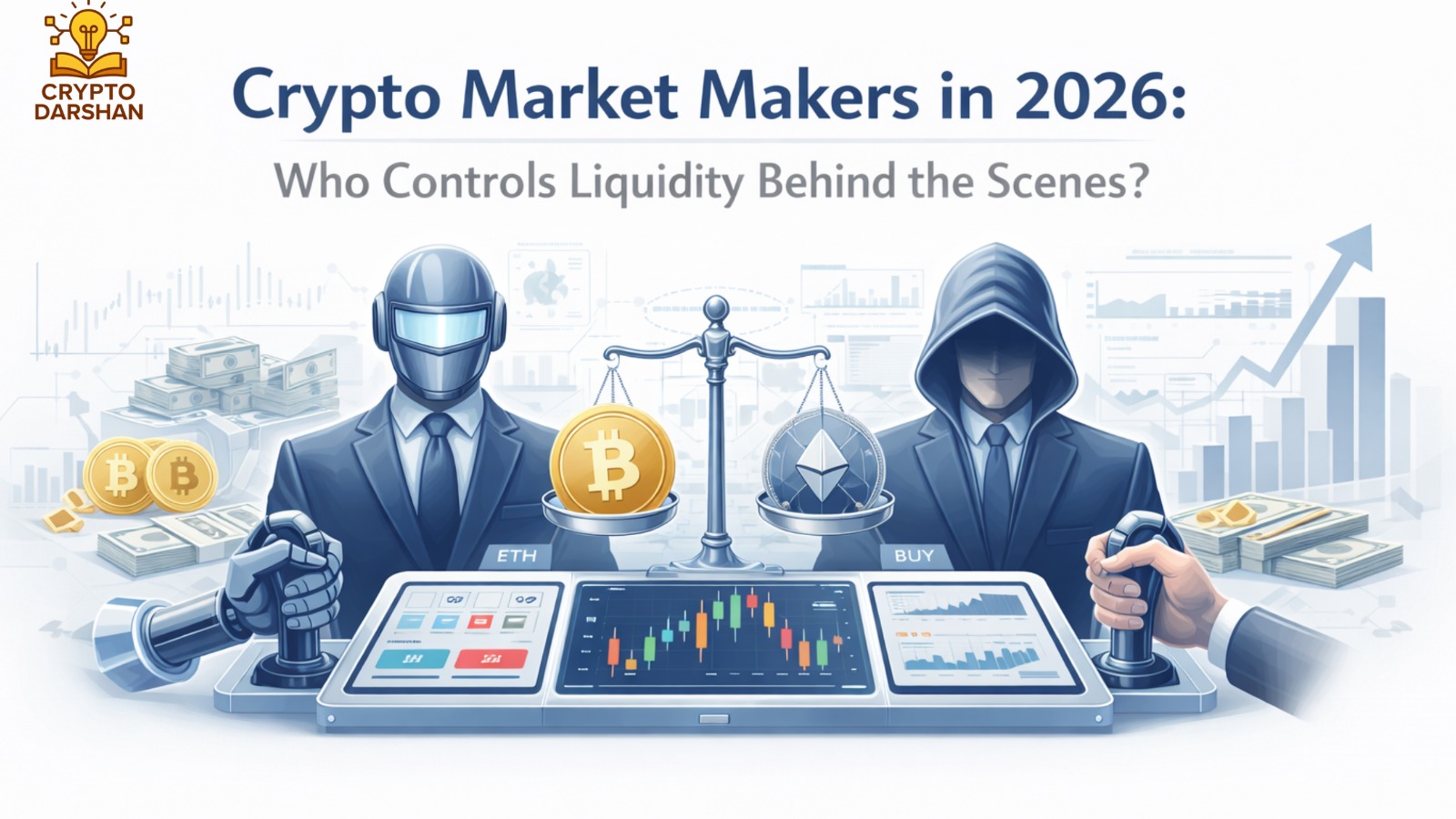
The cryptocurrency market has evolved from a niche digital experiment into a trillion-dollar global ecosystem. As of 2026, the crypto landscape is more sophisticated, regulated, and interconnected than ever before. Yet, behind every trade, price movement, and liquidity pool lies a group of key players who quietly shape the market’s rhythm the crypto market makers. These entities, often unseen by retail traders, are the backbone of liquidity, ensuring that digital assets can be bought and sold efficiently across exchanges.
This article explores the world of crypto market makers in 2026, examining who they are, how they operate, and the influence they wield over the global digital asset economy. It also delves into the technologies, regulations, and strategies that define their role in maintaining liquidity and stability in an increasingly complex market.
Understanding Market Making in Crypto

What Is a Market Maker?
Market makers are trading firms that continuously provide prices at which they will buy or sell securities. Their goal is to profit from the spread the difference between these two prices while ensuring that traders can always find a counterparty for their transactions.
In traditional finance, market makers are essential to stock exchanges and commodities markets. In crypto, their role is even more critical due to the market’s volatility, fragmented liquidity, and 24/7 trading environment.
Why Market Makers Matter in Crypto
Without market makers, crypto markets would be illiquid and inefficient. Traders would face wide spreads, slippage, and unpredictable price movements. Market makers stabilize prices, reduce volatility, and enhance trading volume by ensuring that there’s always liquidity available.
In 2026, as institutional investors, decentralized finance (DeFi) protocols, and retail traders coexist in the same ecosystem, market makers have become the invisible architects of liquidity balancing supply and demand across centralized and decentralized platforms.
The Evolution of Crypto Market Making

Early Days: Manual Trading and Arbitrage
In the early 2010s, crypto market making was largely manual. Traders exploited price differences between exchanges through arbitrage, manually buying low on one platform and selling high on another. Liquidity was thin, and spreads were wide.
The Rise of Algorithmic Market Making
By the late 2010s and early 2020s, algorithmic trading transformed the landscape. Automated bots began executing thousands of trades per second, narrowing spreads and improving efficiency. Firms like Alameda Research, Jump Trading, and Wintermute became synonymous with high-frequency crypto market making.
The 2026 Landscape: AI-Driven Liquidity Networks
In 2026, artificial intelligence and machine learning dominate market-making strategies. Algorithms now adapt in real time to market conditions, regulatory changes, and even social sentiment. Liquidity provision is no longer confined to centralized exchanges it extends across decentralized liquidity pools, cross-chain bridges, and tokenized asset markets.
Who Controls Liquidity in 2026?

1. Institutional Market Makers
Institutional players dominate the crypto liquidity landscape in 2026. These firms operate globally, providing liquidity across hundreds of trading pairs and exchanges.
Key Institutional Market Makers:
- Wintermute – A leading algorithmic trading firm specializing in both centralized and decentralized markets. Known for its AI-driven liquidity models.
- Jump Crypto – The crypto arm of Jump Trading, providing liquidity across major exchanges and DeFi protocols.
- Cumberland DRW – A pioneer in institutional crypto trading, offering deep liquidity for Bitcoin, Ethereum, and emerging altcoins.
- GSR Markets – A global liquidity provider with a focus on structured products and token market support.
- Flow Traders – A traditional market maker that expanded into digital assets, bridging the gap between traditional finance and crypto.
As institutional players expand their footprint, the impact of ETF inflows on liquidity mirrors the trends analyzed in Ethereum ETF Developments & Institutional Buying: The Setup for an ETH Rally?, highlighting how structured capital reshapes market depth. This growing institutional presence also enables these firms to provide liquidity across markets and influence token launches, exchange listings, and even governance decisions in decentralized ecosystems.
2. Decentralized Market Makers (DMMs)
Decentralized market makers operate through smart contracts rather than centralized entities. They use automated market maker (AMM) algorithms to facilitate trades directly on blockchain networks.
Leading DMM Platforms in 2026:
- Uniswap v5 – The latest iteration of the iconic AMM, featuring dynamic fee structures and cross-chain liquidity aggregation.
- Balancer – A multi-asset liquidity protocol allowing customizable pools and algorithmic rebalancing.
- Curve Finance – Specializing in stablecoin and wrapped asset liquidity, Curve remains a cornerstone of DeFi liquidity.
- PancakeSwap – Dominant on Binance Smart Chain, offering retail-friendly liquidity pools and yield farming.
- SushiSwap – Evolved into a multi-chain liquidity hub with integrated lending and derivatives.
These decentralized systems have democratized liquidity provision, allowing anyone to become a market maker by depositing assets into liquidity pools.
3. Hybrid Market Makers
Hybrid market makers bridge centralized and decentralized ecosystems. They use centralized infrastructure for speed and efficiency while leveraging decentralized protocols for transparency and accessibility.
Examples of Hybrid Models:
- Kairon Labs – Provides liquidity for token projects across both CEXs and DEXs.
- Keyrock – Uses algorithmic strategies to manage liquidity across multiple venues, including DeFi protocols.
- Amber Group – Combines institutional-grade trading infrastructure with DeFi integrations.
Hybrid models are increasingly popular in 2026, as they offer the best of both worlds the reliability of centralized systems and the openness of decentralized finance.
How Market Makers Operate

1. Quoting and Spreads
Market makers continuously post buy and sell orders for assets. The difference between these prices the spread represents their profit margin. In highly liquid markets, spreads are narrow; in volatile or low-volume markets, they widen to compensate for risk.
2. Inventory Management
Market makers must manage their inventory carefully to avoid exposure to price swings. They use hedging strategies, derivatives, and cross-exchange arbitrage to maintain balanced portfolios.
3. Algorithmic Strategies
Modern market makers rely on advanced algorithms that analyze order books, price trends, and market sentiment. These algorithms adjust quotes dynamically, ensuring optimal liquidity provision while minimizing risk.
4. Cross-Exchange Arbitrage
Arbitrage remains a core strategy. Market makers exploit price discrepancies between exchanges, ensuring that prices remain consistent across the market. This activity enhances overall market efficiency.
5. Token Market Support
Many crypto projects hire market makers to support their token’s liquidity post-launch. These partnerships help maintain stable prices, attract investors, and ensure healthy trading volumes.
The Role of AI and Machine Learning

In 2026, artificial intelligence is central to market-making operations. AI models analyze massive datasets including blockchain transactions, social media sentiment, and macroeconomic indicators to predict market movements and optimize liquidity strategies.
AI Applications in Market Making:
- Predictive Analytics: Forecasting price trends and volatility.
- Dynamic Spread Adjustment: Real-time optimization of bid-ask spreads.
- Risk Management: Automated hedging and exposure control.
- Sentiment Analysis: Using natural language processing to gauge market mood.
- Cross-Chain Liquidity Routing: AI-driven routing of trades across multiple blockchains for best execution.
AI has made market making faster, smarter, and more adaptive, reducing human error and improving market stability.
Regulation and Transparency in 2026

Global Regulatory Landscape
By 2026, crypto regulation has matured significantly. Governments and financial authorities have implemented frameworks to ensure transparency, prevent manipulation, and protect investors.
Key Regulatory Developments:
- MiCA (Markets in Crypto-Assets Regulation) in the European Union mandates disclosure of market-making activities.
- U.S. SEC and CFTC Oversight ensures fair trading practices and reporting standards.
- Asia-Pacific Regulations in Singapore, Japan, and South Korea promote responsible liquidity provision and AML compliance.
Market makers must now register with regulatory bodies, disclose their trading algorithms, and adhere to strict reporting requirements.
Transparency Through Blockchain
Blockchain technology itself enhances transparency. On-chain data allows regulators and traders to monitor liquidity flows, detect wash trading, and verify market depth in real time. Decentralized exchanges, in particular, offer unparalleled visibility into liquidity dynamics.
The Impact of Market Makers on Token Prices

Market makers play a crucial role in shaping token prices, especially during early trading phases. Their activities can stabilize or amplify price movements depending on market conditions.
Positive Impacts:
- Reduced volatility
- Narrower spreads
- Improved price discovery
- Enhanced investor confidence
Potential Risks:
- Artificial price support
- Market manipulation
- Conflicts of interest in token partnerships
Regulatory oversight and transparent reporting have mitigated many of these risks by 2026, but vigilance remains essential.
Market Making in DeFi: The New Frontier

Decentralized finance has redefined liquidity provision. Automated market makers (AMMs) like Uniswap and Curve have replaced traditional order books with liquidity pools governed by mathematical formulas.
How AMMs Work
AMMs use algorithms such as the constant product formula (x * y = k) to determine prices based on the ratio of assets in a pool. Liquidity providers (LPs) deposit tokens into these pools and earn fees from trades.
Innovations in 2026
- Dynamic AMMs: Adjust pricing curves based on volatility and demand.
- Cross-Chain Liquidity Pools: Enable seamless trading across multiple blockchains.
- AI-Enhanced AMMs: Use predictive models to optimize pool performance.
- Institutional DeFi: Large firms now provide liquidity to DeFi protocols, merging traditional finance with decentralized systems.
DeFi market making has become a multi-trillion-dollar sector, offering both opportunities and challenges for liquidity providers.
The Role of Stablecoins and Tokenized Assets

Stablecoins and tokenized real-world assets (RWAs) have become central to liquidity management in 2026. Market makers use these assets to hedge volatility and facilitate cross-border trading.
Popular Stablecoins:
- USDC
- USDT
- DAI
- EURC
- GUSD
Tokenized Assets:
- Tokenized Treasury Bonds
- Real Estate Tokens
- Commodity-Backed Tokens
These instruments provide stability and bridge the gap between traditional finance and crypto markets, allowing market makers to operate with reduced risk.
Challenges Facing Market Makers in 2026

1. Regulatory Complexity
Global compliance requirements vary across jurisdictions, creating operational challenges for international firms.
2. Market Fragmentation
Liquidity remains fragmented across thousands of exchanges and blockchains, requiring sophisticated aggregation tools.
3. Technological Arms Race
Competition among market makers drives constant innovation in AI, latency reduction, and algorithmic efficiency.
4. Security Risks
Cyberattacks, smart contract vulnerabilities, and exchange hacks continue to threaten liquidity providers.
5. Ethical Concerns
Questions about fairness, transparency, and potential manipulation persist, especially in smaller token markets.
The Future of Market Making

Integration with Traditional Finance
By 2026, the line between traditional and crypto markets has blurred. Major financial institutions now operate crypto desks, and tokenized securities trade alongside digital assets. Market makers serve as the bridge between these worlds.
Rise of Autonomous Market Makers (AMMs 2.0)
Next-generation AMMs use AI and decentralized governance to self-adjust parameters, optimize liquidity, and distribute rewards autonomously.
Cross-Chain Liquidity Networks
Interoperability protocols enable liquidity to flow seamlessly across blockchains, reducing fragmentation and improving efficiency.
Retail Participation
Retail investors increasingly participate in liquidity provision through user-friendly DeFi platforms, earning passive income from trading fees.
Sustainability and ESG Integration
Market makers are adopting environmentally conscious practices, using green data centers and supporting carbon-neutral blockchain networks.
Case Studies

Case Study 1: Wintermute’s AI Liquidity Engine
Wintermute’s 2026 AI engine integrates real-time data from over 200 exchanges and DeFi protocols. It uses reinforcement learning to optimize spreads and manage risk dynamically, achieving record-low slippage rates across major trading pairs.
Case Study 2: Uniswap v5 Cross-Chain Aggregation
Uniswap’s latest version aggregates liquidity across Ethereum, Polygon, and Arbitrum, using AI-driven routing to ensure best execution. This innovation has made decentralized liquidity as efficient as centralized exchanges.
Case Study 3: GSR’s Token Market Support
GSR partners with emerging blockchain projects to provide post-launch liquidity. Its hybrid model combines algorithmic trading with human oversight, ensuring stable token performance and investor confidence.
The Human Element in Market Making

Despite the dominance of automation and AI, human expertise remains vital in 2026. Market makers still rely on experienced analysts, risk managers, and strategists to interpret macroeconomic trends, regulatory shifts, and geopolitical events that algorithms cannot fully predict. Human oversight ensures that automated systems remain aligned with ethical standards and compliance requirements.
The collaboration between human intelligence and machine learning has created a new paradigm known as augmented market making. In this model, AI handles execution and optimization, while humans focus on strategic decision-making, relationship management, and innovation. This synergy has proven essential in navigating unpredictable market conditions, such as sudden regulatory announcements or black swan events.
The Globalization of Liquidity

Crypto liquidity is no longer confined to a few major hubs. In 2026, liquidity flows seamlessly across continents, time zones, and asset classes. Emerging markets in Africa, Latin America, and Southeast Asia have become active participants in the global liquidity network. Local exchanges and DeFi platforms are now integrated into global liquidity pools, supported by both institutional and decentralized market makers.
This globalization has democratized access to capital and trading opportunities. Small projects in developing regions can now access liquidity through decentralized protocols, bypassing traditional financial barriers. As a result, market making has become a catalyst for financial inclusion, enabling broader participation in the digital economy. This trend is particularly visible in emerging markets, where improving regulatory clarity and infrastructure expansion reflect the momentum discussed in Middle East Crypto Adoption: The Next Global Hub?, highlighting rising institutional confidence and capital inflows.
The Role of Data and Analytics in Modern Market Making

Data has become the lifeblood of market making in 2026. Firms now rely on real-time analytics, blockchain data feeds, and predictive modeling to make split-second decisions. Advanced data pipelines aggregate information from multiple sources including centralized exchanges, decentralized protocols, and even social media to create a unified view of market conditions.
Predictive analytics tools powered by quantum computing are emerging as the next frontier. These systems can simulate millions of potential market scenarios in seconds, allowing market makers to anticipate liquidity shortages or price shocks before they occur. The integration of quantum algorithms with AI-driven trading systems has given leading firms a competitive edge, enabling them to maintain tighter spreads and higher profitability.
Data transparency has also improved investor trust. On-chain analytics platforms now allow traders to verify liquidity depth, trading volume, and market maker activity in real time. This transparency has reduced manipulation and increased accountability across the industry.
The Rise of DAO-Based Market Makers

Decentralized Autonomous Organizations (DAOs) have entered the market-making space, creating community-driven liquidity networks. These DAOs pool resources from thousands of participants to provide liquidity across multiple exchanges and blockchains. Governance tokens allow members to vote on strategies, fee structures, and risk parameters.
DAO-based market makers represent a new era of decentralized liquidity management. They combine the efficiency of algorithmic trading with the inclusivity of community governance. In 2026, several DAO market makers, such as HydraDAO and LiqNet DAO, have gained prominence by offering transparent, democratic alternatives to traditional liquidity providers.
Crypto Market Makers in 2026: Who Controls Liquidity Behind the Scenes? (FAQ)

1. What are crypto market makers?
Crypto market makers are firms or entities that continuously place buy and sell orders on exchanges to ensure liquidity. On centralized exchanges (CEXs), they operate through order books. In decentralized finance (DeFi), liquidity providers (LPs) supply assets to automated market makers (AMMs) instead of placing traditional limit orders.
2. Why is liquidity important in crypto markets?
Liquidity determines how easily assets can be bought or sold without significantly affecting price.
- High liquidity → tighter spreads and smoother execution
- Low liquidity → higher slippage and sharper price swings
- Strong liquidity → increased institutional participation
3. Who are the major crypto market makers in 2026?
Several professional trading firms dominate centralized exchange liquidity:
- Jump Crypto
- Wintermute
- GSR
- Amber Group
- Cumberland
These firms provide order book depth, arbitrage across exchanges, and stabilize spreads during normal market conditions.
4. Do exchanges control liquidity?
Large centralized exchanges influence liquidity because they:
- Partner with specific market makers
- Offer incentives such as fee rebates
- Control listing policies and trading infrastructure
Major exchanges shaping liquidity include:
- Binance
- Coinbase
- Kraken
While exchanges do not directly “control” prices, they strongly influence where liquidity concentrates.
5. How does DeFi liquidity differ from centralized liquidity?
In DeFi, liquidity comes from automated market makers such as:
- Uniswap
Key differences:
- Liquidity is pooled, not order-book based
- Anyone can become a liquidity provider
- Pricing is algorithmic rather than manually quoted
However, liquidity in DeFi is still concentrated in major token pairs and large pools.
6. What role do stablecoins play in liquidity?
Stablecoins act as the backbone of crypto trading. The largest example is:
- Tether
Stablecoins are used for:
- Trading pairs
- Settlement between exchanges
- Hedging and arbitrage
If stablecoin liquidity tightens, overall market liquidity can shrink quickly.
7. Can liquidity disappear during market stress?
Yes. Liquidity is dynamic, not permanent.
- Market makers may widen spreads during volatility
- Large sell-offs can drain order books
- Automated systems may reduce exposure under extreme risk
This is why flash crashes and rapid liquidations can occur even in large markets.
8. Is crypto liquidity centralized in 2026?
It is partially centralized.
- A small group of professional firms dominates CEX liquidity
- DeFi allows broader participation but capital remains concentrated
- Stablecoin issuers and major exchanges indirectly shape liquidity flows
Overall, while crypto markets appear decentralized, a relatively small number of institutions provide most of the effective liquidity behind the scenes.
Conclusion
In 2026, crypto market makers are the unseen architects of digital finance. They control liquidity, stabilize prices, and enable seamless trading across an increasingly complex ecosystem. From institutional giants like Wintermute and Jump Crypto to decentralized protocols like Uniswap and Curve, these entities form the backbone of the crypto economy.
As AI, regulation, and cross-chain technology continue to evolve, market making will become even more intelligent, transparent, and integrated. The future of liquidity lies in a hybrid world where centralized efficiency meets decentralized transparency, and where market makers remain the silent force powering the global digital asset revolution.