

The UK’s online gambling sector has crossed a major milestone, with remote betting now accounting for more than £4.5 billion in annual gross gaming yield. Yet this figure represents just one slice of a much larger global picture. Worldwide, crypto gambling has exploded from a niche experiment into an industry generating tens of billions in revenue, with estimates for 2024 ranging from $10 billion to over $81 billion depending on how the market is measured.
The UK’s £4.5B Online Gambling Milestone

Britain’s gambling industry hit £16.8 billion in total gross gaming yield (GGY) for the fiscal year ending March 2025, driven largely by a 13% jump in online activity. Remote gambling—covering online slots, sports betting, and casino games—now makes up the majority of this growth, with Q3 2025 alone seeing £1.42 billion in online GGY.
Key drivers behind the UK’s online surge include:
- Mobile-first betting: Smartphones and apps have made placing bets easier than ever, with 13.5 million average monthly active accounts recorded in early 2025.
- Slots dominance: Online slots continue to lead revenue, outpacing traditional sports betting in many quarters.
- Regulatory pressure: Stricter rules on affordability checks and advertising have increased compliance costs, pushing some players toward unlicensed offshore sites.
Despite these headwinds, the UK market remains resilient, with analysts projecting continued double-digit growth through 2033.As crypto gambling expands globally, crypto regulation is becoming increasingly important for platforms, payment providers, and users
Crypto Gambling: From Niche to Mainstream

While the UK’s regulated online market thrives, crypto gambling has been quietly rewriting the rules on a global scale. What began as Bitcoin-only casinos in the early 2010s has evolved into a sophisticated ecosystem supporting multiple cryptocurrencies, instant payouts, and provably fair gaming.
Market Size and Growth Trajectory
The numbers tell a staggering story. In 2020, the crypto gambling market was worth roughly $250 million. By 2024, it had grown to an estimated $81.4 billion in gross gaming revenue—more than 300x growth in just four years. Even conservative estimates place the sector at $10–11 billion in GGR for 2024, still a massive leap from prior years.
Projections for 2025 and beyond suggest the momentum isn’t slowing:
- Total crypto gambling wagering volume surpassed $90 billion in 2025, with 2026 expected to see another 25–30% increase.
- Crypto casinos now account for approximately 17% of all Gaming bets worldwide, more than double their share in 2020.
- The broader blockchain gaming ecosystem counted 102 million active players in 2025, up 72% year-over-year.
Why Crypto Casinos Are Winning Players
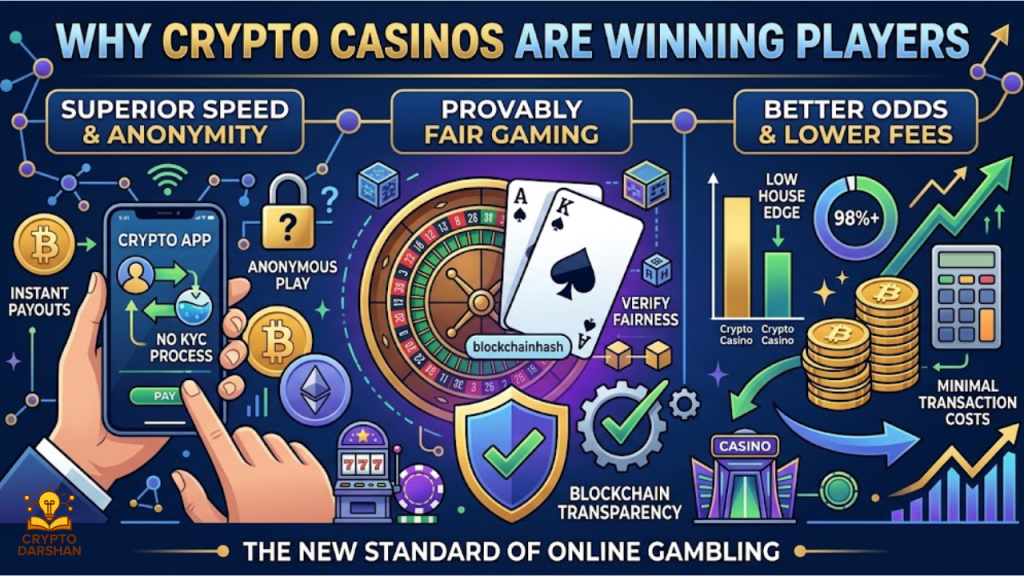
Several factors explain crypto gambling’s rapid ascent:
- Speed and cost: Transactions settle in minutes (or seconds) with minimal fees, compared to days for traditional bank withdrawals.
- Privacy and accessibility: Many platforms require little to no KYC (Know Your Customer) verification, appealing to users in restricted jurisdictions.
- Global reach: Crypto casinos operate across borders, sidestepping the licensing and regulatory hurdles that constrain fiat operators.
- Tech-savvy audience: A new generation of bettors, comfortable with digital assets and DeFi, finds crypto-native platforms more intuitive.
Major operators like Stake have reported close to $4.7 billion in GGR for 2024 alone, putting them in the same league as traditional giants like Entain ($5 billion) and Flutter Entertainment ($14 billion).
Regulatory Landscape: A Patchwork of Rules
Unlike the UK’s tightly regulated Gambling Commission framework, crypto gambling operates in a legal gray zone across much of the world. Some jurisdictions, like Curaçao, have begun introducing compliance measures specifically for crypto operators, including mandatory wallet screening and a preference for fiat-backed stablecoins.
In the United States, the picture is even more fragmented. States like Hawaii maintain strict anti-gambling stances, while others are exploring how to tax and regulate crypto-based betting. The rise of prediction markets like Polymarket has further complicated the regulatory picture, testing the limits of what traditional financial institutions and regulators will tolerate.
For players, this means:
- Licensed crypto casinos (e.g., those holding Curaçao or Malta licenses) offer more consumer protections but may require KYC.
- Unlicensed platforms provide greater anonymity but carry higher risks of fraud or sudden shutdowns.
- Stablecoins dominate: By 2026, USDT and USDC had become the default deposit currencies for most crypto casinos, reducing volatility concerns for both players and operators.
Crypto vs. Traditional Online Gambling: Key Differences
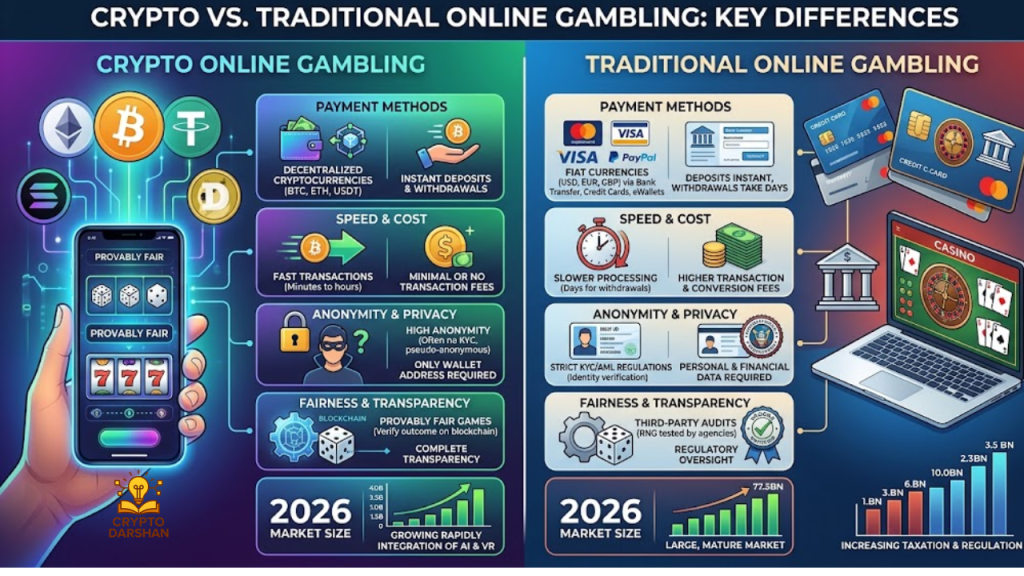
| Feature | Traditional Online Casinos | Crypto Casinos |
|---|---|---|
| Payment Methods | Bank transfers, credit cards, e-wallets | Bitcoin, Ethereum, stablecoins, altcoins |
| Payout Speed | 1–5 business days | Minutes to hours |
| KYC Requirements | Mandatory in regulated markets | Often optional or minimal |
| Licensing | UKGC, MGA, state-level US licenses | Curaçao, offshore, or unlicensed |
| Game Fairness | RNG audited by third parties | Provably fair algorithms on-chain |
| Market Reach | Restricted by jurisdiction | Global, borderless |
The Road Ahead: Convergence or Divergence?

As crypto gambling continues to scale, the line between traditional and digital betting is blurring. Major fiat operators like Flutter and DraftKings are exploring crypto payment rails, while crypto-native platforms are pursuing formal licenses to gain legitimacy.
For the UK’s £4.5B+ online market, the challenge is clear: maintain player protections and tax revenue without driving users toward unregulated offshore crypto sites. For global crypto gambling, the question is whether increased regulation will stifle innovation or bring the sector into the mainstream.
One thing is certain: with over 659 million crypto users worldwide in 2025 (projected to reach 741 million in 2026), the audience for digital betting is only growing. Whether through licensed hybrid platforms or decentralized protocols, crypto gambling is no longer a sideshow—it’s a central player in the future of online betting.