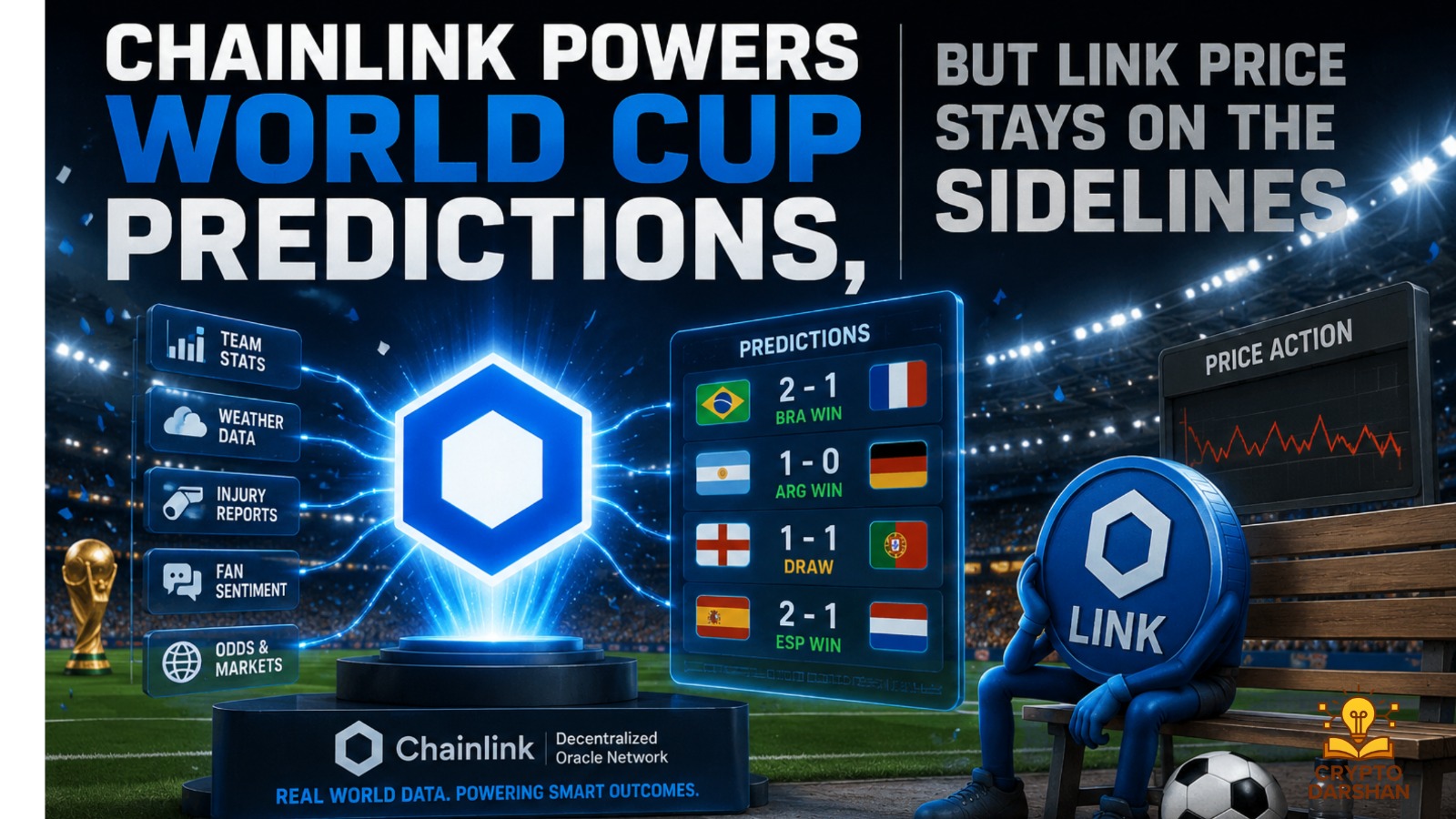
Chainlink has landed a high-profile role in the 2026 FIFA World Cup prediction markets, putting its oracle technology in front of a massive global audience. Platforms like Myriad and other prediction providers are using Chainlink as their exclusive oracle to automatically pull live match data and settle bets in real time. For the Chainlink ecosystem, this is a textbook real-world use case: bringing off-chain sports results on-chain in a secure and verifiable way.
What makes this deal stand out is the scale and visibility. Prediction platforms are targeting billions of football fans, with some contests dangling six-figure prize pools and processing large trading volumes around World Cup matches. Chainlink sits at the core of this flow, quietly feeding scores and outcomes to smart contracts so they can pay out winners without delays or manual intervention.
How Chainlink Actually “Settles” the World Cup
To understand why this matters, it helps to simplify what Chainlink does here. Chainlink is a decentralized oracle network that brings real-world data, like sports scores, into smart contracts so they can execute automatically. For the World Cup, the oracles pull official match results from trusted sports data providers and deliver them to prediction market contracts on-chain.
Instead of one central server submitting results, multiple independent Chainlink nodes verify and transmit the data, which helps reduce manipulation or single points of failure. In some integrations, partners also combine it with specialized data firms and infrastructure, using the Chainlink Runtime Environment to automate market creation, resolution, and settlement. The outcome is simple for users: once the referee blows the final whistle, the market can be resolved and payouts processed almost instantly.
Why This Is a Big Showcase for Chainlink
From a technology and adoption angle, the World Cup deal is a huge showcase. Chainlink has long positioned itself as the “industry-standard” oracle layer for DeFi, gaming, and other smart contract use cases. World Cup prediction markets let Chainlink demonstrate that same infrastructure in a mainstream, high-pressure environment where uptime, accuracy, and speed really matter.
This is also part of a broader push where Chainlink is working with traditional finance and institutions through products like CCIP (Cross-Chain Interoperability Protocol) and cross-chain settlement solutions. The World Cup partnership fits into that narrative: link aims to be the middleware that connects any real-world system—whether it is sports data, financial markets, or government statistics—to blockchain applications.
But LINK Price Action Tells a Different Story
Despite the strong fundamentals and headline partnerships, LINK’s market performance often does not instantly mirror the growth in use cases. Even with the World Cup integration, traders have seen episodes where LINK’s price remains range-bound or reacts only modestly to major news. This is a familiar pattern in crypto: utility and price can move on very different timelines.
Several factors can explain this disconnect. First, overall crypto sentiment and macro conditions can overshadow project-specific news, especially during periods of risk-off behavior in broader markets. Second, many of Chainlink’s integrations are infrastructure-level deals that accrue value slowly over time, rather than triggering immediate speculative spikes. Finally, market participants may already “price in” Chainlink’s role as the default oracle, so even big wins are seen as confirmation rather than a surprise.
Understanding LINK’s Token Dynamics

To appreciate why more usage does not always equal instant price jumps, it helps to look at how the LINK token functions. LINK is used to pay oracle nodes for providing data and running services on the network. Node operators often stake or lock LINK as collateral to signal reliability, and higher-quality nodes with more at stake can attract more jobs and fees.
As more World Cup markets, DeFi platforms, and institutional pilots use LINK, demand for oracle services rises, which over time can lead to higher token usage and staking. However, this effect builds gradually and can be masked in the short term by broader market cycles, profit-taking, and speculative rotations into other hot narratives. For long-term holders, the key question is whether sustained adoption translates into a steadily growing economic layer around LINK rather than short-lived hype.
What This Means for Chainlink and Crypto Markets

The World Cup prediction markets highlight an important point: real-world adoption does not always come with flashy price candles, but it does deepen the foundations of a project. Chainlink is quietly embedding itself wherever smart contracts need trustworthy data, from sports and gaming to DeFi and tokenized assets.
For traders, this creates a tension. On one side, there is the temptation to chase faster-moving coins. On the other, Chainlink’s growing list of high-stakes use cases suggests a slow but solid build-out of real utility. Whether LINK eventually “catches up” in price may depend less on one event like the World Cup and more on how much value flows through its oracle and cross-chain infrastructure over the next several cycles.