

Cardano’s blockchain has activated the Van Rossem hard fork, a protocol upgrade that — for the first time at this level — was approved end-to-end through community governance. This upgrade moves the network to Protocol Version 11 and represents a meaningful step toward community-led evolution and improved smart-contract efficiency on Cardano’s mainnet.
What the Van Rossem hard fork is
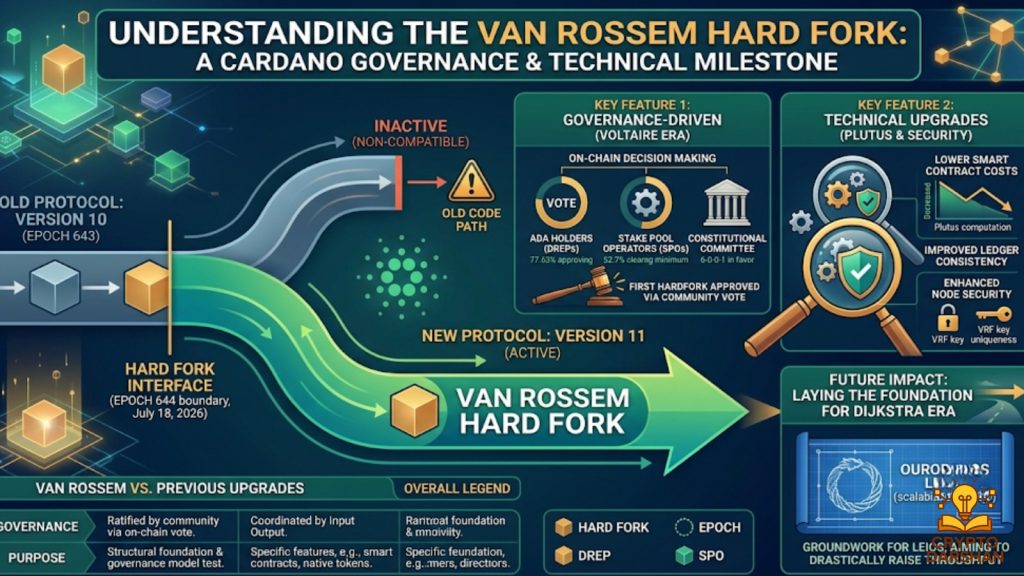
- The Van Rossem hard fork is a protocol-level upgrade that was scheduled and executed after on‑chain ratification by Cardano governance participants.
- The activation moved Cardano from protocol version 10 to version 11, with the change applied on mainnet during the designated epoch transition.
- It bundles a set of proposed Cardano Improvement Proposals (CIPs) and fixes that target costs, performance, and security of the platform.
Why this upgrade matters
- This is the first protocol upgrade in which the community—not the original developers acting alone—completed the entire approval process, showing Cardano’s governance model functioning as designed
- Community approval demonstrates the network’s shift toward decentralized decision-making, where ADA holders, delegated representatives and stake pool operators all play defined roles in upgrades.
- The change lays groundwork for future scalability and cost-efficiency improvements because lowering smart-contract execution overhead and applying security fixes helps foster dApp development and broader on‑chain activity.
How the vote unfolded

- The Van Rossem proposal required sign-off across Cardano’s tripartite governance process; results show different voting margins from each body.
- Delegated representatives (DReps) voted strongly in favor, with roughly 79% approval, comfortably above the required threshold.
- The constitutional committee confirmed the proposal complied with the Cardano Constitution, with unanimous agreement among its members.
- Stake pool operators — the entities that run the network’s validator nodes — approved the upgrade by the slimmest margin (just above 50%), highlighting that governance outcomes can be closely contested in a decentralized system.coindesk+1
What changed technically (high level)
- The fork included several CIPs and at least one VRF (verifiable random function) security fix, plus optimizations aimed at reducing smart-contract costs for developers and users.
- Wallet users generally did not need to take action, as the fork was implemented at the node/protocol level; however, protocol-level upgrades still require coordination between infrastructure operators and client software maintainers.
- By moving to protocol version 11, Cardano opens the door to further upgrades and proposals that depend on this foundation.
Market and ecosystem reaction

- News coverage around the activation mixed technical explanation with market context: some traders adjusted positions ahead of activation while on‑chain observers tracked vote tallies and operator support
- Commentators emphasize the symbolic importance: the community’s ability to approve a hard fork end-to-end is a milestone for Cardano’s Voltaire governance era.
- Developers and protocol watchers are now watching for follow-up CIPs and how the changes impact dApp deployments and transaction costs.
What this means for Cardano’s future

- The Van Rossem fork proves the governance process can successfully deliver protocol updates, which should accelerate roadmap items that depend on broad community buy‑in.
- Close votes among stake pool operators underscore that Cardano’s governance is competitive and that reaching consensus may sometimes be narrow — a normal outcome for decentralized systems
- With the governance mechanism validated, the community can now more confidently propose and pass upgrades aimed at scalability, composability, and developer experience.
Illustrative example
- Imagine a dApp developer who was hesitating to deploy a complex smart contract because of execution costs; the Van Rossem optimizations aim to lower those costs, making deployment more attractive and potentially increasing on‑chain activity.
Takeaway
- The Van Rossem hard fork is a technical and governance milestone: it upgrades Cardano to Protocol Version 11 while being the first protocol-level change fully approved through the community’s voting process.
- The narrow approval from some governance bodies highlights decentralization in practice, and the technical tweaks should help lower smart‑contract costs and support future growth.