
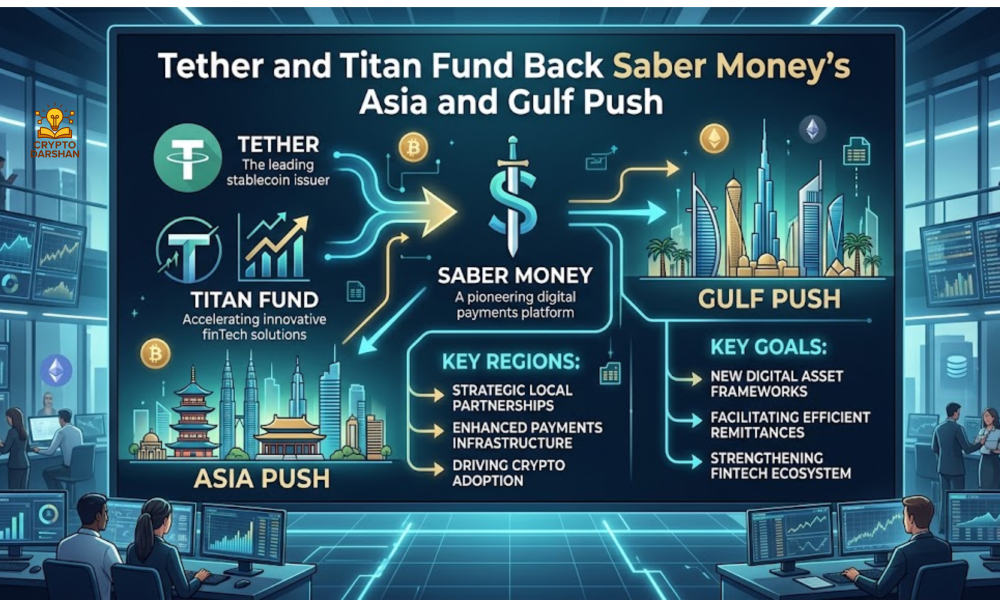
Stablecoin issuer Tether and CMCC Global’s Titan Fund have invested in Saber Money, a cross-border payments company that uses stablecoins to move funds between businesses and financial institutions. Saber will use the funding to expand across Asia-Pacific and the Gulf, seek new licenses and build more banking partnerships.
What Saber Money does
Saber provides payment infrastructure that lets banks, fintech companies and businesses send money internationally using stablecoins. Its services cover remittances, payroll and other business payments through application programming interfaces.
The company says its system can operate around the clock, allowing clients to start transfers outside traditional banking hours. More than 90% of its payments are completed in under one minute, according to Saber.
Saber’s corporate group also operates Mudrex, an Indian cryptocurrency exchange. The company currently holds licenses, registrations and authorizations in Canada, the European Union, India and Australia.
Funding details remain limited

Saber did not disclose how much money it raised or the valuation implied by the investment. The company says Tether and Titan Fund are strategic backers, joining existing investors Y Combinator and Nexus Ventures.
The capital will support expansion into new payment corridors and stronger operations in existing markets. Saber says local banking relationships and regulatory approvals will be central to its growth plan, especially in markets where international transfers remain costly or require several intermediaries.
The company plans to develop payment products for businesses paying overseas suppliers, managing corporate treasury operations and moving working capital between countries.
Why Tether is investing
Tether CEO Paolo Ardoino described emerging markets as an important area for stablecoin payment adoption. He pointed to Saber’s regulatory presence and access to financial systems across Asia and the Middle East.
Ardoino said stablecoin settlement could reduce the costs of international payments, particularly for businesses that depend on multiple financial intermediaries. Traditional cross-border payments can involve correspondent banks, currency conversion and compliance checks, which may add time and cost.
Tether’s investment follows similar moves in the payments sector. In May, it backed LemFi to support USDT settlement for remittances between developed economies and markets in Africa and Asia. Earlier this month, it also invested in EFY Finance, a Latin American fintech offering stablecoin payment services across 17 countries.
Asia and the Gulf are key markets

Asia accounts for about 35% of global payment flows, according to figures cited in Saber’s announcement. South Asia and East Asia and the Pacific together receive more than $1 trillion each year, while the United Arab Emirates recorded about AED 188 billion in outbound remittances in 2025.
Titan Fund co-founder and managing partner Shiau Sin Yen said Asia contributes roughly 53% of global remittance flows. He also cited a projection that cross-border business-to-business stablecoin payments could reach $5 trillion by 2035, although the announcement did not identify the source of that estimate.
Saber sees international trade, migration and digital commerce as the main forces behind demand for faster and cheaper payments in Asia and the Gulf. The company has not named the specific countries it will enter next or the licenses it plans to pursue.
Strong growth, limited disclosure
Saber says its payment volumes grew more than sixfold over the past nine months. It says it has processed billions of dollars across more than 40 countries.
However, the company did not provide a detailed breakdown of volumes by market, the average transaction size, or the exact definition of “payment volumes.” Investors and customers should therefore treat the growth figures as company-reported metrics rather than independently audited results.
The company’s speed claim is also based on its own reporting. Saber says more than 90% of payments settle in under a minute, but it did not publish methodology, transaction samples or a comparison with traditional payment rails.
The challenge of local-currency settlement

Stablecoin transfers can move value quickly, but turning those funds into local currency still requires banking access, liquidity and local compliance. Gravity Team CEO Mārtiņš Beņķītis said in August that stablecoin payments can settle within seconds, but conversion into local currencies depends on banking connections and market liquidity.
This is why Saber’s plan to secure direct access to local banking networks matters. Direct banking relationships could help the company lower settlement costs, improve payout reliability and offer services tailored to individual markets.
Other companies are pursuing the same opportunity. In September, Fin.com raised $20 million in seed funding to build stablecoin payment services across South Asia, Africa and the Middle East. Fin.com says its infrastructure supports more than 40 currencies and payouts in over 30 countries.
What comes next for Saber
Saber has not announced a launch schedule for its planned business-to-business payment products. It also has not identified the new payment corridors, licenses or banking partners it intends to add.
The investment gives Saber more resources to compete in cross-border payments, but success will depend on execution. The company must win regulatory approvals, maintain banking access, manage liquidity and prove that stablecoin-based payments can deliver lower costs and reliable service at scale.