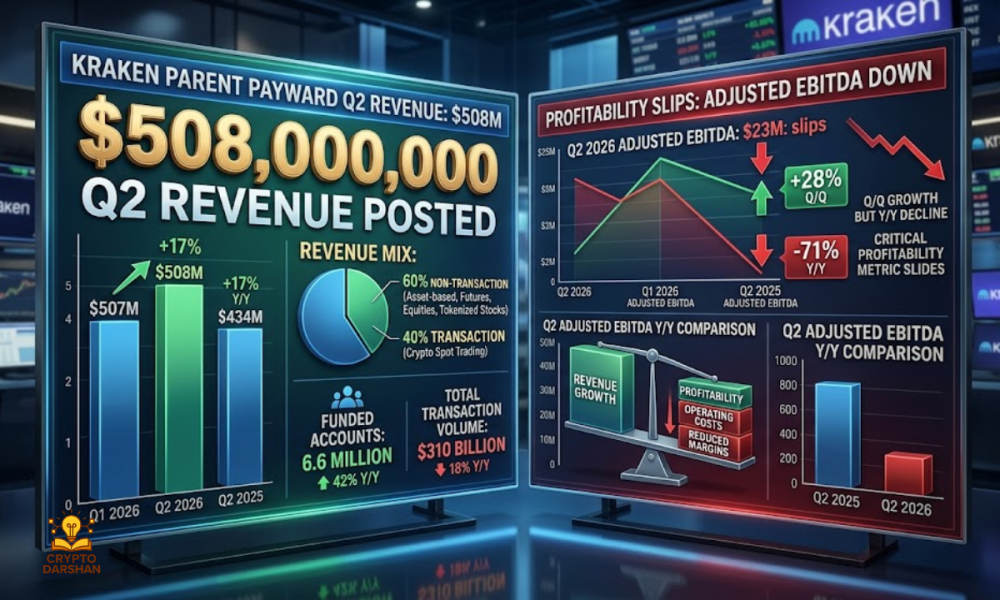
Payward, the parent company of crypto exchange Kraken, reported $508 million in adjusted revenue for the second quarter of 2026, a 17% increase from the same period last year. However, the company’s adjusted EBITDA—a key profitability metric—fell sharply to $23 million, down from $80 million in Q2 2025. The results highlight a mixed quarter: strong revenue and user growth, but weaker trading volumes and a significant drop in earnings.
Revenue Up, But Earnings Under Pressure
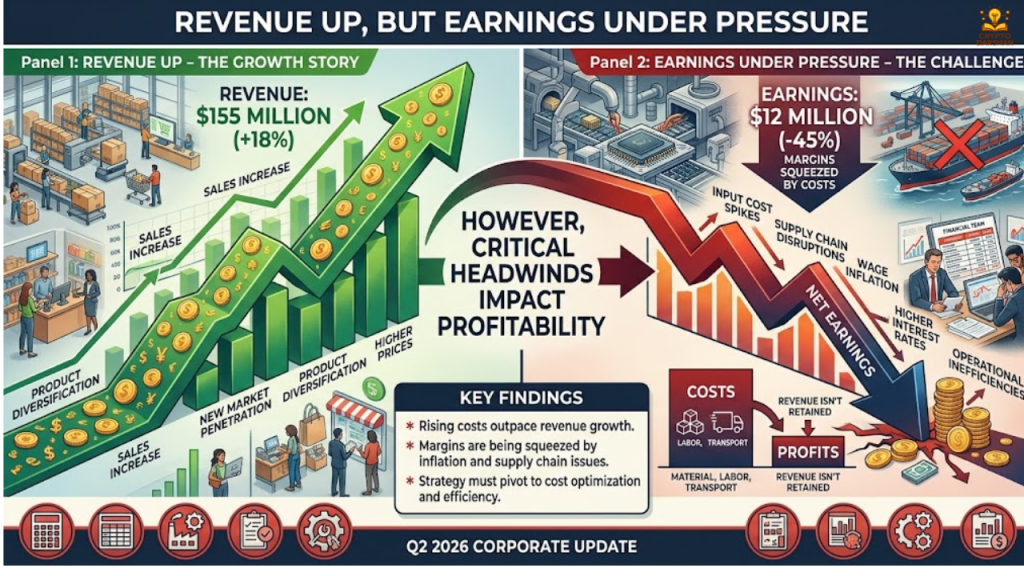
Payward disclosed its Q2 results on August 14, showing that revenue continued to climb even as profitability came under pressure. Adjusted revenue reached $508 million, up from $432 million in the second quarter of 2025. At the same time, adjusted EBITDA dropped by more than 70%, falling from $80 million to just $23 million.
The company did not report net income in this release. Payward has previously described both adjusted revenue and adjusted EBITDA as management-level metrics that exclude certain expenses, meaning they are not direct GAAP measures but are used internally to track performance.
Transaction Volume Declines Amid Shift in Revenue Mix
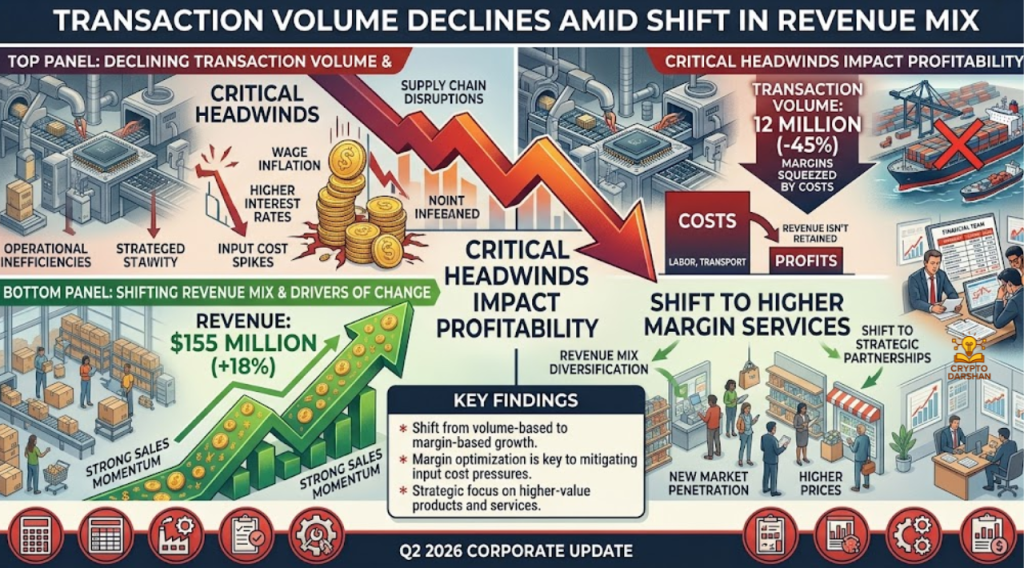
A key driver behind the earnings drop was a decline in overall trading activity. Total platform transaction volume fell 18% year over year to $310 billion, with Payward pointing to weaker crypto spot trading as a major factor. Despite this, the company noted growth in other areas, including traditional futures, equities, and tokenized equities. Futures daily average revenue trades rose 8% during the quarter.
Revenue also became less reliant on transaction fees. Asset-based and other revenue made up 60% of total revenue, up from 55% a year earlier. Payward said this shift reflects income generated from assets and services around its trading operations, rather than a retreat from trading itself.
At the end of the quarter, assets on the platform stood at $40 billion. The company also reported $65 billion in “Real Assets on Platform,” a metric that holds prices at Q2 2025 levels to remove market-price effects. On this adjusted basis, assets grew 48% year over year.
To understand how crypto exchanges generate revenue, see our guide on how crypto exchanges make money.
Funded Accounts Hit Record High—With a Caveat
Payward reported 6.6 million funded accounts in Q2 2026, a 42% increase from the prior year and the highest level in its history. However, direct comparison with Kraken’s previously published figure of 4.4 million funded accounts for Q2 2025 requires caution.
The newer Payward definition counts distinct funded accounts across its platforms and products, and it counts sub-accounts separately. In contrast, Kraken’s 2025 disclosure described funded accounts as funded customers with balances above zero. The reporting perimeter has also expanded as Payward integrated acquired businesses such as NinjaTrader and Bitnomial.
Bitnomial Deal Reshapes Payward’s U.S. Derivatives Strategy

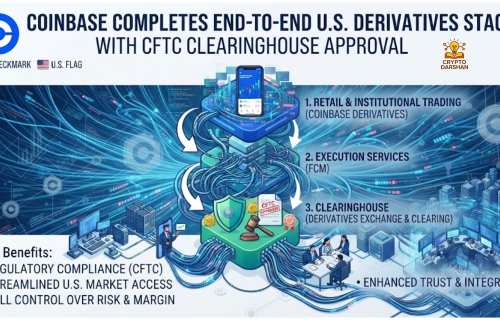
A major strategic development in the quarter was Payward’s acquisition of Bitnomial, which closed on May 1. The $550 million deal gave Payward a vertically integrated U.S. derivatives stack, including a CFTC-regulated designated contract market, clearing organization, and futures commission merchant.
Payward said this infrastructure supported regulated U.S. perpetual futures and spot margin products during Q2. Separately, a July CFTC letter shows that Kraken is reconsidering the future of Kraken Derivatives Exchange—the former Small Exchange it acquired in 2025—including potential partnerships or a sale following the Bitnomial transaction.
Payward’s broader regulatory push remains in progress. The Office of the Comptroller of the Currency (OCC) still lists Payward National Trust Company’s May 8 charter application among pending digital-asset licensing requests. If approved, the proposed national trust company would give Payward a federally supervised custody entity.
What’s Next: Tokenization, Banking, and More Acquisitions
Looking ahead, Payward outlined a second-half strategy focused on expanding trading products, banking services, tokenization, payments, and infrastructure sold to third-party platforms. The company completed its Reap acquisition on July 1 and has agreed to acquire Magic Labs’ wallet infrastructure business, though that deal has not yet closed.
Tokenized equities remain a central part of this plan. Payward recently expanded its xStocks product beyond U.S. equities through a partnership with GTN, while Kraken has begun allowing eligible users to use selected tokenized stocks as collateral.
Bottom Line: Growth With Profitability Questions

Payward’s Q2 results present a mixed picture for investors and users. Revenue and funded accounts both increased, signaling continued growth in the business and its user base. At the same time, transaction volume fell and adjusted EBITDA dropped sharply from $80 million to $23 million, raising questions about near-term profitability.
The next financial report will show whether Payward can maintain revenue growth while restoring earnings momentum. For now, the company is betting that its expanded product suite, U.S. derivatives infrastructure, and push into tokenization and banking will support long-term value—even as short-term profitability faces headwinds