The cryptocurrency market has evolved far beyond simple spot trading. As digital assets mature, traders and institutions increasingly turn to crypto derivatives platforms to hedge risk, speculate on price movements, and gain leveraged exposure to the market. These platforms have become a cornerstone of modern crypto finance, offering tools similar to those found in traditional financial markets but adapted for the unique dynamics of blockchain-based assets.
Many beginners also combine derivatives trading with automated strategies like copy trading. If you’re new to this concept, read our guide on Copy Trading Crypto: Pros, Cons, and Hidden Risks Beginners Miss to understand how traders replicate professional strategies in crypto markets.
This comprehensive guide explores everything about crypto derivatives platforms — including their types, functions, benefits, risks, and how to choose the right platform. It also examines the regulatory landscape, common trading strategies, and the future of derivatives in the evolving digital asset economy.
What Are Crypto Derivatives?

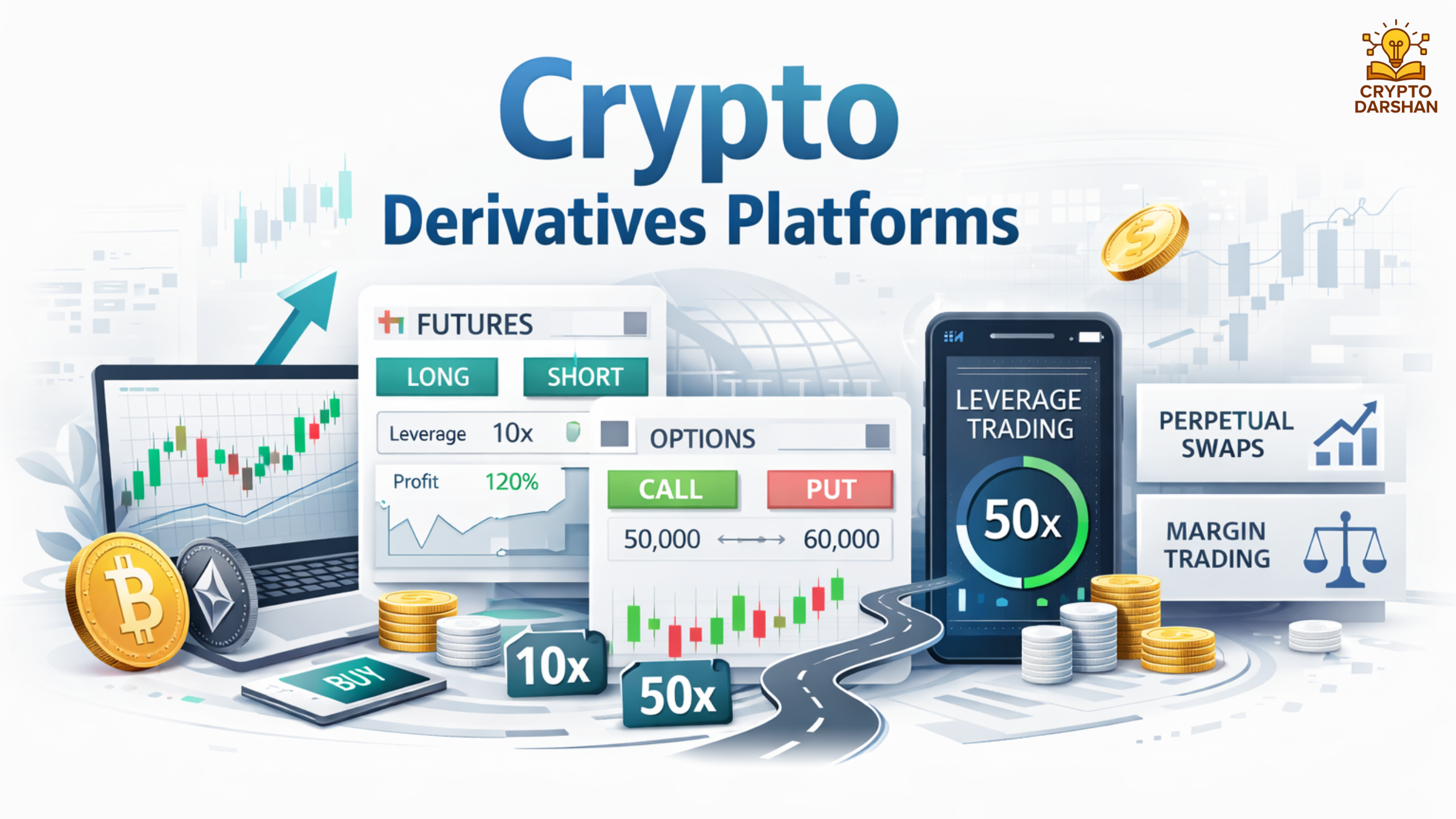
Crypto derivatives are financial contracts whose value is derived from the price of an underlying cryptocurrency, such as Bitcoin or Ethereum. Instead of owning the actual coins, traders speculate on their future price movements.
Key Characteristics
- Underlying Asset: The cryptocurrency that determines the contract’s value.
- Leverage: Allows traders to control larger positions with smaller capital.
- Settlement: Can be in crypto or fiat currency.
- Expiration: Some contracts have fixed expiry dates, while others (like perpetual swaps) do not.
Common Types of Crypto Derivatives
- Futures Contracts: Agreements to buy or sell a cryptocurrency at a predetermined price on a specific date.
- Options Contracts: Give the holder the right, but not the obligation, to buy or sell an asset at a set price before expiration.
- Perpetual Swaps: Similar to futures but without an expiry date, allowing continuous trading.
- Forwards: Customized contracts between two parties to trade an asset at a future date.
- CFDs (Contracts for Difference): Allow traders to speculate on price changes without owning the underlying asset.
The Evolution of Crypto Derivatives Platforms

The first crypto derivatives appeared around 2014, but the market gained real traction after 2017 when Bitcoin futures launched on major exchanges like CME and CBOE. Since then, dozens of specialized platforms have emerged, offering advanced trading tools, high leverage, and deep liquidity.
Key Milestones
- 2014: BitMEX introduces Bitcoin perpetual swaps.
- 2017: CME and CBOE launch regulated Bitcoin futures.
- 2019–2021: Binance, Bybit, and FTX expand derivatives offerings.
- 2022–2024: Institutional adoption grows, with more regulated exchanges entering the space.
How Crypto Derivatives Platforms Work
Crypto derivatives platforms function as intermediaries that match buyers and sellers of derivative contracts. They provide the infrastructure for order execution, margin management, and risk control.
Core Components
- Trading Engine: Processes orders and matches trades in real time.
- Margin System: Determines how much collateral is required to open and maintain positions.
- Liquidation Mechanism: Automatically closes positions when margin requirements are not met.
- Funding Rate System: Keeps perpetual swap prices aligned with spot market prices.
- Risk Management Tools: Include stop-loss orders, take-profit levels, and insurance funds.
Example Workflow
- A trader deposits collateral (e.g., USDT or BTC).
- The trader opens a leveraged position on a futures or perpetual contract.
- The platform calculates margin requirements and monitors risk.
- When the position is closed, profits or losses are settled in the chosen currency.
Benefits of Trading Crypto Derivatives

1. Leverage and Capital Efficiency
Derivatives allow traders to amplify exposure with less capital. For example, 10x leverage means controlling $10,000 worth of Bitcoin with only $1,000 in margin.
2. Hedging Against Volatility
Investors can hedge spot holdings by taking opposite positions in derivatives. This reduces exposure to price swings.
3. Speculative Opportunities
Traders can profit from both rising and falling markets by going long or short.
4. Price Discovery
Derivatives markets contribute to more accurate price discovery by reflecting market sentiment and expectations.
5. Liquidity and Market Depth
High trading volumes on derivatives platforms enhance liquidity, making it easier to enter and exit positions.
Risks of Crypto Derivatives Trading

1. Leverage Risk
While leverage magnifies profits, it also increases potential losses. A small price movement can liquidate a highly leveraged position.
2. Market Volatility
Cryptocurrency prices can change rapidly, leading to unexpected losses.
3. Counterparty Risk
If a platform fails or is hacked, traders may lose funds.
4. Regulatory Uncertainty
Different jurisdictions have varying rules for derivatives trading, which can affect platform operations.
5. Liquidation Risk
Automated liquidation systems can close positions abruptly if margin requirements are not met.
Major Crypto Derivatives Platforms
1. Binance Futures
- Overview: One of the largest derivatives exchanges by volume.
- Features: Up to 125x leverage, perpetual and quarterly futures, cross and isolated margin.
- Advantages: Deep liquidity, robust security, and wide asset selection.
2. Bybit
- Overview: Known for its user-friendly interface and advanced trading tools.
- Features: Perpetual contracts, copy trading, and risk management tools.
- Advantages: Fast execution, transparent funding rates, and strong community support.
3. OKX
- Overview: Offers futures, options, and perpetual swaps.
- Features: Multi-collateral margin, unified account system, and institutional-grade tools.
- Advantages: High liquidity and diverse product range.
4. Deribit
- Overview: Specializes in Bitcoin and Ethereum options.
- Features: Advanced options strategies, low latency, and professional-grade analytics.
- Advantages: Deep options liquidity and strong reputation among institutional traders.
5. Bitget
- Overview: Focuses on social and copy trading.
- Features: Perpetual contracts, futures, and spot integration.
- Advantages: User-friendly design and community-driven features.
6. CME Group
- Overview: A regulated U.S. exchange offering Bitcoin and Ethereum futures.
- Features: Institutional-grade infrastructure and compliance.
- Advantages: Trusted by traditional investors and institutions.
How to Choose the Right Crypto Derivatives Platform

1. Regulation and Security
Select platforms with strong regulatory oversight and proven security measures, such as cold storage and multi-signature wallets.
2. Liquidity and Volume
Higher liquidity ensures tighter spreads and better execution.
3. Leverage Options
Choose leverage levels that align with risk tolerance and trading strategy.
4. Fees and Funding Rates
Compare trading fees, funding rates, and withdrawal costs.
5. User Interface and Tools
A clean, intuitive interface with advanced charting tools enhances trading efficiency.
6. Customer Support
Reliable customer service is essential for resolving issues quickly.
Trading Strategies for Crypto Derivatives

1. Hedging Strategy
Used to protect existing spot positions from adverse price movements. For example, a long-term Bitcoin holder might short Bitcoin futures to offset potential losses.
2. Arbitrage Strategy
Exploits price differences between exchanges or between spot and futures markets.
3. Scalping
Involves making multiple small trades to profit from minor price fluctuations.
4. Swing Trading
Focuses on capturing medium-term price movements over days or weeks.
5. Spread Trading
Involves taking opposite positions in related contracts to profit from price differentials.
The Role of Leverage in Crypto Derivatives

Leverage is a defining feature of derivatives trading. It allows traders to control large positions with minimal capital, but it also increases risk exposure.
Example
- Without Leverage: A trader buys 1 BTC at $60,000. If the price rises to $66,000, the profit is $6,000.
- With 10x Leverage: The same move yields a $60,000 profit on a $6,000 margin — but a 10% drop would result in liquidation.
Managing Leverage
- Use stop-loss orders.
- Avoid maximum leverage.
- Monitor margin levels regularly.
Regulatory Landscape of Crypto Derivatives

Regulation varies widely across jurisdictions. Some countries embrace derivatives trading, while others restrict or ban it.
United States
- Regulated by the Commodity Futures Trading Commission (CFTC).
- Only licensed exchanges like CME can offer crypto futures.
European Union
- Governed by MiFID II and ESMA guidelines.
- Focus on investor protection and transparency.
Asia
- Singapore and Japan have clear frameworks for derivatives trading.
- China bans crypto derivatives trading.
Emerging Markets
Countries like India and Brazil are developing regulatory frameworks to balance innovation and risk management.
Institutional Adoption of Crypto Derivatives

Institutions increasingly use derivatives for hedging and portfolio diversification. The availability of regulated products like CME Bitcoin futures has made crypto exposure more accessible to traditional investors.
Drivers of Institutional Interest
- Regulatory clarity
- Custody solutions
- Market maturity
- Integration with traditional finance systems
Institutional Products
- Bitcoin and Ethereum futures
- Options for risk management
- Structured products combining crypto and traditional assets
The Future of Crypto Derivatives Platforms

The next phase of growth will likely focus on decentralized derivatives, cross-chain trading, and AI-driven risk management.
Key Trends
- Decentralized Derivatives (DeFi): Platforms like dYdX and GMX enable on-chain derivatives trading without intermediaries.
- Tokenization of Derivatives: Smart contracts automate settlement and collateral management.
- Integration with Traditional Finance: Hybrid platforms bridging crypto and traditional markets.
- AI and Automation: Predictive analytics and algorithmic trading for better risk control.
- Regulatory Evolution: Clearer global standards to protect investors and encourage innovation.
As blockchain evolves into a foundational layer for financial systems, derivatives trading may increasingly move on-chain — a shift explored in Blockchain as Public Infrastructure: The New Digital Railways.
Best Practices for Safe Derivatives Trading

- Start Small: Begin with low leverage and small positions.
- Use Stop-Loss Orders: Protect against sudden market reversals.
- Diversify: Avoid concentrating all capital in one asset or position.
- Stay Informed: Monitor market news and funding rates.
- Choose Reputable Platforms: Prioritize exchanges with strong security and transparency.
Advanced Concepts in Crypto Derivatives

1. Funding Rates and Perpetual Swaps
Funding rates are periodic payments exchanged between long and short traders to keep perpetual contract prices close to spot prices. When the funding rate is positive, long traders pay shorts; when negative, shorts pay longs.
2. Basis Trading
Basis trading involves exploiting the difference between spot and futures prices. Traders buy the asset in the spot market and sell futures when futures prices are higher, locking in a risk-free profit.
3. Options Greeks
Options traders use “Greeks” to measure risk:
- Delta: Sensitivity to price changes.
- Gamma: Rate of change of delta.
- Theta: Time decay of an option’s value.
- Vega: Sensitivity to volatility.
4. Collateral Management
Platforms now allow multiple collateral types, including stablecoins and altcoins, to reduce liquidation risk and improve capital efficiency.
The Role of Decentralized Derivatives Platforms

Decentralized derivatives platforms operate on blockchain networks, allowing users to trade directly from their wallets without intermediaries.
Advantages
- Transparency: All transactions are recorded on-chain.
- Custody Control: Users retain control of their funds.
- Global Access: No geographic restrictions.
Challenges
- Liquidity Constraints: Lower trading volumes than centralized exchanges.
- Smart Contract Risks: Vulnerabilities can lead to losses.
- Complex User Experience: Requires technical knowledge.
Leading DeFi Derivatives Platforms
- dYdX: Offers perpetual contracts with decentralized order books.
- GMX: Uses a liquidity pool model for perpetual swaps.
- Synthetix: Enables synthetic asset creation and derivatives exposure.
The Impact of Technology on Derivatives Trading

1. Artificial Intelligence
AI algorithms analyze market data to predict trends, optimize strategies, and manage risk dynamically.
2. Blockchain Integration
Smart contracts automate settlement, margin calls, and liquidation, reducing human error.
3. Cross-Chain Solutions
Interoperability protocols allow derivatives trading across multiple blockchains, improving liquidity and efficiency.
4. High-Frequency Trading (HFT)
Advanced bots execute thousands of trades per second, exploiting micro-opportunities in price movements.
Economic Importance of Crypto Derivatives
Crypto derivatives contribute to the broader financial ecosystem by:
- Enhancing market efficiency.
- Providing hedging tools for miners and investors.
- Supporting institutional participation.
- Driving innovation in financial engineering.
They also influence spot market prices, as derivatives often lead price movements due to speculative activity.
Common Mistakes to Avoid in Derivatives Trading

- Overusing Leverage: Excessive leverage leads to rapid liquidation.
- Ignoring Funding Rates: High funding costs can erode profits.
- Neglecting Risk Management: Failing to set stop-losses increases exposure.
- Trading Without Strategy: Random trades often result in losses.
- Following Hype: Emotional trading based on social media trends is risky.
Educational Resources for Derivatives Traders

- Exchange Academies: Binance Academy, Bybit Learn, and OKX Learn offer free tutorials.
- Books: “Options, Futures, and Other Derivatives” by John Hull provides foundational knowledge.
- Online Courses: Platforms like Coursera and Udemy offer structured learning paths.
- Communities: Reddit, Discord, and Telegram groups share insights and strategies.
The Future Outlook: 2025 and Beyond

The crypto derivatives market is expected to surpass trillions in daily volume as institutional adoption grows. Innovations like tokenized derivatives, AI-driven trading bots, and cross-chain liquidity pools will redefine how traders interact with digital assets.
Regulatory clarity will attract more traditional investors, while decentralized platforms will empower retail traders globally. The convergence of technology, finance, and regulation will create a more mature, transparent, and efficient derivatives ecosystem.
The Role of Stablecoins in Derivatives Trading

Stablecoins such as USDT, USDC, and DAI play a crucial role in derivatives markets. They serve as collateral, settlement currency, and a hedge against volatility.
- Collateral Efficiency: Stablecoins reduce exposure to crypto price swings.
- Liquidity Support: They provide consistent liquidity across exchanges.
- Cross-Border Accessibility: Stablecoins enable global participation without fiat conversion delays.
As stablecoin regulation improves, their integration into derivatives platforms will deepen, enhancing stability and transparency.
Environmental and Ethical Considerations

The rise of crypto derivatives also raises questions about sustainability and ethics.
- Energy Consumption: Platforms built on proof-of-work blockchains face scrutiny for high energy use.
- Market Manipulation: High leverage and unregulated trading can lead to artificial volatility.
- Transparency: Ethical platforms disclose funding rates, liquidation data, and insurance fund usage.
Sustainable practices, such as using proof-of-stake networks and transparent reporting, are becoming industry standards.
Crypto Derivatives Platforms – FAQ

1. What are crypto derivatives platforms?
Crypto derivatives platforms are trading platforms that allow users to trade financial contracts whose value is derived from cryptocurrencies like Bitcoin or Ethereum.
Instead of buying the actual asset, traders speculate on the future price movement using contracts such as futures, options, and perpetual swaps.
2. How are derivatives different from spot trading?
- Spot trading: You buy and own the cryptocurrency directly.
- Derivatives trading: You trade contracts based on the asset’s price without owning the asset itself.
For example, a trader can speculate on the price of Bitcoin rising or falling without holding BTC.
3. What types of crypto derivatives are commonly traded?
Futures Contracts
Agreements to buy or sell crypto at a predetermined price on a specific future date.
Perpetual Futures (Perpetual Swaps)
Similar to futures but with no expiration date, allowing traders to hold positions indefinitely.
Options Contracts
Give traders the right, but not the obligation, to buy or sell crypto at a predetermined price.
4. What are the most popular crypto derivatives platforms?
Some well-known platforms include:
- Binance
- Bybit
- OKX
- Deribit
- BitMEX
These platforms offer futures, perpetual contracts, and options with advanced trading tools.
5. What is leverage in crypto derivatives?
Leverage allows traders to borrow funds to increase trading position size.
Example:
- With 10× leverage, a $100 deposit controls a $1000 position.
While leverage can amplify profits, it also increases the risk of liquidation if the market moves against the position.
6. What is liquidation in derivatives trading?
Liquidation occurs when a trader’s losses reach a point where the platform automatically closes the position to prevent further losses.
This usually happens when using high leverage.
7. Are crypto derivatives risky?
Yes. Crypto derivatives carry higher risk than spot trading because of:
- High volatility
- Leverage
- Liquidation risk
- Complex instruments
Proper risk management and position sizing are essential.
8. Why do traders use crypto derivatives?
Common reasons include:
- Hedging: Protecting portfolios against price drops.
- Speculation: Profiting from price movements.
- Leverage: Trading larger positions with smaller capital.
- Short selling: Profiting when prices fall.
Conclusion
Crypto derivatives platforms have transformed the digital asset landscape, offering traders and institutions powerful tools for speculation, hedging, and portfolio management. While the potential rewards are significant, so are the risks. Understanding how these platforms work, managing leverage responsibly, and choosing regulated, secure exchanges are essential for long-term success.
As the market matures, derivatives will continue to play a central role in shaping the future of cryptocurrency trading. With innovation in decentralized finance, institutional participation, and regulatory clarity, crypto derivatives are poised to become a permanent fixture in the global financial ecosystem.