
In the world of cryptocurrency and blockchain investing, understanding valuation metrics is essential for making informed decisions. One of the most discussed and sometimes misunderstood metrics is the Fully Diluted Valuation (FDV). This figure plays a crucial role in assessing the potential value of a crypto project, especially when tokens are still being released or vested over time.
The FDV gives investors a complete picture of what a project’s market capitalization would look like if all tokens were in circulation. It helps identify whether a token is overvalued or undervalued and provides insights into future price movements as more tokens enter the market.
This comprehensive guide explains what Fully Diluted Valuation means, how it is calculated, why it matters, and how investors can use it to evaluate crypto projects effectively.
What Is Fully Diluted Valuation (FDV)?

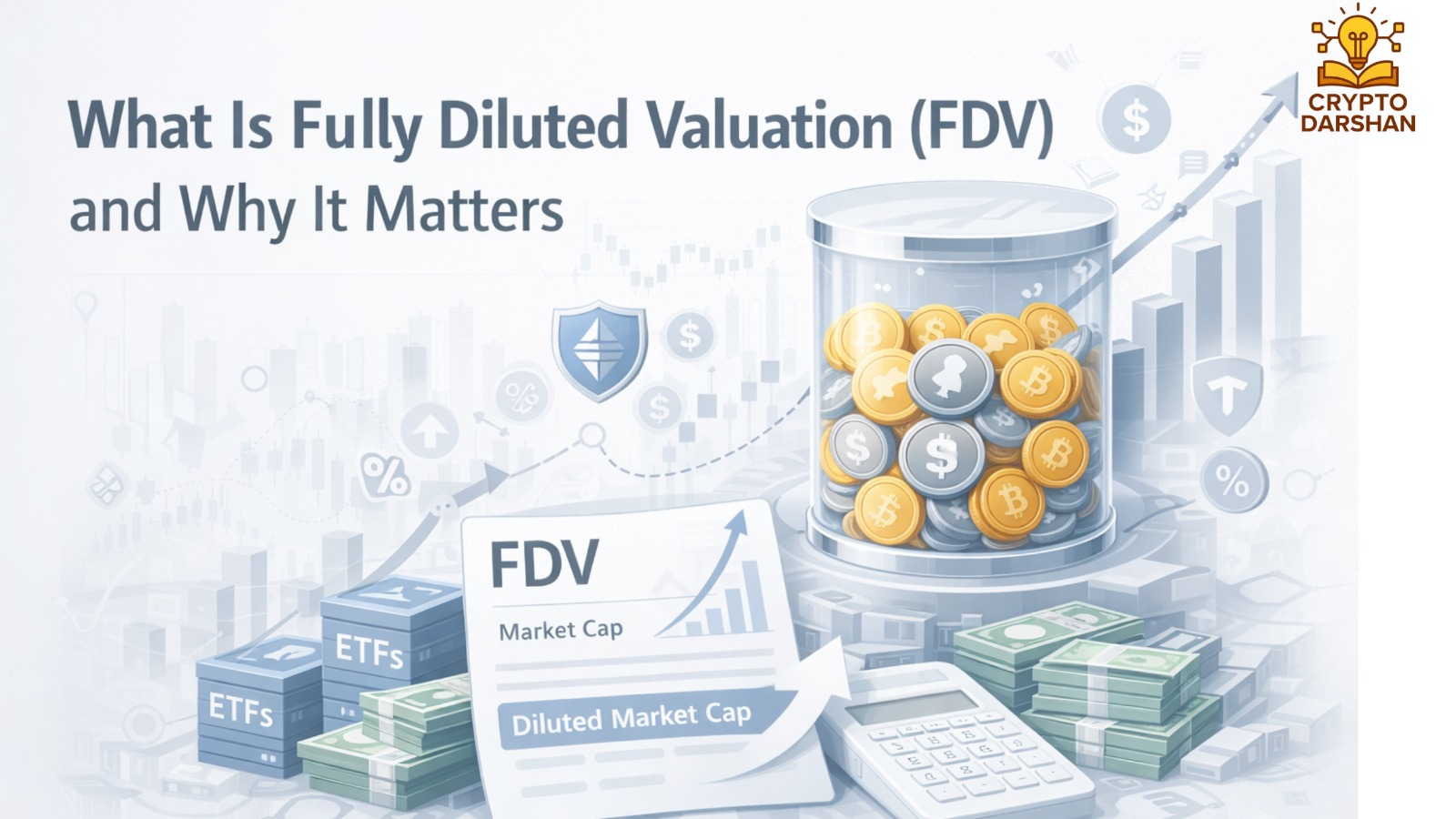
Fully Diluted Valuation (FDV) is a measure of the total value of a cryptocurrency project, assuming all of its tokens are in circulation. It’s a statistical representation of the maximum value of a cryptocurrency project, providing individuals with a view of the project beyond the given point.. It represents the hypothetical market capitalization assuming every token that could exist whether locked, vested, or reserved is available for trading.
In simpler terms, FDV shows what the total value of a project would be if every token were released and priced at the current market rate.
Fully Diluted Valuation Formula
The formula for calculating FDV is straightforward:
Fully Diluted Valuation = Total Token Supply × Current Token Price
For example, if a project has a total token supply of 1 billion tokens and the current price per token is $2, the FDV would be:
1,000,000,000 × $2 = $2,000,000,000 (or $2 billion)
This means that if all tokens were in circulation, the project’s total market value would be $2 billion.
Fully Diluted Valuation vs. Market Capitalization

While Fully Diluted Valuation and market capitalization are related, they are not the same. Understanding the difference between the two is key to evaluating a project’s true value.
| Metric | Definition | Formula | Purpose |
| Market Capitalization | The current value of all circulating tokens. | Circulating Supply × Current Price | Shows the project’s present market value. |
| Fully Diluted Valuation (FDV) | The potential value if all tokens were in circulation. | Total Supply × Current Price | Shows the project’s future or maximum possible valuation. |
Example
Suppose a project has:
- Circulating Supply: 100 million tokens
- Total Supply: 1 billion tokens
- Current Price: $1
Market Cap = 100 million × $1 = $100 million
FDV = 1 billion × $1 = $1 billion
This means the project’s current market value is $100 million, but if all tokens were released, its valuation could reach $1 billion assuming the price remains the same.
Why Fully Diluted Valuation Matters in Crypto

The Fully Diluted Valuation is a critical metric for investors, traders, and analysts because it provides a more complete view of a project’s potential value and future risks.
1. Understanding Future Supply Pressure
Fully Diluted Valuation helps investors anticipate how future token releases might affect price. If a large number of tokens are still locked or vested, their eventual release could increase supply and put downward pressure on the token’s price.
2. Evaluating Long-Term Value
FDV allows investors to assess whether a project’s current price is sustainable in the long run. A high FDV compared to its current market cap may indicate that the token is overvalued relative to its fundamentals.
3. Comparing Projects Fairly
Fully Diluted Valuation provides a standardized way to compare projects with different tokenomics. Two projects might have similar market caps but vastly different FDVs, revealing which one has more potential dilution risk.
4. Assessing Token Distribution and Vesting
By analyzing Fully Diluted Valuation alongside token release schedules, investors can understand how much of the supply is controlled by insiders, teams, or early investors and when those tokens will enter circulation. FDV becomes even more important in emerging sectors like SocialFi, where tokenized communities can launch with massive future supply unlocks learn more in our detailed guide on What Is SocialFi? The Rise of Tokenized Communities.
5. Identifying Overhyped Projects
Projects with extremely high FDVs relative to their current adoption or utility may be overhyped. FDV helps investors spot inflated valuations before they lead to price corrections.
How to Calculate FDV in Practice

Calculating FDV is simple, but interpreting it correctly requires understanding a project’s tokenomics.
Step 1: Identify Total Token Supply
Check the project’s whitepaper or official documentation to find the maximum total supply of tokens.
Step 2: Find the Current Token Price
Use a reliable crypto data platform such as CoinMarketCap or CoinGecko to get the latest market price.
Step 3: Apply the FDV Formula
Multiply the total token supply by the current token price.
Example:
- Total Supply: 500 million tokens
- Current Price: $0.50
FDV = 500,000,000 × $0.50 = $250,000,000
This means the project’s fully diluted valuation is $250 million.
FDV and Tokenomics

Token Burn Mechanisms
Token burns permanently remove tokens from circulation, reducing the total supply and potentially lowering the FDV. Projects often use burn mechanisms to create scarcity and support price appreciation. For example, some DeFi platforms burn a portion of transaction fees or buy back tokens from the market to destroy them
Total Token Supply
The total token supply is the maximum number of tokens that will ever exist for a project. It directly affects the Fully Diluted Valuation (FDV) because FDV is calculated by multiplying the total supply by the current token price. A project with a large total supply will naturally have a higher Fully Diluted Valuation , even if only a small portion of tokens are currently in circulation.
Circulating Supply
The circulating supply refers to the number of tokens currently available for trading in the market. It’s a key factor in determining a project’s market capitalization, while FDV considers the total supply. A large gap between circulating supply and total supply often signals that many tokens are still locked or vested.
Vesting Schedules
Vesting schedules outline when and how locked tokens will be released to team members, investors, or advisors. These schedules are crucial for understanding how FDV will evolve over time. If a large number of tokens are set to unlock within a short period, it can create selling pressure and affect market stability.
Inflation and Emission Rates
Some crypto projects continuously issue new tokens through mechanisms like staking rewards or mining. This process, known as inflation or emission, gradually increases the total supply and, therefore, the FDV. High inflation rates can dilute existing holders’ value, while controlled emissions can support long-term ecosystem growth.
The Relationship Between FDV and Token Price

FDV can influence how investors perceive a token’s price potential.
- High FDV: Suggests that the token might face downward pressure as more tokens are released. Investors may view it as overvalued.
- Low FDV: Indicates limited future dilution, which can be attractive if the project has strong fundamentals.
However, FDV alone doesn’t determine price direction. Market demand, project utility, and investor sentiment also play major roles.
Fully Diluted Valuation in Early-Stage Projects

Early-stage crypto projects often have a small circulating supply and a large number of locked tokens. This can make their FDV appear disproportionately high compared to their current market cap.
For example, a project might have only 5% of its tokens in circulation. If the token price is high due to limited supply, the FDV could look massive even if the project is still in its infancy.
Investors should be cautious in such cases, as future token unlocks could significantly dilute value and impact prices.
FDV and Token Unlocks

Token unlocks are one of the most important factors affecting FDV. When locked tokens are released, they increase the circulating supply, which can lead to price drops if demand doesn’t grow proportionally.
Common Token Unlock Categories
- Team and Founders: Tokens allocated to the project team, usually vested over several years.
- Private Investors: Tokens sold during early funding rounds, often subject to lock-up periods.
- Ecosystem Rewards: Tokens distributed for staking, liquidity mining, or community incentives.
- Treasury and Reserves: Tokens held for future development or partnerships.
Monitoring token unlock schedules helps investors anticipate potential market movements and adjust their strategies accordingly.
FDV and Market Perception

The Fully Diluted Valuation can shape how investors perceive a project’s potential.
- A high FDV may signal strong confidence in the project’s future but can also raise concerns about overvaluation.
- A low FDV might indicate undervaluation or limited growth potential, depending on the project’s fundamentals.
Market perception often drives short-term price movements, but long-term value depends on real-world adoption and utility.
FDV in Comparison to Traditional Finance

In traditional finance, Fully Diluted Valuation is similar to the concept of fully diluted market capitalization used for stocks. It accounts for all potential shares that could exist if options, warrants, or convertible securities were exercised.
In crypto, FDV serves the same purpose providing a complete picture of potential dilution and total value. However, unlike traditional markets, crypto tokens often have more complex release schedules and use cases, making Fully Diluted Valuation analysis even more critical.
Common Misconceptions About FDV
- FDV Equals Market Cap:
FDV is not the same as market capitalization. Market cap reflects current value, while FDV represents potential future value. - High FDV Means Overvaluation:
A high FDV doesn’t always mean a project is overvalued. It could indicate strong long-term potential if the project has solid fundamentals and growth prospects. - FDV Predicts Future Price:
FDV is a valuation metric, not a price forecast. It helps assess potential dilution but doesn’t guarantee future performance. - FDV Is Static:
FDV changes with token price and supply. As tokens are burned, minted, or unlocked, FDV fluctuates accordingly.
How Investors Use Fully Diluted Valuation

1. Risk Assessment
Investors use FDV to gauge dilution risk. A project with a high FDV relative to its market cap may face significant selling pressure as tokens unlock.
2. Valuation Comparison
FDV allows investors to compare projects across different sectors, such as DeFi, gaming, or infrastructure, on a level playing field. New narratives like decentralized physical infrastructure networks often launch with aggressive tokenomics, which we explored in DePIN: The Next Big Crypto Trend?
3. Investment Timing
By analyzing FDV and token release schedules, investors can decide when to enter or exit positions to minimize dilution risk.
4. Portfolio Diversification
Understanding FDV helps investors balance their portfolios between high-risk, high-FDV projects and more stable, low-FDV assets.
FDV and Real-World Examples

Example 1: High FDV Project
A new DeFi project launches with only 10% of its tokens in circulation. The token trades at $5, giving it a market cap of $50 million and an FDV of $500 million.
If the project fails to grow fast enough to justify its FDV, the token price may drop as more tokens are released.
Example 2: Low FDV Project
Another project has 80% of its tokens already in circulation, with a market cap of $100 million and an FDV of $120 million. The small gap between market cap and FDV suggests limited dilution risk, making it potentially more stable.
FDV and Long-Term Investing
For long-term investors, FDV is a valuable tool for identifying sustainable projects. A balanced FDV indicates that the project’s valuation aligns with its growth potential and token release schedule.
Investors should combine FDV analysis with other metrics such as:
- Total Value Locked (TVL)
- Active users
- Revenue generation
- Developer activity
- Community engagement
This holistic approach ensures a more accurate assessment of a project’s long-term viability.
Limitations of Fully Diluted Valuation

While FDV is useful, it has limitations that investors should consider:
- Assumes Constant Price: FDV assumes the current token price remains unchanged, which is rarely the case.
- Ignores Market Demand: FDV doesn’t account for future demand or adoption.
- Overlooks Token Utility: Some tokens have specific use cases that affect their value beyond supply metrics.
- Can Be Misleading for Early Projects: Projects with small circulating supplies can appear overvalued due to inflated FDVs.
Therefore, FDV should be used alongside other indicators for a complete analysis.
How to Use Fully Diluted Valuation Wisely
- Compare FDV to Market Cap: A large gap may indicate potential dilution risk.
- Check Token Release Schedules: Understand when new tokens will enter circulation.
- Analyze Project Fundamentals: Evaluate the team, technology, and roadmap.
- Monitor Market Conditions: External factors like regulation and sentiment can affect FDV interpretation.
- Diversify Investments: Avoid overexposure to high-FDV projects.
The Future of FDV in Crypto Analysis

Integration with Advanced Analytics Tools
As the crypto market matures, Fully Diluted Valuation (FDV) will become a standard metric integrated into advanced analytics platforms. Future tools will likely combine FDV data with token unlock schedules, trading volumes, and on-chain activity to give investors a clearer picture of a project’s real valu.
Greater Focus on Token Release Transparency
Transparency around token distribution and vesting schedules will become increasingly important. Projects will be expected to disclose detailed information about token unlocks, emissions, and burn mechanisms. This will allow investors to better understand how FDV evolves over time and how future supply changes might affect price stability.
Use of FDV in Risk Assessment Models
FDV will play a larger role in risk management and valuation models used by investors and analysts. By comparing Fully Diluted Valuation to market capitalization, analysts can estimate potential dilution risks and identify overvalued or undervalued projects. This approach will help investors avoid projects with inflated valuations and focus on those with sustainable growth potential.
Adoption by Institutional Investors
As institutional participation in crypto increases, FDV will become a key metric for evaluating long-term investment opportunities. Institutions prefer transparent and quantifiable data, and FDV provides a clear measure of a project’s potential market size. This will lead to more standardized valuation frameworks across the industry, aligning crypto analysis with traditional financial models.
Evolution Toward Dynamic FDV Models
The future of Fully Diluted Valuation analysis will likely move beyond static calculations. Dynamic FDV models will account for real-time factors such as token burns, staking rewards, and market demand. These models will provide a more accurate reflection of a project’s evolving value, allowing investors to adjust their strategies quickly in response to market changes.
FAQ: Fully Diluted Valuation (FDV)

Q1: What is Fully Diluted Valuation (FDV)?
Fully Diluted Valuation (FDV) is the total value of a cryptocurrency or token if all possible coins or tokens were in circulation. It’s calculated by multiplying the maximum supply of the token by its current market price.
Q2: How is Fully Diluted Valuation different from market capitalization?
Market capitalization only considers the coins currently in circulation, whereas FDV accounts for all coins that could ever exist, including those not yet released.
Q3: Why does FDV matter in crypto markets?
FDV gives investors a bigger-picture view of a token’s potential value. It helps assess risks of dilution, future supply increases, and whether a token is overvalued compared to its circulating market cap.
Q4: Can Fully Diluted Valuation affect investment decisions?
Yes. A token with a high FDV relative to market cap may face future price pressure as more tokens are released. Conversely, a token with a low FDV relative to market cap could have growth potential if new tokens are gradually unlocked.
Q5: How should I use FDV in analysis?
Use FDV alongside other metrics like circulating supply, tokenomics, and adoption rate. It’s a tool for long-term evaluation, not short-term trading.
Conclusion
The Fully Diluted Valuation (FDV) is one of the most important metrics in crypto valuation. It provides a complete picture of a project’s potential market value by considering all tokens that could exist.
Understanding FDV helps investors identify dilution risks, compare projects fairly, and make informed investment decisions. However, Fully Diluted Valuation should not be viewed in isolation it must be analyzed alongside tokenomics, market demand, and project fundamentals.
In a market driven by speculation and rapid change, the MiCA Regulation and similar frameworks will further emphasize transparency and accountability. As the crypto industry evolves, mastering concepts like FDV will be essential for navigating the future of digital asset investing.