The cryptocurrency industry evolves rapidly, with new narratives and technologies emerging every year. From decentralized finance (DeFi) to non-fungible tokens (NFTs) and GameFi, each wave of innovation has reshaped how blockchain technology is used and understood. The latest trend gaining momentum is DePIN, short for Decentralized Physical Infrastructure Networks.
Decentralized Physical Infrastructure Networks represents a powerful fusion of blockchain technology with real-world infrastructure. It aims to decentralize the ownership, operation, and monetization of physical systems such as wireless networks, energy grids, data storage, and mobility services. By leveraging token incentives and community participation, DePIN projects are redefining how infrastructure is built and maintained.
This comprehensive guide explores what Decentralized Physical Infrastructure Networks are, how they work, why it matters, and why many experts believe it could become the next major crypto trend.
1. What Is DePIN?

1.1 Definition
DePIN (Decentralized Physical Infrastructure Networks) refers to blockchain-based systems that enable the development, maintenance, and operation of physical hardware infrastructure in a decentralized and open manner. These networks leverage the strengths of blockchain technology, such as immutability, transparency, and security, to facilitate the creation of peer-to-peer networks that meet hardware demands through an open marketplace.
In simple terms, DePIN turns real-world infrastructure into a shared, community-driven network powered by blockchain incentives.
1.2 The Core Idea
Traditional infrastructure systems like telecommunications, cloud storage, and transportation are expensive to build and maintain. They are typically controlled by large corporations with high overhead costs and limited transparency. DePIN flips this model by distributing ownership and operation among participants who contribute resources and earn tokens in return.
This approach democratizes infrastructure, reduces costs, and creates new economic opportunities for individuals worldwide. DePIN rewards can be volatile, much like GameFi tokens, which we explored in GameFi Is Back in 2026.
2. The Origins of DePIN

2.1 Early Inspiration
The concept of decentralized infrastructure is not entirely new. Early blockchain projects like Helium and Filecoin laid the groundwork for DePIN years before the term became popular.
- Helium Network: Created a decentralized wireless network where users deploy hotspots to provide connectivity and earn HNT tokens.
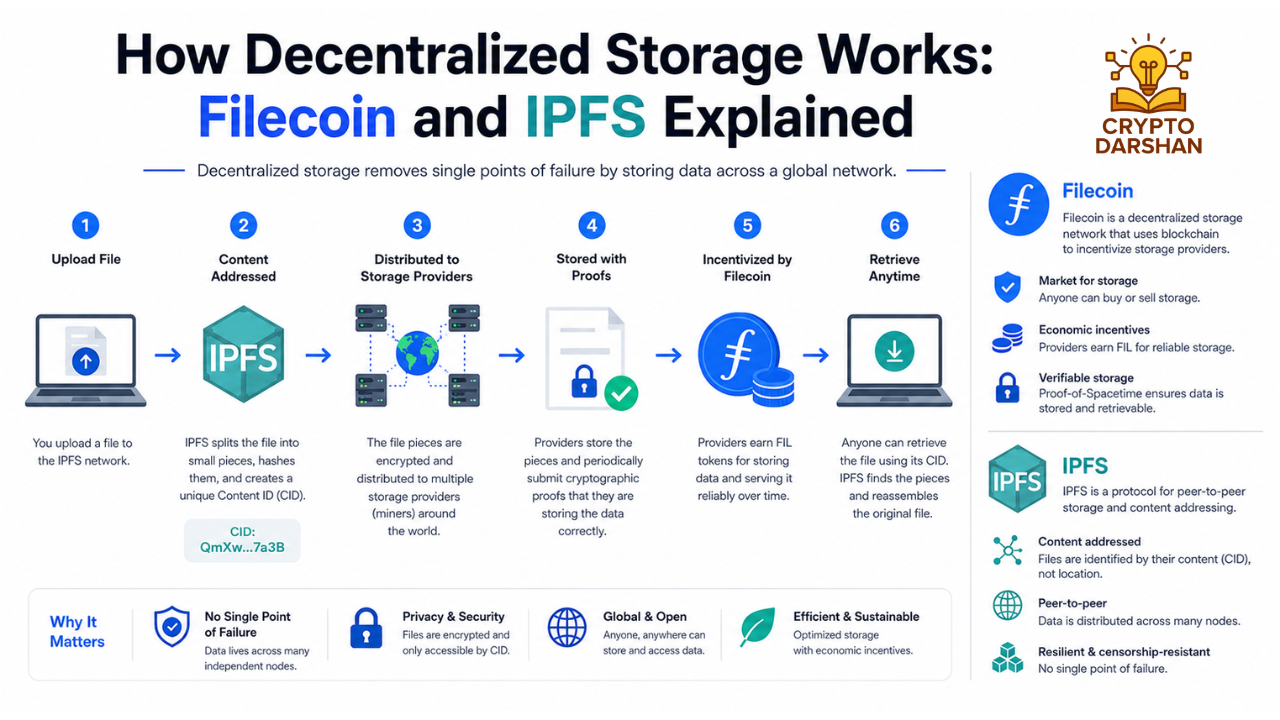
- Filecoin: Built a decentralized storage network where users rent out unused disk space in exchange for FIL tokens.
These projects demonstrated that blockchain incentives could coordinate large-scale physical networks without centralized control.
2.2 The Evolution of the Term “DePIN”
The term DePIN gained traction in 2023 when analysts and venture capital firms began grouping these projects under a single category. It replaced earlier terms like “Proof of Physical Work” (PoPW) and “Token Incentivized Physical Networks.”
By unifying these ideas under one label, Decentralized Physical Infrastructure Networks became a recognizable narrative similar to how “DeFi” unified decentralized financial applications.
3. HowDecentralized Physical Infrastructure Networks Works

3.1 The Building Blocks
DePIN networks combine several key components:
- Blockchain Layer: Provides transparency, security, and token issuance.
- Physical Infrastructure: Includes hardware like sensors, routers, storage devices, or vehicles.
- Participants: Individuals or organizations that contribute resources to the network.
- Token Incentives: Reward participants for providing services or maintaining infrastructure.
- Data Layer: Collects and verifies real-world data to ensure network integrity.
3.2 Incentive Mechanism
DePIN relies on token-based incentives to motivate participation. Contributors earn tokens for performing useful work, such as providing network coverage, storing data, or generating renewable energy.
For example:
- In Helium, users earn tokens for providing wireless coverage.
- In Filecoin, users earn tokens for storing and retrieving data.
- In Render Network, users earn tokens for contributing GPU computing power.
This model aligns economic incentives with network growth, creating a self-sustaining ecosystem.
3.3 Proof of Physical Work (PoPW)
Many DePIN projects use a consensus mechanism known as Proof of Physical Work. Unlike Proof of Work (PoW), which relies on computational power, PoPW verifies that participants perform real-world tasks.
For instance, a node might prove it’s providing Wi-Fi coverage or storing data by submitting cryptographic proofs verified on-chain. This ensures that rewards go to genuine contributors rather than passive token holders.
3.4 Governance and Community Control
Most DePIN projects are governed by DAOs (Decentralized Autonomous Organizations). Token holders can vote on network upgrades, reward structures, and partnerships. This ensures that the community, not a central authority, controls the network’s direction.
4. Categories of DePIN Projects

DePIN spans multiple industries, each addressing different types of physical infrastructure.
4.1 Connectivity Networks
These projects focus on building decentralized communication systems.
- Helium (HNT): Provides decentralized wireless coverage for IoT and 5G devices.
- Pollen Mobile: Builds community-owned mobile networks.
- WiFi Map: Rewards users for sharing internet access.
4.2 Storage and Computing
These networks decentralize data storage and computing power.
- Filecoin (FIL): Decentralized cloud storage.
- Arweave (AR): Permanent data storage on blockchain.
- Render Network (RNDR): Decentralized GPU rendering for 3D graphics and AI.
4.3 Energy and Sustainability
Decentralized Physical Infrastructure Networks is also transforming the energy sector by enabling peer-to-peer energy sharing.
- Power Ledger: Facilitates decentralized energy trading.
- Energy Web: Builds blockchain-based energy infrastructure.
- Sun Exchange: Allows users to invest in solar energy projects.
4.4 Mobility and Transportation
These projects decentralize transportation and logistics.
- DIMO: Collects and monetizes vehicle data.
- Hivemapper: Builds a decentralized mapping network using dashcam footage.
- Peaq Network: Provides infrastructure for machine-to-machine (M2M) economies.
- Drife: A decentralized ride-hailing platform.
4.5 Sensor and Data Networks
DePIN can also power networks that collect and share real-world data.
- WeatherXM: Builds a decentralized weather data network.
- PlanetWatch: Uses sensors to monitor air quality.
- Geonet: Collects geospatial data for mapping and analytics.
- IoTeX: Connects IoT devices to blockchain for secure data exchange.
5. Why DePIN Matters

5.1 Democratizing Infrastructure
DePIN allows anyone to participate in building and owning infrastructure. Instead of relying on centralized corporations, communities can deploy and manage networks collectively. This democratization empowers individuals and reduces monopolistic control.
5.2 Lowering Costs
By crowdsourcing infrastructure, DePIN reduces capital expenditure. Participants contribute hardware and resources voluntarily, motivated by token rewards. This model is more cost-efficient than traditional centralized systems.
5.3 Enhancing Transparency
Blockchain technology ensures that all transactions, contributions, and rewards are transparent and verifiable. This eliminates corruption, inefficiency, and opaque pricing models common in centralized infrastructure industries.
5.4 Creating New Income Streams
DePIN enables individuals to earn passive income by contributing to networks. For example, running a Helium hotspot or a Hivemapper dashcam can generate tokens, turning everyday devices into income-generating assets.
5.5 Accelerating Global Adoption
DePIN networks can expand faster than traditional infrastructure because they rely on community participation rather than centralized deployment. This makes them ideal for underserved regions lacking reliable connectivity or energy access.
5.6 Promoting Sustainability
Many DePIN projects focus on renewable energy and efficient resource use. By decentralizing energy production and consumption, they contribute to global sustainability goals.
6. The Economic Model of DePIN

6.1 Tokenomics
DePIN projects use native tokens to coordinate incentives. These tokens serve multiple purposes:
- Rewarding contributors for providing services.
- Paying for network usage (e.g., data storage or bandwidth).
- Governance participation through decentralized voting.
A well-designed token economy ensures sustainability by balancing supply, demand, and utility.
6.2 Supply and Demand Dynamics
The value of a DePIN token depends on network usage and contribution levels. As more users consume services, demand for tokens increases. Simultaneously, contributors earn tokens for expanding the network, creating a feedback loop that drives growth.
6.3 Sustainability Challenges
Poorly designed tokenomics can lead to inflation or unsustainable reward systems. Successful DePIN projects must balance early incentives with long-term utility to avoid speculative bubbles.
6.4 Real-World Utility
Unlike many crypto tokens that rely on speculation, DePIN tokens have tangible utility. They represent access to real-world services, bandwidth, storage, energy, or data, giving them intrinsic value. Understanding rewards in networks is easier if you know how crypto derivatives work, as explained in Funding Rates, Open Interest & Liquidations Explained.
7. Real-World Examples of DePIN Success

7.1 Helium Network
Helium is one of the earliest and most successful DePIN projects. It built a decentralized wireless network with over one million hotspots worldwide. By rewarding users with HNT tokens, Helium created a global IoT network without traditional telecom infrastructure.
7.2 Filecoin
Filecoin revolutionized cloud storage by allowing users to rent out unused disk space. It now hosts petabytes of data across thousands of nodes, offering a decentralized alternative to centralized providers like Amazon Web Services.
7.3 Hivemapper
Hivemapper uses dashcams to crowdsource mapping data. Drivers earn tokens for contributing footage, creating a decentralized alternative to Google Maps. This model incentivizes real-world data collection at scale.
7.4 Render Network
Render Network connects artists and developers with unused GPU power. It decentralizes rendering tasks for 3D graphics, AI, and metaverse applications, reducing costs and increasing accessibility.
7.5 WeatherXM
WeatherXM rewards users for deploying weather stations that collect local climate data. This creates a decentralized, accurate, and community-owned weather network.
8. The Role of Blockchain in DePIN

Blockchain provides the foundation for DePIN’s trustless coordination.
8.1 Transparency and Verification
Smart contracts ensure that contributions are verified and rewarded automatically. This eliminates the need for intermediaries and ensures fairness.
8.2 Tokenization of Physical Assets
Blockchain enables the tokenization of physical infrastructure, allowing fractional ownership and liquidity. For example, a solar panel or hotspot can be represented as a token that generates yield.
8.3 Decentralized Governance
Decentralized Physical Infrastructure Networks projects often use decentralized autonomous organizations (DAOs) to manage decision-making. Token holders can vote on network upgrades, reward structures, and partnerships.
8.4 Interoperability
Blockchain allows different DePIN networks to interact seamlessly. For instance, a decentralized energy grid could integrate with a mobility network to power electric vehicles.
9. Challenges Facing DePIN

9.1 Hardware Costs
Deploying physical infrastructure requires upfront investment in hardware. This can limit participation, especially in developing regions.
9.2 Data Verification
Ensuring that physical work is genuine and not spoofed is a major challenge. Projects must develop robust verification mechanisms to prevent fraud.
9.3 Regulatory Uncertainty
DePIN operates at the intersection of crypto and real-world industries, making it subject to complex regulations. Governments may impose restrictions on data collection, energy trading, or telecommunications.
9.4 Token Volatility

Fluctuating token prices can affect network stability. If rewards lose value, participants may stop contributing, slowing network growth.
9.5 Scalability
As networks expand, maintaining efficiency and security becomes more difficult. DePIN projects must balance decentralization with performance.
9.6 Competition with Centralized Giants
DePIN projects often compete with established corporations that have vast resources and infrastructure. Overcoming this dominance requires strong community engagement and real-world utility.
10. The Future of Decentralized Physical Infrastructure Networks

10.1 Integration with AI and IoT
DePIN networks are likely to merge with artificial intelligence (AI) and the Internet of Things (IoT). AI can optimize resource allocation, while IoT devices can provide real-time data for decentralized networks.
10.2 Institutional Adoption
Enterprises and governments may adopt DePIN models to reduce costs and improve transparency. For example, decentralized energy grids could complement national sustainability goals.
10.3 Cross-Network Collaboration
Future DePIN ecosystems may interconnect, allowing data and resources to flow seamlessly between networks. This interoperability will enhance efficiency and scalability.
10.4 Tokenized Real-World Assets (RWAs)
DePIN could merge with the growing trend of tokenized real-world assets, enabling fractional ownership of infrastructure like solar farms, data centers, or transportation fleets.
10.5 Global Impact
DePIN has the potential to bridge the digital divide by providing affordable connectivity, energy, and data access to underserved regions. Its community-driven model aligns with the broader vision of Web3 empowering individuals through decentralization.
11. Investment Opportunities in DePIN

11.1 Why Investors Are Paying Attention
Venture capital firms and institutional investors are increasingly backing DePIN projects. The combination of real-world utility and blockchain incentives offers a compelling value proposition.
11.2 Key Metrics to Evaluate
When analyzing DePIN projects, investors should consider:
- Network growth rate (number of active nodes or devices).
- Token utility and demand drivers.
- Hardware adoption costs.
- Revenue generation potential.
- Community engagement and governance.
11.3 Long-Term Potential
DePIN could become a trillion-dollar industry by decentralizing critical infrastructure sectors. As adoption grows, early participants may benefit from both token appreciation and network revenue.
11.4 Risks for Investors
Investors should also be aware of risks such as regulatory uncertainty, token inflation, and hardware obsolescence. Diversification and due diligence are essential.
12. Comparing Decentralized Physical Infrastructure Networks to Previous Crypto Trends

| Trend | Focus | Core Value | Example Projects |
| DeFi | Financial services | Decentralized finance | Uniswap, Aave |
| NFTs | Digital ownership | Art and collectibles | OpenSea, Blur |
| GameFi | Gaming economies | Play-to-earn models | Axie Infinity |
| DePIN | Real-world infrastructure | Decentralized physical systems | Helium, Filecoin, Hivemapper |
DePIN stands out because it connects blockchain technology to tangible, real-world assets. Unlike purely digital trends, it has measurable physical impact.
13. The Road Ahead
DePIN is still in its early stages, but its potential is enormous. As technology matures and regulatory clarity improves, more industries will adopt decentralized infrastructure models.
The next wave of innovation may see DePIN networks powering smart cities, autonomous vehicles, and renewable energy grids all coordinated through blockchain.
FAQ-DePIN: The Next Big Crypto Trend?

1. What is DePIN in crypto?
DePIN stands for Decentralized Physical Infrastructure Networks. It’s a blockchain model where physical infrastructure like routers, solar panels, or IoT devices is owned, managed, and monetized in a decentralized way by participants, instead of a single company.
2. How does DePIN work?
Users deploy physical devices that connect to a blockchain network. The network tracks usage and rewards participants in crypto tokens based on their contribution. Smart contracts automate payments and verify network activity.
3. Why is DePIN considered a big trend?
DePIN combines real-world assets with crypto incentives. It allows people to earn tokens by sharing resources like internet bandwidth, energy, or storage. It’s gaining attention because it makes crypto tangible and useful in everyday life.
4. What are some popular DePIN projects?
Examples of DePIN projects include:
- Helium (HNT) – decentralized wireless network
- Filecoin (FIL) – decentralized storage
- WeatherXM – decentralized weather stations
These projects reward users for contributing to the network.
5. How can investors benefit from DePIN?
Investors can earn tokens by running nodes or providing resources to a network. DePIN tokens can also appreciate if the network grows. It’s a way to combine passive income with crypto investments.
6. What are the risks of DePIN?
- Device downtime or malfunction reduces rewards
- Regulatory uncertainty in some regions
- Network security risks
- Token price volatility
It’s important to research each project thoroughly before investing.
7. How is DePIN different from traditional crypto projects?
Unlike traditional crypto, which is mostly digital, DePIN is tied to real-world assets. Users directly interact with physical infrastructure, making it more tangible and utility-focused than pure speculative tokens.
8. Can DePIN scale globally?
Yes, theoretically. The network can expand as more participants add devices. However, scaling depends on adoption, device availability, and regulatory acceptance in different countries.
9. How to get started with DePIN?
- Research active DePIN projects
- Buy or deploy compatible hardware
- Set up your node or device
- Connect to the network and start earning tokens
10. Is DePIN only for tech-savvy users?
Not necessarily. While some projects require technical setup, many networks are creating plug-and-play solutions to make participation easier for mainstream users.
Conclusion
DePIN represents a paradigm shift in how infrastructure is built, owned, and operated. By combining blockchain incentives with real-world assets, it creates a new economic model that empowers individuals, reduces costs, and enhances transparency.
From decentralized wireless networks to community-powered energy grids, DePIN is transforming the physical world through decentralization. As adoption accelerates, it could become the next major crypto trend, bridging the gap between digital innovation and real-world impact.
In the evolving landscape of Web3, Decentralized Physical Infrastructure Networks stands as a powerful reminder that blockchain’s true potential extends far beyond finance it can reshape the very foundations of global infrastructure.