
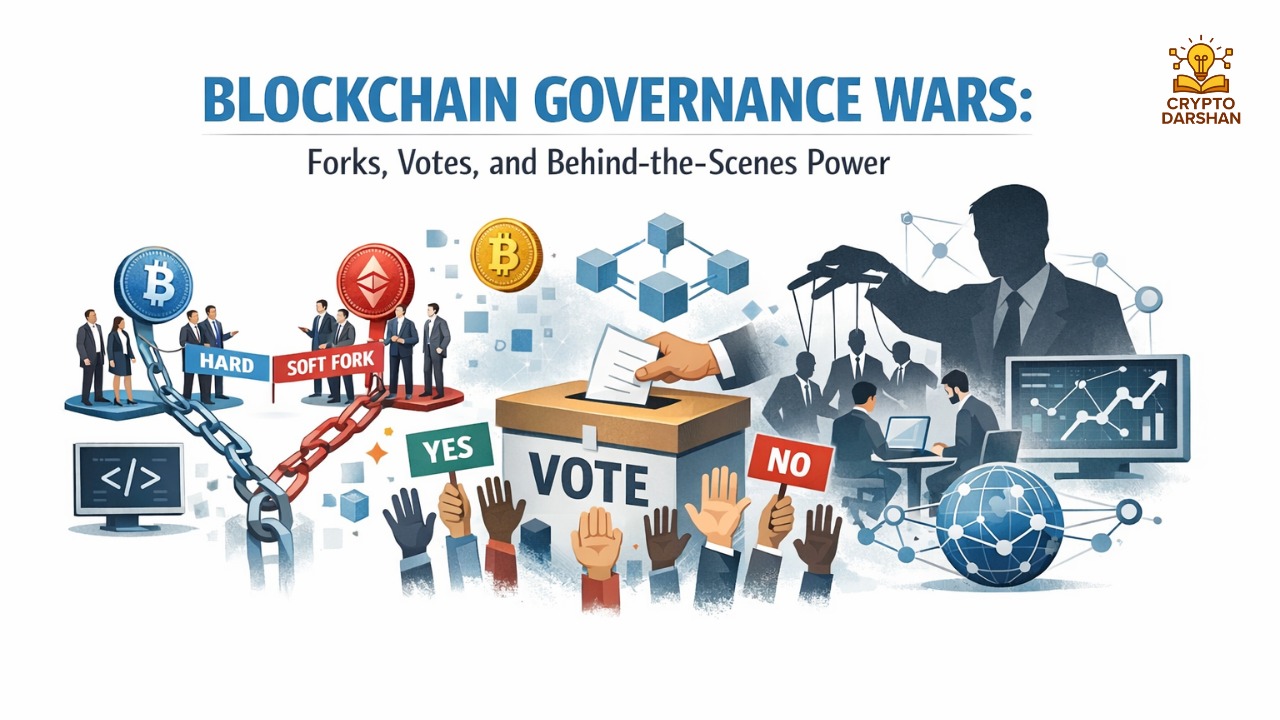
Blockchain was supposed to remove politics from money and coordination. Instead, it created a new kind of politics—one that plays out in code repositories, validator dashboards, token‑weighted votes, and late‑night calls between founders, exchanges, and large holders.
Governance is the system a blockchain uses to decide what changes, who decides, and how decisions become reality. When governance works, networks evolve without breaking trust. When it fails, communities split, chains fork, and power concentrates in places most users never see.
This guide explores the “governance wars” that shape major blockchains: the visible battles (forks and votes) and the quieter struggles (influence, incentives, and coordination). It’s written for a general audience with an easy reading level, but it goes deep enough to help you understand what’s really happening when a chain “upgrades.”
Governance decisions influence almost every part of the crypto ecosystem, including staking systems and validator incentives. To better understand this area of DeFi, you can also read our guide Liquid Staking Explained: LSTs, Restaking, and New DeFi Yields.
Why blockchain governance becomes a battlefield

A blockchain is not just software. It is a living system with:
- Users who want low fees, stability, and safety
- Developers who want to ship improvements and fix bugs
- Validators/miners who want revenue and predictable rules
- Token holders who want price appreciation and influence
- Businesses (exchanges, wallets, stablecoin issuers) who want reliability
- Regulators who want compliance and accountability
These groups often want different things. Even when they agree on goals, they may disagree on timing, risk, and tradeoffs.
Governance becomes a battlefield because blockchains have three hard constraints:
A. Upgrades are risky
Changing consensus rules can break compatibility. A small bug can cause chain splits, lost funds, or halted networks.
B. There is no “CEO” with final authority
Even when a foundation exists, it cannot force everyone to upgrade. A blockchain only changes if enough participants adopt the new rules.
C. Incentives are not aligned
A change that helps users (lower fees) might reduce validator revenue. A change that helps developers (new features) might increase complexity and risk.
So governance is not just about “voting.” It is about coordination under conflict.
The core governance question: Who has the power?

In practice, power in blockchain governance comes from a few sources:
Code power (developers)
Developers write and maintain the client software. If most nodes run a specific client, the maintainers of that client have influence.
But developers cannot force adoption. They can propose, implement, and persuade.
Hidden reality: Many users assume “the chain” is the code. But the chain is the social agreement to treat a certain history as valid. Code is a tool that expresses that agreement.
Economic power (token holders and whales)
Large holders can influence governance votes, market sentiment, and funding. They can also threaten to sell, which can pressure communities.
Hidden reality: Token‑weighted voting often turns governance into a shareholder system. That can be efficient, but it can also concentrate power.
Operational power (validators/miners)
Validators and miners decide what blocks get produced. If they refuse to upgrade, an upgrade may fail or split.
Hidden reality: Even if token holders vote “yes,” validators can delay or shape implementation by choosing what software to run.
Platform power (exchanges, wallets, stablecoins)
Exchanges decide tickers, listings, and which fork gets the “main” brand. Wallets decide default networks. Stablecoin issuers decide which chain gets liquidity.
Hidden reality: In a fork, the chain that gets exchange support often wins mindshare, even if it loses ideological arguments.
Narrative power (founders, influencers, media)
Public perception matters. Governance debates are often won by the side that frames the story better: “decentralization,” “security,” “innovation,” “censorship resistance,” or “user protection.”
Hidden reality: Many governance wars are PR wars with technical details used as ammunition.
Forks: the nuclear option of governance

A fork happens whenever a community makes a change to the blockchain’s protocol, or basic set of rules. Forks come in different forms:
Soft fork vs hard fork (simple explanation)
Soft fork
- Tightens rules (makes them more strict)
- Old nodes may still accept new blocks as valid (depending on design)
- Often used for backward‑compatible upgrades
Hard fork
- Changes rules in a way that old nodes reject
- Requires coordinated upgrade
- If coordination fails, the chain can split into two networks
Hard forks are where governance wars become visible. They force a choice: upgrade or stay behind.
Why forks happen
Forks usually happen because of:
- Technical disagreements (scaling approach, security model)
- Economic conflicts (fee markets, issuance, MEV rules)
- Values conflicts (censorship resistance vs compliance)
- Emergency responses (exploits, hacks, chain halts)
- Power struggles (who controls roadmap and funding)
The fork playbook: how a split becomes real
A fork becomes real when:
- A group publishes new client software
- Validators/miners choose to run it
- Exchanges decide how to list it
- Stablecoins and DeFi liquidity choose a home
- Users follow the chain that “feels” legitimate
The technical split is only half the story. The economic and social split decides which fork survives.
Votes: on‑chain governance and its tradeoffs

Many modern chains use on‑chain governance, where proposals are submitted and token holders vote. If a proposal passes, it may automatically execute or trigger an upgrade process.
This sounds clean. But it introduces new problems.
Token voting is not “one person, one vote”
It is “one token, one vote.” That means:
- Wealth equals influence
- Early insiders often have outsized power
- Delegation can create political machines
Some chains try to soften this with:
- Delegated voting (choose representatives)
- Quadratic voting (reduce whale dominance—hard to implement safely)
- Reputation systems (hard to keep Sybil‑resistant)
- Lockups (more voting power if you lock tokens longer)
But the core tension remains: token voting is efficient for capital coordination, not necessarily fair for community representation.
Voter apathy is common
Most holders do not vote. Reasons include:
- Complexity and time cost
- Low perceived impact
- Delegation to “experts”
- Tokens held on exchanges (custodial voting issues)
Low turnout makes governance easier to capture.
Governance attacks are real
If voting controls treasury or protocol parameters, attackers may:
- Borrow tokens to vote (if rules allow)
- Bribe voters (directly or via “vote markets”)
- Capture delegates
- Push proposals that look harmless but hide risk
Some protocols add safeguards:
- Time delays (timelocks)
- Multiple voting rounds
- Emergency veto councils
- Quorum requirements
- Separate “constitutional” rules for core changes
But every safeguard adds complexity and introduces new centers of power.
Behind‑the‑scenes power: the governance layer most people miss

Even in chains with formal voting, the real decision often happens earlier—during agenda setting.
Agenda setting: who decides what gets proposed?
If only a small group can write proposals, fund audits, or coordinate validators, they control the menu of choices.
Common agenda setters include:
- Core dev teams
- Foundations
- Large delegates
- Major DeFi protocols
- Infrastructure providers
If you control the agenda, you can shape outcomes without “rigging” votes.
Funding: the quiet lever
Governance is heavily influenced by who pays for:
- Core development
- Security audits
- Grants
- Marketing
- Legal defense
- Bug bounties
Treasuries can decentralize funding, but they can also become political prize pools.
Client diversity and “implementation power”
If most validators run one client, that client’s maintainers have leverage. A bug or design choice can effectively become policy.
Client diversity reduces this risk, but it is expensive. Multiple clients mean:
- More engineering work
- More coordination
- More chances for inconsistent behavior
So many ecosystems drift toward a dominant client, even if they claim decentralization.
Social coordination: private chats and emergency calls
When crises hit—exploits, chain halts, major bugs—governance becomes fast and informal. Decisions may be made in:
- Private Discord/Telegram groups
- Foundation calls
- Validator coordination channels
- Exchange risk teams
This is not always malicious. It is often necessary. But it reveals a truth: decentralization is a spectrum, and emergencies pull systems toward centralization.
Governance war themes: what people actually fight about

Governance wars repeat the same themes across chains.
Scaling: bigger blocks vs layered systems
Scaling debates often become identity debates.
- Bigger blocks can increase throughput but raise node costs
- Layer‑2 systems can scale without bloating base layer, but add complexity and new trust assumptions
Communities split when they disagree on what “decentralization” means: cheap nodes or cheap transactions.
Monetary policy: issuance, burns, and inflation
Changing issuance affects:
- Validator/miner revenue
- Token scarcity narratives
- Long‑term security budgets
Even small changes can trigger major conflict because they redistribute value.
MEV and fairness
MEV (maximal extractable value) is profit from transaction ordering. Governance fights include:
- Should MEV be minimized, redistributed, or embraced?
- Should private mempools exist?
- Should builders be regulated by protocol rules?
MEV debates are governance debates about who gets paid and who gets protected.
Censorship resistance vs compliance
As regulators focus on crypto, chains face pressure to:
- Block sanctioned addresses
- Filter certain transactions
- Enforce KYC at protocol edges
Some communities treat compliance as survival. Others treat it as betrayal.
This conflict is not going away.
Security vs speed
Fast upgrades can ship innovation. Slow upgrades reduce risk. Governance wars often come down to:
- “Move fast” builders vs “safety first” conservatives
- Startups vs long‑term institutions
- New users vs large capital
Case study patterns

Rather than rehashing every famous fork in detail, it helps to understand the patterns that show up again and again.
The “values fork”
A values fork happens when two groups disagree on what the chain is for.
- One side prioritizes censorship resistance and minimal change
- The other prioritizes usability, scaling, or governance flexibility
These forks often create two communities with different cultures.
The “emergency fork”
An emergency fork happens after a hack, exploit, or catastrophic bug.
Key questions include:
- Should the chain roll back history?
- Should losses be socialized?
- Who decides what counts as “legitimate” intervention?
Emergency forks reveal the real governance structure because decisions must be made quickly.
The “treasury war”
When a chain has a large treasury, governance becomes a battle over:
- Grants and funding priorities
- Salaries and vendor contracts
- Marketing and partnerships
- Political alliances among delegates
Treasury wars can be more intense than technical wars because they involve direct resource control.
The “validator cartel” fear
In proof‑of‑stake systems, people worry about validator concentration:
- Large staking providers
- Exchange validators
- Restaking and shared security layers
Governance debates often revolve around whether the protocol should limit concentration or accept it as market reality.
Governance models compared: what works, what breaks

There is no perfect governance model. Each one trades off speed, legitimacy, and decentralization.
Off‑chain governance (rough consensus)
Common in older systems and some major ecosystems.
Pros
- Flexible and human
- Can incorporate expertise
- Avoids plutocratic voting optics
Cons
- Hard to measure legitimacy
- Can be dominated by loud voices
- Decisions may happen in private
Off‑chain governance often relies on social norms and credible leadership.
On‑chain token voting
Common in DeFi and many L1s.
Pros
- Clear process and measurable outcomes
- Easy to execute treasury actions
- Transparent voting records
Cons
- Whale dominance
- Low turnout
- Bribery and vote markets
- Delegation capture
Token voting is powerful but tends to centralize unless carefully designed.
Delegated governance (representatives)
Holders delegate votes to trusted actors.
Pros
- Higher participation via delegation
- More informed voting
- Faster decisions
Cons
- Delegate oligarchies
- Lobbying and capture
- Voters stop paying attention
Delegation can work well if delegates compete and transparency is strong.
Councils, committees, and “guardians”
Some protocols add councils for emergencies or constitutional checks.
Pros
- Faster crisis response
- Protection against hostile proposals
- Clear accountability
Cons
- Centralization risk
- Political legitimacy issues
- Council capture
Councils are often necessary, but they must be constrained and auditable.
The governance stack: layers where power can hide

To understand behind‑the‑scenes power, think in layers:
- Social layer: community norms, legitimacy, narratives
- Development layer: who writes and reviews code
- Client layer: which software implementations dominate
- Consensus layer: validators/miners and their incentives
- Economic layer: exchanges, stablecoins, liquidity
- Interface layer: wallets, RPC providers, front ends
- Legal layer: foundations, jurisdictions, enforcement risk
A chain can be decentralized at one layer and centralized at another.
Example: A chain might have thousands of validators (decentralized consensus) but rely on a few RPC providers and wallets (centralized interface). In a crisis, the interface layer can shape user behavior more than consensus does.
Governance capture: how it happens in practice

“Capture” means a small group gains disproportionate control over decisions. It can happen without breaking rules.
Accumulation and delegation
A few entities accumulate tokens or collect delegations. Over time, they become kingmakers.
Complexity as a weapon
If proposals are hard to understand, most people won’t vote. Experts and insiders gain power.
Bribes and vote markets
If voting power can be rented, governance becomes a marketplace. This can be transparent (explicit incentives) or hidden (side deals).
Control of infrastructure
If a few providers run:
- major validator operations
- key clients
- RPC endpoints
- block builders
they can influence outcomes even without votes.
Crisis centralization
During emergencies, communities accept centralized coordination. Temporary measures can become permanent.
How communities defend themselves

Governance wars are not always destructive. They can lead to stronger systems if communities learn.
Clear upgrade processes
Good governance includes:
- Public roadmaps
- Formal improvement proposals
- Testnets and audits
- Timelines and rollback plans
- Transparent decision logs
The goal is to reduce surprise and reduce the need for emergency politics.
Separation of powers
Some protocols separate:
- Treasury decisions
- Parameter changes
- Core consensus changes
This reduces the blast radius of governance capture.
Timelocks and veto windows
A delay between vote and execution gives time for:
- review
- community response
- emergency action if needed
Timelocks are not perfect, but they reduce “overnight coups.”
Delegate transparency
If delegation is used, strong norms help:
- public voting rationales
- conflict disclosures
- performance tracking
- easy redelegation tools
Delegates should compete on trust and competence.
Client diversity and open standards
Encouraging multiple clients and shared specs reduces implementation monopolies.
This is expensive, but it is one of the strongest defenses against hidden control.
Forks vs votes: which is more “decentralized”?
It depends on what you mean by decentralization.
- Forks allow exit. If you disagree, you can create a new chain. That is a form of decentralization through competition.
- Votes allow voice. If you disagree, you can try to change the chain from within. That is decentralization through participation.
But both can be captured:
- Forks can be won by exchanges and liquidity
- Votes can be won by whales and delegates
In reality, healthy ecosystems often use both:
- Votes for routine decisions
- Fork threats as a check on abuse
- Social consensus as the final court
The human factor: governance is culture

Two chains can have similar governance rules but very different outcomes because culture matters.
Culture includes:
- How conflict is handled
- Whether dissent is tolerated
- Whether leaders are trusted
- Whether transparency is expected
- Whether “winning” matters more than legitimacy
A chain with strong norms can survive intense debates without splitting. A chain with weak norms can fracture over small issues.
Governance in proof‑of‑stake: new power centers

Proof‑of‑stake changed governance dynamics.
Staking providers as political actors
Many users stake through:
- exchanges
- liquid staking protocols
- custodians
These providers can become voting blocs, even if they claim neutrality.
Liquid staking and governance
Liquid staking tokens improve usability, but they can concentrate stake into a few protocols. That can create:
- correlated risk
- governance influence
- systemic dependence
Governance debates often revolve around whether to limit these effects or accept them. Governance frameworks also impact DeFi protocols and yield strategies. Learn more in Crypto Lending Platforms Guaranteeing Your Returns in 2026.
Restaking and shared security
Restaking can create new layers of influence: operators, AVSs, and shared slashing conditions. Governance becomes multi‑chain and harder to reason about.
This increases the need for clear constitutional rules and risk management.
Frequently Asked Questions (FAQs)

1. What is blockchain governance?
Blockchain governance refers to the decision-making process used to manage and upgrade a blockchain network. It involves developers, miners/validators, token holders, and community members who collectively decide on protocol changes, upgrades, and policies through proposals, discussions, and voting mechanisms.
2. What are governance wars in blockchain?
Governance wars occur when different groups within a blockchain ecosystem disagree on the future direction of the network. These conflicts may involve debates over scaling solutions, protocol upgrades, token economics, or leadership influence, often resulting in heated community discussions and sometimes network forks.
3. What is a blockchain fork?
A blockchain fork happens when the network splits into two separate chains due to rule changes or disagreements. Forks occur when developers introduce updates that are not accepted by all participants, causing some nodes to follow the new rules while others continue with the old ones.
4. What is the difference between a hard fork and a soft fork?
A hard fork creates a permanent split in the blockchain, producing two separate networks with different rules.
A soft fork, on the other hand, is backward compatible, meaning nodes running older software can still interact with the updated network without splitting the chain.
5. How do blockchain voting systems work?
Blockchain governance often uses on-chain or off-chain voting systems. Token holders can vote on improvement proposals based on the number of tokens they own or stake. These votes determine whether upgrades or policy changes are implemented.
6. What role do developers play in blockchain governance?
Developers design and propose technical changes through Blockchain Improvement Proposals (BIPs), EIPs, or similar frameworks. Although they create the code, the broader community—including miners, validators, and users—must support these changes for them to be adopted.
7. Who really controls a blockchain network?
In theory, blockchain networks are decentralized and community-driven. However, in practice, influence can come from large token holders, mining pools, core developers, venture capital firms, and major ecosystem organizations that shape decision-making.
8. Can governance conflicts affect cryptocurrency prices?
Yes. Governance disputes and potential forks often create market uncertainty, which can lead to price volatility. Investors may react quickly to governance disagreements because they influence the future stability and scalability of the blockchain.
Conclusion
Blockchain governance is not a side topic—it is where power in crypto is decided. Forks and on‑chain votes are the visible tools, but the real outcomes are often shaped earlier through agenda setting, funding, client development, validator coordination, exchange support, and public narratives.
Governance “wars” happen because blockchains must evolve without a central authority, while different groups (developers, validators, token holders, businesses, and users) have competing incentives. When coordination succeeds, upgrades strengthen the network. When it fails, communities split, legitimacy is contested, and influence concentrates in the hands of those who control capital, infrastructure, or attention.
The key takeaway is simple: decentralization is not just about how many nodes exist—it’s about who can realistically change the rules, who can block change, and who can steer the ecosystem during crises. Understanding these forces is essential for anyone building on, investing in, or relying on a blockchain.