
Fibonacci Retracements are one of the most powerful tools used by crypto traders to identify potential entry and exit points in the market. Derived from the famous Fibonacci sequence, these retracement levels help traders predict where price corrections might end and where the next move could begin. In the volatile world of cryptocurrency, understanding Fibonacci Retracements can make the difference between a profitable trade and a missed opportunity.
The concept is based on the idea that markets move in waves. After a strong price movement, whether upward or downward, prices often retrace a predictable portion of that move before continuing in the original direction. Fibonacci Retracements help traders identify these potential reversal zones.
This guide explores how Fibonacci Retracements work, how to apply them to crypto charts, and how to use them to find entry points that actually work. It also covers advanced strategies, common mistakes, and practical examples to help traders master this essential technical analysis tool.
Understanding the Fibonacci Sequence and Its Role in Trading

The Fibonacci sequence of numbers is as follows: 0, 1, 1, 2, 3, 5, 8, 13, 21, 34, 55, 89, 144, etc. Each term in this sequence is simply the sum of the two preceding terms, and the sequence continues infinitely. When these numbers are divided by one another, they produce ratios that appear frequently in nature, art, and financial markets.
The key Fibonacci ratios used in trading are:
- 23.6%
- 38.2%
- 50%
- 61.8%
- 78.6%
These ratios represent potential retracement levels where price corrections may pause or reverse. The 61.8% level, known as the “golden ratio,” is particularly significant and often acts as a strong support or resistance level.
In crypto trading, Fibonacci Retracements are applied to price charts to identify these levels after a significant price move. Traders use them to anticipate where the price might pull back before resuming its trend.
How Fibonacci Retracements Work in Crypto Markets

Fibonacci Retracements work by measuring the distance between a high and a low point on a chart and then dividing that distance by the key Fibonacci ratios. The resulting levels are plotted horizontally across the chart, creating potential zones of support and resistance.
For example, if Bitcoin rises from $20,000 to $30,000, a trader can apply Fibonacci Retracements to this move. The retracement levels would be calculated as follows:
- 23.6% retracement: $27,640
- 38.2% retracement: $26,180
- 50% retracement: $25,000
- 61.8% retracement: $23,820
- 78.6% retracement: $22,140
These levels indicate where Bitcoin might find support if it starts to pull back from $30,000. Traders watch these zones closely for signs of reversal, such as bullish candlestick patterns or increased trading volume.
Why Fibonacci Retracements Are Effective in Crypto Trading

Fibonacci Retracements are effective because they reflect the psychology of market participants. Many traders and algorithms use these levels, creating a self-fulfilling prophecy. When enough traders expect a reversal at a certain Fibonacci level, their collective actions can cause the price to react accordingly.
In crypto markets, where volatility is high and price swings are frequent, Fibonacci Retracements provide structure and predictability. They help traders:
- Identify potential entry points during pullbacks
- Set stop-loss levels below key retracement zones
- Determine profit targets based on retracement extensions
- Confirm trend continuation or reversal
By combining Fibonacci Retracements with other indicators like moving averages, RSI, or MACD, traders can increase their accuracy and confidence in trade setups.
Setting Up Fibonacci Retracements on Crypto Charts
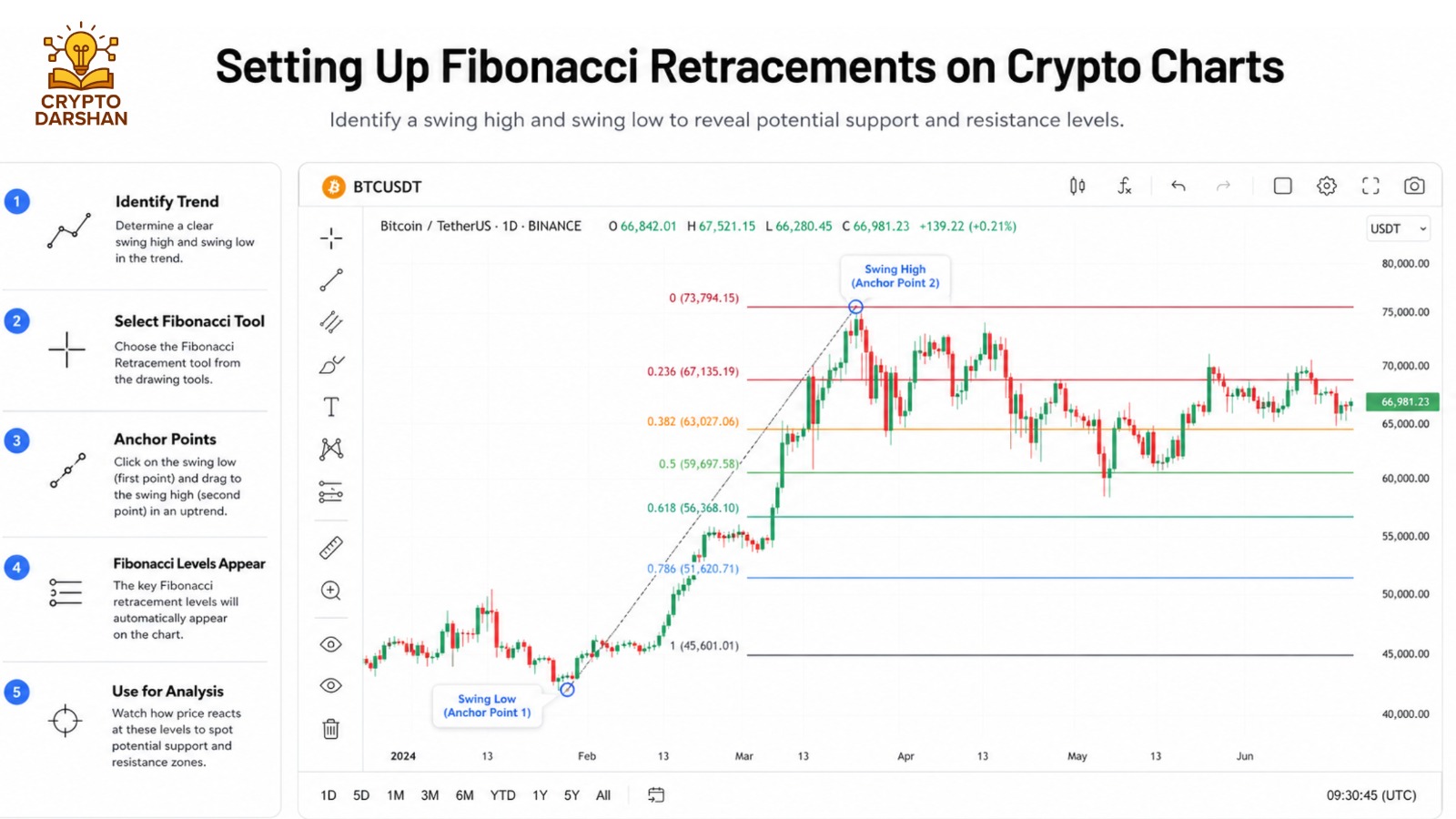
Fibonacci Retracements are a vital part of technical analysis in crypto trading. They help identify potential support and resistance levels where price corrections might pause or reverse. Setting them up correctly on a chart ensures accurate analysis and better trading decisions. The process involves a few key steps that must be followed carefully to get reliable results.
1. Identify the Trend
Before applying Fibonacci Retracements, it’s essential to determine the overall market trend. The trend shows the general direction of price movement—either upward (bullish) or downward (bearish). In an uptrend, prices make higher highs and higher lows, while in a downtrend, they make lower highs and lower lows. Recognizing the trend helps decide which swing points to use when drawing the retracement tool. Applying Fibonacci Retracements against the main trend can lead to misleading signals.
2. Select the Swing Points
Once the trend is identified, the next step is to choose the correct swing points. These are the highest and lowest points of a significant price move. For an uptrend, select the swing low (the lowest point before the price started rising) and drag the Fibonacci tool up to the swing high (the highest point before the pullback). For a downtrend, do the opposite, start from the swing high and drag down to the swing low. Choosing accurate swing points is crucial because they determine where the Fibonacci levels will appear.
3. Plot the Levels

After selecting the swing points, the Fibonacci Retracement tool automatically plots horizontal lines at key Fibonacci ratios, 23.6%, 38.2%, 50%, 61.8%, and 78.6%. These lines represent potential areas where the price might retrace before continuing in the direction of the main trend. Each level acts as a possible support or resistance zone. For example, in an uptrend, the 38.2% or 61.8% levels often serve as strong support areas where buyers may re-enter the market. In a downtrend, these same levels can act as resistance zones where sellers might step in. Observing how the price behaves around these levels helps traders anticipate future movements.
4. Analyze the Zones
Once the Fibonacci levels are plotted, the next step is to analyze how the price interacts with them. Traders look for signs of reversal or continuation near these zones. For instance, if the price approaches a Fibonacci level and forms a bullish candlestick pattern, it may signal a potential bounce or continuation of the uptrend. Similarly, if the price fails to hold above a Fibonacci support level, it could indicate further downside movement. Volume analysis can also help confirm the strength of reactions at these levels.
5. Combine with Other Indicators
Fibonacci Retracements work best when combined with other technical indicators. Tools like moving averages, RSI (Relative Strength Index), and MACD (Moving Average Convergence Divergence) can provide additional confirmation. For example, if a Fibonacci level aligns with a 50-day moving average or an oversold RSI reading, it strengthens the case for a potential reversal. Trendlines and chart patterns such as triangles or flags can also enhance the accuracy of Fibonacci analysis.
6. Adjust as the Market Evolves

Crypto markets are highly volatile, and price structures change rapidly. As new highs and lows form, it’s important to adjust the Fibonacci Retracements accordingly. Updating the swing points ensures that the retracement levels remain relevant to the current market conditions. Traders should also monitor how the price reacts to these updated levels over time. If the market breaks through a key Fibonacci level, it may signal a shift in trend or momentum, prompting a reassessment of the trading strategy.
7. Practice and Backtest
Setting up Fibonacci Retracements effectively requires practice and experience. Traders should backtest their setups on historical data to understand how prices have reacted to Fibonacci levels in the past. This helps build confidence and improves decision-making in live trading. Practicing on demo accounts or using chart replay tools can also help refine the ability to identify accurate swing points and interpret retracement behavior.
When using Fibonacci Retracements for crypto, it’s important to choose significant swing points that represent major market moves. Minor fluctuations can produce unreliable levels.
Key Fibonacci Levels and Their Meanings

Each Fibonacci level has its own significance in crypto trading:
23.6% Level
This level represents a shallow retracement and often occurs in strong trends. If the price only pulls back to 23.6% before continuing, it indicates strong momentum.
38.2% Level
A moderate retracement level that often acts as the first major support or resistance zone. Many traders look for entries around this level in trending markets.
50% Level
Although not a true Fibonacci ratio, the 50% level is widely used because markets often retrace half of a previous move before continuing. It’s a psychological midpoint.
61.8% Level
Known as the golden ratio, this level is one of the most powerful in technical analysis. It often marks the end of a correction and the beginning of a new impulse wave.
78.6% Level
This deep retracement level suggests a strong correction but not necessarily a trend reversal. If the price holds above this level, it can still resume the original trend.
Using Fibonacci Retracements to Find Entry Points

Fibonacci Retracements are most effective when used to identify entry points during pullbacks in trending markets. The process involves:
- Identifying the Trend: Determine whether the market is bullish or bearish.
- Waiting for a Pullback: After a strong move, wait for the price to retrace to one of the Fibonacci levels.
- Confirming the Signal: Look for confirmation signals such as candlestick patterns, volume spikes, or indicator crossovers.
- Entering the Trade: Enter near the retracement level with a stop-loss below the next Fibonacci level.
For example, if Ethereum rallies from $1,500 to $2,000 and then retraces to the 61.8% level at $1,690, a trader might enter a long position there, expecting the uptrend to continue.
Fibonacci retracement is especially popular among traders using swing trading strategies to capture medium-term price moves.
Combining Fibonacci Retracements with Other Indicators

While Fibonacci Retracements are powerful on their own, combining them with other technical indicators can improve accuracy. Some effective combinations include:
Moving Averages
When a Fibonacci level aligns with a moving average (such as the 50-day or 200-day), it strengthens the support or resistance zone.
RSI (Relative Strength Index)
If the RSI shows oversold conditions near a Fibonacci support level, it increases the likelihood of a reversal.
MACD (Moving Average Convergence Divergence)
A bullish MACD crossover near a Fibonacci retracement level can confirm a potential entry point.
Trendlines and Chart Patterns
When Fibonacci levels coincide with trendlines or chart patterns like triangles or flags, they provide additional confirmation for trade setups.
Fibonacci Extensions: Taking Profits with Precision

Fibonacci Retracements help identify entry points, while Fibonacci Extensions help determine profit targets. Extensions project potential price levels beyond the original move, using ratios such as 127.2%, 161.8%, and 261.8%.
For example, if Bitcoin retraces to the 61.8% level and then resumes its uptrend, traders can use Fibonacci Extensions to estimate where the next resistance might occur. The 161.8% extension is often used as a primary profit target.
Combining Fibonacci Retracements and Extensions allows traders to plan both entries and exits with mathematical precision.
Common Mistakes When Using Fibonacci Retracements

Even though Fibonacci Retracements are simple to apply, many traders make mistakes that reduce their effectiveness:
- Using Incorrect Swing Points: Choosing minor highs and lows can produce unreliable levels.
- Ignoring Market Context: Fibonacci levels work best in trending markets, not in sideways ranges.
- Over-Reliance on Fibonacci: Always confirm signals with other indicators or price action.
- Forcing the Tool to Fit: Avoid adjusting swing points just to make the levels align with price action.
- Neglecting Risk Management: Even strong Fibonacci setups can fail; always use stop-loss orders.
Avoiding these mistakes ensures that Fibonacci Retracements remain a reliable part of a trading strategy.
Fibonacci Retracements in Bull and Bear Markets

The behavior of Fibonacci Retracements differs slightly between bull and bear markets.
In Bull Markets
During uptrends, retracements often act as buying opportunities. Traders look for pullbacks to Fibonacci levels to enter long positions. The 38.2% and 61.8% levels are particularly effective for identifying strong support zones.
In Bear Markets
In downtrends, Fibonacci Retracements act as resistance levels. Traders use them to identify potential short entries when the price retraces upward before continuing lower.
Understanding how Fibonacci Retracements behave in different market conditions helps traders adapt their strategies accordingly.
Real-World Examples of Fibonacci Retracements in Crypto

Example 1: Bitcoin Bull Run
During Bitcoin’s 2020–2021 bull run, the price frequently retraced to the 38.2% and 61.8% Fibonacci levels before continuing higher. Traders who recognized these retracements were able to enter at optimal points and ride the trend.
Example 2: Ethereum Correction
After Ethereum reached a peak in 2021, it retraced nearly 61.8% before finding support and resuming its uptrend. This level acted as a strong buying zone for many traders.
Example 3: Altcoin Volatility
Smaller cryptocurrencies often experience sharper retracements. In these cases, the 78.6% level can provide valuable entry points for high-risk, high-reward trades.
These examples demonstrate how Fibonacci Retracements can be applied across different crypto assets and market conditions.
Advanced Fibonacci Strategies for Crypto Traders

Fibonacci Confluence Zones
A confluence zone occurs when multiple Fibonacci levels from different timeframes or price swings align closely. These zones represent strong areas of support or resistance and often lead to significant price reactions.
Fibonacci Clusters
When several retracement levels from different moves overlap, they form Fibonacci clusters. These clusters indicate high-probability reversal zones.
Multi-Timeframe Analysis
Using Fibonacci Retracements on multiple timeframes helps traders identify key levels that align across daily, weekly, and monthly charts. This approach increases the reliability of the analysis.
Combining with Elliott Wave Theory
Elliott Wave Theory and Fibonacci Retracements complement each other well. Fibonacci levels often correspond to wave retracements, helping traders identify where corrective waves might end.
Risk Management with Fibonacci Retracements

Effective risk management is essential when trading with Fibonacci Retracements. Key principles include:
- Setting Stop-Loss Orders: Place stop-losses just beyond the next Fibonacci level to limit potential losses.
- Position Sizing: Adjust trade size based on risk tolerance and distance to stop-loss.
- Diversification: Avoid overexposure to a single crypto asset.
- Using Multiple Confirmations: Combine Fibonacci Retracements with other signals to reduce false entries.
By integrating Fibonacci Retracements into a disciplined risk management plan, traders can protect capital while maximizing profit potential. Even when Fibonacci levels look perfect, proper risk management is essential to protect your capital.
Fibonacci Retracements and Market Psychology

Fibonacci Retracements reflect the natural rhythm of market psychology. Traders tend to take profits after strong moves, causing retracements. When prices reach key Fibonacci levels, new buyers or sellers often step in, creating a balance between fear and greed.
The widespread use of Fibonacci Retracements reinforces their effectiveness. As more traders watch these levels, they become self-reinforcing zones of support and resistance.
Understanding this psychological aspect helps traders anticipate market behavior and make more informed decisions.
Practical Tips for Using Fibonacci Retracements in Crypto

- Use Higher Timeframes: Fibonacci levels on daily or weekly charts are more reliable than those on shorter timeframes.
- Combine with Volume Analysis: Rising volume near a Fibonacci level confirms the strength of the reversal.
- Avoid Overcrowded Charts: Keep charts clean to focus on the most relevant Fibonacci levels.
- Backtest Strategies: Test Fibonacci-based setups on historical data before applying them in live trading.
- Stay Updated: Market conditions change rapidly in crypto; adjust Fibonacci levels as new highs and lows form.
These practical tips help traders apply Fibonacci Retracements effectively in real-world scenarios.
The Future of Fibonacci Retracements in Crypto Trading

As crypto markets evolve, Fibonacci Retracements remain a cornerstone of technical analysis. With the rise of algorithmic trading and AI-driven strategies, Fibonacci levels are increasingly integrated into automated systems.
Future developments may include adaptive Fibonacci tools that adjust dynamically based on volatility or market sentiment. However, the underlying principles of Fibonacci Retracements—mathematical ratios and human psychology—will continue to guide traders in identifying high-probability entry points.
FAQ: Setting Up Fibonacci Retracements on Crypto Charts

1. What is a Fibonacci retracement in crypto trading?
A Fibonacci retracement is a technical analysis tool used to identify potential support and resistance levels. It is based on key Fibonacci ratios like 23.6%, 38.2%, 50%, 61.8%, and 78.6%, helping traders predict where price pullbacks might occur.
2. How do you draw Fibonacci retracement levels correctly?
To draw Fibonacci retracement:
- In an uptrend: connect the swing low to the swing high
- In a downtrend: connect the swing high to the swing low
Most platforms like TradingView provide an automatic Fibonacci tool for this.
3. Which Fibonacci levels are most important in crypto trading?
The most commonly used levels are:
- 38.2% – shallow retracement
- 50% – psychological level
- 61.8% – the “golden ratio” (strong support/resistance)
Among these, 61.8% is considered the most significant by many traders.
4. Does Fibonacci retracement work in volatile crypto markets?
Yes, but it’s not foolproof. In highly volatile markets like Bitcoin or Ethereum, Fibonacci works best when combined with other indicators like volume, trendlines, or RSI.
5. Can beginners use Fibonacci retracement effectively?
Yes. Fibonacci retracement is beginner-friendly because:
- It’s easy to apply on charts
- It visually highlights key levels
- Most charting tools automate the process
However, beginners should practice identifying correct swing highs and lows.
6. What is the difference between retracement and extension?
- Retracement: predicts pullbacks within a trend
- Extension: predicts future price targets beyond the current trend
Both tools are often used together for better trade planning.
7. Which timeframes work best for Fibonacci retracement?
Fibonacci retracement works on all timeframes, but:
- Higher timeframes (4H, daily) are more reliable
- Lower timeframes (5m, 15m) are more prone to noise
Swing traders usually prefer higher timeframes.
Conclusion
Fibonacci Retracements for crypto trading provide a structured, mathematical approach to identifying entry points that work. By understanding how these levels function, traders can anticipate potential reversals, manage risk effectively, and enhance their overall trading performance.
From the golden ratio to advanced confluence strategies, Fibonacci Retracements offer insights into the natural rhythm of crypto markets. When combined with sound risk management and confirmation tools, they become a powerful ally for both novice and experienced traders.
In a market driven by emotion and volatility, Fibonacci Retracements bring order, logic, and precision, helping traders find clarity amid the chaos of crypto trading.